The Syllabus Review — Michael Gougis at Montreal Fringe 2026
Public displays of affection! Mass shootings! Drugs, deities — it's the first day of college, and real-life Prof. G explains why you can't send naughty photos to your classmates and how to outrun the criminology students.
The Syllabus
Montreal Fringe 2026 By Michael Gougis White Wall Studio, 4532 av. Laval Presented by Morbidelli 17 Productions
Reviewed by Aubrey Naur
The Professor Who Couldn't Break Character
Gougis is an (ex?) working adjunct out of Los Angeles, and over the course of two decades his opening-day handout has metastasized from a modest two-page contract of mutual expectation into a Talmudic document with, among its clauses, a sentence forbidding students from placing their legs across the laps of the students seated next to them. This clause exists, he explains, because a student once placed his legs across the lap of the student seated next to him, and when Gougis asked him to stop, the student replied that there was nothing in the rules that said he couldn't.
What I enjoyed was that it was not entirely clear where the bit begins and ends.
The Syllabus is a solo show about the form of the auditorium lecture. It's an ouroboros of a thing, going on forty to an hour, and plays with the expectations of anyone who has ever sat through critical theory just to get their bachelor's.
The premise, which Gougis will later, in the alley behind the venue, describe to me in almost these words, is that the first hour of any class he ever taught was essentially an hour-long stand-up special, because if his students weren't laughing they weren't paying attention, and if they weren't paying attention he wasn't teaching. So he took the hour, wrote it down as a script and first took it to the Vancouver Fringe, where he asked for a mentor, and was given one of the rats from the cast of Rat Academy — “one of the best comedies I've ever seen,” he says, and I believe him.
It Is a Lecture
Here's what you have to understand about The Syllabus. It is not a satire of a lecture, nor a parody of a lecture. It is a lecture, period. Gougis takes a form of institutional authority familiar to him from teaching, and simply sets it in motion with avalanchingly insane subject matter.
Each clause is a battle scar from his teaching days.The clause about hooking up became necessary because of an incident involving three students last semester, at which point the general rule “do not hook up with people” was found to be insufficiently specific.
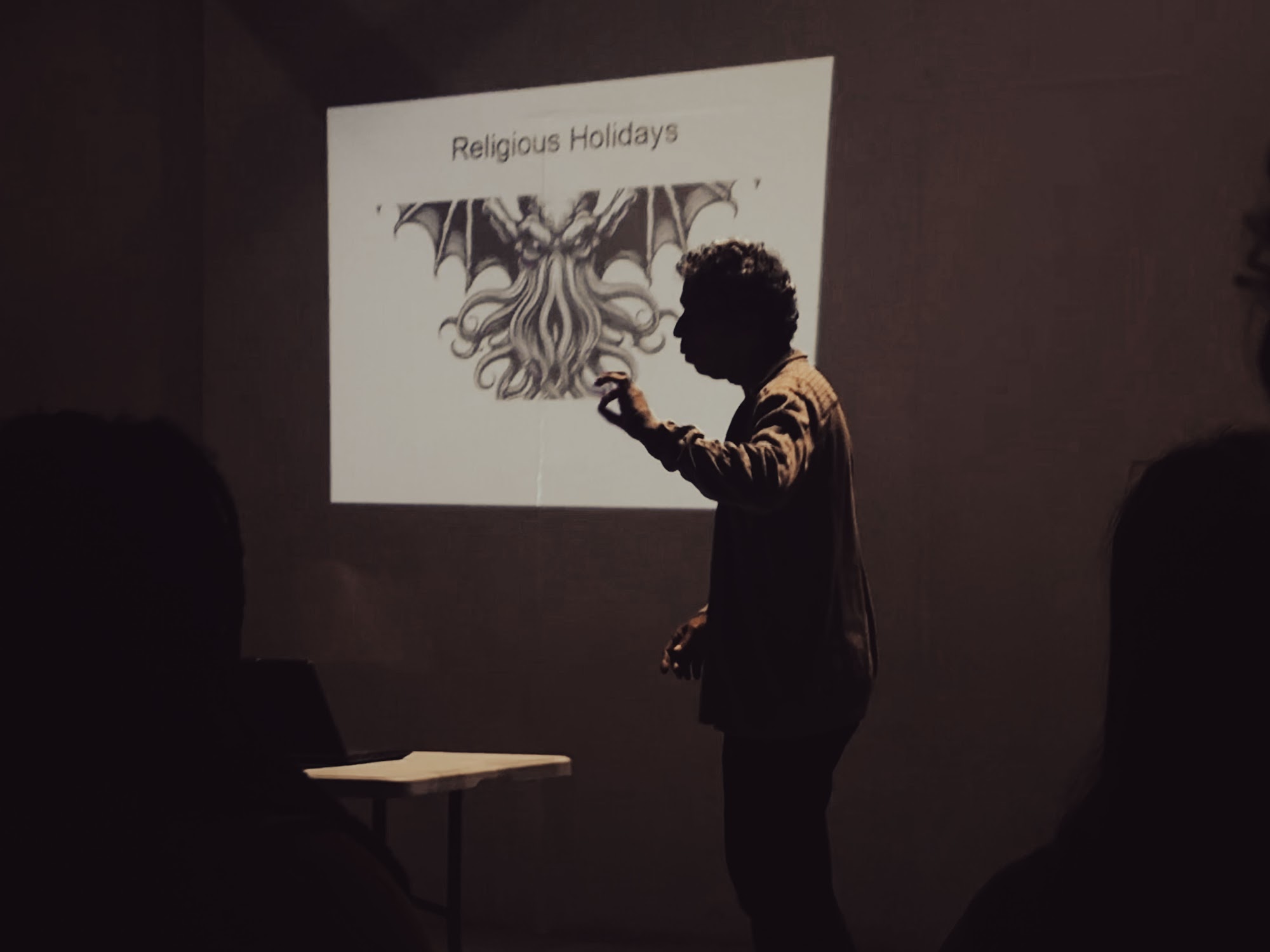
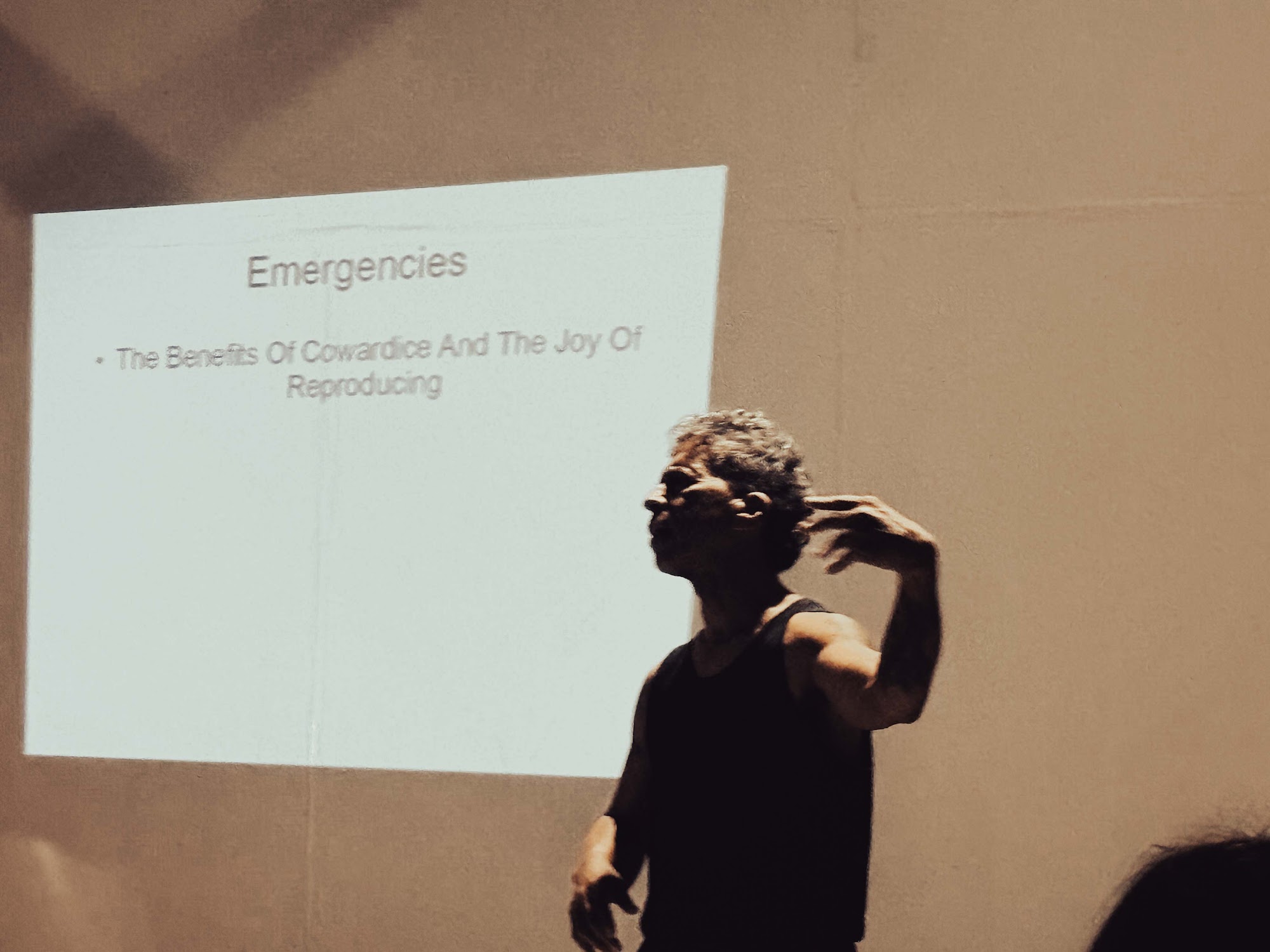
He had slide on religious holidays that includes Cthulhu. He had a media studies slide which contained nothing but a nine-inch dominatrix stiletto. In his hands, a housekeeping announcement transforms into a small self-help pamphlet titled, more or less, The Benefits Of Cowardice And The Joy Of Reproducing. Then the emergency procedures section, which, in a very good running joke about the ambient dread of the American classroom, distinguishes between two categories of genuine crisis: earthquakes and guns. He knows how to weaponize the pause, the small warm smile, the eye contact, the pedagogical gentleness of show of hands, how many of you would. The form is so authoritative that it will peddle any kind of BS whatsoever.
There is a Bad Grandpa quality to some of it — like he was saying everything lecturer would ordinarily save for the drive home, muttered to nobody in particular through the windshield. “Please do not try to bribe me with sexual favors. You're not good enough at it yet. You're only twenty years old. You still think that just doing it is exciting.”
A Personal Detour
A confession. In university, I had a coping mechanism for boring classes, which was to pretend that they were theatre. Shout out to Dr. Peters. Whenever Dr. Peters got going on about the Stoics, which he loved to do, I would slide down in my seat, tune out the words and start doing gesture analysis.
I discovered, watching him, a truth about the particular hell that lecturers endure: they have to rehearse, over and over, the same material for a rotating audience of hungover twenty-year-olds who are, in the best case, doing gesture analysis instead of listening, and, in the worst case, sleeping through the gestures too.
I bring Dr. Peters up because what Gougis does on the stage at White Wall Studio is literally the kind of gesture study that I did from my seat in a first-year philosophy class, except he is in fact doing it as theatre, and it's twelve dollars to watch.
A partial catalogue, from my notebook:
The finger of specification. The precision-pinch. The flat palm swept across the body to underline the projected slide. The full-wingspan T-pose, arms out to claim the entire wall, deployed with mock conviction and held on the beat. The mock-alarm, hands up beside the head, palms out: hold on, people. Oh and the cupped sphere, the illustrious cupped sphere, both hands cradling an invisible object. Irresistible. And, occasionally, he calls out a latecomer or a specific person in the third row, at which moment the fourth wall reveals that it had just been a fibreboard divider covered in felt. He's enframed an entire vocabulary of professorial hand gestures, almost a kind of sign language in its syntax.
This is what it means to take a banal form, do it in the context of Fringe, and in calling it art turn it into art.
The Mechanism
You get bored after about fifteen minutes. I want to insist on this, because it is not a failure of the show, but its very mechanism. The performance is a matter of duration and framing. The cadence lulls you. The gestures, having been made visible, become invisible again. He helps you to enter back inside the register of every boring lecture you've sat through. You are being lectured to n every posture your body knows to take in a lecture hall. You are, without noticing it, sitting up straighter. Why are you taking notes on a napkin? You didn't consent, but your body did. It's the social contract of the classroom made theatre.
In the Alley Behind White Wall
In the alley behind White Wall Studio, after the show, Gougis's gestures are still there but denatured. He shakes hands. He thanks each person who walks out. He asks if he can say goodbye to everyone on their way out, which is a very professorial thing to ask permission for. He is scornful, in the alley, of what he calls “the C-word.”
I thought, for a bad half-second, that he meant the word he had just dropped in his show, entirely within reason, in the context of why not to include it in your paper. He did not. Nor did he mean “California,” the state whose largest cultural export, I've gathered, is not oranges but the art of public speaking.
“To me, lately, the C-word is content,” he says. “It's just content, and it's just so sad.” He was talking about the is it gonna make money, the way “the creative process just gets ground into product.”
The Syllabus is structurally a one-trick-pony, and the pony does start to become a little hoarse, if I am being honest, somewhere around the midpoint of the hour, when the professor's tics have become legible to the point of fatigue. Then, in the other 30 minutes that would follow, something strange would happen. Call it hypnosis, call it conditioning, call it a love letter to the rhetoric of U.S. collegiate brainwashing — it had all been to settle the audience into the form. The show had only been breaking the pony in.
Reviews are to me what lectures are to Gougis (it's a month out from Montréal Fringe and I'm still pumping them out), so let's honor the form by ending on a quote. “Art gives shape to a life. We could be sitting in front of a TV right now. Instead, we're out on a beautiful Montreal night, watching live theatre and hearing and seeing stuff that we might never have seen in our lives. How cool is that?”
A work of art. Show a friend. Watch your hands.
Reviewed by Aubrey Wang
Comédie / Comedy, Spectacle Solo / Solo Show, Théâtre / Theatre
The Syllabus
Public displays of affection! Mass shootings! Drugs, deities — it's the first day of college, and real-life Prof. G explains why you can't send naughty photos to your classmates and how to outrun the criminology students.
Créateur, auteur, interprète | Creator, Writer, Performer Michael Gougis Compagnie | Company Morbidelli 17 Productions
Running time · Durée 40 min Content warnings · Avertissements references to mass shootings; sexual content; classroom disasters; a racial slur used as part of an audience-participation bit; audience participation Langue | Language Show in English · Spectacle en anglais Dates July 2026, Montreal Fringe


%402x.svg)



.webp)


