Ornela Kapetani trained as an actor, then as a drama therapist in the ATP method, and now she puts herself through the treatment in front of strangers. On LOLA IS DEAD, the heroine’s journey, and why the people in the room are witnesses, not an audience.
Interview · LOLA IS DEAD
We Go Into Ourselves to Become Ourselves
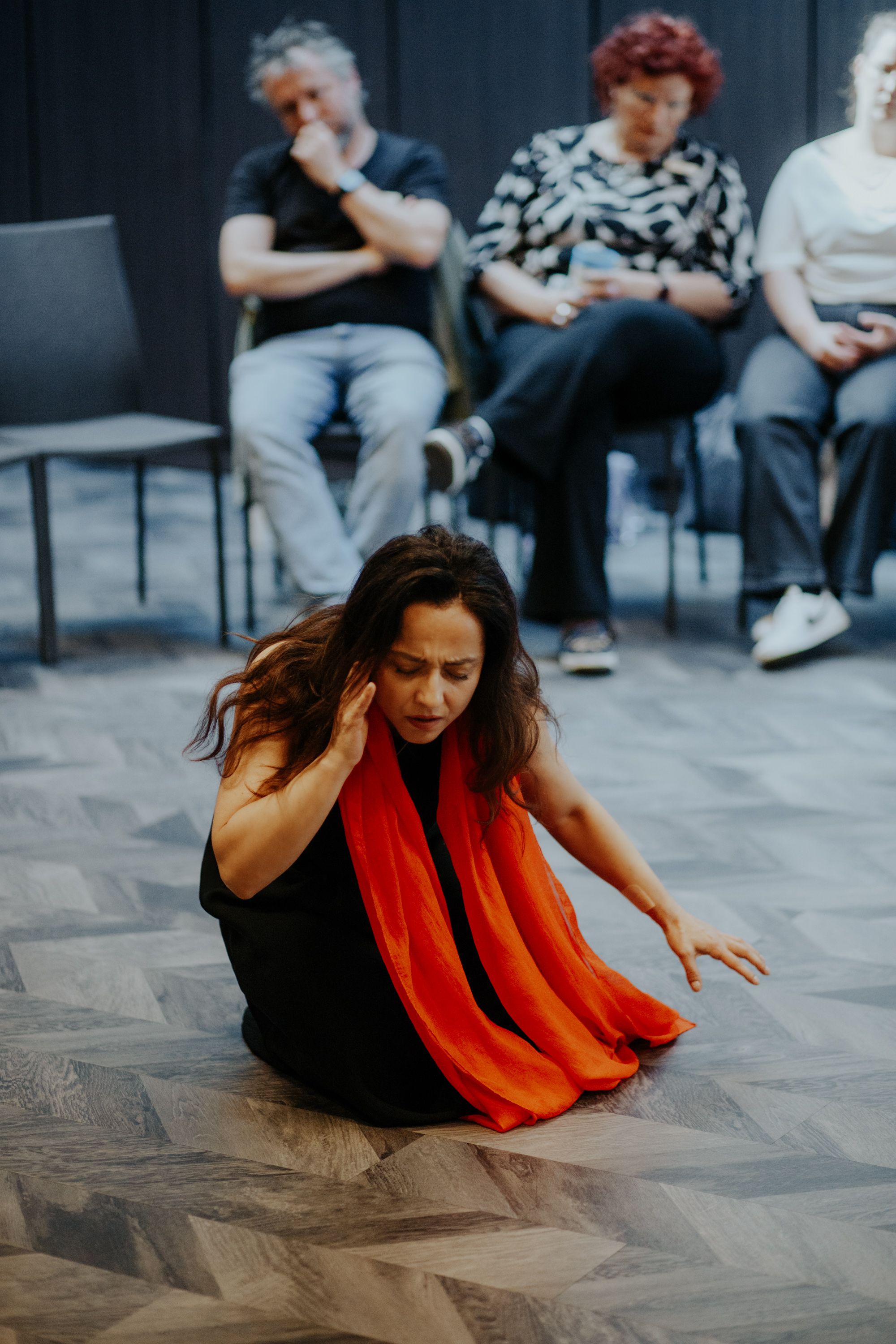
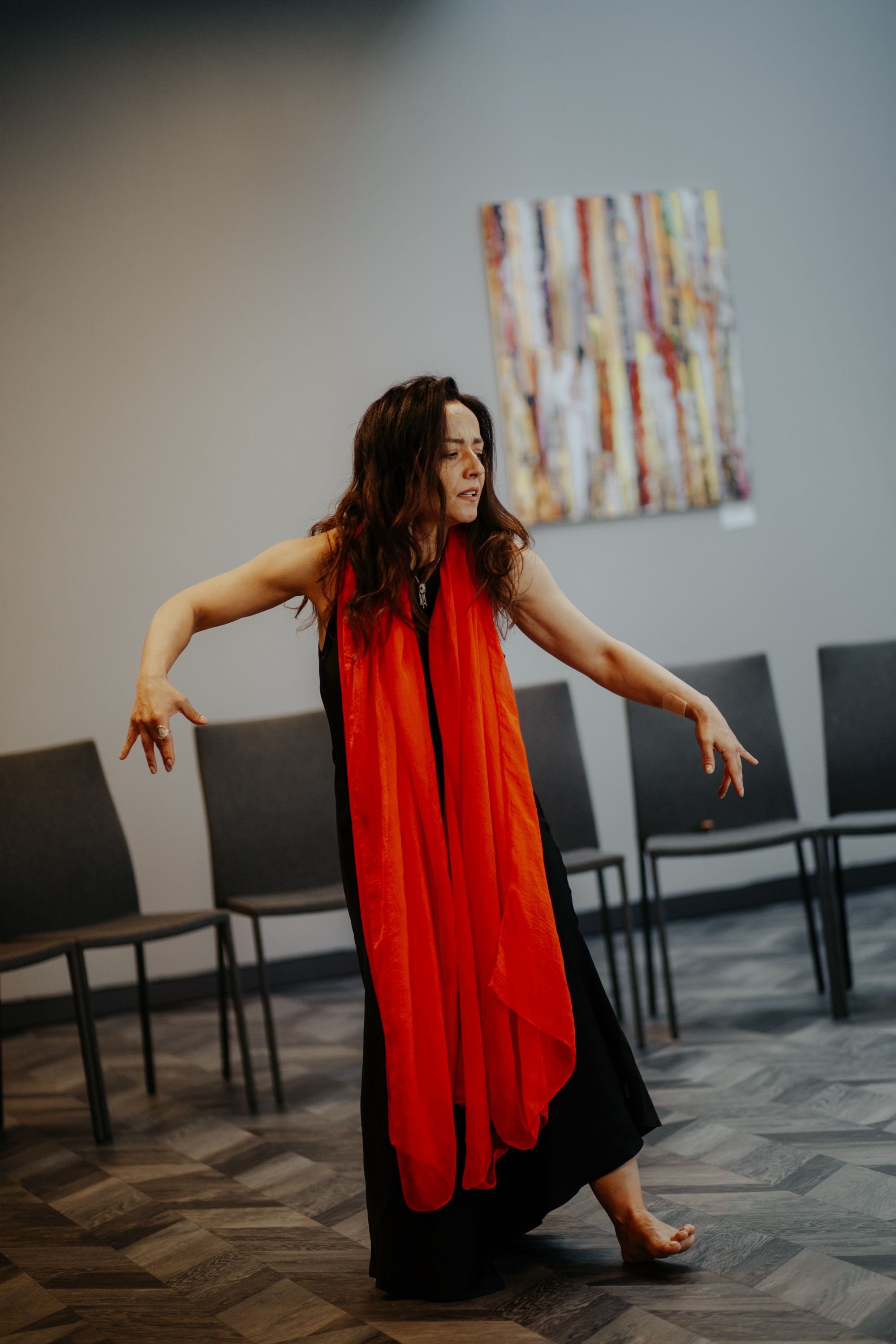
LOLA IS DEAD is a solo show created and performed by Ornela Kapetani at the Montréal Fringe. In Jungian terms it is structured as an individuation: a descent into the unconscious and a return. Performing alone and barefoot, Kapetani takes on a succession of archetypal figures: the Mother in her devouring aspect as much as her nurturing one, the grandmothers of the lineage, animal figures, men from her past.
The matriarchal figures in their vindictiveness, childhood desires and injuries, mythical configurations of the love object — these are the personal and ancestral shadow, the disowned material the work turns toward rather than away from. The discomfort this produces belongs to the method: shame is the affect that marks shadow material surfacing, and its integration is a part of the therapeutic process.
Ornela Kapetani came to therapy through performance. She was born in Sarandë, on the Albanian coast, in 1979, of Greek and Albanian heritage, and trained as an actor at the ARHI school in Greece, taking lead roles in Albanian and Greek film, among them Gentian Koçi's award-winning Daybreak, The Daughter and Correction.
the deep; the abyss
Aubrey: It all seems so Jungian.
We opens on a tooth and goes straight into corporal memory, ancestral figures, dreams. Is this autobiographical?
Ornela: It is a biographical work.
It started from a longing to create a work on my maternal lineage, to understand the transmission of intergenerational trauma. It coincided with a really challenging period in my life, when I lost a long-term relationship and the boundaries of the conscious and the unconscious blurred.
I developed a recurrent toothache at the time, and I used this as an opening image. I had read numerous research papers on how traumatic experiences are encoded by our bodies; written into our very bones. The research suggests that trauma may even be stored in the mouth as well, or both, as is the case with teeth.
beneath the root, another root; beneath the source, its source
In the Sesame Approach, the school of drama therapy Kapetani trained in, the psyche is reached through a somatic image rather than through talk or narrative. From the tooth the narrative unfolds.
Aubrey: People say "the body keeps the score" online constantly.
But in practice, no-one seems able to agree on what that means. How does a tooth become the way in?
Ornela: I used the persistent problems I had been having with my mouth and teeth as an entryway into exploring intergenerational trauma.
Teeth are the most valuable thing we have. It is very painful to lose a tooth, not to mention expensive; teeth are the most obvious indicators of overall health, and the research has linked poor mouth hygiene, bad teeth, with genetic and epigenetic factors.
In the work, I map a connection between the toothache [that I had been experiencing as an adult] and my childhood experiences. I turn to my pain and ask: what does it want from me? Why, at this specific period in time, am I going through what I am going through?
And the story is told from the perspective of a spider. As I ask my pain and go into the root of the pain, in the root of the tooth I find a spider, and the spider is the one that takes me into this whole exploration, where I move through four generations of women in my family.
chastisement; correction
I had found the performance relatable and strange at once, and partly opaque by design. Like a medusa's head, the work is apotropaic. The action that forces the audience to behold is the same as the one that purges.
Aubrey: And what is down there?
Ornela: I am trying to uncover the messaging, the entrapment, the structures of the patriarchy that had been quashing my spirit.
Instead of following my inner purpose, my soul's purpose, I had been trapped in this horrible situation, a state of separation and division, where I had been continuously abused, yet the abuse had been disguised as a form of care. "I'm doing this because I love you. I'm doing this because you have to be proper." The messaging is constantly that the abuse occurred because people loved us.
Aubrey: With the best intentions.
Ornela: There are two events from my life woven into the story, but I am not dwelling on who abused me.
I am trying to go beyond documenting an event. I create a form that becomes almost like a dream, where each character is embodied, activated, and I am constantly changing from one to the next, because they are the parts I hold in myself.
It is not just that this character is my grandmother; it is the part of the grandmother that lived in me. It is not my mother per se; it is a part I have internalised, and I treat myself in similar ways. It becomes a dark night of the soul, where I voluntarily descend into a place of wanting to understand: what is this life? Whose life am I living? Who am I?
a way that keeps no signpost, and raises no stone for the dead
In LOLA IS DEAD, inner states are given external, physical form rather than described, which places the show in a line that runs back through German Expressionist theatre; its logic is associative, closer to a dream than a plot. Images recur and rhyme with one another instead of building toward an argument.
Aubrey: It sounds like a hero's journey.
Ornela: A heroine's journey.
There is a difference between the hero's journey and the heroine's journey. The hero's journey is outward; the masculine responds to the call, goes out on an adventure, and comes back triumphant. The heroine's journey is an inward journey, a journey where we go into ourselves to become ourselves. We don't respond to an external.
Aubrey: Walk me through the heroine's journey.
I've read my Joseph Campbell, so is it a similar structure?
Ornela: The heroine's journey is Maureen Murdock's, parallel to Joseph Campbell.
Joseph Campbell has the hero's journey, which moves through many stages of responding to the call, following the call, and entering an adventure. Whereas the feminine journey begins with a separation from the mother, a separation from the feminine, because from very early on we are conditioned to neglect intuition and creativity. We understand that in order to be in the world we need to identify with the masculine, and in the process of identifying with the masculine we become very adventure-oriented, which is contradictory to our nature, our circular kind of being.
the craft; the errand
For her master's in Drama and Movement Therapy at the Royal Central School of Speech and Drama, Kapetani trained in the Sesame Approach. Sesame was founded by Marian "Billy" Lindkvist and built on Jung; it draws on Rudolf Laban's movement analysis and Peter Slade's play theory, and it encounters the psyche through image and myth rather than through direct talk.
Aubrey: So much of the mythic canon, Jung included, is a bit of a sausage party.
The frameworks are male. How are women's needs different, in the show and in your practice?
Ornela: My intention was to deal with the lineage of my mother, because there is so much patriarchal conditioning through the generations.
Especially now, we arrive at a place where we feel that in order to be, we need to be tough, decisive, emotionless, dry. And I think we are fed up with the idea that we need to be homogenised into pursuing life as if it were a mission. In the performance, the feminine journey, throughout all its expansion, is a journey of waiting. We are not in action most of the time. Even our physiology, even the fact that every month we must menstruate, involves an opening, a fullness, and an emptiness. So in that full and empty cup, how do we allow ourselves to be in the world, to bring the creative feminine into it, where it is not just to conquer but also to enjoy, to be receptive, to allow life to happen?
Aubrey: Most people start in therapy and move toward performance. You began with actor training.
Ornela: In the play, I map my movement through the world from one place to another through music.
I sing a lot, in different languages: in Albanian, in Greek, and in English, and every song maps an era of my life. I was born in Albania and immigrated to Greece when I was about eleven. I grew up in Greece and studied acting there, and after my studies I was involved with an NGO working with women who were victims of trafficking in Greece. That is how the drama therapy began. After that experience, it clicked for me that something was happening: as I was doing these drama games, applying what I had learned in drama school, I started to notice things happening to these women in the shelters who, in the beginning, couldn't speak, were muted, the trauma so intense they couldn't trust anyone. Through the drama games they would open up, and trust me. I created a performance with those women, and then I started to research what this thing was that I was doing. I stumbled onto drama therapy, went to study in London, and became a drama therapist. Acting and drama therapy have been two parallel processes for me; I never abandoned one for the other, because I see them as intertwined. To intentionally use theatre as a therapeutic tool is the ultimate gift I have been able to explore.
the breaking already in the book; the wave already in the count
Years in the British system followed, including a post as a CAMHS practitioner at the South London and Maudsley NHS Trust. She is now based in Mile End, Montréal, where she practises as a registered drama therapist, at the Montreal Therapy Centre and in private practice, trauma-informed and anti-oppression in approach, working in particular with racialized, queer and trans clients.
Aubrey: And the form has a name.
I'd never heard of Autobiographical Therapeutic Performance, but what I've read of it makes sense.
Ornela: Autobiographical therapeutic performance is the gem of drama therapy.
It is a short-term, innovative trauma treatment in which the participant voluntarily chooses to create their life, or a particular experience, as a living, breathing work of art. They come with an intention that we clarify over a certain time, and at the end they create a performance. I, the drama therapist, work primarily as a therapist, and then, towards the shaping of the performance, I switch hats and become a director. But the client has written the performance, and through the therapeutic process they have uncovered the negative script that is running their lives. They are able to shift the script and rescue themselves. At the end there is an open performance to which they invite witnesses. So, contrary to theatre, we are not talking about an audience that passively observes and identifies with a character; the witnesses are there as trustworthy, reparative people.
Aubrey: My compartmentalised modern brain wants to say: leave the therapy out of the performance.
How do you go from therapist to director without losing the client?
Ornela: So primarily the state is therapeutic.
This is a performance created and intended as a therapeutic act. It is group or individual therapy, where all the tools of the drama therapy method are used, and there are different phases. The first phase is harvesting and clarifying the therapeutic intention. The second is scene work, theme work connected to the therapeutic goal you intend to explore. Then we begin to tap into script writing, because you need a script. And there is a crisis moment that we already know will occur, because no one wants to fail, no one wants to say "I'm not doing this." That is exactly the intention: you will go through a crisis in order to see yourself through. From the beginning of the process, you have a performance date. We are not just floating around for six months. And even as a director, the therapist is still a therapist, because even as we enter the rehearsal process things keep coming up; the client is still vulnerable, still shaky. So it is a very delicate balance of holding the client and directing the client.
Aubrey: Being witnessed by people who actually know you.
If that were me, I think it would be terrifying.
Ornela: Yes, it is.
But that is exactly the therapeutic element: you move through the fear and do something your community would never dare to do, and by doing it you become a kind of shaman, a conduit for them to reassess their relationship with you, and to deepen their awareness and knowledge of you.
Aubrey: A shaman mostly facilitates an experience for someone else.
As I picture it.
Ornela: But at the same time she is also in an altered state, the shaman.
If a shaman is going to give you a potion, he is going to drink from the potion too. It is not one way, where you take this and I bang the drum for you to do it. As you are taking the potion, I have taken it as well, and we are both going into the unknown.
Aubrey: Women in the audience must see their own mothers in it.
Ornela: A lot of the feedback I get from this performance is that many women feel that this is them.
The stories I am sharing are true to the dynamic I am portraying, true to how they were treated by their mother. So I hear women come and say, thank you for sharing that, and thank you for doing it, because I had never thought I had other options, that I could do something different, that I could reframe this relationship. It is quite cardinal, the relationship with our mother, because our mothers, as they say, give us life, but they also give us traumas to form souls.
what keeps watch wants no breath, no wind, no spirit
Three lineages intersect in the work: her earlier actor training, the subsequent Sesame approach she was taught, and the ATP practitioner she now is, working under the form's founder. A fourth presence belongs to Allyson Manta, a former Cirque du Soleil choreographer now teaching Pilates with a different but complimentary therapeutic approach.
Aubrey: You co-directed with Allyson Manta, who came out of Cirque du Soleil and now teaches Pilates.
How did your body, the therapy body, meet hers?
Ornela: Allyson is a very close friend of mine, and we spend a lot of hours talking about our experiences.
When I was working with her in Pilates, she had a gentle touch that really moved me internally; when she would put her hands on different parts of my body, I would almost feel an aesthetic shifting. I had a clear vision of the show when I was writing it, and I wanted a feminine lens. Primarily I had worked with my director-supervisor, Armand Volkas, my mentor and colleague, and with him I roughed out some of the ideas. But once the performance solidified in me, I wanted a feminine cup, a feminine eye. I didn't want to work with a director, because I had a clear vision of what I wanted the performance to be. In the beginning I wanted someone simply to be with me, present, while I went through the motions; then, once we had solidified the form and what we were doing, that is where Allyson began to have more input, in the staging and choreography. But in the beginning I was very protective of my vision; I wasn't open to suggestions, or very few, because I already had everything. It's like I had a dream last night, and I remember the dream, and that's how the dream goes.
the messenger; the angel
Aubrey: So who is Lola?
Ornela: So Lola is not me in the performance, but she is holding a part of me that is looking out for me.
Lola could be a real person in my life, or one I have never met, but she is holding a higher self that is guiding the soul in the darkness.
Aubrey: And you play everyone.
Ornela: I'm playing every single part.
the circle; the encampment
Aubrey: You stage it in the round.
It turns the tables, the way the round does; you assume the performer is the one trapped in the circle.
Ornela: The initial idea, when I first started presenting the performance, was to do it in a circle, almost like being in the Colosseum, the lion devouring the fighter.
It is a kind of seeing this creature being devoured by demons. I wanted people to be unable to escape, not even with their eyes. It is not a performance where you sit back and rest; it won't be shoved down your throat, not in a violent way, but there is no time for passivity. I have a problem with an audience being pacified, just marvelling at something: ah, this is great; ah, that one, not so good. I want the audience to be active, but also to feel something that can resonate with their own experience, whether they are women or men; even men have a feminine aspect that some of them identify with.
Aubrey: You've toured it.
Is it received differently across borders?
Ornela: So in Eastern Europe it was embraced.
This is my story, many women said; my god, where were you? This is my mother. Do you know my mother? In the US it was more, I see the storyline, but there are some aspects I cannot identify with. It still moves people and has a lot of impact, but not in the same way I experienced in Eastern Europe, where it was, oh my god, what did you just show me? In Montreal I am not sure what to expect, because my personal experience of being here is that it is a little more removed, or people spend too much time in hibernation. Maybe it is the climate, or North America, I don't know; the focus is different.
death; the gate
Aubrey: What rose to the surface that you did not expect?
Ornela: Another element that comes here in the performance is death.
We don't want to talk about death, we don't want to see it; we go about life as if it will never happen to us, and there is a confrontation with that. In order to individuate, in order to be fully in love, we have to kill; the way we were shaped by the world needs to die for the inner purpose, the soul's purpose, the growth to happen. So there is an actual confrontation with death, a process of individuation, a process of deepening your experience of life.
Aubrey: Performing it over and over, has the audience ever broken the thing open?
Ornela: I have had reactions from the audience that I never anticipated, and that were more truthful to the real event.
Because I am interconnected with the audience, it is not just that they watch me; I interact with them. Once, when I reached out to ask an audience member for something, their response completely shocked me. Usually in a performance the audience thinks, the actor is asking me something, so I'll say yes, I'll do what they ask.
But I encountered an audience member who was defiant and said, "Fuck you, no, I'm not doing that." It is shocking, but it is also one of those moments that are pure gold, because in the moment you are forced to deal with the real situation, the way it actually was. I am not dealing with audience members trying to please me. To be met with defiance actually became therapeutic in the moment. I burst into tears, because I felt the truth of it, and then I was forced to find another response, forced into silence, not to just go with the script I had come with.
Aubrey: I think I have to come and see it.
You know, IRL. With my real actual physical body.
Ornela: Tell me when you want to come, and I'll give you a ticket.


%402x.svg)

.webp)


