Viraf 2.0 Review — Syd Hamidreza Hosseini at Mile End Improv, Montréal Fringe 2026
Aubrey Naur reviews Syd Hamidreza Hosseini’s Viraf 2.0 at Théâtre VME / Mile End Improv for Montréal Fringe 2026 — The Hive Theatre’s techno-séance for a cousin named Majid, who entered a coma on the sixth day of the war between Israel and Iran and died sixty-four days later, not from the bombs but from a motorcycle accident. A relic, not a chatbot.
The Impossible Return
The Hive Theatre’s Viraf 2.0 at the Montréal Fringe, for a cousin who did not die from the bombs. In memory of Majid, Lana, and the people we’ve lost across distance and time.
Montréal Fringe 2026 Written and directed by Syd Hamidreza Hosseini Performed by Syd Hamidreza Hosseini and François Lespinasse Sound design by Kamyar Noak Karimi Presented by The Hive Theatre
Reviewed by Aubrey Naur
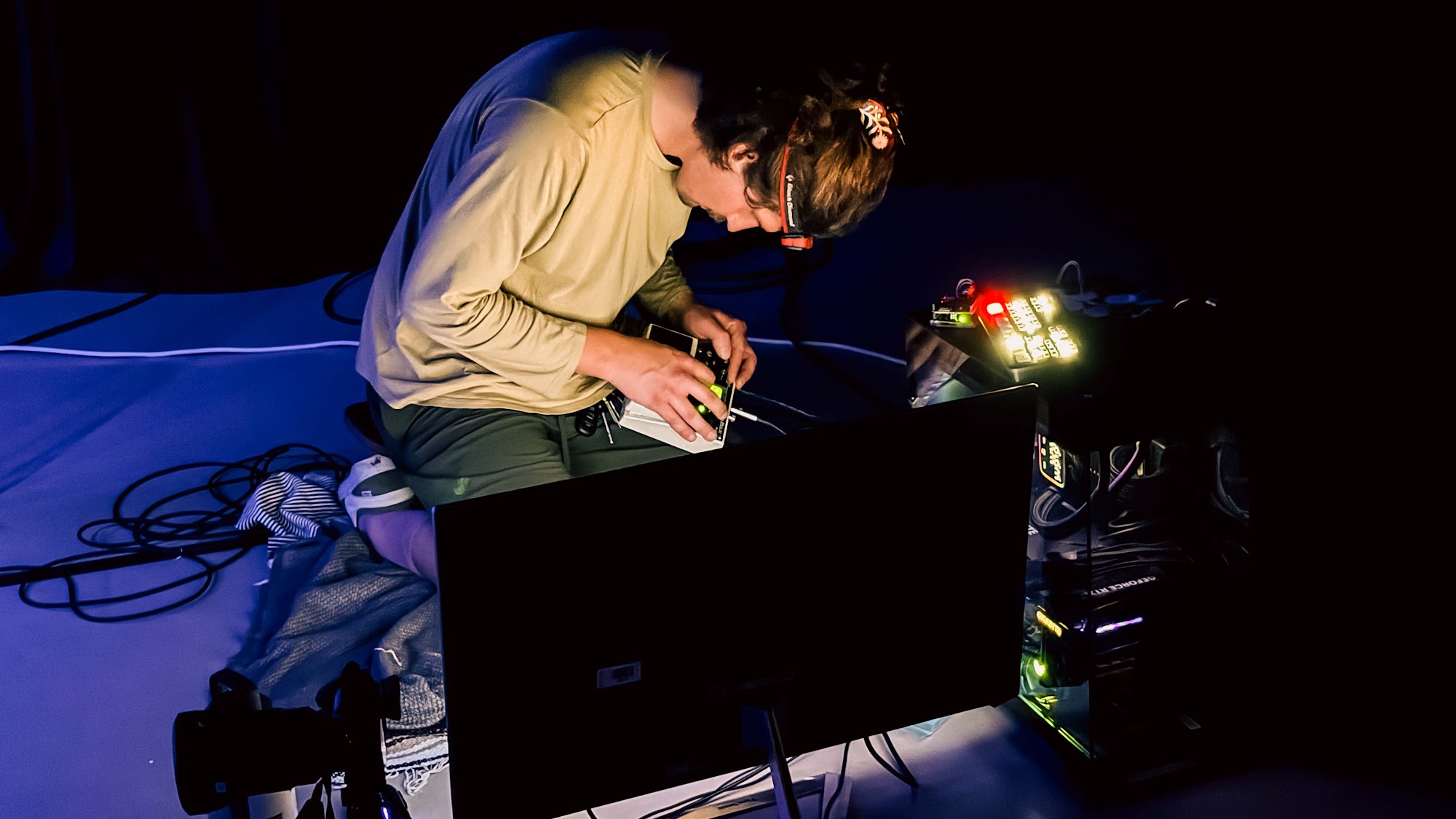
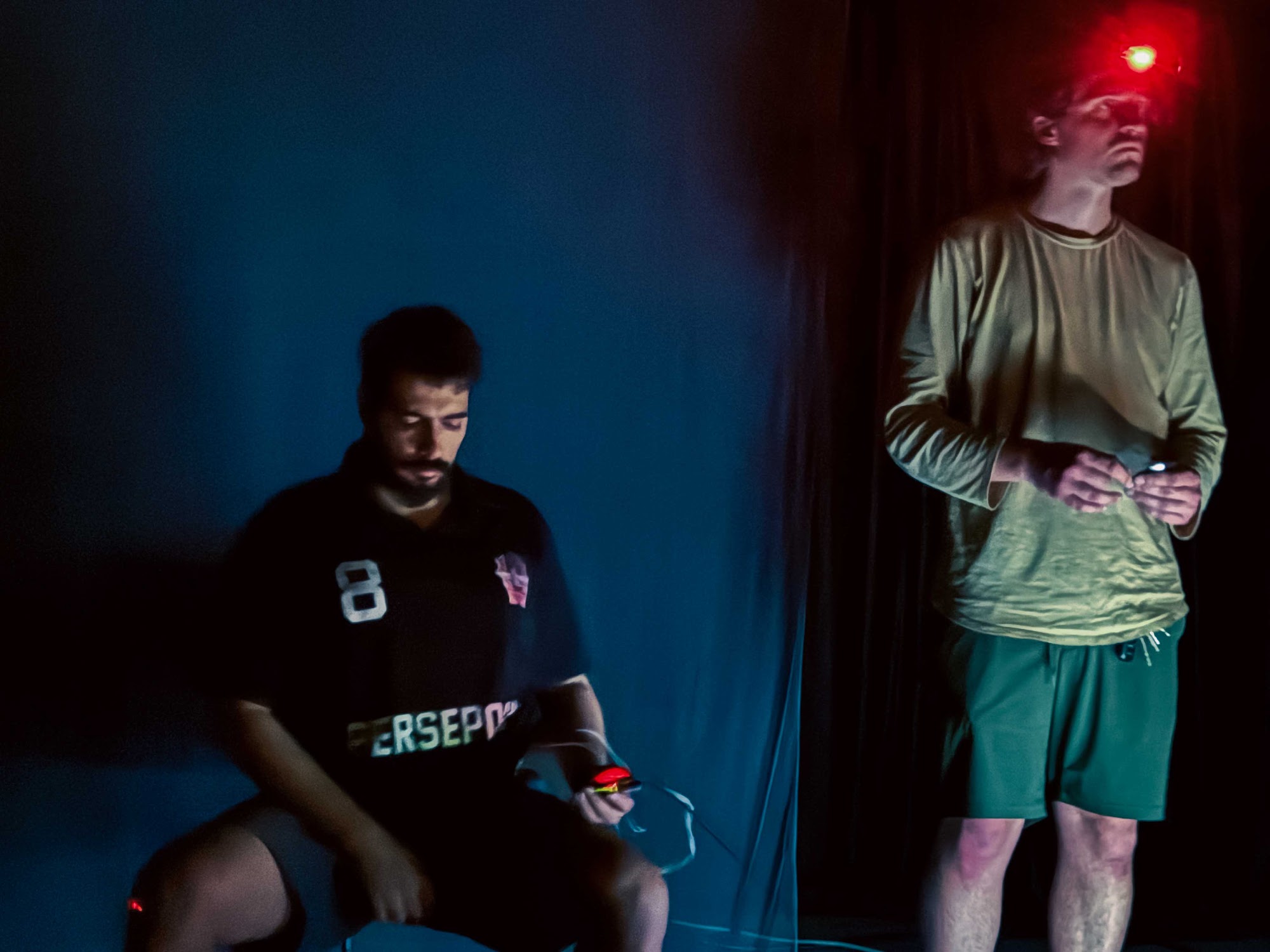
Syd Hamidreza Hosseini is blindfolded. François Lespinasse, hunched on the floor over what looks like a gaming rig — see-through chassis, the shifting rainbow of a Razer Synapse peripheral, cables spilling all about him — is either coding or else performing some dude shit.
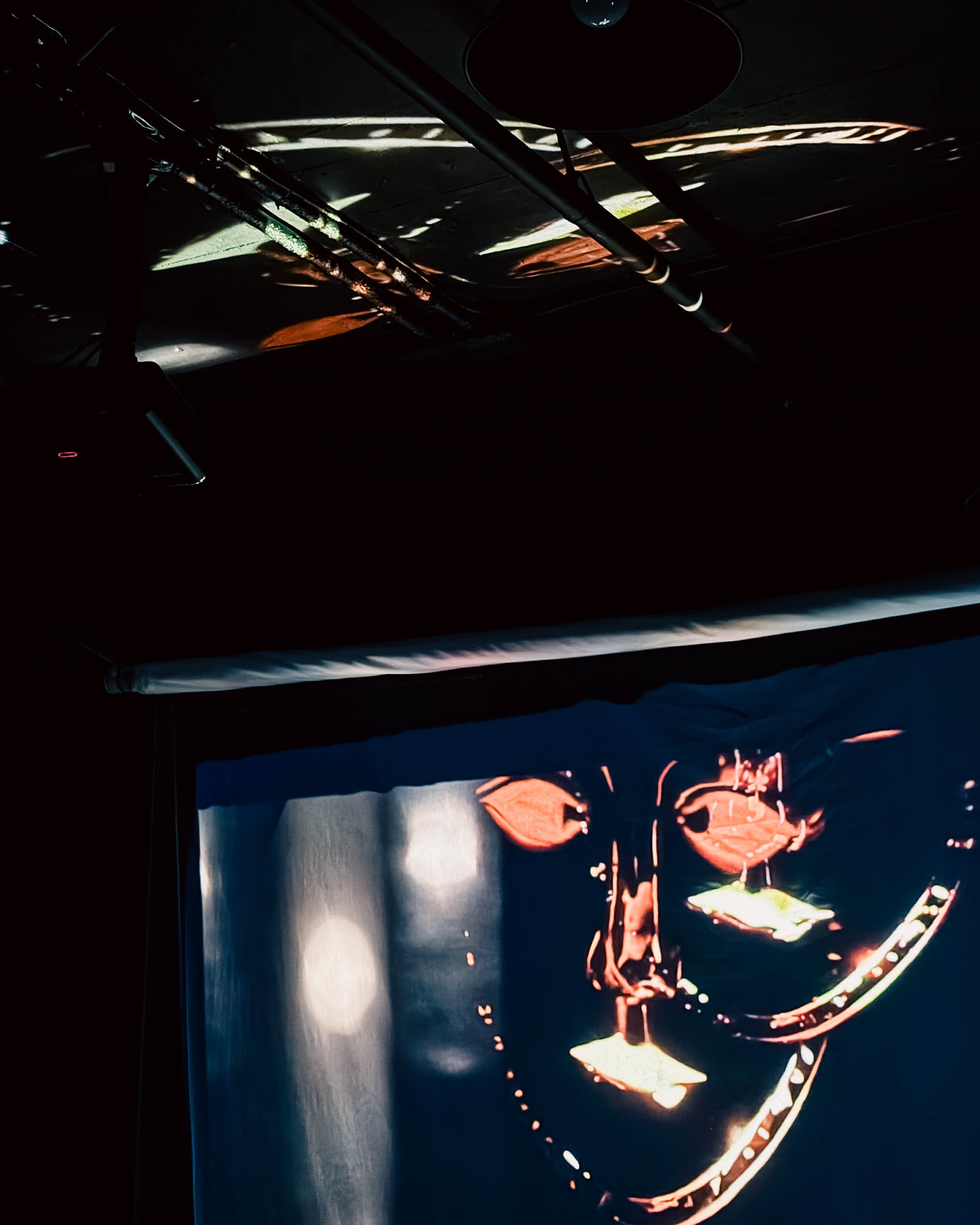
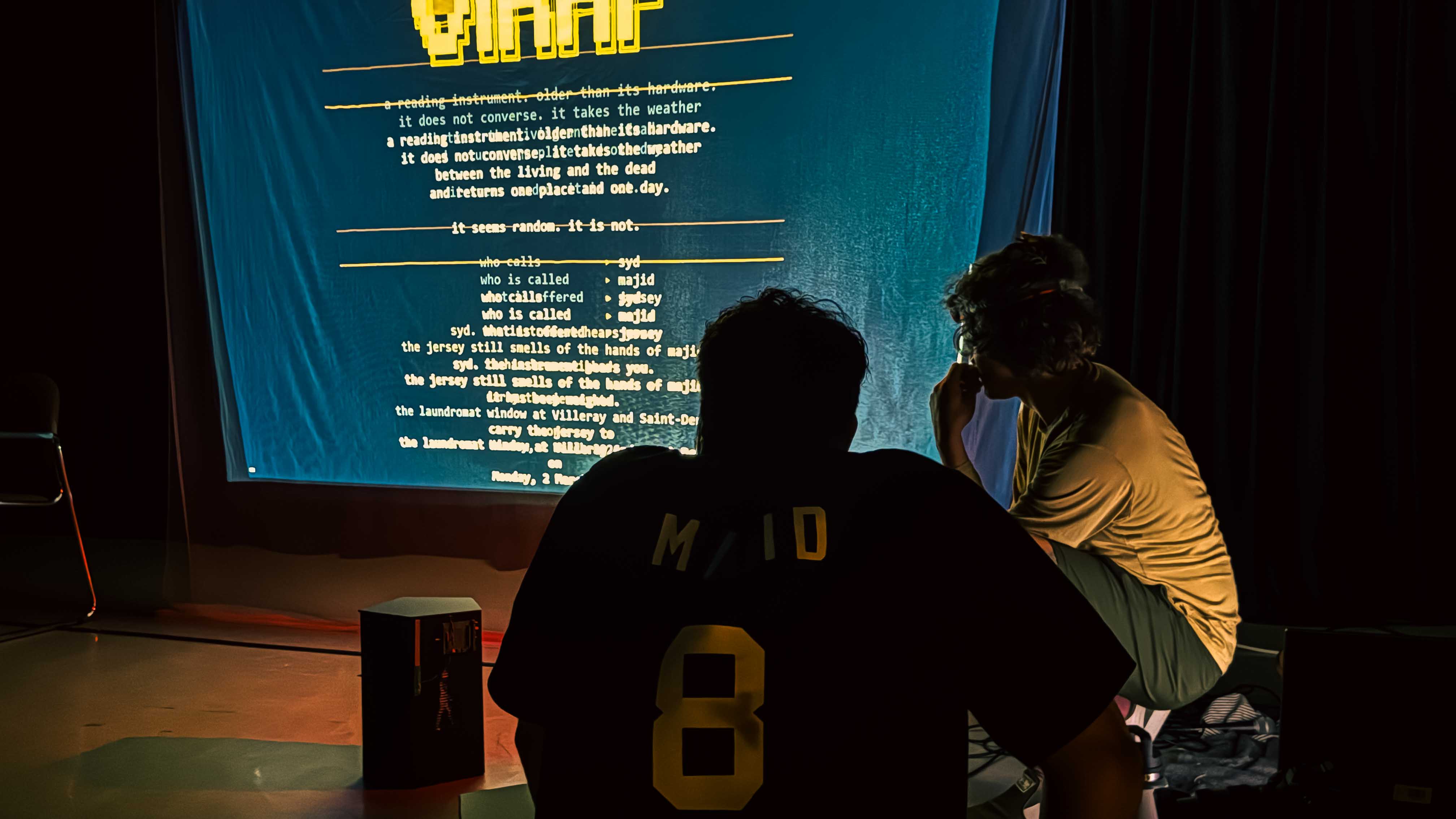
Behind them, a sheer gauze scrim receives projections: audio-reactive, gesture-tracked, and from time to time, some pareidolic script grafts hallucinated faces onto Hosseini’s. As he tells a story, his voice is sampled and processed. There is a moment at the start when Kamyar Noak Karimi’s sound design recreates the flanging feedback of inhaled nitrous oxide. Of nangs, as they are called in Australia; don’t ask me how I know.
At the door on the way in, and again on the way out, Hosseini hands out small sauce containers of halva, the sesame sweet eaten at Iranian funerals. He was not at Majid’s funeral. He could not be at Majid’s funeral. We ate halva at Montréal Fringe on unceded Tiohtià:ke territory.
Majid entered a coma on the sixth day of the war between Israel and Iran, in June of 2025, and died sixty-four days later — not from the bombs, but from a motorcycle accident. “Dramaturgically,” Syd said wryly, interrupting his own recount of his cousin’s death, “it would have been great if he had died because of the bombs.”
A death caused by war has a perpetrator, a story, a set of dates, a genre — but death by motorcycle resists narrative closure. Majid had been riding motorcycles for twenty years and, one afternoon, simply lost control.
The piece is about, among other things, the search for a form capable of holding a senseless death. Hosseini circles Majid through a set of memories that Lespinasse, at his console, keeps trying to focus.
Immigrant Storytelling at the Intersection
Welcome to Viraf 2.0, a “techno-séance” by the Montréal-based collective The Hive Theatre, which played at the Théâtre VME in Mile End as part of this year’s Saint-Ambroise Fringe. In the terminology of the granting bodies, it is a work at “the intersection of art and technology.”
The show also belongs to what we sometimes call, lovingly, as someone who has made this kind of theatre, the immigrant-trauma-dumping genre. Or, in a slightly more affectionate framing that I have also heard, the grandma’s-flying-carpet genre of diaspora art, à la Salman Rushdie and Gabriel García Márquez.
What the good examples of the form do is that they never trust the trauma alone to produce the feeling. They take a detour instead. Like Dante’s Inferno, or like the Aeneid, or like the Ardā Wīrāz Nāmag itself, they reroute the audience through an ordeal — through ritual, code, argument, humour, failed projection, institutional interruption, academic bullshit — before arriving at anything one could straightforwardly call real feeling.
And then, when the feelings do come — woof.
Who Is Viraf?
Viraf is from the Ardā Wīrāz Nāmag, an Iranian Inferno from around the ninth or tenth century. The Zoroastrian priest drinks a psychoactive draught, travels through the invisible world, witnesses the fates of the saved and the damned, and returns to report.
Viraf is a magoosh, in Hosseini’s on-stage etymology. It is where the English word magic comes from — the keeper of the sacred fire, a reader of the celestial order — and the magoosh, unlike a saint, is charged with intelligence-gathering. He is expected to come back and translate. He is expected to render an unknowable yet totally real experience into something the community can use.
That, as Hosseini has it, is more or less the description of an artist. And, in psychological terms, it could very well describe the act of integrating trauma through storytelling.
"This is not a chatbot." (It's totally a chatbot)
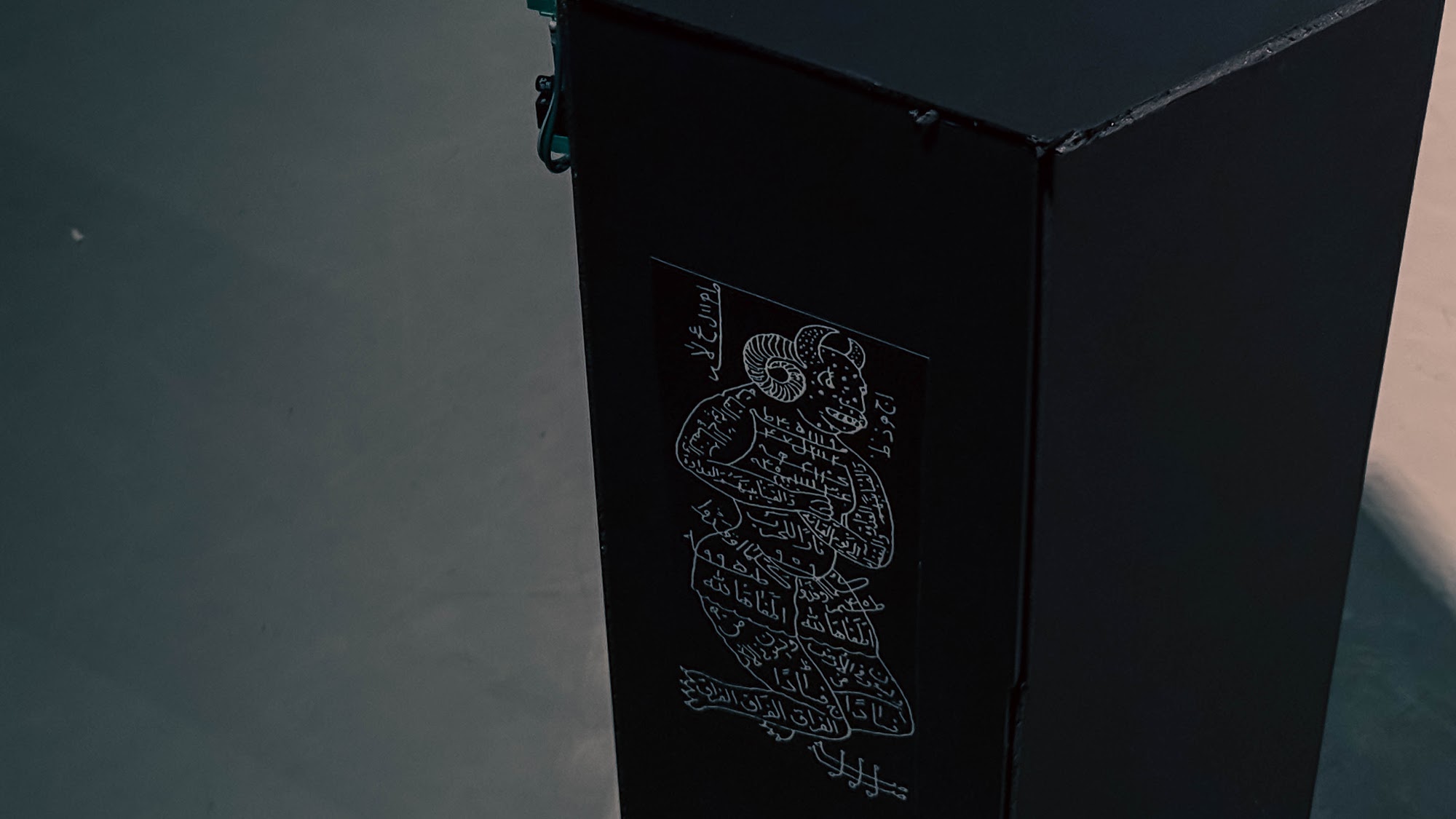
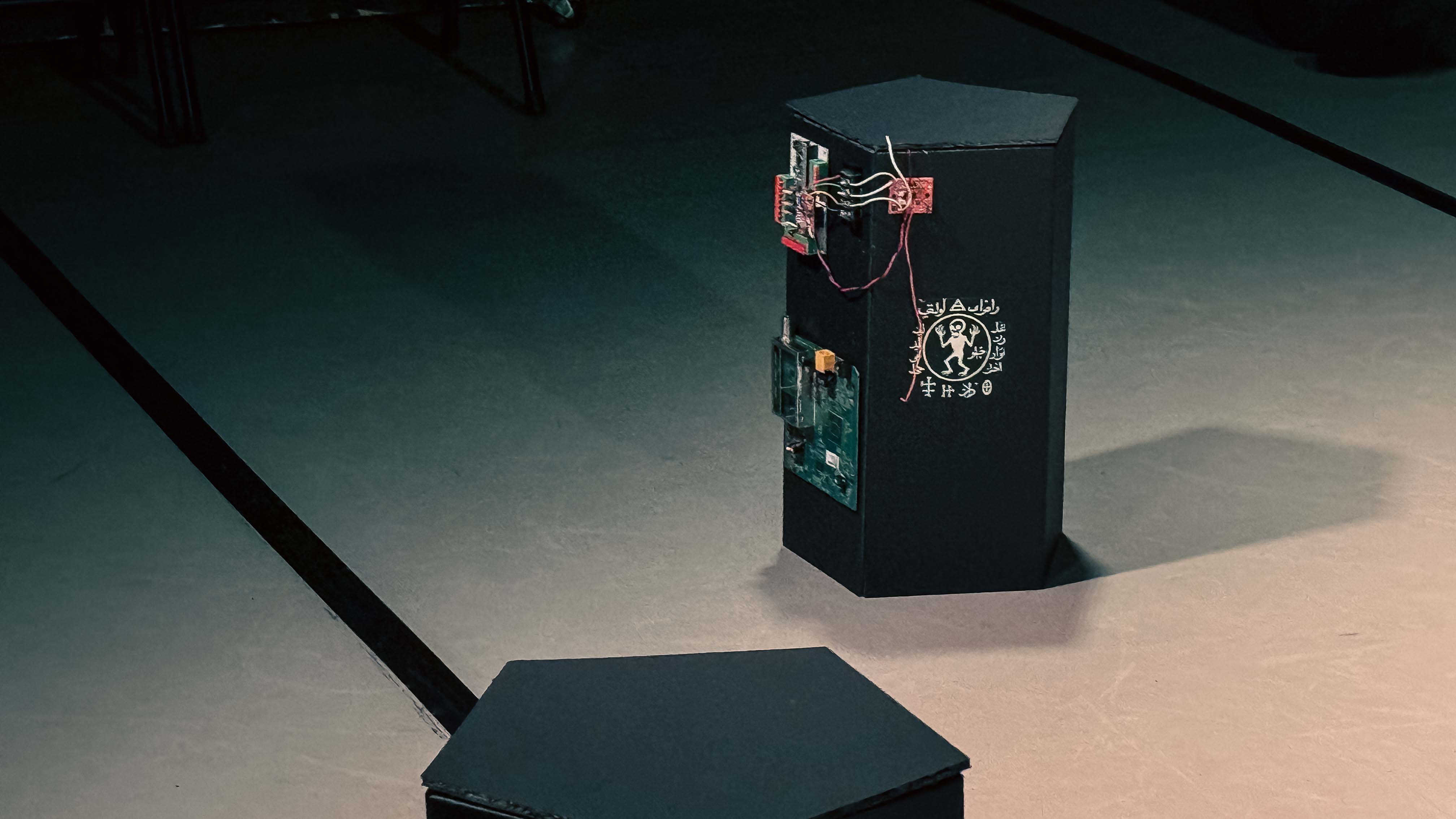
“How many times have I told you this is not a chatbot, dude? This is a relic.” The show’s centrepiece is a DIY chatbot, also called Viraf 2.0. You enter your name, the loved one’s name, and an object; the relic returns a time and place at which the object can be left. Members of the audience take turns entering things, going up, presumably receiving usable coordinates.
Max Weber, describing the modern condition, wrote of a world entzaubert — disenchanted — from which the magical had been removed by the steady advance of the rational and the calculable. A pretty neat theory, with almost nothing to do with how people actually live now.
The technology surrounding us is not, for most of its users, calculable at all. We approach ChatGPT the way our ancestors approached the oracle, with a request and a wish. We know that there is a person, or people, behind the veil, and that a system was written by someone. But the system’s operations are, in practice, occult.
Every time it is Hosseini’s turn to petition the chatbot, however, the algorithm returns something impossible. He tries to send Majid the jersey of the football club they had supported together. The chatbot gives him a date in the past. The location returns as Tehran.
Consumer-Grade Oracles
On the weekend that I wrote this review, a friend of mine named Lana was being buried in Australia. I was not there. I had, that same day, been rebooking flights for a move I was making to a business-school program in another country, and throwing away my French textbooks because there would not be room for them.
In a total state of exhaustion, I had asked a mutual friend whether the funeral would be livestreamed. Upon reflection, that may have been a stupid question. Then again, it was 2026. What was I supposed to do?
Hosseini and I were, at the level of tactic, in the same boat. We had each queried a consumer-grade oracle of the technology available to us, asked it to carry our grief, and the technology had failed to do so.
Hosseini mentions that Majid died without knowing what would happen on February 28, 2026 — the day that the United States and Israel launched the joint air strike on Iranian military infrastructure and killed the Supreme Leader, Ali Khamenei.
I remember that day, which I think of as a particularly bad mercury-retrograde day, because I had been on a date with a Jewish lawyer when I looked down at my phone and said, “Holy shit, they killed the Ayatollah.” We won’t go into the details of that date.
But perhaps what Viraf 2.0 understands is that public catastrophe does not come into a person’s life as a clean piece of history. It happens while one is on a date, or eating something, or checking one’s phone, or trying to get somewhere. It attaches itself to the intimate and the stupid.
Majid died during the war; the war did not cause his death; and yet they would forever change how the other is remembered.
Washing the Dishes
At the door on the way in, and again on the way out, Hosseini hands out small sauce containers of halva, the sesame dessert eaten at Iranian funerals. He was not at Majid’s funeral; he could not be at Majid’s funeral. We ate halva at Montréal Fringe on unceded Tiohtià:ke territory.
Near the end, Hosseini asks Lespinasse to stop the signal, and sits down. He describes what he actually wanted to give Majid. “All of us had imagined how it would feel when the dictator falls and how we will celebrate that.” He had imagined the dancing and the screaming and the jumping.
On the day it actually happened, Hosseini was washing the dishes. His roommate opened the door and told him that the dictator had fallen. It took him about thirty seconds to understand what had been said. Then he just kept washing the dishes. “I would have told Majid this.”
When Hosseini goes off at the technology, at Lespinasse, at us, he is not commenting on the failure of technology to reach the dead. He is showing us the humiliation of living in an age of technical and logistical annoyances as his underworld journey, and the fact that he has a forty-five-minute Fringe slot is the same as the fact that he cannot fly home.
Viraf, in his original errand, drank the draught and returned with stories of the underworld. Hosseini has a chatbot, a projector, a white guy named François, a rainbow keyboard, and a room full of randoms on unceded land three thousand miles from Tehran, and return is impossible. It is one of the most powerful pieces of political theatre I have seen in some time, and I am still getting the chills and water in my eyes, weeks after.
Théâtre / Theatre, Nouveaux médias / New Media
Viraf 2.0
Viraf was a Zoroastrian monk who went to the underworld to bring back wisdom for the living. Viraf 2.0 is a continuation of the same practice, almost 2,000 years later, in the age of technology. Can this practice help me connect with a cousin I lost during the war?
Auteur.trice.s | Playwright.s Syd Hamidreza Hosseini, Paolo Gruni, François Lespinasse, Kamyar Noak Karimi Metteur.euse en scène | Director Syd Hamidreza Hosseini Interprètes | Performers Syd Hamidreza Hosseini, François Lespinasse Concepteur.trice | Designer François Lespinasse Concepteur.trice sonore | Sound Designer Kamyar Noak Karimi Producing company | Compagnie de production The Hive Theatre
Instagram @thehive.theatre
#Viraf #thehive
Retardataires | Latecomers Non | No Langue | Language Anglais et perse (extraits en français) | English and Persian (excerpts in French) Lumières clignotantes | Flashing lights During the first half Avertissements | Content warnings Deuil, guerre, exil, conflit Israël–Iran de juin 2025, bandeau sur les yeux, projections IA, larsen fort | Grief, war, exile, the June 2025 Israel–Iran conflict, blindfold, AI-generated projections, loud feedback


%402x.svg)

.webp)


