It's All Her Fault Review — Internet Imagism at Gene Frankel 2026
Aubrey Naur on It's All Her Fault (Five Evenings Theater, Gene Frankel Theatre, 2026): Andrei Ivanov's Belarusian new drama staged as a masterclass in internet imagism and human puppetry.
It's All Her Fault
By Andrei Ivanov Gene Frankel Theatre Presented by Five Evenings Theater Translated, adapted and directed by Eduard Tolokonnikov
★ ★ ★ ★ ½
A mother catfishes her own son in Andrei Ivanov's It's All Her Fault. Staged by Five Evenings Theater, the American adaptation is an expressionist meteorite of human puppetry.
Reviewed by Aubrey Naur
In America, you write a play about your mother in order to understand your lover. In Mother Russia (or in Belarus, from whence the playwright Andrei Ivanov hails) you write a play about your lover in order to understand your mother.
It’s All Her Fault (Это всё она) was presented by Five Evenings Theater at the Gene Frankel Theatre. A mother catfishes her son. The premise carries the lurid charge of a tabloid headline or a moral panic forum, yet this New York production eschews melodrama for epic, modernist scale.
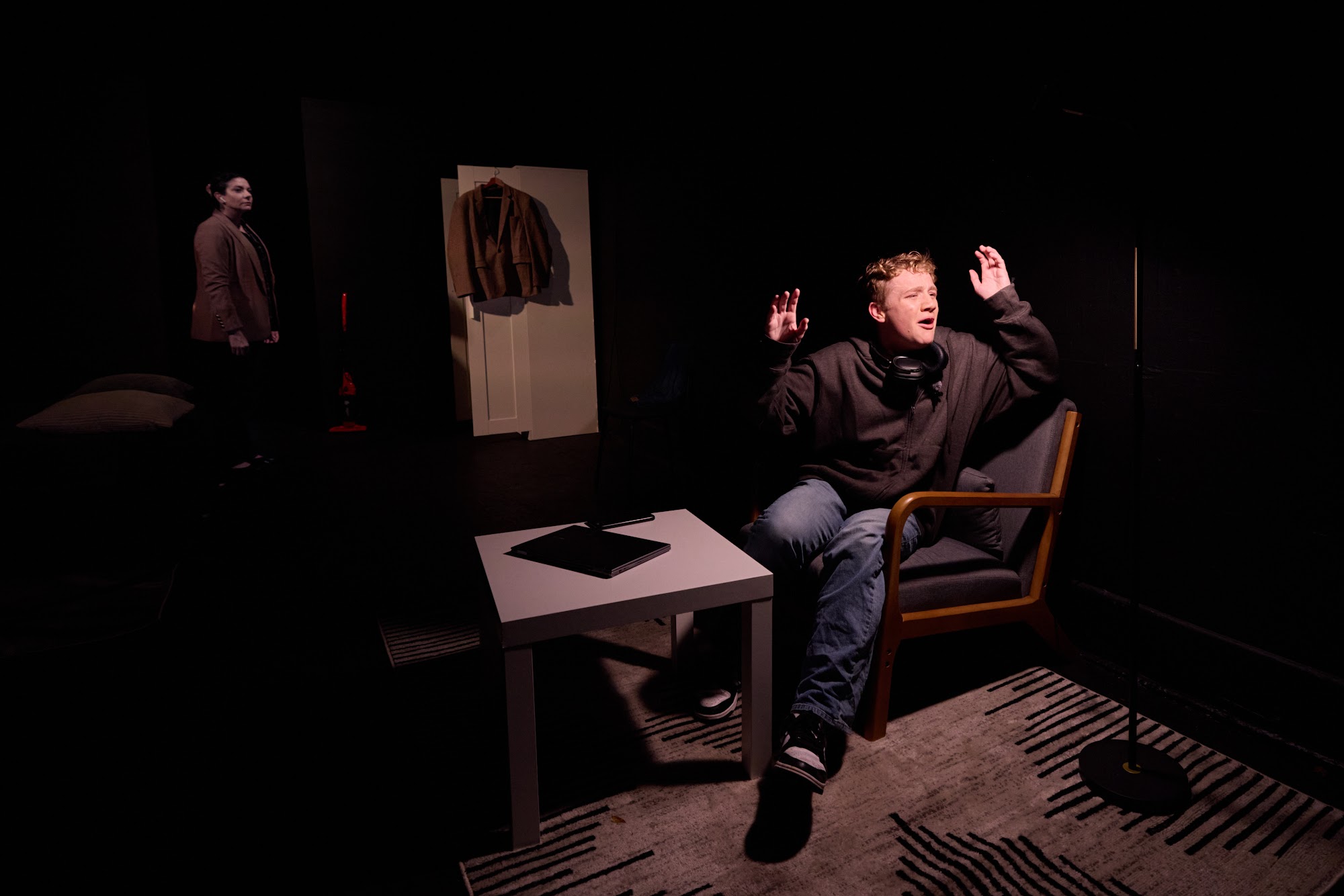
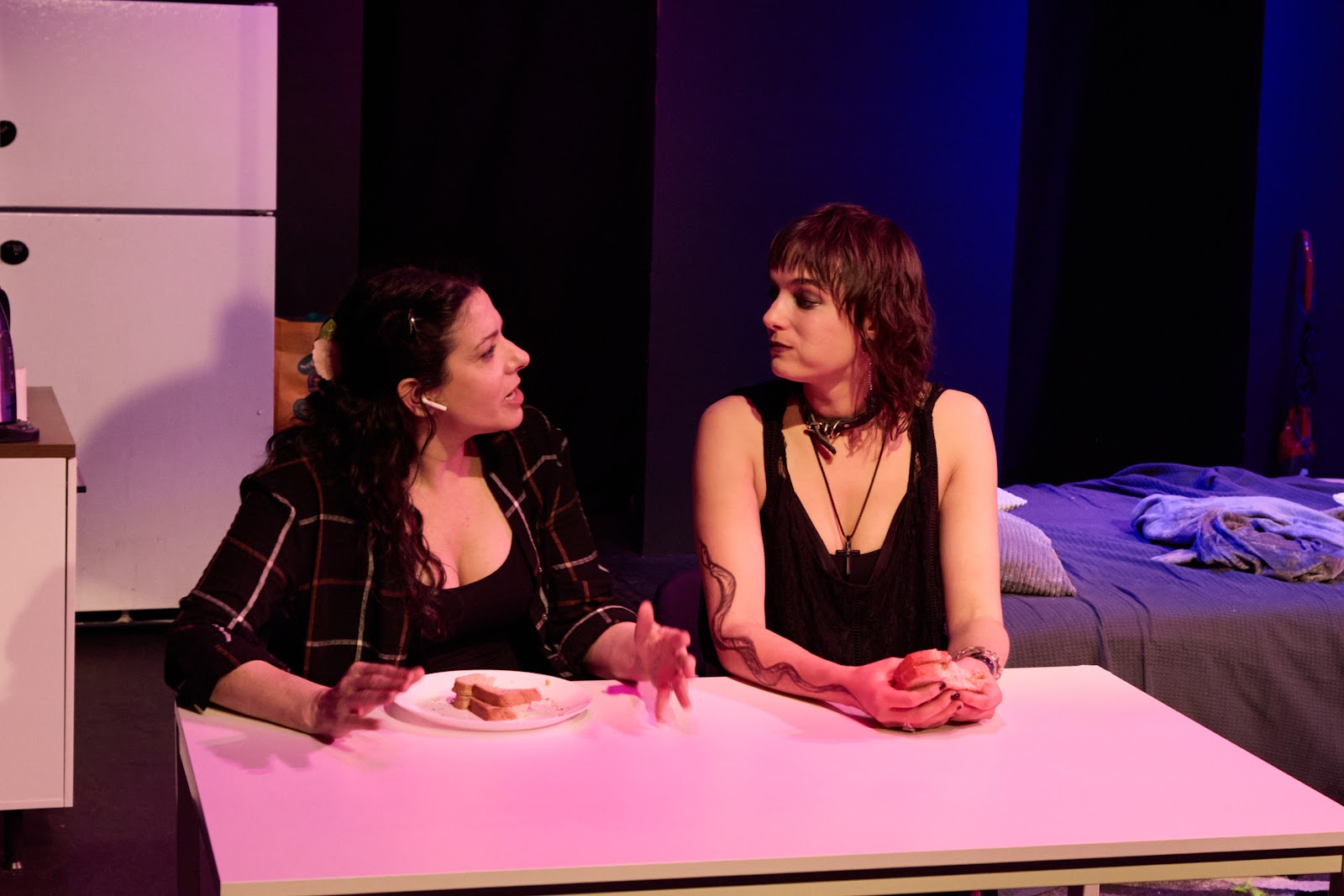
Tammy (Lisa Birnbaum), a recently widowed mother unhinged by grief, cannot penetrate the sullen silence of her teenage son, Cody (Keegan Gulledge). Cody has barricaded himself in his room, subsisting on headphones, YouTube shorts of bike crashes, and the gothic avatar of "The Tower Raven." Desperate to pierce his defensive perimeter, Tammy executes an amateur cyber-espionage operation: she invents "Toffee," an ethereal, sunlight-allergic goth girl with a snake tattoo, Nietzschean cynicism, and a fictitious taxidermist father.
What begins as a gambit of parental surveillance metastasizes into an intoxicating, incestuous romance of mirrors, accelerating toward an inevitable catastrophe.
Andrei Ivanov’s Belarusian New Drama Replaces American Therapeutic Ambiguity with Slavic Maximalism
People in the West like to think Russian theatre is austere and minimalist, when the truth is that it is maximalist. Characters are always either screaming or brooding. Russian theatre has scale. It's All Her Fault is emotionally enormous.
It is a theatrical language born from cultures that do not euphemize domestic warfare — cultures where, quite literally, your mother hits you across the face with everyday domestic objects, whether a kitchen sandal or a bag of cookies, and where affection is so heavy it threatens to crush its recipient.
Watching Cody’s eyes squint defensively into the blue glow of his monitor and his digital counterpart's jaw tighten in response evoked personal ghosts: my Gen X Russian ex-boyfriend, who possessed an identical clenched physical posture and had no vocabulary for positive aesthetic appreciation other than declaring something was "strong." It’s All Her Fault is, in my ex’s exact sense, terrifyingly strong.
In the Anglo-American tradition, family dramas are therapeutic exercises: characters circle their resentments until they eventually reach a fragile truce over a casserole. Ivanov’s text, which took the post-Soviet theatre circuit by storm after its 2013 shortlist debut at the Lyubimovka festival, comes instead from Russian and Belarusian new drama — a movement rooted in raw social naturalism, psychological extremity, and classical fatalism.
A puppet show in which the puppets are people
Every play about the internet runs into the same problem: two people typing to each other is very boring to watch. I came to Eduard Tolokonnikov's staging with strong views about Internet theatre, and I left impressed. Tolokonnikov translated, adapted and directed the production for Five Evenings Theater, which he runs with Roman Freud.
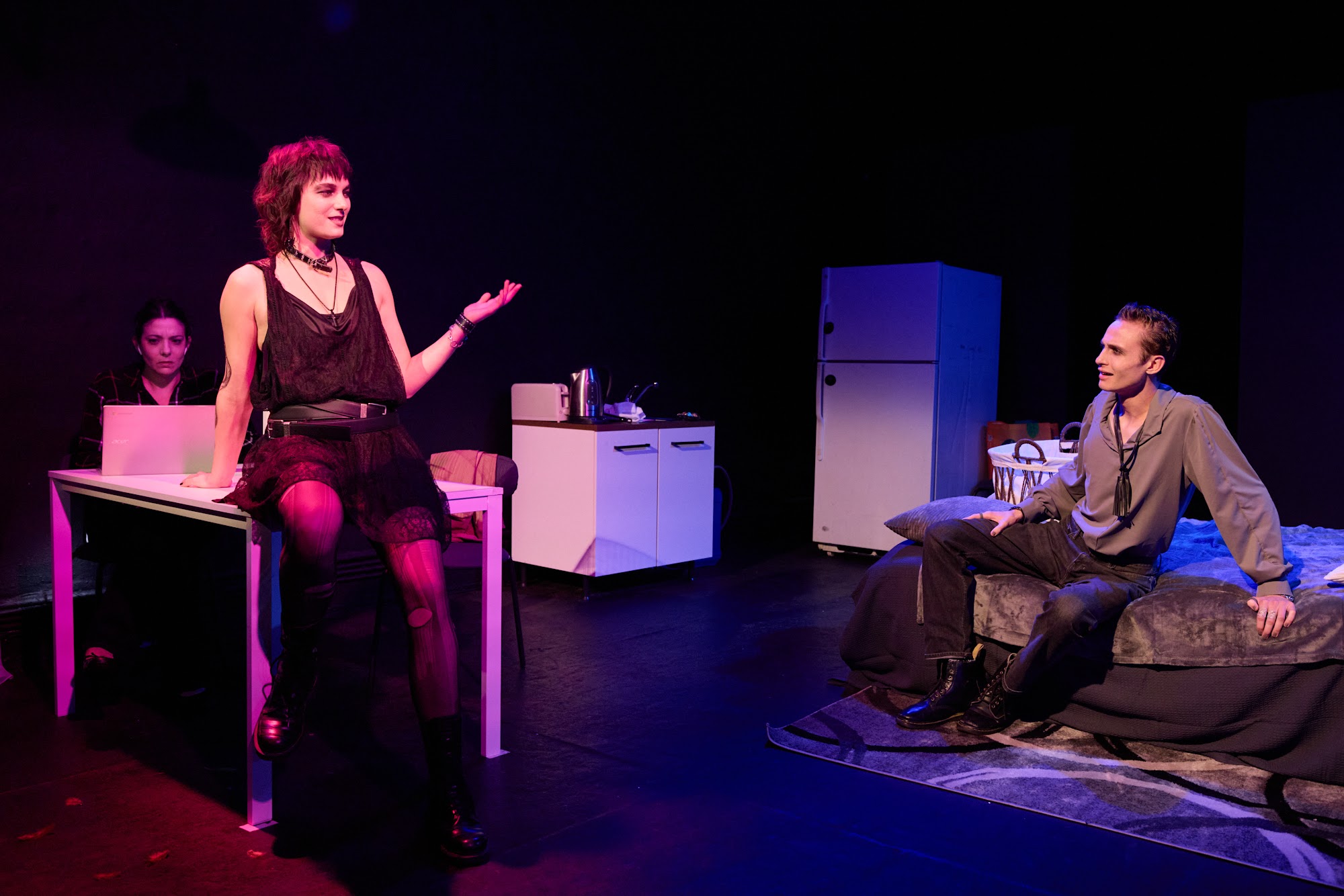
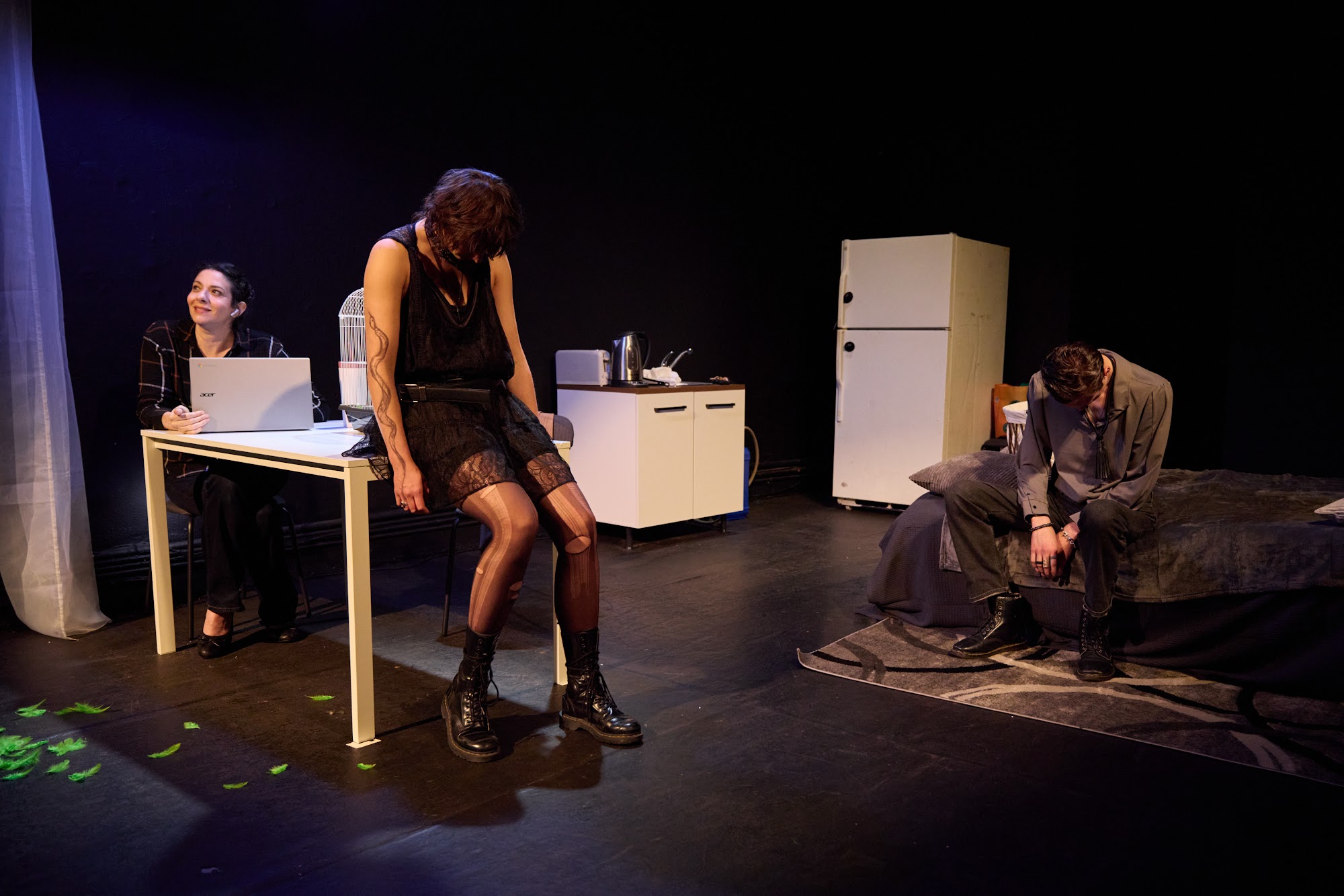
For about half the play, mother and son sit at separate tables and type. Meanwhile their online selves are played live. Irina Liss is Toffee. Teddy Fischer is the Tower Raven.
Their solution is puppetry, except the puppets are human. It reminded me of two improv games, Helping Hands, where you play someone else's arms, and Moving Bodies, where you move your partner like a doll. It probably helps that Fischer performs stand-up somewhere in New York every night and tours with an improv troupe called CRUD!
The avatars evolve from mannequins to full stage agents. On paper, the idea of online personas as mannequins sounds obvious. On stage, with those glassy eyes moving back and forth, it's unsettling and very, very successful.
Fischer enters with a startling dance vocabulary of popping and locking, like Moldovan Eurovision idol who had fallen into a vat of embalming liquid. He looked totally possessed, as if the boy's soul had climbed into a shop-window dummy. Fischer’s physical presence has a distinct body-snatcher aura: in Hunter Lustberg’s cross-lighting, his sharp facial contours resemble a haunting composite — partly an older version of Keegan Gulledge’s Cody, partly an unearthly mannequin animated by Cody’s wounded id.
Irina Liss, whom I previously admired in The Suitors of Helen, demonstrates a radically chameleonic range here. Rather than playing an authentic teenage goth girl, Liss plays a middle-aged mother’s clumsy, romanticized projection of one. She moves with the hyper-articulated grace of an idealized doll, embodying the tragic psychoanalytic reality of the piece: the avatars have developed a haunting autonomous existence outside of their creators, leaving their human puppeteers trapped in the strings.
Both actors have obviously studied the people they're attached to and absorbed how they move, to the point where they could sense what their "real-life" counterparts were doing without needing to look. When Cody types a jagged insult, Fischer’s mouth twists and his frame recoils; when Tammy crafts an elaborate lie about being allergic to UV light and wandering through graveyards at night, Liss whips her head around in motherly embarrassment. It was an astonishing feat of clockwork attunement.
Puppetry is about prosthetics and fine adjustment, which is also a decent description of both psychoanalysis and the internet. The mother tries to reach her son by becoming the girl he wants online; the son displaces everything onto the screen. The love story is Peter Pan as Vkontakte fanfic: two lost kids, one allergic to sunlight, circling each other in digital Neverland where nobody ever grows up.
Hands, eyebrows, and scale
The physical performance style of the ensemble is unapologetically foreign to New York’s naturalistic downtown scene. Under Tolokonnikov’s direction, the cast draws directly on the traditions of the Shchukin Theatre Institute and classical Russian psychological theatre.
You can feel the direction in every moment, because none of it moves like American acting. There's no Brando slouch and no mumbling. You could feel the Moscow tradition in this production. Every gesture is set, every turn is blocked.
In the West, "hand acting" is an insult. Here it is a discipline. At one point Gulledge, who once played Ralphie in the national tour of A Christmas Story, claps his hands on a word, as a sort of "tsk." I don't think English has a name for it, and I have never seen an American teenager do it. It's a punctuation mark from somewhere else.
It is hard to feel much for a sulking American teenager. The worst thing that can happen to him is a bad Wi-Fi day. Under Tolokonnikov's direction, we see Gulledge playing more-than any American teenager, and unapologetically so. He is playing a boy of the 2010s somewhere in the Russian-speaking world. Once you see the scale of what he is up against, the anger you would have laughed at from an American teenager seems like the only reasonable response.
Lisa Birnbaum’s Tammy is a tour de force of emotional maximalism. Her face is a volatile topographic map of domestic anxiety, grief, and suffocating maternal tyranny. She goes from screaming fury to sudden, unhinged laughter. A lot of it is in the eyebrows. There is an ancient, Balkan-Slavic continuum in Birnbaum’s visage: within a single scene, her features collapse and reassemble, showing you simultaneously who this woman was as a reckless young girl, who she is as a grieving widow, and who she will be as an embittered, scolding grandmother. It is an extreme landscape of peaks and valleys.
In a tight 74-seat room like the Gene Frankel, playing with that degree of operatic projection could easily have shattered the production’s credibility. Yet because the emotional stakes are so absolute, Birnbaum’s ferocious scale fills the space like an electrical storm.
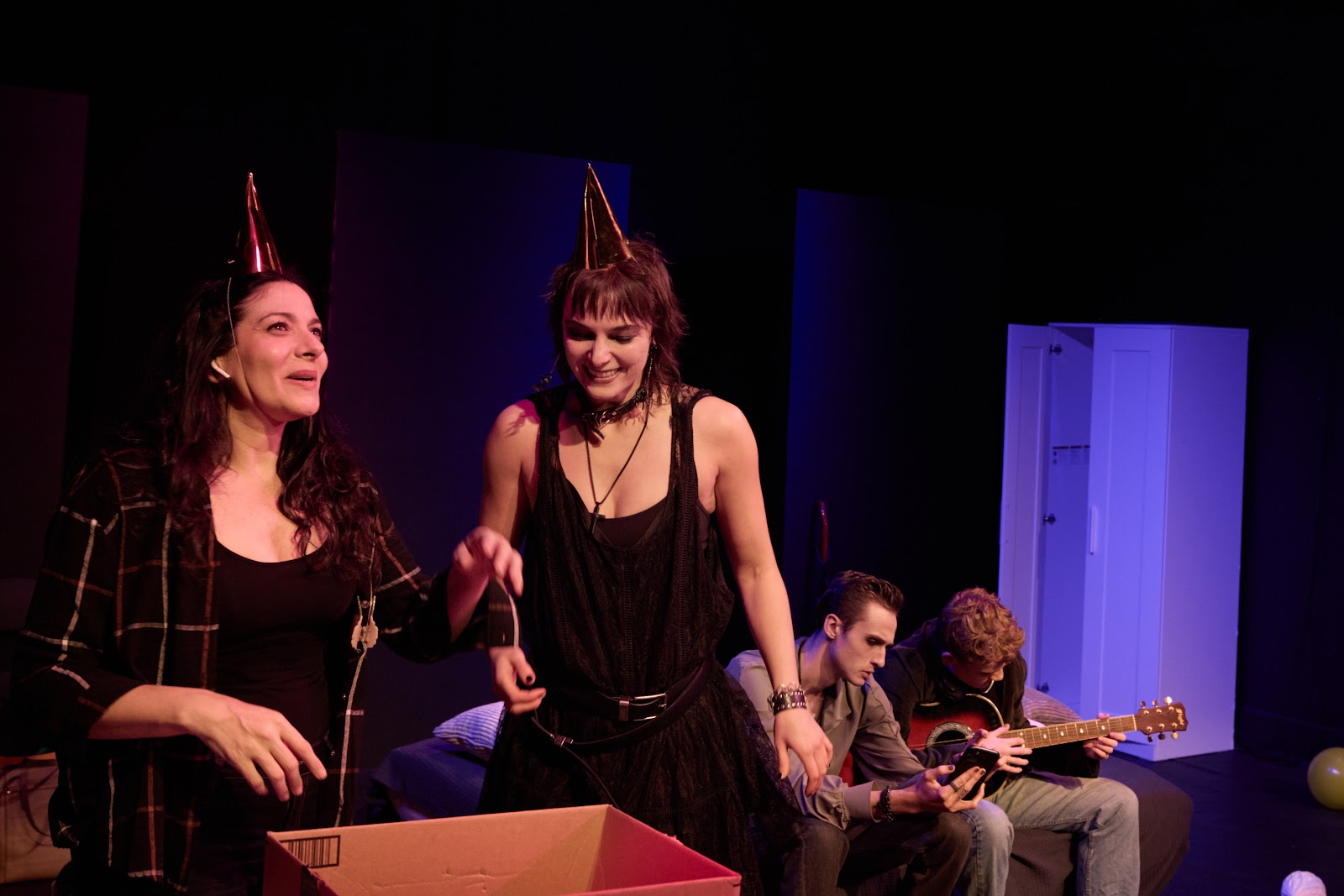
The cast projects as if the back wall were half a mile away, and once again I feel the need to emphasize the sheer scale played by this small cast of four.
Internet Imagism. Everyday Objects, Primitives of the Web, and the Poetry of Negative Space
I'm a huge fan of translations that try to preserve something of the texture of the original, and the translation that the New York production worked with was pure Imagist poetry. Eduard Tolokonnikov has adapted Ivanov's text into an experience that I want to call Internet imagism. Like the early twentieth-century poetic experiments of Ezra Pound, the emotional life of the play is anchored entirely in concrete, evocative physical objects that stand as stark emblems for internal moods.
In one of Cody’s stream-of-consciousness monologues to his nine YouTube subscribers, he fixates on his schoolteacher who openly eats chalk in front of her students.
In another, Cody's father’s jacket still carries the lingering phantom scent of his square-bottled "Deep Red" cologne ("warm wood in the sun"). When Tammy commands her son to "clean" the jacket, Cody retreats to the bathroom with a thin utility box cutter. Under Hunter Lustberg’s harsh red and blue lighting gels and billowing theatrical smoke, Cody shreds the garment into ribbons.
While I wish the translation had been more faithful to the internet of 2013 rather than updating it for an audience in 2026 (the production cycles through "cringe", "no cap" and Zoomer rather than Millennial slang) the play’s digital architecture is refreshingly free from Silicon Valley slickness. There is no Apple product placement, no glossy iOS interface.
We get, instead, the Blue Whale challenge and a Web 1.5 digital reality instantly recognizable to anyone living outside Western tech bubbles — technology a Somalian scammer could navigate with ease. Near the climax, Cody stares at a blank gray silhouette surrounded by empty negative space, accompanied by a canned stock image of a puppy and the deadpan system notice: "Sorry, nobody is here." In Cody's monologue, that negative space becomes an imagist symbol of his devastation.
A working translation, and the "fault" in the title
Tammy and Cody have American names now, Toffee claims to be from San Francisco, and Cody dreams of college in New York. But the language still sounds slightly translated, and I liked that. One line is "She's just trying to rage me", where a two-syllable substitution like "anger" or "enrage" would have broken the jab.
The original title, "Это всё она," means roughly "It's All Her." The English adds "Fault," and so it takes a side. That's interesting, because Ivanov built a two-sided play. A sheer white curtain hangs at house left. I took it as a veil for the internet age, Rawls's veil of ignorance with a Wi-Fi password: behind it you can be anyone, and so can everyone else.
It is also, at heart, a fairy tale. The story mother and son keep coming back to is Peter Pan: a boy who flies out of a window, and a mother who leaves it open for him. In this play the window is open all the time. Tammy keeps forgetting to close it. Everything is laid out in advance, and archetypes behave the way archetypes do. You know where it's going, and it's the fatalism that keeps you hooked.
My only qualm is with the ending, which felt a bit too on-the-nose. Maybe that's just me, a Westernized person who wanted a little mumble. Then I remembered that this is what Chekhov would have wanted. Ivanov puts the gun on the wall early: the bird, the blood on the sleeve, the open window.
Ivanov has described his subject as "the pathology of feelings in the context of technological progress." That's a strong phrase, as my ex would say. The play has become a repertory staple in the Russian-speaking world, with a music-theatre version in Moscow, a festival-winning student production in Yekaterinburg, and a star-led commercial tour.
Five Evenings is a small company in the wave of Russian-speaking theatre that has reached New York since 2022. Of that wave, it is among the most traditional, in a way that feels radically modern (which, incidentally, turned out to be the very selling point of the Modernists).
Reviewed by Aubrey Naur
Théâtre / Theatre
It's All Her Fault
How far would you go to reach your child?
You knock. He says he's fine. The door stays shut, and the only light under it comes from a screen. Since his father died, Cody has barely said a word to his mother. He lives online now, under a name she doesn't know, talking to people she has never met. Tammy has tried everything. Nothing she says gets through. So she tries something she can never take back. If you were ever the one behind the door, you already know half of this story. It's All Her Fault is a psychological drama about grief, loneliness, and how far a parent will go to reach a child. Where it ends, we'll leave for the theater.
Texte | Playwright Andrei Ivanov (Это всё она) Traduction, adaptation et mise en scène | Translation, adaptation and direction Eduard Tolokonnikov Compagnie | Company Five Evenings Theater Direction artistique | Artistic director Roman Freud (co-founder) Codirection | Co-director Eduard Tolokonnikov (co-founder) Production | Producer Marina Philidor Interprétation | Cast Lisa Birnbaum (Tammy, the mother), Keegan Gulledge (Cody, the son), Irina Liss (Toffee), Teddy Fischer (The Tower Raven) Scénographie | Set Ksenia Peretrukhina Éclairages | Lighting Hunter Lustberg Son | Sound Jeff Kushner Costumes et maquillage | Costume and makeup Galina Ponomareva
Durée | Running time 90 minutes, no intermission Public | Audience Recommended for ages 16+. Contains suicide, domestic violence, catfishing, sexual references, animal harm and bereavement. Langue | Language English
Venue Gene Frankel Theatre 24 Bond Street, New York, NY 10012 November 4–21, 2026 (closed)