Aubrey Wang reviews Bombastia (or, Blood Upon the Risers) by Luc D'Arcy at Zoopraxic, Long Island City 2026 — a studio picture in a Queens loft: home-front melodrama, screen acting scaled for the stage, and a war that finishes off all the milk.
Bombastia (or, Blood Upon the Risers)
By Luc D'Arcy Zoopraxic, Long Island City, NY Presented by The MONA Directed by Luc D'Arcy
★ ★ ★ ★ ★
Reviewed by Aubrey Naur
Photo credit: Diego Quintanar
In a Long Island City loft, the MONA's Bombastia (or, Blood Upon the Risers) sets a war in the kitchen and serves it with milk and good manners.
A Play of Eyes
Bombastia is above all a play of eyes, sparkling and dewy and guileful. My notebook at this point records, with a candor I can only blame on Garett Pembrook's lighting, "oh it makes me wet." The staging creates a moiré of interference, glances laid over glances until the pattern shimmers and you lose track of who is watching whom. The audience on the risers gulped audibly, and often.
In every scene we can never tell whether these characters are going to fuck or turn each other in to their Gestapo. Everyone has a finger on the trigger, and the pistol is loaded.
The moral structure is noir. A cheerful recruiter with no interior; a system everyone half-believes; a woman who thinks she’s outside it and discovers she’s inside it; one door. The thing that undoes the characters comes out of their own mouths.
The Home Front
The genre, under the retro-future dressing, is not the war picture but the home-front picture. A soldier on leave, a woman at home, a kitchen, a drink, the war offstage and peeking through only as vouchers and parades and rumours: we're in the world of The Clock, Since You Went Away, The Best Years of Our Lives. The home-front form supplies every character's reason to stay in a scene despite mounting discomfort: somebody is about to leave and somebody isn’t.
Our protagonist, Sam, is the Code-era noir heroine, reclaimed: smart, immobile, waiting. Her weapons are her mouth and her face. Whatever its misogyny, the Hays Code gave us the woman whose intelligence is the subtext is the suspense.
The war comes to Sam one visitor at a time, and every visitor is carrying advice. It is a play of tenderness dressed as warnings, and warnings dressed as tenderness.
Sam packs a bag at one point and never uses it. The pacifist who won’t sew another button is also, physically, the woman who stays put, and the play has the nerve to let you wonder for eighty minutes whether it's out of principle or paralysis.
The Door, and the Risers
Bombastia (or, Blood Upon the Risers) was written and directed by Luc D'Arcy and is produced by the Museum of New Art. D'Arcy's curtain speech describes the MONA as "a theater company, blog, and producing entity that does indie theater and intimate spaces." They first put the piece on last February out of two apartments, his and Aziza Gharib's; the company played BCTR in January and took a different show to Edinburgh in August.
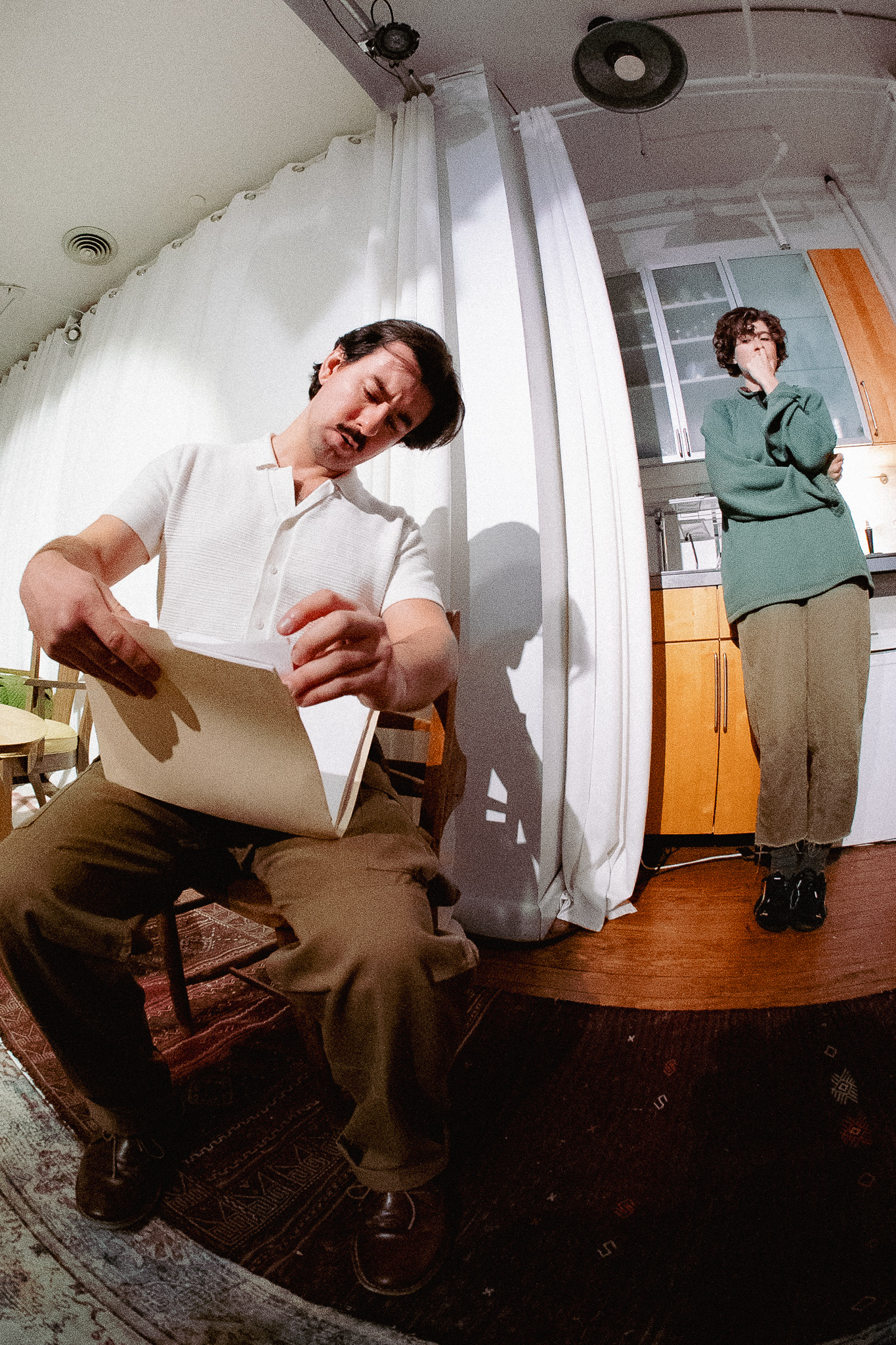
Now Bombastia has landed at Zoopraxic, a loft tucked into a run of warehouses in Long Island City, as part of the venue's Rehoused Residency. The venue has not one but three Persian carpets, the kind from Ruggable that you could peel the paisley off to chuck in the wash.
The structure is a siege conducted entirely through one door, through which the audience is also directed to not use the bathroom. There are no intervals, and over the course of a tight ninety the tension is laid so thick we forget our bladders exist.
Old Hollywood Writing
The dialogue sounded like it was written by someone who has watched a great many old movies. The characters talk in clipped, complete sentences with one thought per line and the verb exactly where Wilder or Hawks would have written them. “Soldiers don’t read.” “That is my cue.” “Call me a stoic, but I think we’re headed towards some good.”
The jokes too feel studio: setup, pause, undercut: the pilot asks Sam if she exercises, and she says, “No. I just take very small bites.” It is a deeply intelligent script. Before a light cue or a costume has had a chance to do anything, the writing alone has made the evening a studio picture.
The diction sets the circumstance so completely that the actors only have to play each other, and a script this tight gives them nothing to hide behind and nothing they need to.
And every line is aimed. There is no speech in the play that isn’t designed to have an effect on someone else. Even Michael’s long story about his mother is told at Sam, for a reaction, and the reaction is in the script: “No. Not really.” The cast is as involved in each other as casts in those pictures were.
Screen Acting, Enlarged
It is hard to do Old Hollywood for 2026 and have remain a completely new and original work. There was something uncanny about the effect of watching something dubbed "retro-futurist" in 2026 where the faintest trace of pastiche is absent. It is harder still to give screen acting the scale of the stage. Bombastia pulls off both.
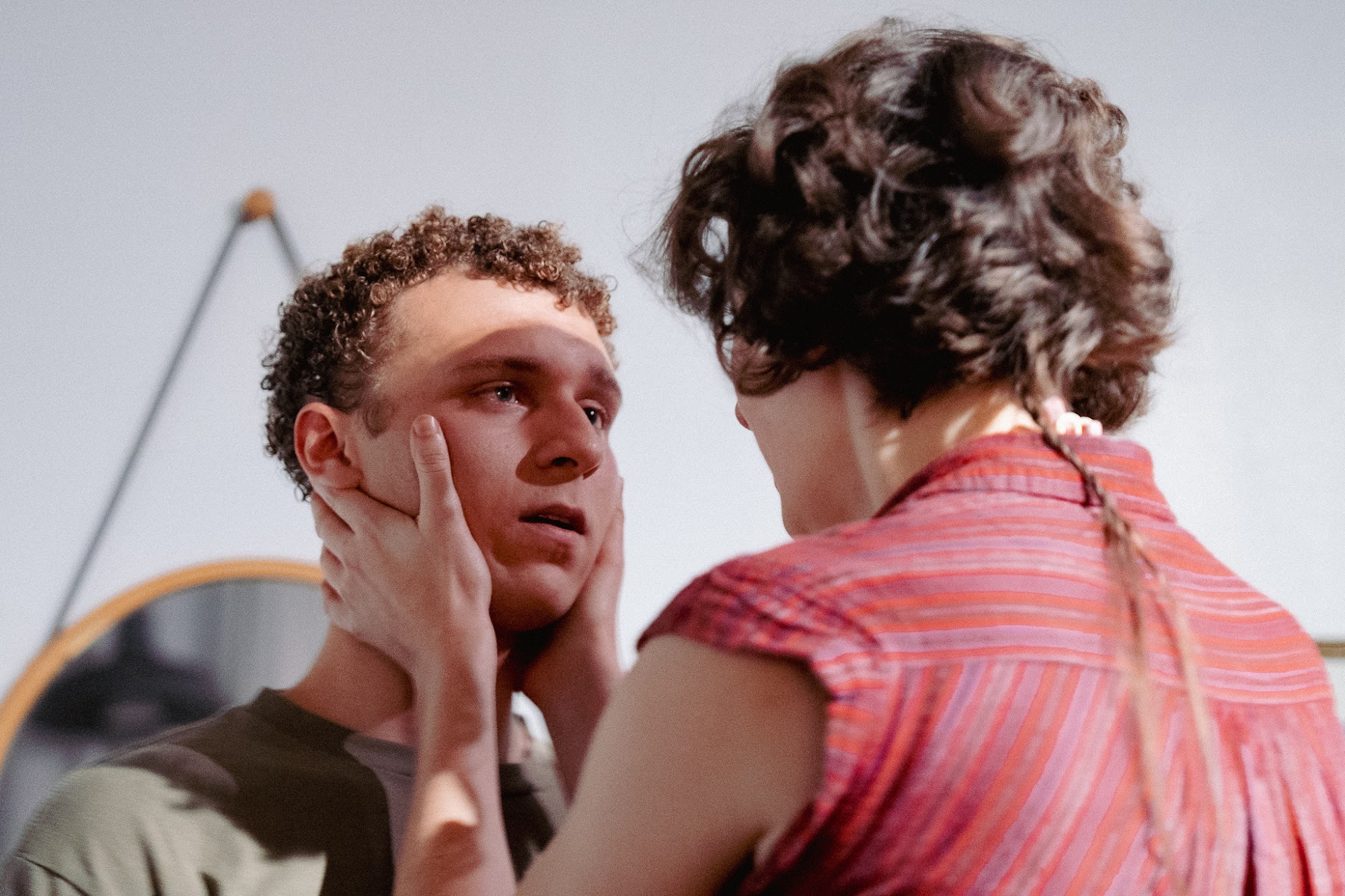
Everyone plays the small register, the flicker, the half-smile, the glance that goes to the door and back, and plays it one size up. They enlarge the subtlest of their expressions and reactions and project them to the back of a loft with a floorplan that doesn't exactly demand much projection.
The effect is double, and both halves are thrilling. It makes a loft the size of a living room feel like a bigger space than it is, and it makes everything happen so fast that you almost miss it: a reaction that in a film would be a cutaway is, here, a quarter-second on a face three feet away, and then it is gone and the scene has already moved on.
On film the reaction shot is a gift from the editor. Here the reaction is permanently in frame, enlarged just enough to read and withdrawn before anyone can dwell on it.
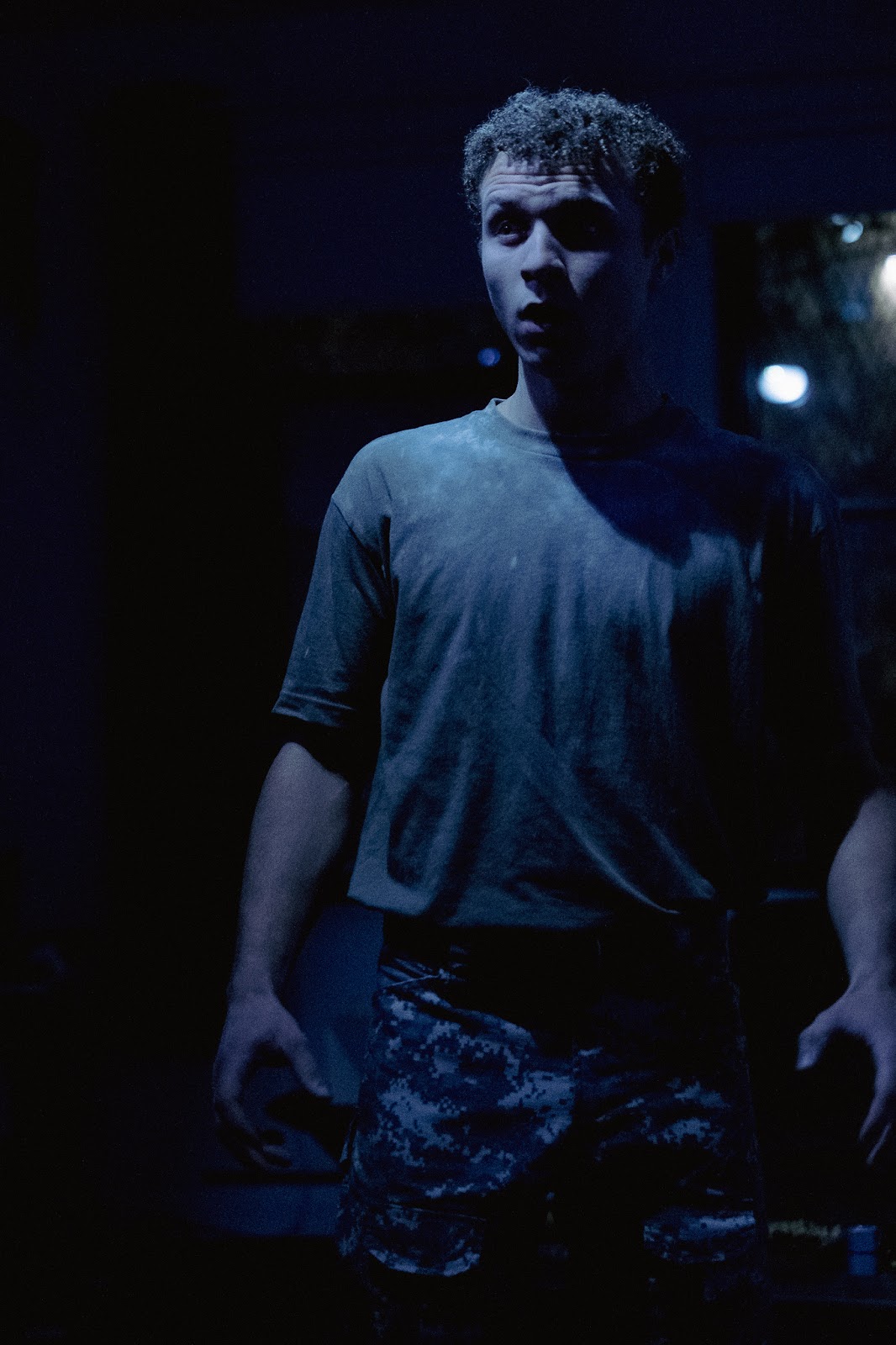
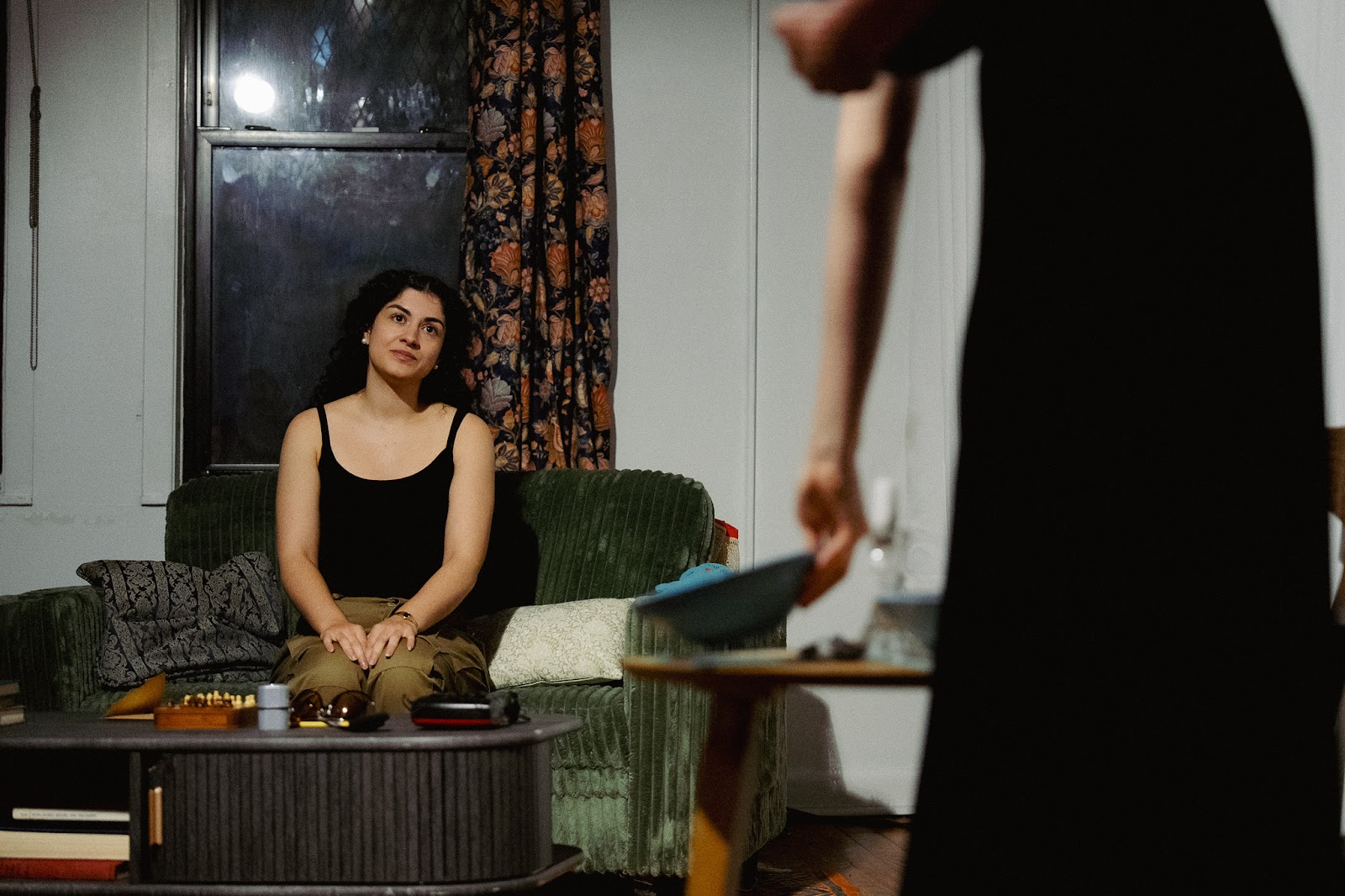
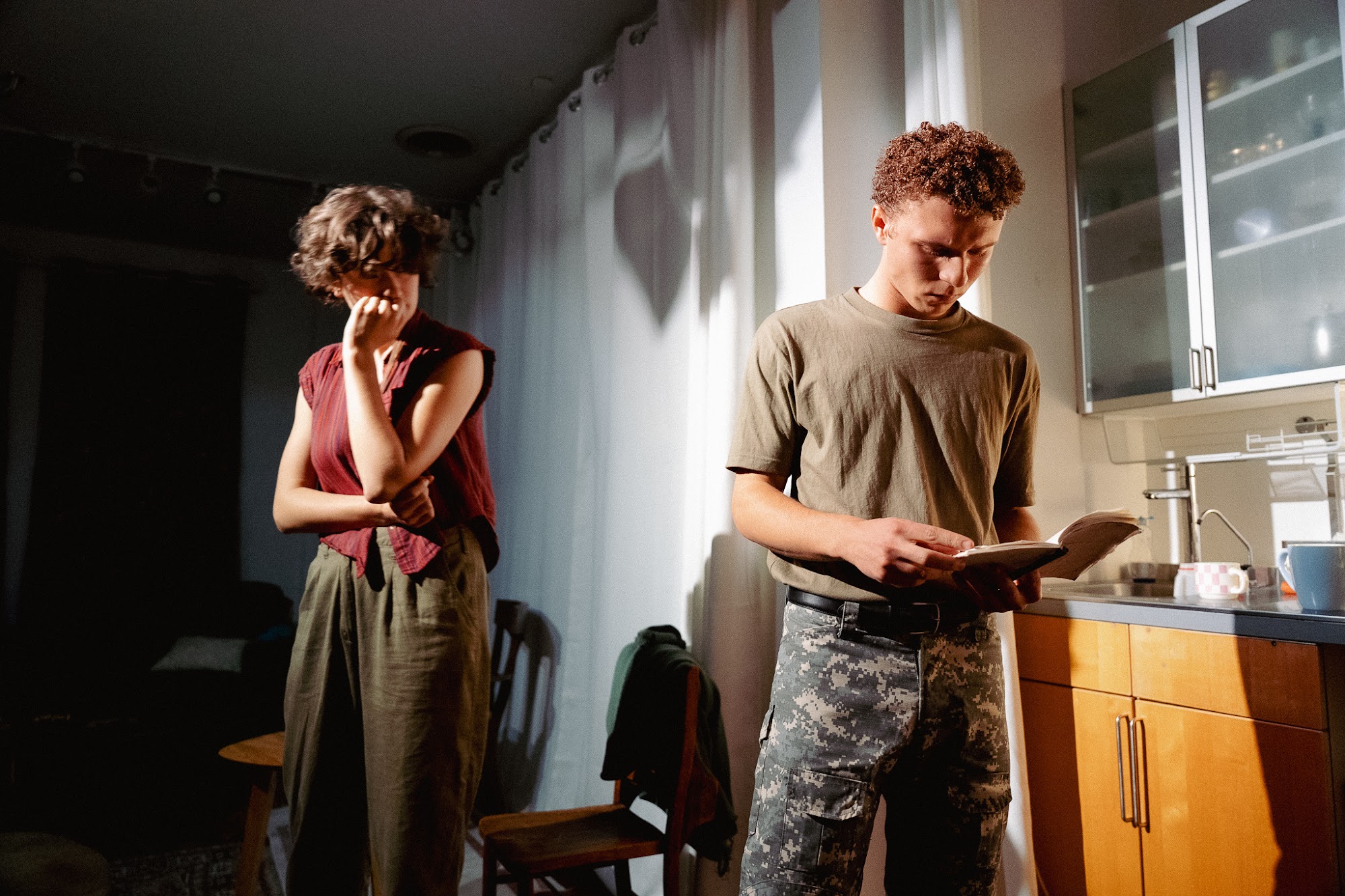
Garett Pembrook lights it like a studio portrait, lateral and low, half of every face in shadow and the eyes catching. Garett Pembrook's light gives everyone the morbid glow of a film negative, and at moments his long roving dusk recalls Roger Deakins's single take in 1917. So you watch the play the way you watch a Bette Davis close-up: you watch somebody listen. Old Hollywood acting emphasised the listener’s face because the camera stayed on it. In Long Island City this company shimmied up the same effect with intuitive blocking and some LEDs.
Some psychological plays of the modern persuasion have come off “Shot-on-Video” to me recently, which is to say, amateurish and slightly embarrassing. Bombastia is not SOV; it is shot on film, in a hyperreal 70mm. It has grain, the warm, slightly sickly saturation of something developed in a basement, and the reality is laid on so thick that some of its naïveté reads as perfectly written rather than as a flaw.
The Pacifist
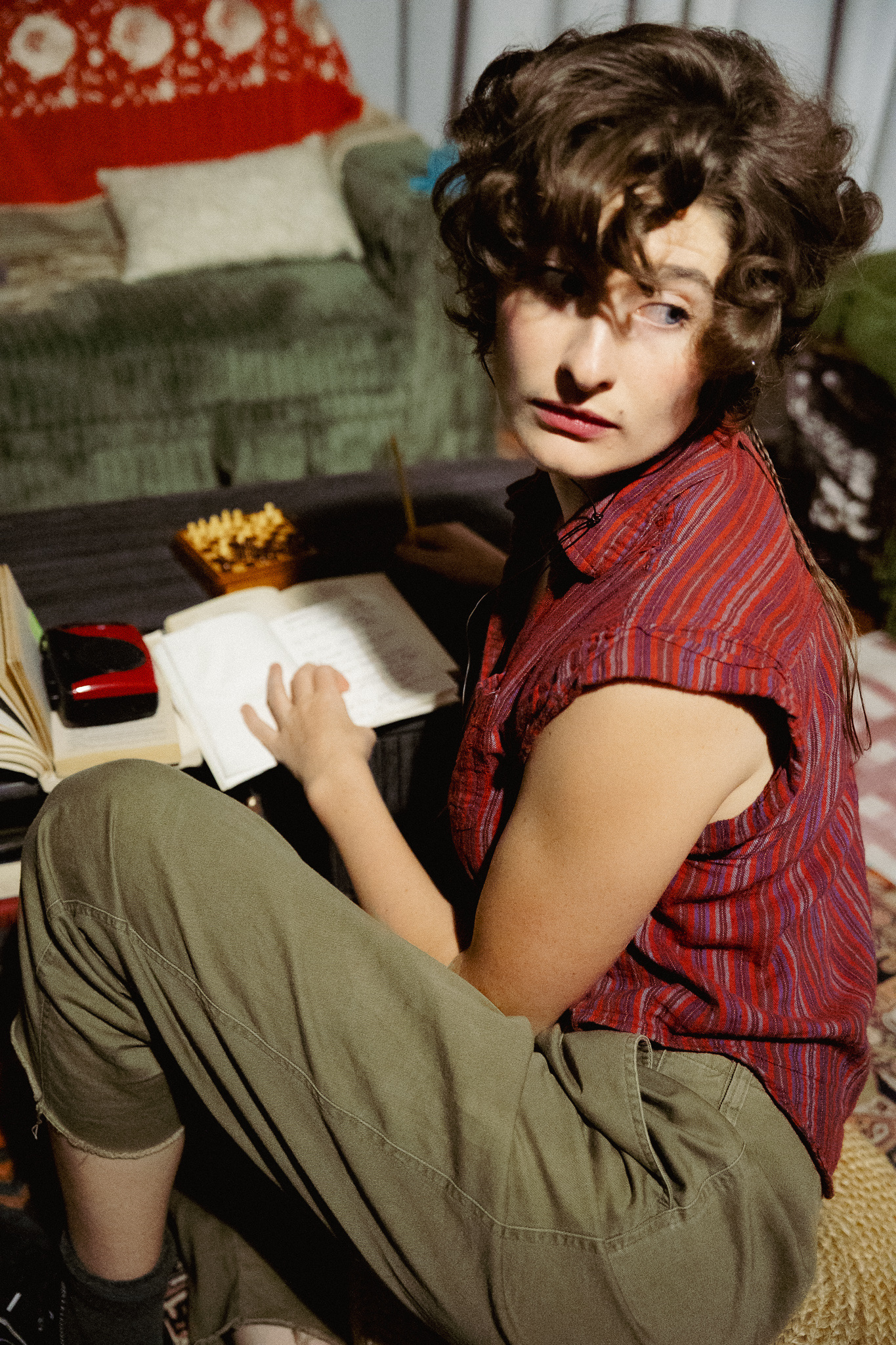
Sam, a poet, is played by Phoebe Lloyd, and Lloyd is the north star of an already stellar production. What Lloyd has is a face that changes every millisecond, and never in the direction you expect. Her eyes are telling one story while her mouth tells another; her mouth is contradicted by her shoulders, which tightens or gives on a different schedule entirely; her neck is contradicted by her hands, which are usually doing something small and private in her lap that has nothing to do with what she is saying.
Watching her is like watching four actors who have each stepped onto stage with incompatible drives, which is exactly what the character demanded. The warmth is rationed, the gestures are precise, and the stage seems to enlarge to hold the sheer amount of traffic going across her.
I want to use the word economy, but economy suggests a performer who does less. Lloyd does more, faster, with finer instruments. You can watch her decide something, undecide it, and feel a third thing about having undecided it, all in the time it takes someone else to finish a line. I'd even dare say that the play is the argument between her face and the rest of her.
Her deadpan is a decoy. When Michael asks if she exercises and she says, "No. I just take very small bites," the line is dry and her face is doing six things. Every part of Lloyd registers the impact of a line separately. Landscapes of ineffable subtext on her face, my notebook says, and for once the notebook undersold it.
Sam has been "on leave" for a year from the textile factory, where she sewed buttons onto uniforms. She is a pacifist, and she says so, flatly, to a soldier in her kitchen, knowing that to say so is treason. Asked when her pouting will end: when the buttons aren't made for soldiers. When there are no soldiers. She keeps her plans for world domination in the drawer next to the hot plate, which is handy, a visitor notes, if they ever need incinerating.
Dramatic Exits
Now the exits, because this is where the production takes a risk that pays off. The dramatic exits — they gave the room the effect of a hermetic seal, as if every exit breaked the airlock on the pressurised chamber. The exits in Bombastia are each an interpretation, a decision about what the person leaving has understood.
Entrances run on preparation; exits run on what the scene did to the person leaving, and D'Arcy stages each one as the moment a character shows what they took from the room. In a room with one door, every exit is a verdict.
"Blood Upon the Risers" is the paratroopers' song, a grisly singalong about a jump that goes wrong; risers are the straps that run from the harness up to the canopy. Risers are also what the audience sits on in a more traditional theatre. The audience had not been sitting on risers that evening, and the play deserves a venue with risers.
Because he people on the risers are the ones who get dropped. The title does to the audience what the recruiter does to Sam: it tells them, kindly and in advance, exactly what is going to happen to them emotionally.
Kitchen Sink, Then Something Else
On the page this is a kitchen-sink drama, a delightful one, and the production keeps the sink. There is a real refrigerator, and it hums. A projector somewhere is blowing hot air and throwing a faint wash of white noise over the room, and beneath every line runs a low, subepidermal bass, a pulse you feel in your fillings before you hear it.
Bailey Trierweiler’s sound design is the thing that made the play, and the genius of it is that I cannot tell you where it stops. Somewhere under the fridge there is a drone that might be a compressor or might be an engine idling on a runway. Every so often something passes overhead, far off, a long low roll that could be a dropship or could be the 7:40 into LaGuardia, and the loft is, after all, a living room in Long Island City under the flight path, so either is believable.
The sound design reads, at once, as an apartment and an airfield, and the strange thing is that it is plausible as either. The war in the script is always offstage; Trierweiler puts it in the walls, and I was unsure whether I was hearing the production or the building.
By the middle of the first scene I gave up on trying to tell them apart, which I think was a part of the storytelling. Sam’s pacifism, her year on the roof, her insistence that the planes are “just reconnaissance,” all of it plays out against a soundtrack that never confirms or denies, and that is exactly the condition the characters live in.
The Soldier at the Tea Set
D'Arcy's instinct about Michael is exactly right: if you want to see what a soldier looks like, don't show him at war. Seat him in front of a coffee table with a tea caddy on his lap. Darion Brown's Michael is tall and coltish and anxious to please, and he cannot stop talking.
Count what he withholds in the first scene, because the play is keeping a ledger: the call sign, the truth about the front, what his mother actually made of him. By the fourth scene the mommy's boy has turned, without any visible gear change, threatening; same height, same smile, and now it is the grin of a wolf. Brown never indicates the switch; he lets it seep in, the way the sound design does.
Between the milk and midnight you realize the man has been on a mission all along, and that the mission was to be seen by this one woman before he dies. Nothing Michael says in the last scene is new information, but he is the one most visibly changed over the course of the play. Brown's performance has a clear before and after, and it is as affecting as the final scenes of Klimov's Come and See (1987).
The Girl from Recruitment
Sarah (Aziza Gharib) sleeps late, records jingles, and works in the Department of Recruitment, and Gharib plays her as the fifties housewife of the home-front picture, the one who keeps the house running while the men are away and keeps her face running the same.
Gharib plays Sarah bright and glib with sinister consistency. She is bright about the battle she can see from downtown and chooses not to watch, and with the exacting composition of a noir film, there is one captivating image of her in the mirror where we see in her eyes that their world hinges on malleable truths. She remains bright, in the play’s most chilling beat, when Sam says Michael is out there and she says, “Who?”
The performance cracks once, for about a second, on “I’m just a little bit tired,” and then closes over like water. Her scenes with Whitney’s Teddy are the state talking to itself. They agree in adjectives, yes-anding like an improv duo building a world. Gharib is funnier than Whitney in these exchanges and more frightening, because she is visibly enjoying herself.
If I have a quarrel with the writing it is that it gives her two humiliations in the last scene and two words to play them with, and Gharib could carry a great deal more. But the two words are enough to tell you what the character has been about: a woman who learned long ago that the safest thing to feel is nothing in particular, and who has gotten very, very good at it.
The Twist
Bombastia is a play that plays with trust. As its title suggests, it is one continuous trust fall that refuses to catch you. I will be careful, because the last stretch deserves to be met cold. But there is one devastating betrayal at the end to the audience trust the play has invested the previous eighty minutes in, and it is so subtle that an inferior production would not have been able to carry it.
It happens in a crisis. Up to that moment Sam has been the stalwart of armchair resistance. What D'Arcy has written, under the kitchen sink, is a play about what literally cannot be said, and the thing that cannot be said is not the war. It is that she was afraid the whole time.
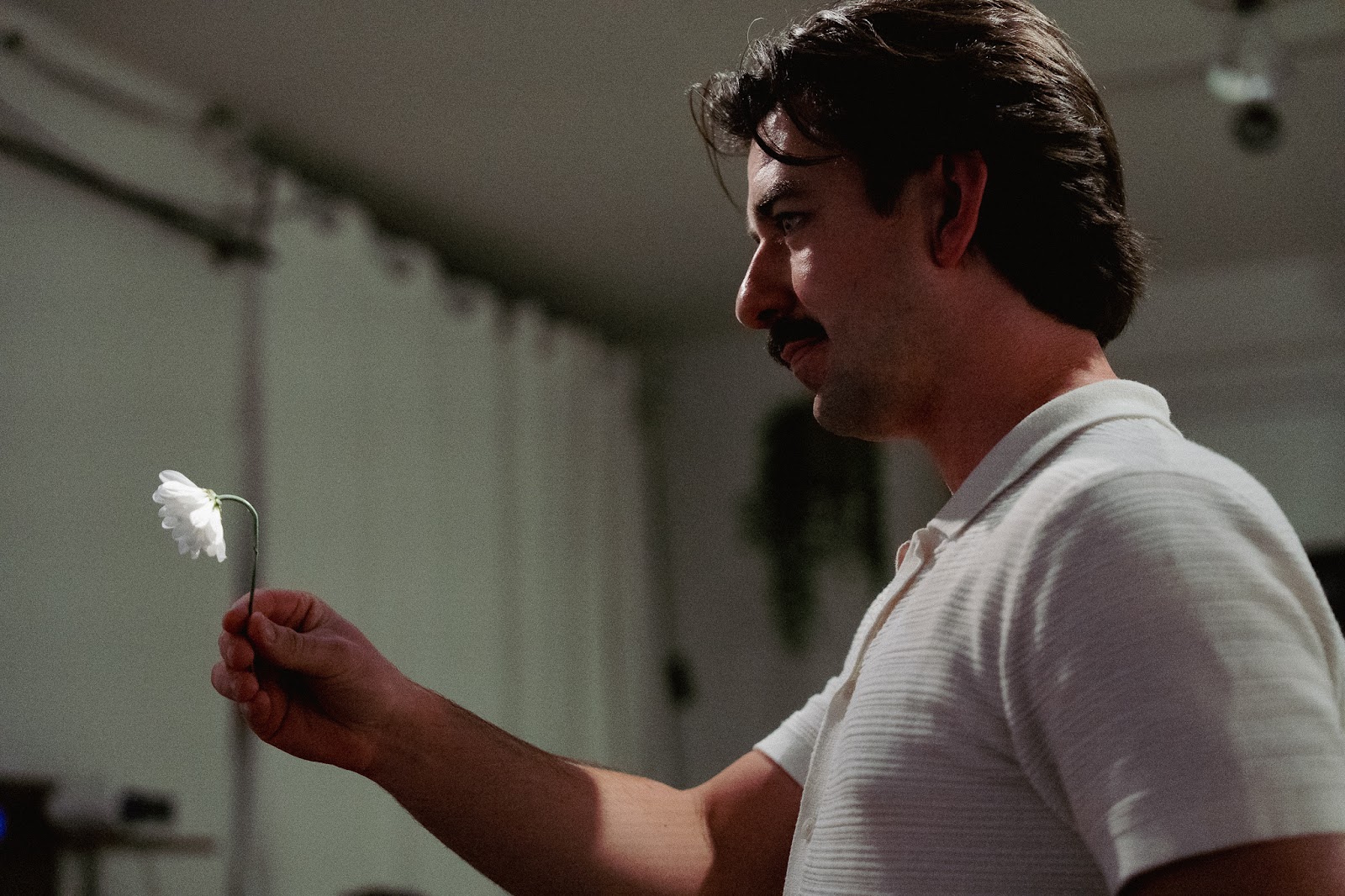
The writer, who on the night I attended was also, apparently, the tech guy, gestures in front of a handheld torch, and am army, a century of marching, is made from one man's hands and a flashlight on a home-style projector setup. It is both the cheapest effect in the show and the most moving. This is a play of long, beautiful people, much like the playwright himself, and here he was, the longest of them, making soldiers out of his fingers.
After
Theatre in New York is in a political mood this November. Clifford Odets's Waiting for Lefty is up at Classic Stage Company. At NYU Skirball this week, Dead Centre's Deaf Republic imagines a town that is exactly like its title. Broadway is full of uniforms. Bombastia is the smallest of these shows and maybe the sneakiest. The other November shows ask the audience to take a position. This only asks whether you'd mind if it finished the milk, in a kind voice, and it's in the intimacy that we get the politics.
I can't tell you why a timeless, almost sci-fi play left me nostalgic for old Hollywood. Maybe it's the retro acting, the clipped, hyperreal military speech, the lighting that makes everyone look like a still from a picture you saw too young to understand. Maybe it's that old movies also believed that one living room, a cast of four and a lot of talk could hold the whole world. The play's feel, its sensitivity, its capacity to hold tension and humor in the same small bite: [and here my notes are indecipherable. Whatever the sentence had been, I agree.]
Reviewed by Aubrey Naur
Théâtre / Theatre
BOMBASTIA (or, Blood Upon the Risers)
Unlikely friends must navigate through a war-torn, near-future New York in this retro-futurist play about retaining one's morality.
In a war-torn, near-future New York, Sam, a young poet, questions the provisional government which has taken over the city. On the precipice, Sam must conform or fight, and all the while the enemy draws nearer.
Écrit et mis en scène par | Written and directed by Luc D'Arcy Interprète | Performer Phoebe Lloyd* (Sam) Interprète | Performer Darion Brown (Michael, the pilot) Interprète | Performer Steele Whitney (Teddy) Interprète | Performer Aziza Gharib* (Sarah, the roommate) Assistant à la mise en scène | Assistant Director Omar Shafiuzzaman Éclairages | Lighting Garett Pembrook Son | Sound Bailey Trierweiler Photos | Photographies Diego Quintanar
Instagram @the.mona.nyc
Langue | Language English Durée | Running time about 80 minutes, no intermission Avis de contenu | Content note Themes of war.
*These actors are appearing courtesy of Actors' Equity Association. Equity-approved showcase.