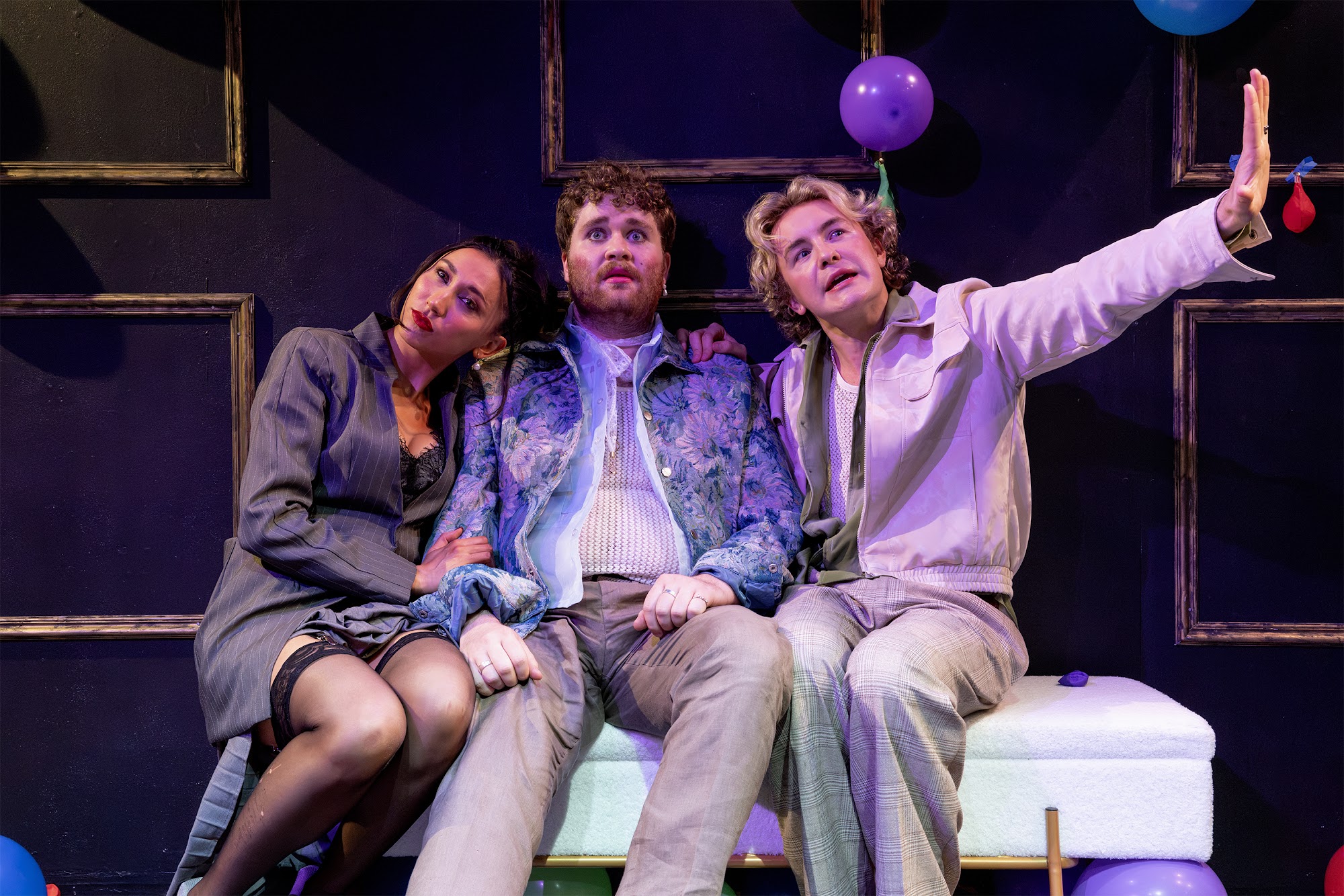
Tartuffe, directed by Phillip James Rouse for RAUS at KXT Broadway, turns Molière's archetypal hypocrite into a tantric wellness guru loose in a house carpeted with balloons. What makes the play comedic is, in part, its lack of a moral centre; you have to choose to root for the Hypocrite or the Murdochian family trust. Is this defrauding, one might ask, or is it unofficial redistribution?
Tartuffe Review: RAUS at KXT Broadway
Tartuffe, directed by Phillip James Rouse for RAUS at KXT Broadway, turns Molière's archetypal hypocrite into a tantric wellness guru loose in a house carpeted with balloons. What makes the play comedic is, in part, its lack of a moral centre; you have to choose to root for the Hypocrite or the Murdochian family trust. Is this defrauding, one might ask, or is it unofficial redistribution?
Reviewed by Faye Tang.
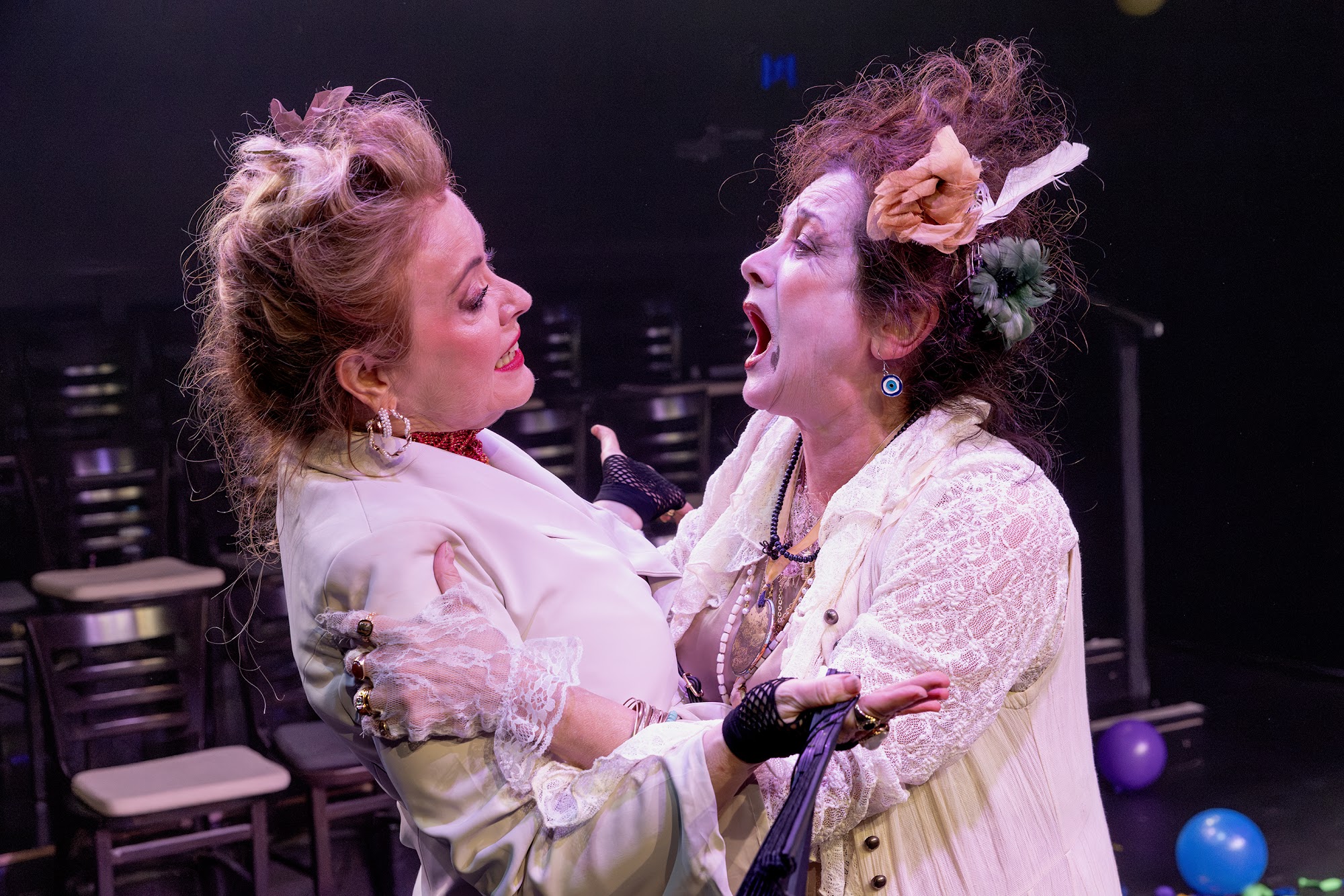
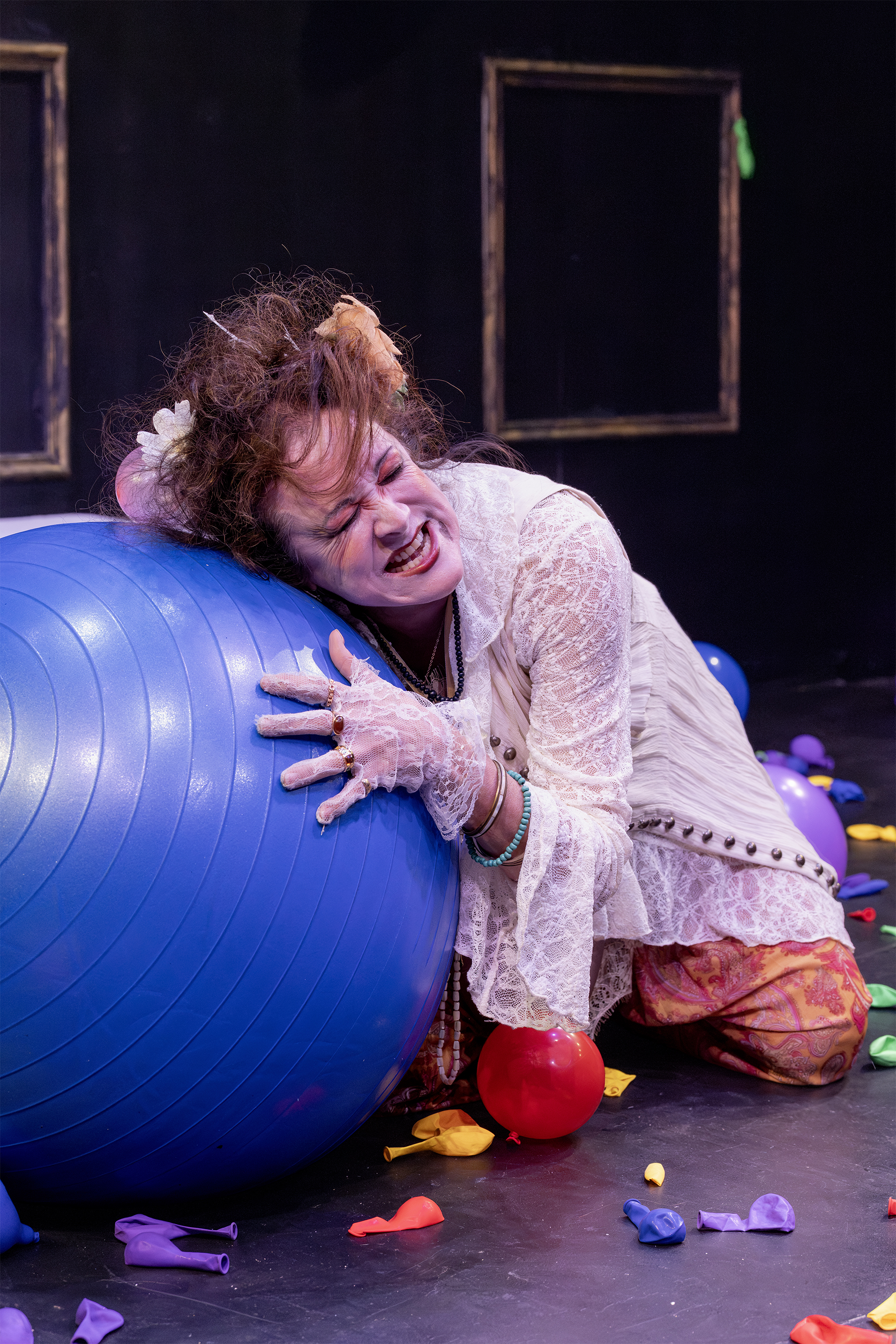
Balloons litter the KXT stage. It's hazardous, like a child's birthday party. Orgonelle (Deborah Galanos), the matriarch of the house, appears, and one could mistake her for the professional clown—her face carefully painted, her body wrapped in lace and feathers, mini balloons adorning her hair, evil eyes glittering in her lobes. But then she begins to wail, and it's immediately clear that she's not in control. Both sides of the KXT theatre watch, discomfited and tentatively bemused, as Orgonelle gasps, cries, pops balloons (suggestively), and calls out for her beloved: Tartuffe, Tartuffe, Tartuffe, and sometimes, "my dear Titi"!
Since its first staging in Molière's Paris of 1664, Tartuffe has earned a hallowed reputation as the archetypical hypocrite. He's that virtue-signalling evangelist you can never catch in an outright lie. Orgonelle—or Orgon, in the original—is his ideal audience, the population that falls for his populism. Throughout the course of the play, Tartuffe wriggles more and more trust (in every sense of the word) from Orgonelle, finally convincing her to bequeath all of her estate unto him, disenfranchising her children, who are good for nothing else than inheritance. What makes the play comedic is, in part, its lack of a moral centre; you have to choose to root for the Hypocrite or the Murdochian family trust.
An anarchical Tartuffe
In recent adaptations, Tartuffe has been played as a Louisianian televangelist, as the Church of England presiding over a Jamaican-Nigerian wedding, as Trump presiding over, well, the obvious. In this production, Phillip James Rouse gives us a more anarchical, though no less exciting, Tartuffe, played by the enigmatic Julian Garner: a tantric wellness guru in a white shirt with buttons tastefully undone, eyes flighty and piercing, toenails varnished with gold, and able to weaponise literally anything to get his way—incompetence, lust, emotional vulnerability, attachment styles, even the spirit of proletarian revolution. Orgonelle, a vulnerable widow, is Tartuffe's perfect victim.
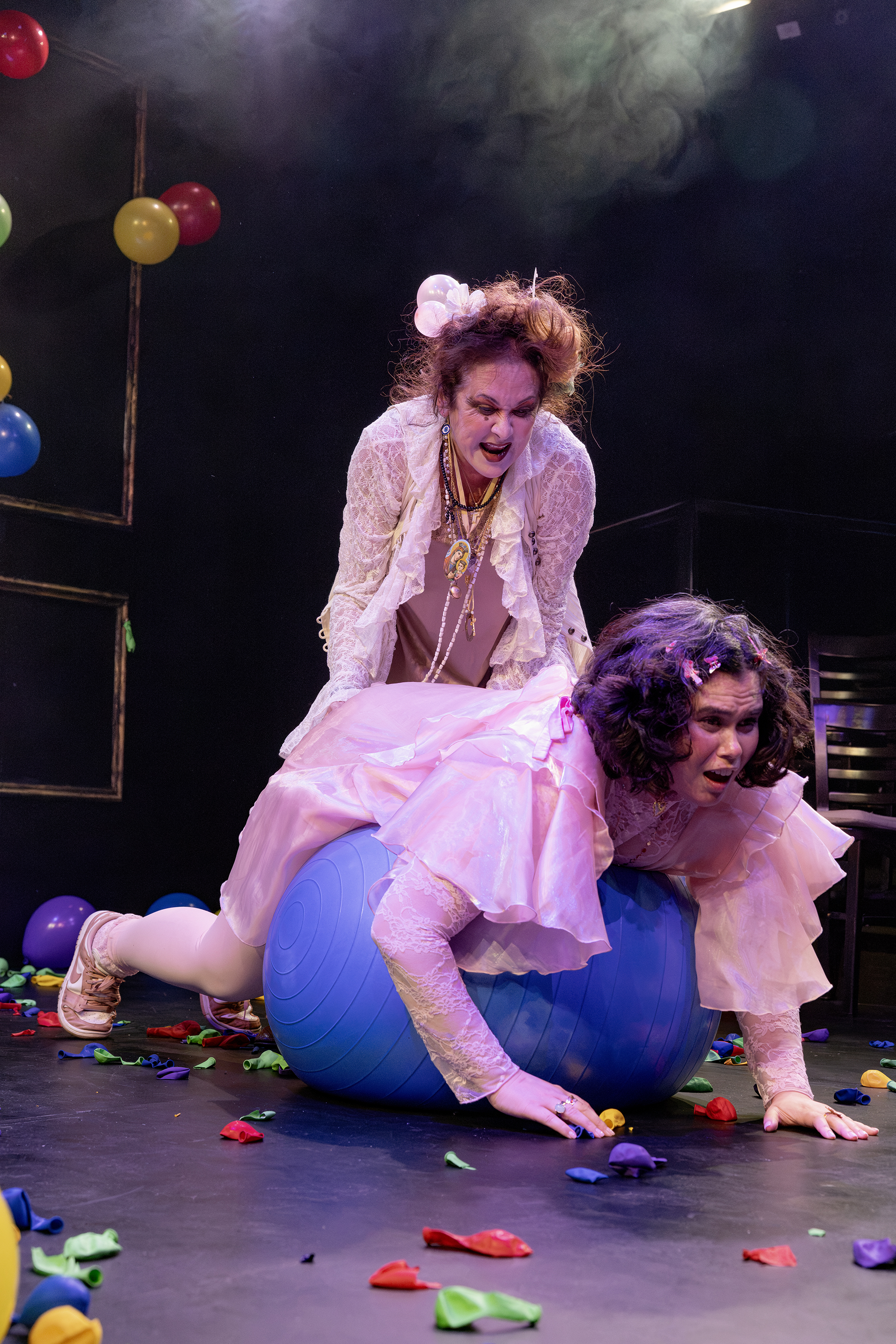
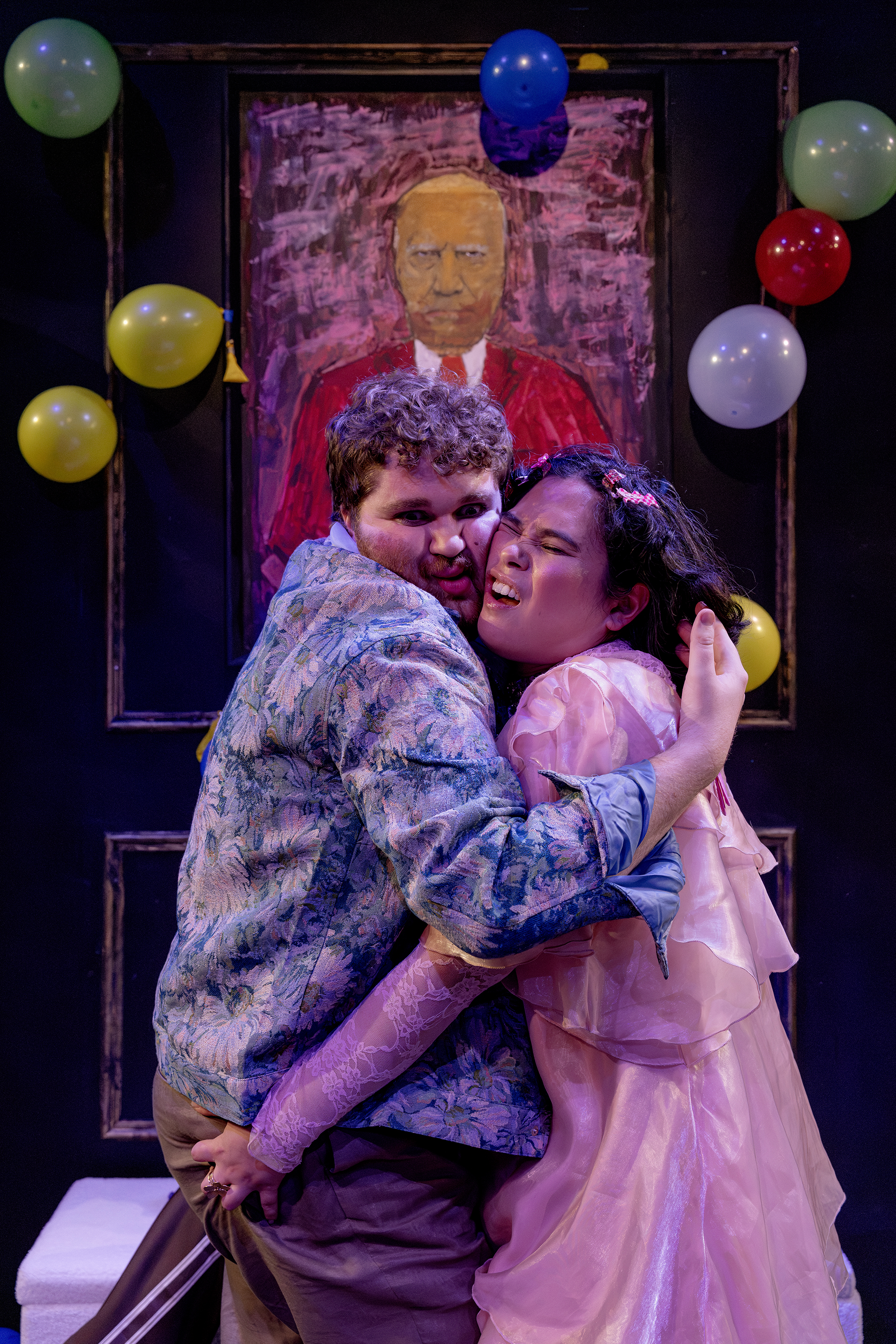
The set is wonderfully attuned to the splitting of Orgonelle's life. The walls are austere, hung with decadent golden frames, the main one containing a portrait of the deceased patriarch. He's dressed slavishly in red, a severe expression on his brow, looking the spitting image of King Charles. The stagefloor, in contrast, is carpeted in balloons. Ostensibly, Tartuffe has excavated Orgonelle's "inner child".
The costumes, designed by Anna Gardiner, are wonderful also. My favourites are Valère (Will Thomas), made up like a Monet painting, sweet and airy and doe-eyed, with little substance of character; and Dorinne (Tamara Lee Bailey), dressed crisply in a grey blazer and pleated skirt, hiked up at the front to show off lingerie-style garters, a costume so badass it provokes Tartuffe to ask, "Why are you dressed like a Victorian-era garter whore?"
It's an interesting question. Why were they dressed like that, so anachronistically? It struck me that the question spoke to the difficulty of adapting Tartuffe, a play about the hypocrisy of 17th century Roman Catholicism, for a mostly secular, 21st century audience. Bare ankles just don't arouse the same outrage they once did. But Rouse and the crew rose valiantly to the task, and not just in costume—they've also rewritten Molière's script in flawless 2026 vernacular, and with clever genderbending choices.
Twist upon twist upon twist
For anybody familiar with the original play, Rouse's production delivers twist upon twist upon twist. In Molière's original, the romance of Valère and Marianne is almost offensively conventional, a steadfast archetype of theatre: young people who are passionately, stupidly in love, despite a woeful inability to communicate.
Rouse riffs on this dynamic in jawdroppingly juicy, unpredictable ways. Firstly, Valère and Marianne are not in love. They don't want to get married.
The entire wedding is a plot hatched by the charismatic, scheming maid Dorinne, and the soon-to-be prodigal son of the house, Damis (sharp-eyed Travis Howard), who happens to be Valère's real lover—yes, it's a lavender marriage for the twenty-first century. Do they know it's legal now? Rouse sidesteps this anachronism with a Casaubon-esque ultimatum: Valère's father has dictated, in his will, that Valère must be married to a woman in order to inherit his family estate.
The gender politics in this arrangement are delicately explored. Why is it that Marianne must sign away her love life for her brother's sake, for money's sake? Has anything actually changed, in the past few centuries, for coddled, isolated, housebound women?
But I have promised a twist upon a twist. The relationship between Marianne and Valère is not what it seems. In a hysterical scene, the lavender marriage turns into a love pretzel. "Valère is MINE!" Marianne (lovable and suitably annoying, played by Dominique Purdue) yells, and then it dawns upon us: Marianne has been in love with Valère all along! The wedding is so hard to pull off not because she has to pretend to be in love with her brother's lover, but because she was harbouring a dirty, illicit, secret: heterosexuality.
This pitch-perfect scene stuns all—viper-tongued Dorinne; wine aunt Elmire (played magnetically by Lucy Miller); me; and the entire row of audience members on the other side of KXT Broadway, hands clapped to their mouths in delight and disbelief.
"This is a corrupt, corrupt family…"
Defraudsters seem to be in the cultural zeitgeist. 2025 blockbuster Saltburn comes to mind—another dramatic thriller about an ordinary social climber speedrunning the demise of an aristocratic family, parasiting the parasites. I can't help but read class relations into this trope. It's easy to feel close and sympathetic to the aristocratic family in decline, especially when they're stuck in farcically doomed situations. But if they're totally out of touch, living in gilded mansions or hopping five-star hotel lobbies, worlds away from the average indie theatremaker/goer, how much do they deserve our sympathy?
In that vein, Rouse's Tartuffe spirals towards an uneasy denouement. Should I cheer as the police, in cahoots with the Judge (Annie Byron), march in and drag "Titi"—male manipulator turned Oedipal manchild—now crying for his "mummy"—off the stage on his backside? On the one hand, it's narratively satisfying; cathartic, even, to watch this slimy villain get outsmarted by the women around him. On the other hand, there's something deeply unsettling about seeing all arms of the Establishment (law enforcement, judiciary, and the billionaire class—all played, notably, by the same few actors) knock noggins to ensure that the Money stays safely within their tightly wound, incestuous circles.
"Is this defrauding, one might ask, or is it unofficial redistribution?"
It's almost enough to make one sympathetic towards poor Titi, for trying his darndest to effect the abolition of an old-money family. As the rich start developing flying cars, and the inklings of class consciousness are nowhere to be seen, one increasingly wonders whether we should start valorising those who hoodwink the rich—whether that's Tartuffe, or Anna Delvey, or Elizabeth Holmes.
Whatever your verdict is on redistributionary white-collar crime, the way RAUS revamps this classic is impressive, teasing urgent questions out of the original play and weaving them together in a raucous, outrageous, carnivalesque show. Did you just watch the good guys defeat the bad, or a masterclass in manipulation? Like any truly memorable production, the choice of interpretation rests with you.
Tartuffe — directed by Phillip James Rouse for RAUS, with costume design by Anna Gardiner. KXT Broadway, seen 10 October 2026.
Orgonelle: Deborah Galanos Tartuffe: Julian Garner Valère: Will Thomas Dorinne: Tamara Lee Bailey Damis: Travis Howard Marianne: Dominique Purdue Elmire: Lucy Miller The Judge: Annie Byron Director: Phillip James Rouse Costume Design: Anna Gardiner