

Four Top Review — Kyle Beechey at Casino 2026
Aubrey Wang reviews Four Top by Kyle Beechey at Casino, Lower East Side, 2026 — a dinner-table comedy of manners that seats you close enough to be cucked from the bucatini.
Aubrey Wang reviews Four Top by Kyle Beechey at Casino, Lower East Side, 2026 — a dinner-table comedy of manners that seats you close enough to be cucked from the bucatini.

Kyle Beechey’s Four Top, presented by Farmhands Productions at Casino on the Lower East Side, is a comedy of manners served over a tantalizing real meal — a fast forty minutes of status probes, sex-work confessions, a misread group text, and real food.

"Look," I had said, as we stepped through the door, "they have adobo walls."
I know they are Pueblo Revival adobe, done in the Southwestern manner, faintly pink in a faintly pink-lit room. I am a "working critic". I am pretending to write in my notebook. At the door, someone hands us sourdough pretzels from a cardboard box stamped ELBOW, in black block capitals. A ransom note from a bakery.
Casino runs on a certain municipal pedigree. It is a restaurant where two ex-food-editors, four art handlers and a man "between things" could plausibly pre-game before heading two doors down to Reign. It is closing night, and the bartenders are talking about the repeat audience.
The ensemble, my notebook says, has the same phenotype as the restaurant. My notebook also records the venue as "Balthazar for swingers". I would be right on both counts.
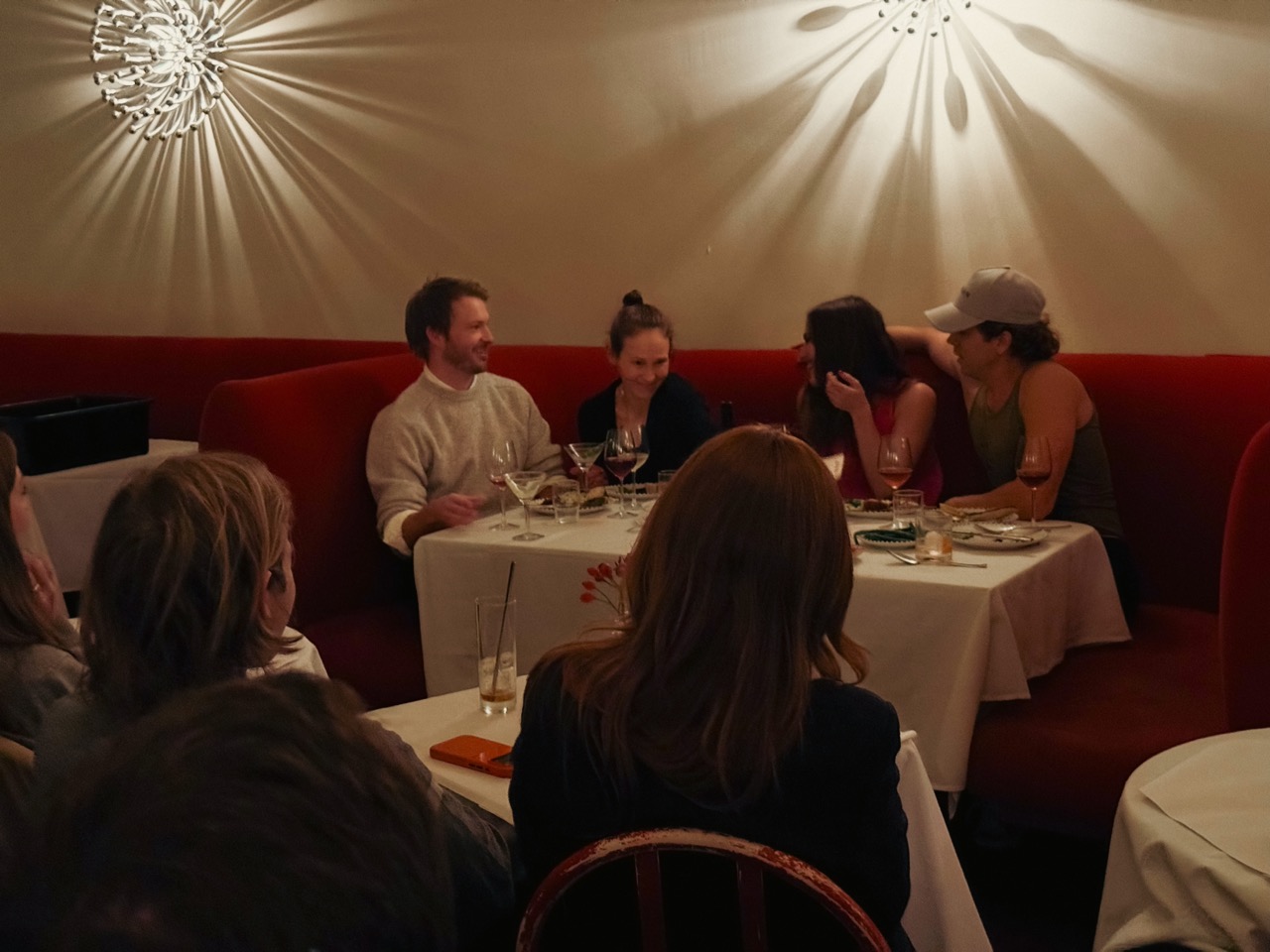
Four Top, presented by Farmhands Productions and co-created with and performed by Beechey, Claire Banse, Michael Seater, Brady Lernihan, and Cade Halvorson, stages a double date at an actual, functioning downtown restaurant. The cast sits in a curved red velvet banquette that bends like a lipsticked mouth, under wire starburst sconces on cream plaster that throw their gold rays across the wall like a Sputnik caught mid-detonation. Flying-saucer pendants hang overhead. White tablecloths. Stemware catches the light.
This is not site-specific theatre. This is site-specific dining with a side of theatre. It is also, frankly, a mild sexual humiliation. Tantalus, we are told, stood forever in water that receded from his lips, beneath fruit that drew back when he reached. The audience is seated in rows but at the perimeter of the table itself, so close you can smell the garlic rising off someone else's clams. You are so near the action that you are, functionally, a fifth wheel at the double date.
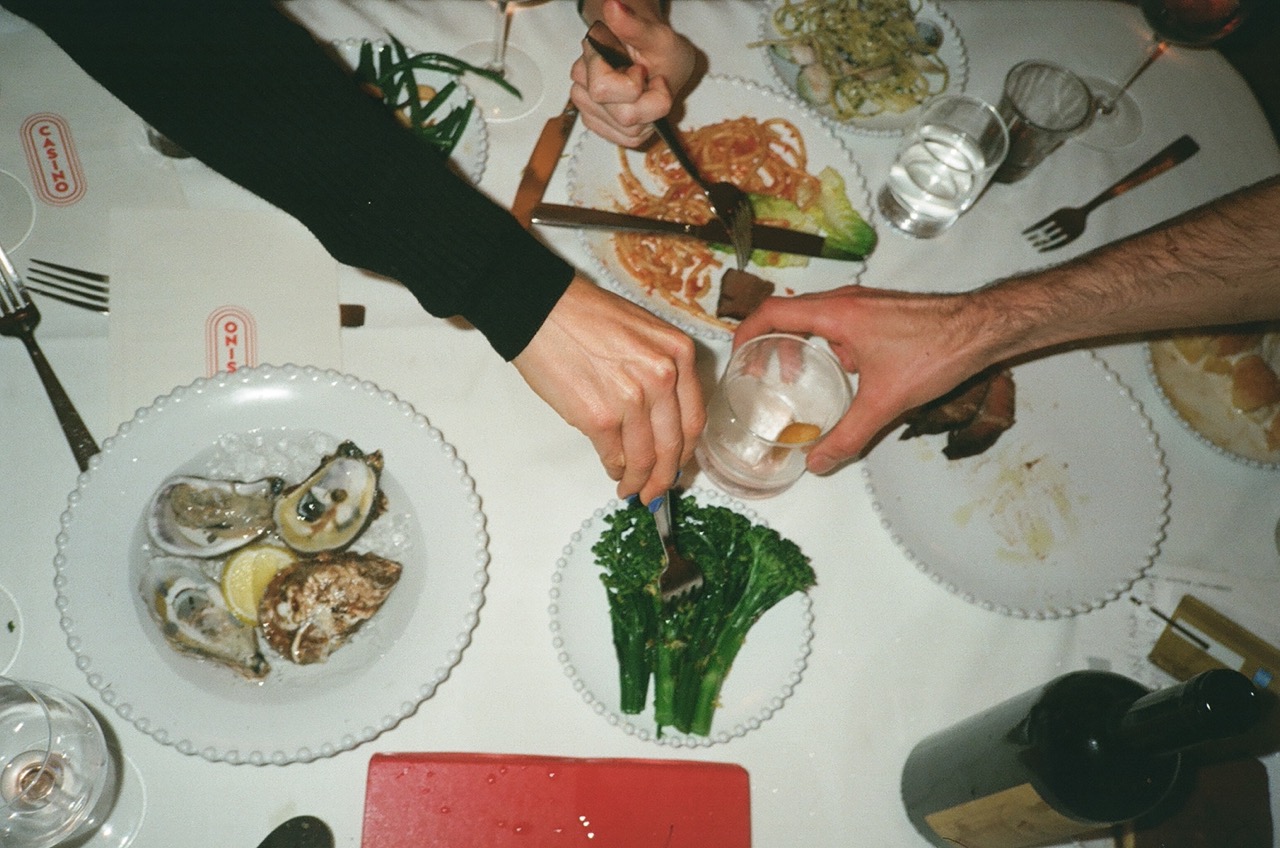
Four at a top: two couples, and a four-sided battlefield on which alliances can re-form at any beat along couple lines, gender lines or education lines, and declare war. This is Yasmina Reza's God of Carnage in a Polanski frame, but drained of the original's bourgeois restraint and reinflated with downtown oversharing—a BBC Radio adaptation of Jane Austen starring Benedict Cumberbatch, except the drawing-room decorum has been stripped out and replaced with natural wine, shared appetizers, and the pervasive generational awkwardness that, in any normal restaurant, the clatter and the lighting are designed to mask. Whereas Reza's couples want something from each other from the first line, Beechey's spend their first half, as far as we can tell, wanting nothing except to posture.
A banquette is a couch designed for looking and being looked at. It's a talk-show couch. The couples talk to each other in half-turns while serving full face. A double date is a performance for an audience it pretends isn't there.
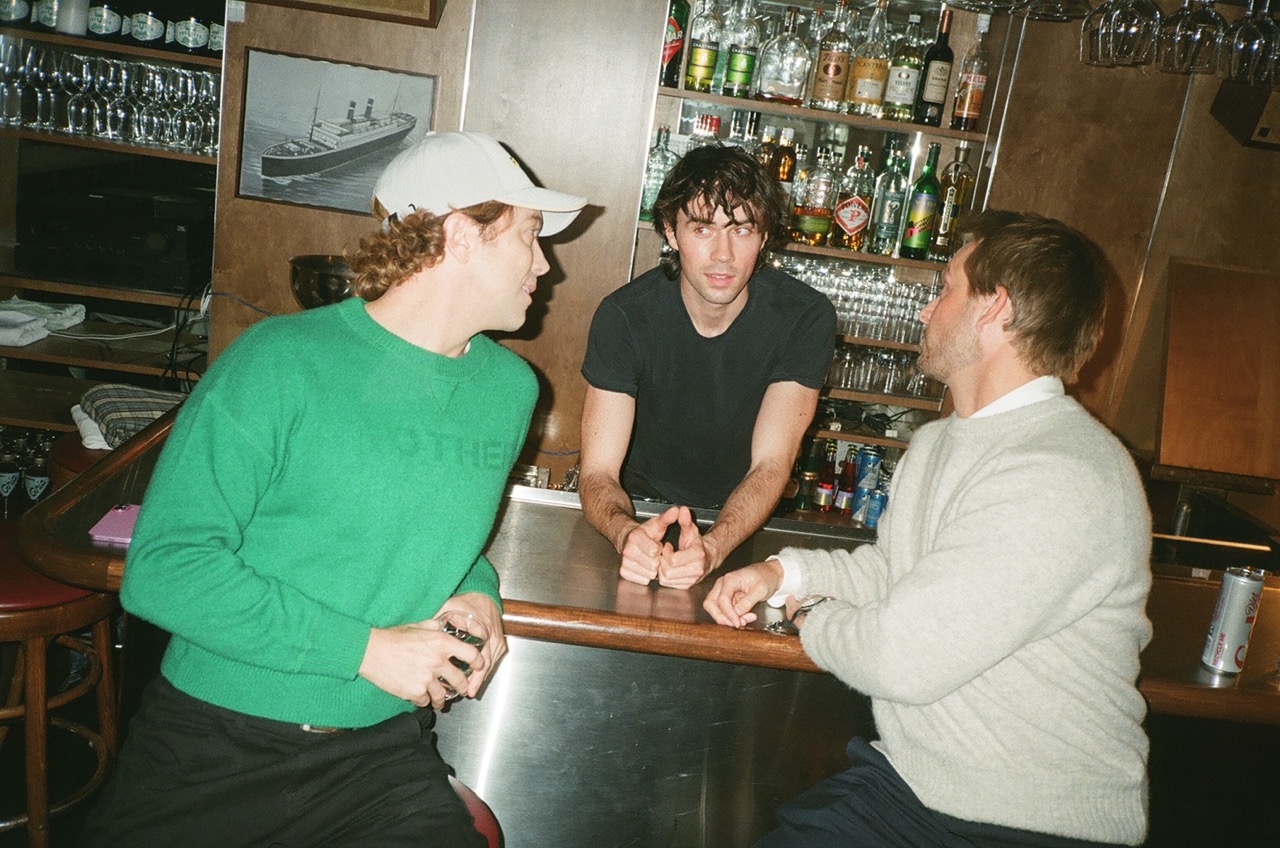
Under the clatter Beechey is writing a comedy of manners, and I want to insist on manners. Pedigree is traded Age of Innocence-style with Rice against NYU ("wouldn't have hurt"), a PhD against "a BA? A DBA? Fuck if I remember." Geography is personality: Bay Ridge versus "Brooklyn with the good parts" versus a Manhattan purist who refuses the East River because she needs the street-corner electricity of not knowing whether the man on the corner is going to fight her or fuck her. ("Which is what we wanted for our daughter," her husband clarifies, pivoting to the two-bedroom.)
"Who's your bartender?" a character asks about the venue's own mixologist. "This guy named Dave." "Jake who? Like, what's his problem?" "I mean, like, ethnically or what?"
A laugh skitters through the room, stops, and restarts at a different pitch, because Casino is two doors down from Reign, and the laugh at "ethnically," has every statistical likelihood of overlapping, by Venn diagram, with the downtown race-science set.
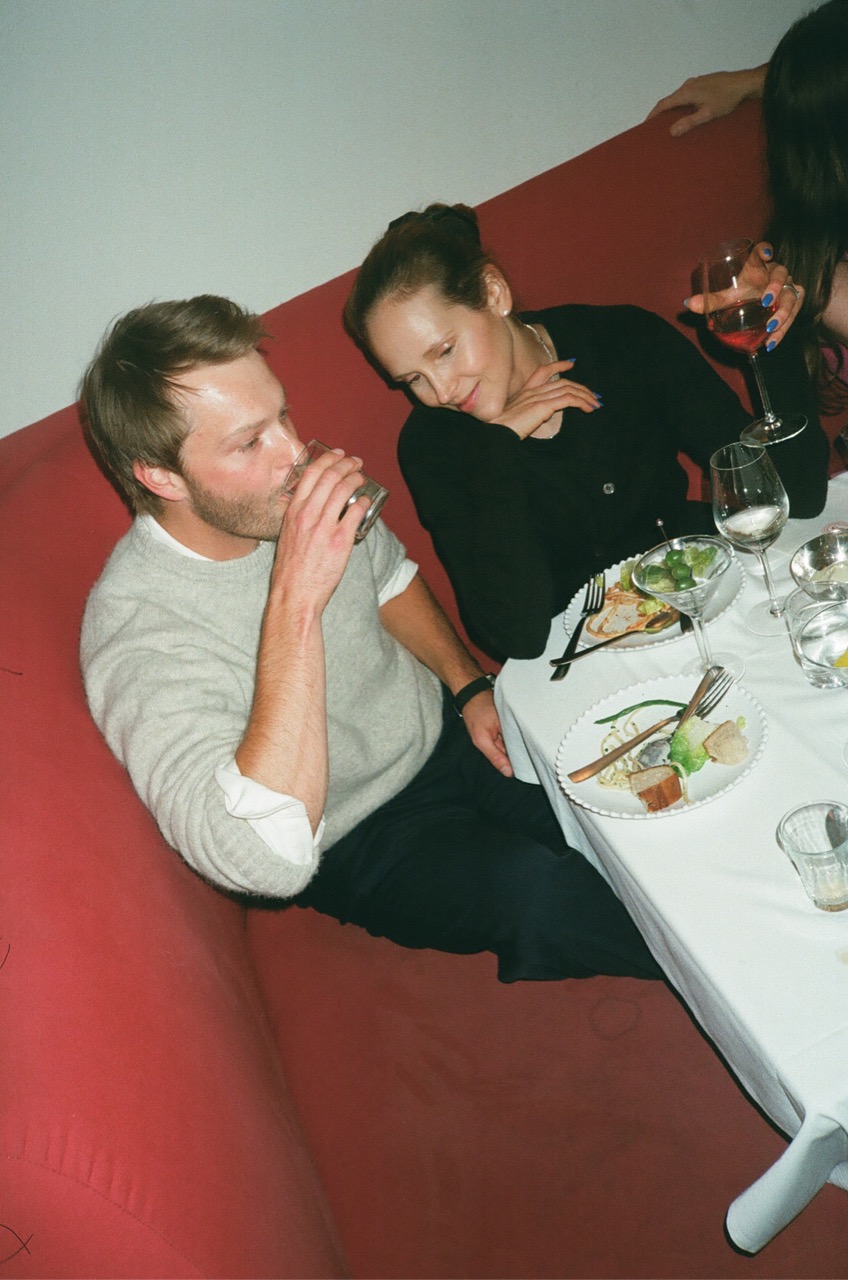
The people, briefly. Beechey, whose Instagram display name is simply "girl kyle," plays a publicist who has just opened her own firm and has two places opening tonight, one of them a Thai restaurant whose investor "fell in love with it on holiday and wanted to bring it back, so he did." She wears an Eartheater-style snatched ponytail and, like the singer, has the pale Mayflower glow of a woman so Protestant she might be either a dominatrix or allergic to sex.
Lernihan plays her husband, who owns six restaurants, "should be seven," and really shouldn't be off duty; he lounges in a slate-grey sweater with the loose, undershot charisma of a gas-station Tom Hiddleston.
Beechey and Lernihan play a marriage that has already had every conversation. If the goal was verisimilitude, verisimilitude delivered. I was confident that the characters would fold each other into a.gentle beige future with a Le Creuset dutch oven in matte sage. Together they read either as the Southern Gothic couple in their twenties or as the kinkiest people south of Houston Street.
Beechey's wit is a serrated bread knife; the hosts' own verdict on the place, "reliably serviceable, if not a bit boring," gets recycled later for Brooklyn. The dialogue is a lattice of status probes. Barnard and the Amtrak from Jersey as quoted as the units of social currency.
Moments later. The dinner has unraveled over one word in a group text: were the two couples "curious," as in intellectually open, or "curious," as in available?
The restaurateur played by Michael Seater turns to the couple his wife's friend has set them up with and says, "You said blind date. Now it's like, oh, how's the bucatini, you wanna fuck my wife?"
The guests, an art historian (Banse) and her husband (Brady Lernihan), who have just moved to the city, thought the hosts were open. The hosts, a restaurant publicist (Kyle Beechey) and the restaurateur, had called it a "blind date" as a joke. "You said blind date," the art historian insists.
The art historian's confessions, matter-of-fact, between bites, of a background in sex work, a pregnancy after four or five dates, a client who fell in love and followed her home, a donor arrangement with a former best friend that collapsed: all of that had been an overture, to swinging, which never happens. "Love skipping the small talk and cutting through the fat," she says. "It's how meaningful relationships are built."
That's the subtext and it was the first thing that was served. Like the branzino (the fish, not the wine) it was a dish that these two classes of couples were constitutionally incapable of sharing. Four Top is a character study of white-on-white violence.
Cade Halvorson plays the busboy, who has the perennially molested look of a Gregg Araki protagonist: greasy hair, faint rosacea, the exact blend of sweetness and resignation that suggests a BFA in TouchDesigner and a lease above a tattoo parlor.
Four Top is a play of iteration and the busboy's entrances are its chapter breaks. They do the same job the restaurateur's phone does when it buzzes with a kitchen fire seconds after the art historian has finished disclosing the sex work: they relieve the table of having to do anything with what was just said.
Service, in this play, is the machinery that interrupts consequence. Every entrance of his is an exit for the characters, a way out of the impact they have just had on each other.
"I wanted to see the play where they hit on the busboy instead," my notebook confesses. "I wish there was a play just about sexually harassing service workers." In this production; the busboy character is the most watchable, the most grounded, the most erotically legible; it was as if the very industry of hospitality was invented only to keep that fact tasteful. Halvorson is wonderful, existing helplessly at the right angle to every disaster.
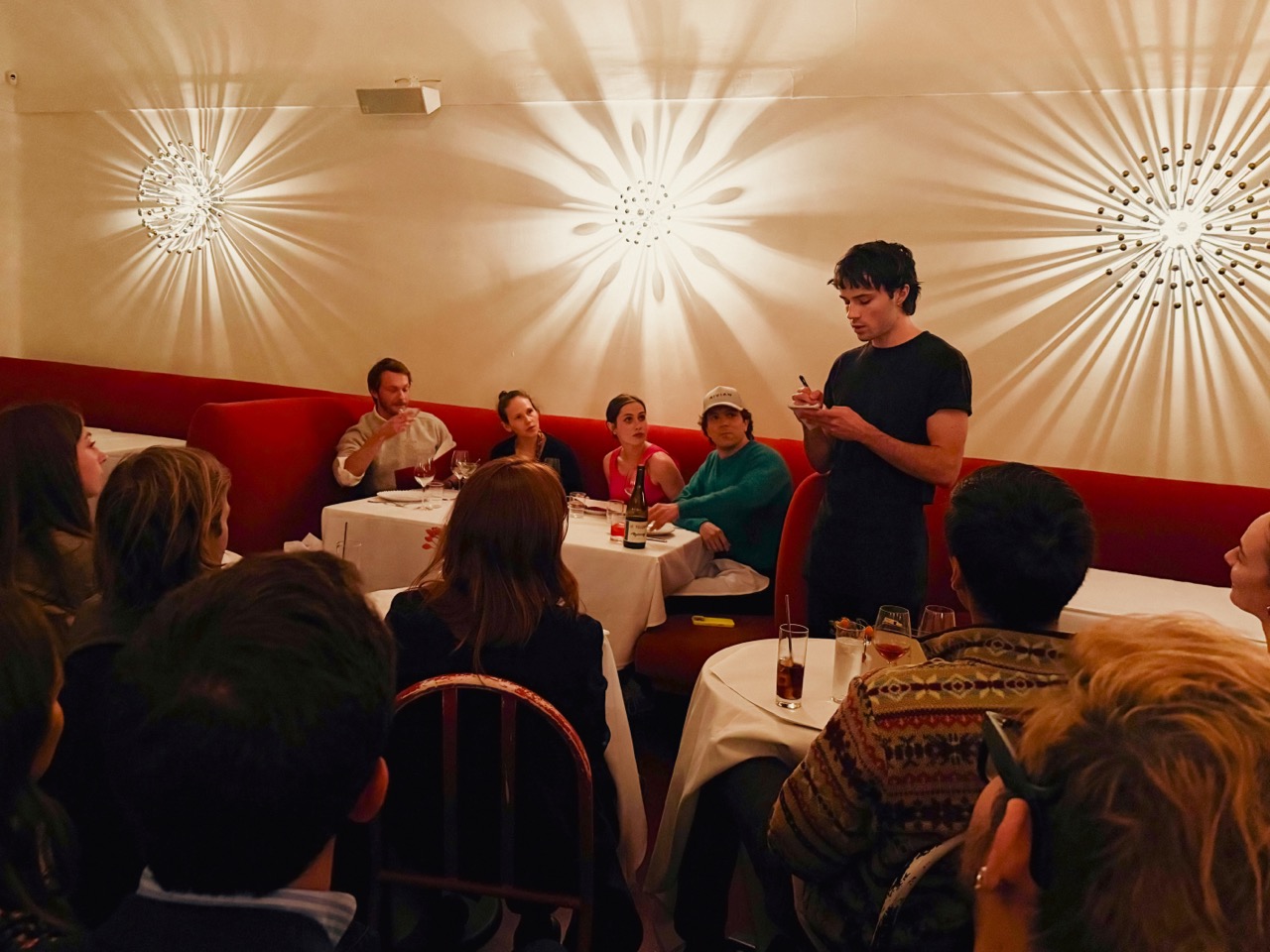
My favourite part was the mukbang. Food is the formal breakthrough of Four Top. Eating on stage is a performance of vulnerability that bypasses gentility, because it's analog to sex, which the characters were not having. The dinner was as close as we got to theatre — and the humiliation of watching dinner time happen while engaged in another, parallel ritual called theatre (which, unlike a cabaret, does not come with table service) had its own weird perverse texture. I could not tell if I was into it or not.
Points for real food. Real food gives these actors a continuous supply of involuntary behavior. The script came alive with the food. Once the actors are visibly telling the truth about dinner, every lie the characters tell about themselves reads as a lie. Four Top pairs dishonesty with the undeniable and this was a pairing that ate.
I had assumed the show was written by a gay man, because the sensibility, the restaurant omniscience, the knowing cruelty, the eye for publicist types, read to me as pure gay-guy taxonomy. Beechey, whose avatar is "girl kyle," is actually just a girl named Kyle.
Class mobility is now the white-woman-to-gay-guy pipeline, and Beechey, who has written about food for Condé Nast Traveler, Vogue and Resy for a decade, is its most elegant case study. Like a fine icked people who already carry the history in their bodies, .
The engine is farce. Nobody here is ever forced, by the pressure of what they want from the person beside them, to say what they mean; the stakes never climb that high, because a reservation is a weak obstacle and manners are a strong one. As the plates go, one of the women says of the other couple, "You guys are a good hang." In twenty-first-century Manhattan that is both the mildest possible indictment and the highest possible praise.
That is probably true to the milieu, and truth to the milieu is what the play is after. But the room has spent fourty-five minutes, the length of a fast, unhinged, two-cocktail meal, watching four people eat well at close range while being sold only drinks. The confessions are baroque and plausible. But once, just once, I would have really liked somebody at that table to take the wig off.
Reviewed by Aubrey Naur
Playwright | Playwright Kyle Beechey
Distribution | Cast Kyle Beechey, Claire Banse, Michael Seater, Brady Lernihan, Cade Halvorson
Production | Production Farmhands Productions
Photos | Photographies Kyle Beechey
Langue | Language English
Durée | Running time approximately 45 minutes
Âge | Age 16+
Contenu | Content sexual themes, substance and alcohol use, strong language
Venue Casino
Lower East Side, New York


