Distortion Review — Sebastian Gray at Actor's Pulse Playhouse, Sydney Fringe 2026
In Sebastian Gray's Distortion at the Actor's Pulse Playhouse for Sydney Fringe 2026, a horror‑thriller about looksmaxxing and internet beauty standards strands its audience alongside an OnlyFans model recovering from a concussion in the room of a lone tech‑tinkerer. Jack Mitchell finds a play that rewards leaning in — where set, sound, and Gray's twitchy performance keep multiple kinds of distortion in the air.
Distortion Review — Lean In at Your Own Risk
Sebastian Gray's horror‑thriller traps its audience in a room with a very online man.
In Sebastian Gray's Distortion at the Actor's Pulse Playhouse for Sydney Fringe 2026, a horror‑thriller about looksmaxxing and internet beauty standards strands its audience alongside an OnlyFans model recovering from a concussion in the room of a lone tech‑tinkerer. Jack Mitchell finds a play that rewards leaning in — where set, sound, and Gray's twitchy performance keep multiple kinds of distortion in the air.
Reviewed by Jack Mitchell.
In Distortion, Sebastian Gray's horror‑thriller play about looksmaxxing and internet beauty standards, there is a moment when the character Mia (Candice Mejias) finds a mysterious black box inside a refrigerator. It belongs to Max (played by Gray), the lone inhabitant of the house, and as she places the box downstage to remove the lid, the whole audience in the Actor's Pulse Playhouse had to lean in to see what was being revealed.
Distortion asks its audience to lean in regularly. Why is Mia, one of the top OnlyFans models in the world, being nursed back to health by Max, a library assistant who lives alone in the holiday town of Halcyon Bay? What is in the black box? And crucially, what is outside of the box, or room, in which we find ourselves? The only notions we have of the outside world are the sounds of a raging storm, and the voice of Foz (an artificial intelligence designed by Max to help manage his timetable). Like Mia, the audience is stuck in Max's room, with only his explanation of the dangers outside to satisfy their curiosity.
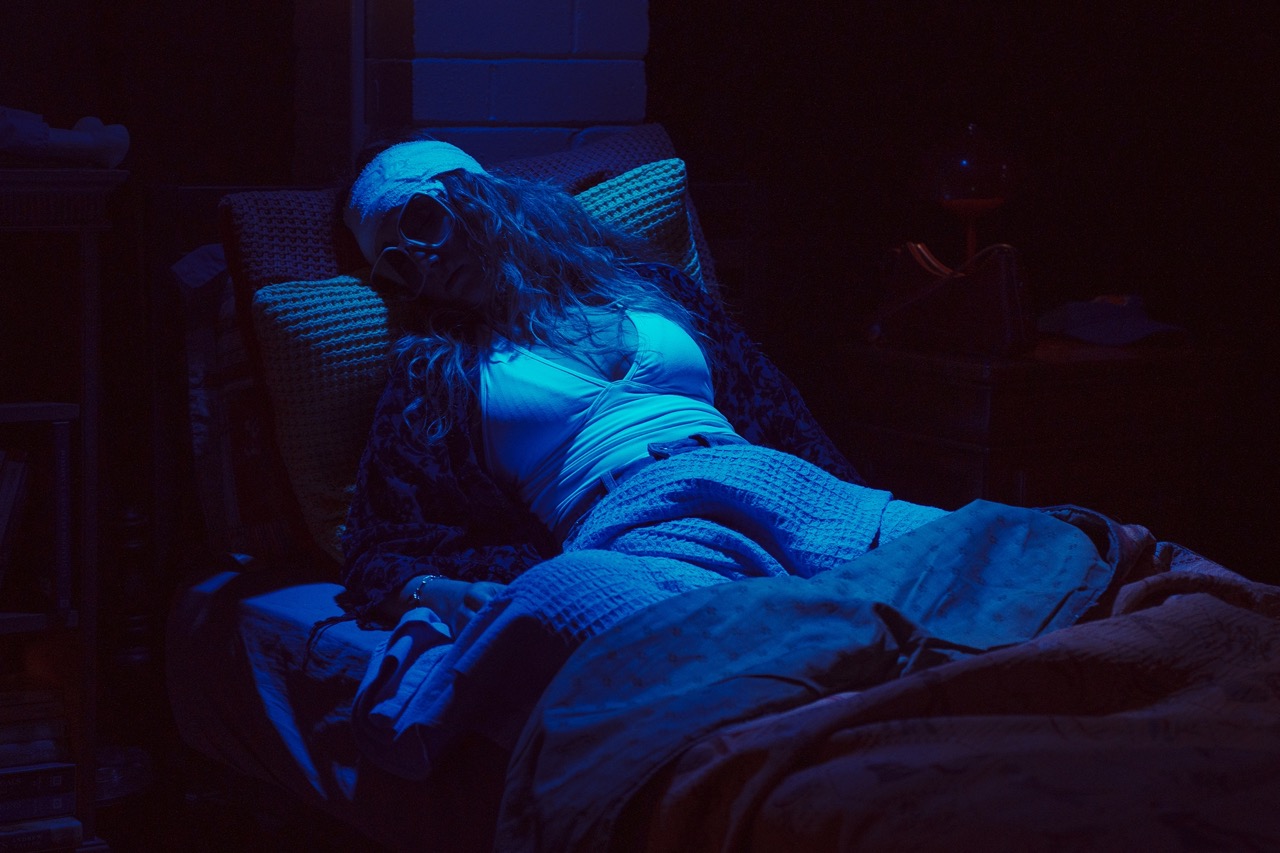
Candice Mejias in Distortion. Photographer: Chloe Callow
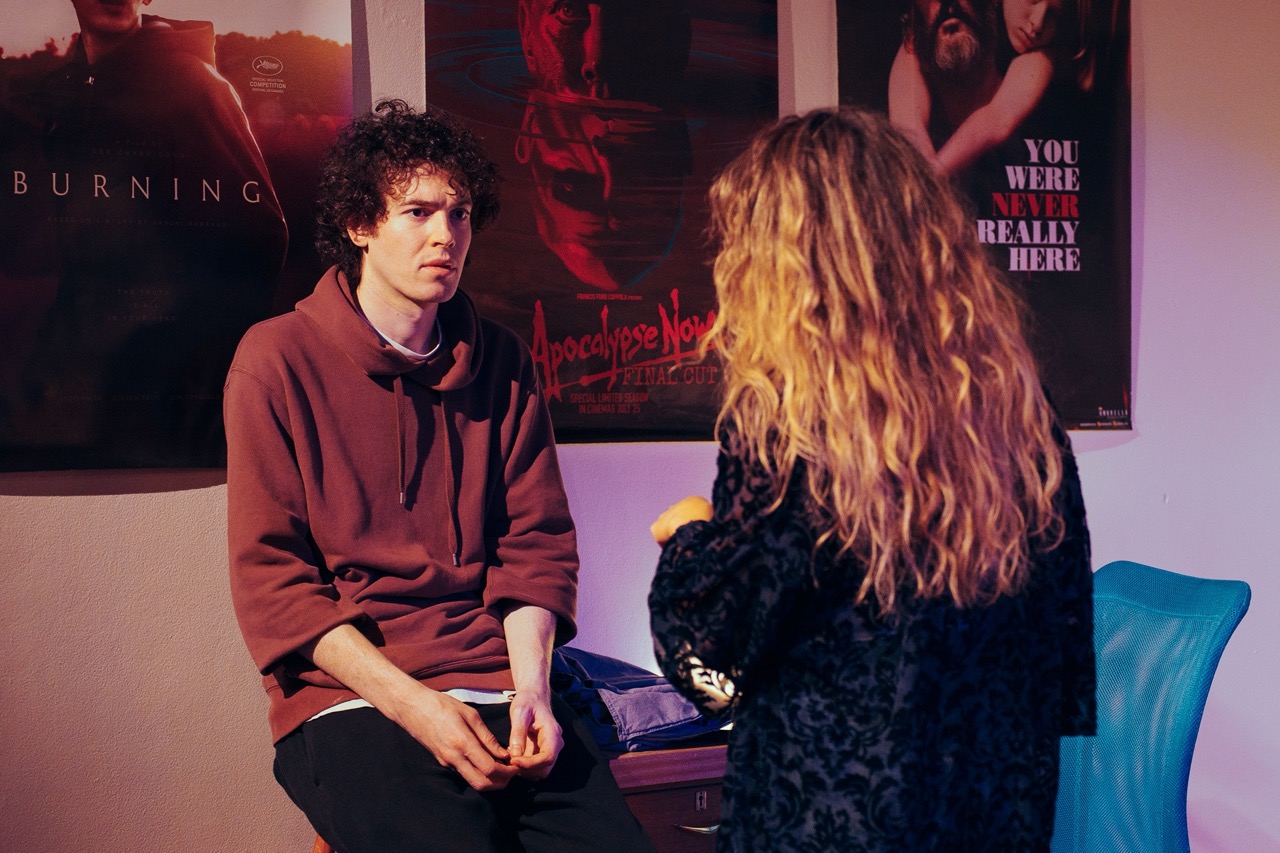
Gray's play might ring bells for audiences familiar with Alex Garland's film Ex Machina (2014). In both the play and the film, there is a male tech‑innovator, a female artificial intelligence, action that is restricted to one house, and a memorable dance sequence. Though Max doesn't have a poster of Ex Machina on his wall, he does have posters of 2001, Robocop, and Parasite, as well as vinyl (Pavement's Crooked Rain) and a full bookshelf (A Little Life, The Secret History, The Bible), all giving us hints to the owner's cultural milieu. Set design is credited to the Distortion team and establishes a detailed world that curious audience members around me were discussing before the lights went down. A doll, a vintage lamp shade, and a small clown on the set also situated the work within the horror genre from the outset.
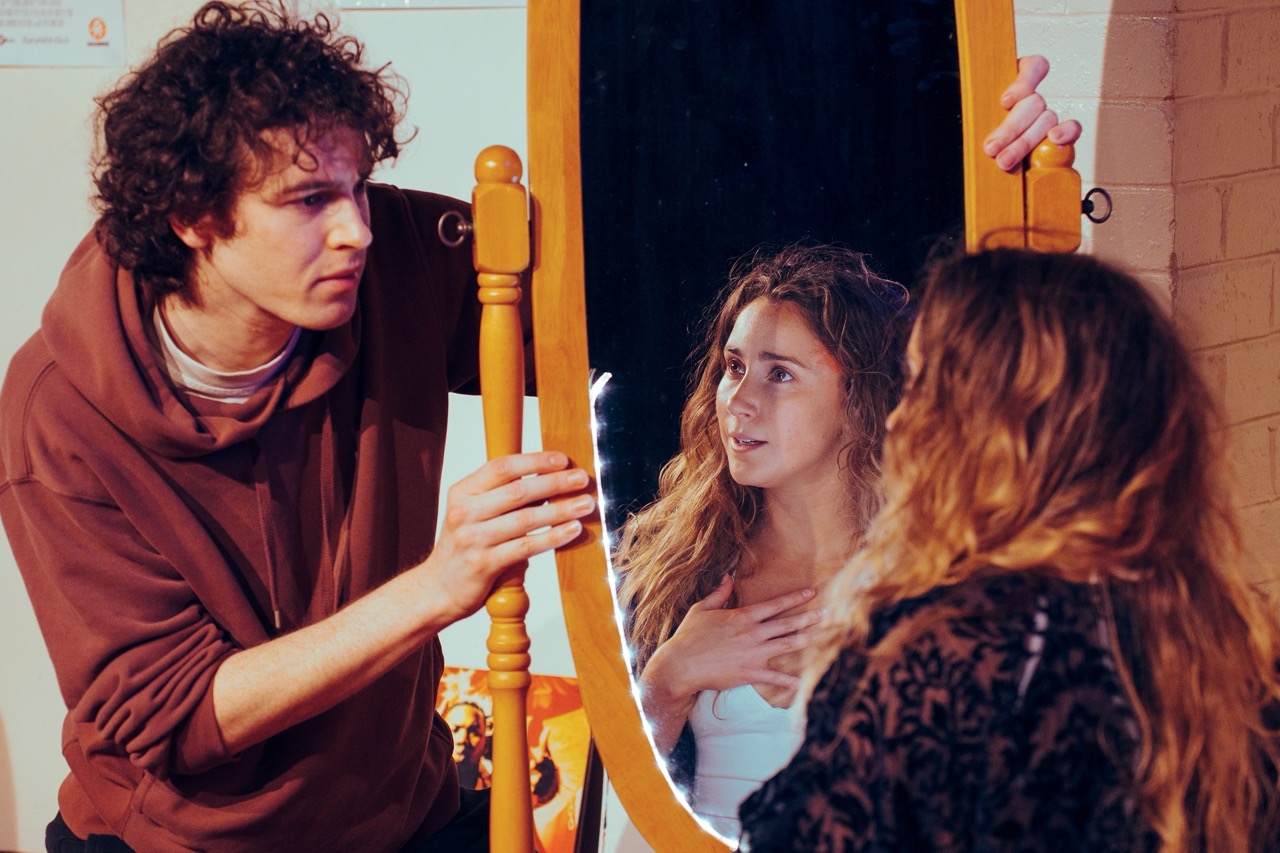
Sebastian Gray and Candice Mejias in Distortion. Photo: Chloe Mallow
Director Chloe Callow's handling of the play's dramatic tension became more convincing as the narrative progressed. The tense opening moments feature Mia waking up after a concussion to discover that she is being kept in Max's room. Callow's direction kept the pace quick but could've done more to convey Mia's trepidation at the hands of a stranger. The time it took for her to feel comfortable with Max felt rushed. However, Callow's handling of the narrative tension after this gradually tightened its grip, with the cramped audience's attention tightening too. A line from Mia that described herself as 'more innocent' than other online creators elicited a solitary guffaw from an audience member; the rest of us were too tense to emit a noise.
There were some well‑timed outbursts from Max that raised the volume and stopped Mia in her tracks, problematising an easy reading of him as a gentle soul. But some of these rises and falls in intensity needed more finessing to implant doubts about Max's identity while keeping him believably benign. There were a few too many shifts too close together, and the sequence meant they lost impact.
Gray's portrayal of Max was twitchy and uncomfortable. His consistent physical language generated sympathy while keeping him unreadable, his face and body constantly on the move. Mejias's Mia was a counterpoint to Max's nervous energy, exuding fluid and self‑confident physicality. Her halter‑neck top and tight, diamante‑encrusted denim shorts were also a counterpoint to Max's loose‑fitting sweats (the costume design is credited to the Distortion team). Both actors were especially comfortable in their physical portrayals, and the contrast between their embodiments communicated a clear visual language throughout the piece.
Lighting design by Julian Dunne kept Max's room in a warm pool for most of the show, although the characters were lost at times when they perched at the stage's edges. The lighting state dimmed when Mia coached a doubtful Max through an 'affirmation session' in front of the room's solitary mirror (covered with a blanket from the play's opening). Gray gave us access to Max's vulnerable self‑image during this moment, and I wanted his expressions to be better lit. The two lamps on stage remained on even when the overhead lights were dimmed, hinting at the digital Foz's presence in the house at all times of day.
Sebastian Gray and Candice Mejias in Distortion. Photo: Chloe Mallow
Gray's play keeps multiple kinds of distortion in the air. There is the physical distortion Mia and Max have inflicted on themselves, attempting to bend themselves toward social media's idea of a beautiful body. There is the 'distortion of the internet' which Max references – a false feeling of intimacy generated between online creator and consumer, leading users to feel that a relationship paid for with subscription money is real‑life, but in fact leaving one's concept of relationships misshapen.
The play's sinister denouement also reveals the extent to which Max's mind is distorted. His unwillingness to confront mental ill‑health in the wake of family tragedy, coupled with feelings of inadequacy as the manosphere takes root in his life, leave his relationships to himself and others fractured. Perceiving himself to be an unappealing potential partner, he coordinates a twisted scheme to meet Mia and control her movements with the assistance of artificial intelligence. Gray's decision to end the play with an extreme outcome fits the horror genre mould, and asks its audience what the price might be of 'leaning in' to the devices in our palms, rather than the person standing across from us.
Distortion — written by and starring Sebastian Gray, directed by Chloe Callow. Actor's Pulse Playhouse, Sydney Fringe Festival 2026. Seen 16 September 2026.
Writer / Max: Sebastian Gray Mia: Candice Mejias Director: Chloe Callow Lighting Design: Julian Dunne Set & Costume Design: the Distortion team Production Photography: Chloe Callow


%402x.svg)

.webp)


