In Sitting Ganaay, Gamilaroi and Wadawurrung dancer Amelia Jean O’Leary carries her auntie’s story onto the stage: a Yinarr with a digging stick, failed by the community that should have carried her, who curses them frozen into the trees. The solo has its world premiere at Studio One (D8 Theatres), UNSW Sydney, 16–19 September, presented by UNSW Creative Lab for Sydney Fringe 2026.
To Map the Yinarr's Walking
Amelia Jean O’Leary on the ancient story passed down from her auntie, the Gamilaroi word that survived as slang, and why a solo leaves nowhere to hide.
In Sitting Ganaay, Gamilaroi and Wadawurrung dancer Amelia Jean O’Leary carries her auntie’s story onto the stage: a Yinarr with a digging stick, failed by the community that should have carried her, who curses them frozen into the trees. The solo has its world premiere at Studio One (D8 Theatres), UNSW Sydney, 16–19 September, presented by UNSW Creative Lab for Sydney Fringe 2026.
Interviewed by Sydney Dramaturgical
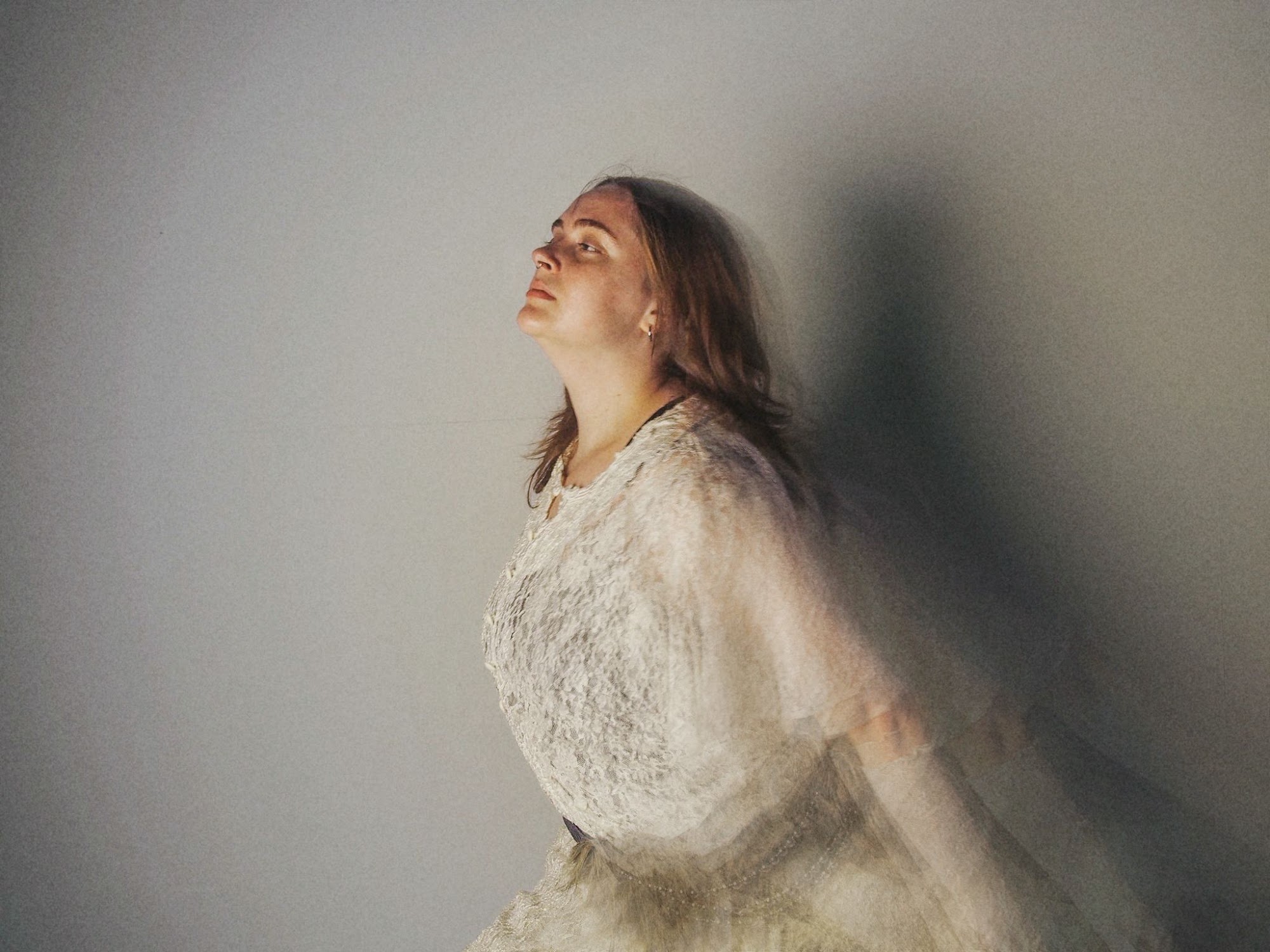
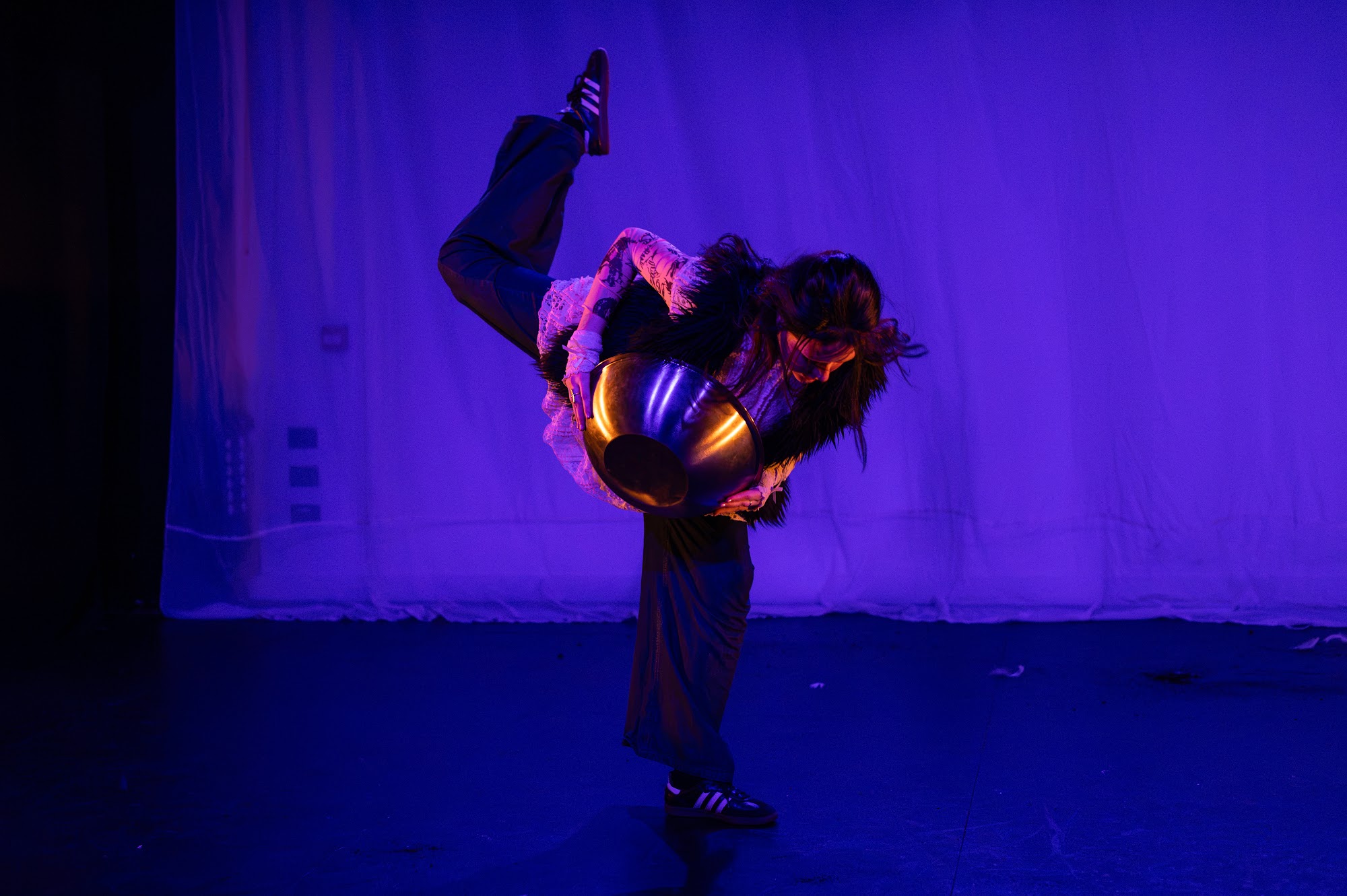
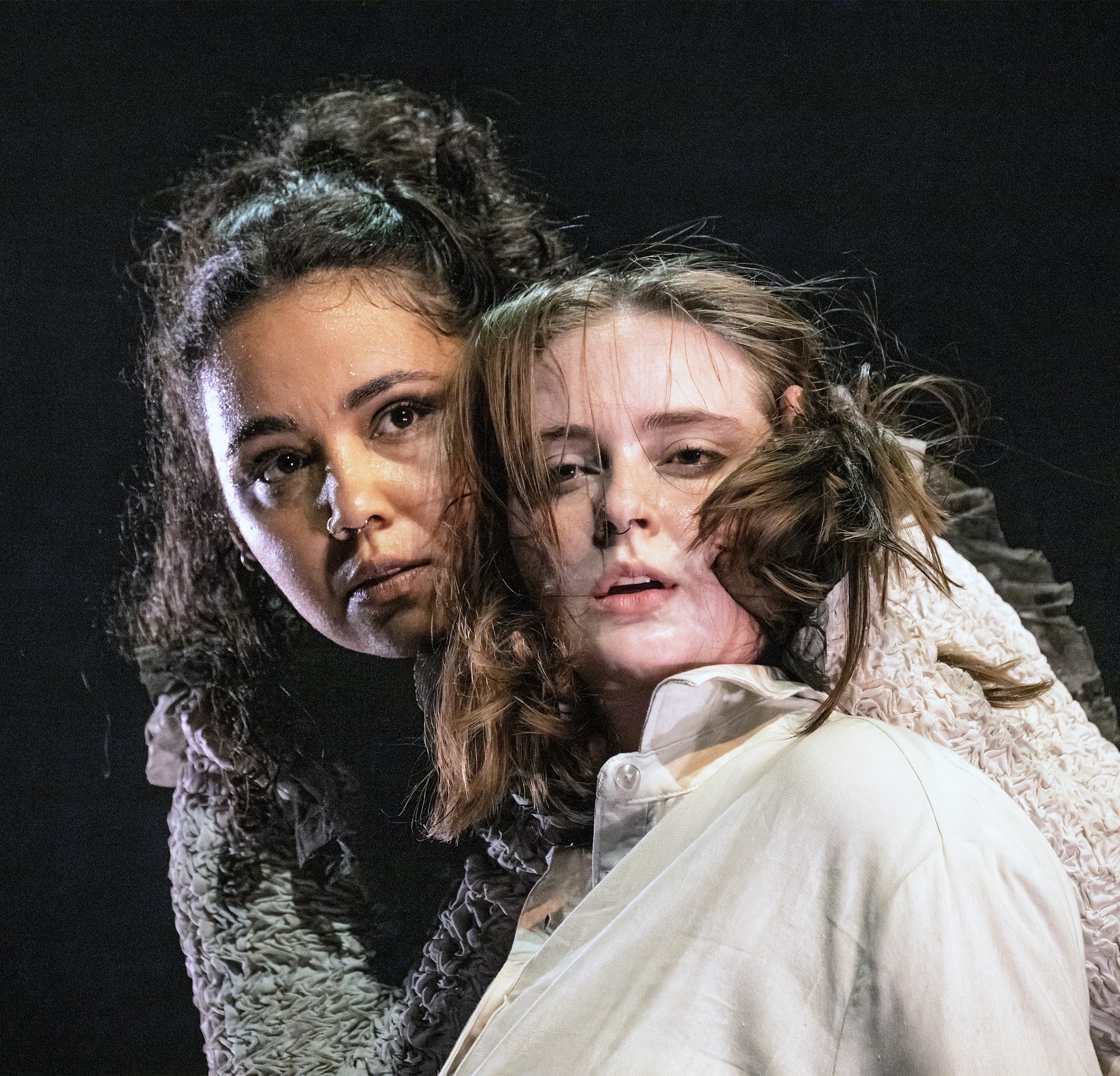
Amelia Jean O’Leary, Sitting Ganaay. Photo: Erica Dixon
THE STORY. For years she heard only the edges of it. When Amelia Jean O’Leary’s auntie told her the whole thing, it was already staged: the whistle in the trees, architecture of their trunks, the long walk of a woman toward a ceremony that will not save her, and the curse at the end of the walk.
O’Leary is a Gamilaroi and Wadawurrung dancer and choreographer. She listened to the story of the Yinarr, and then mapped it onto her own experience.
BACKGROUND. Victorian College of the Arts, a Bachelor of Fine Arts in dance, 2021. Then four years in Melbourne at dizzying velocity: more than five full-length works, among them STAUNCH ASF, which took Melbourne Fringe’s Best Emerging Indigenous Artist Award in 2023.
Sitting Ganaay is her third full-length solo, commissioned by UNSW Creative Lab, built across months of residency instead of the usual fortnight. It’s scored, costumed, choreographed, performed by O’Leary alone.
This conversation has been edited for length and clarity.
The whistle in the trees
Let’s start with the show. I know it’s a dance work, that it deals with loss and colonisation. What is Sitting Ganaay, in your own words?
Sitting Ganaay is a solo contemporary dance work talking about story, and memory, and the embodiment of history. At the moment, as I’m in development, it’s focusing on a specific cultural story: a story my auntie wanted me to talk about in this work.
It’s about a First Nations woman who was travelling to the corroboree. On the way she had all her children with her, and she kept asking for help, because her children were hungry and she needed help; but all of the community just kept walking to the corroboree, and didn’t help her.
Her kids in the story end up passing away. When she makes it to the corroboree, she goes to the centre of the circle and screams at everyone, in pain, about how they couldn’t take care of her, couldn’t support her. She curses them, and they become these trees: on my country, that area is still there, and the trees are shaped almost like frozen humans. She cursed them to be frozen statues, frozen trees, for life; for not taking care of their community like they’re supposed to.
The story is old. Why does it still have teeth?
What my auntie and I talk about a lot is: how can I, as a First Nations woman, relate to these stories, and contextualise them to my own reality, to the times I’m living in? This story sat really deeply for me, because there’s a lot of commercialisation of the idea of community, and in reality people don’t really have the capacity, or don’t understand the balance, of what it means to be part of one.
They don’t know the First Nations way of taking care of someone. I think there’s a fear in the colony that if you give, they’ll just take and take and take, which is kind of the reality of Western culture; it makes people sick. In my culture, you give a bit, you get a bit back when you’re ready. People can take care of you when you’re sick, and when they’re sick, you can take care of them. It’s a balance.
It’s an authenticity, a genuine approach to connection and relationships, that I think is a bit lost at the moment. And even within my own community: what does that mean for First Nations and queer communities as well? So that’s the cultural story the work is based off, and then I like to layer on my own experience and different stories.
Where do the ghosts come in?
She’s also interested in me talking about how a lot of black women become ghosts while they’re still alive. A lot of minority people become these ghosts in this world: people ignore them, and they become almost silenced. That’s quite a common thing for First Nations women.
I always see these quiet aunties and people around me, and I have to sit right next to them to be able to hear their stories, because their stories haven’t been heard, or even cared about being heard. So I’m interested in the idea of a ghost: how ghosts are actually really real, and how I, myself, embody this ghost. It’s a lot of layers!
The title, then. What does sitting ganaay mean?
We even talk about cultural language revitalisation in this work: how my community saved our language through cleverness, through gentleness, through slang and humour, and, I guess, through colonial expectations. Ganaay means digging stick.
The reason we know that word exists in my family is that when a woman would sit with her legs open, they’d say: “you’re sitting ganaay.” That relates to the movement of the digging stick: when you dig for yams, you sit with your legs open, lean forward and dig. So I’m interested in how movement is the reason language survived, in a way, and then became slang, and became an idea of madness, and it all just keeps circling. In this work we’re talking about language, we’re talking about community, and we’re talking about Yinarr (Aboriginal women) as ghosts, in a way.
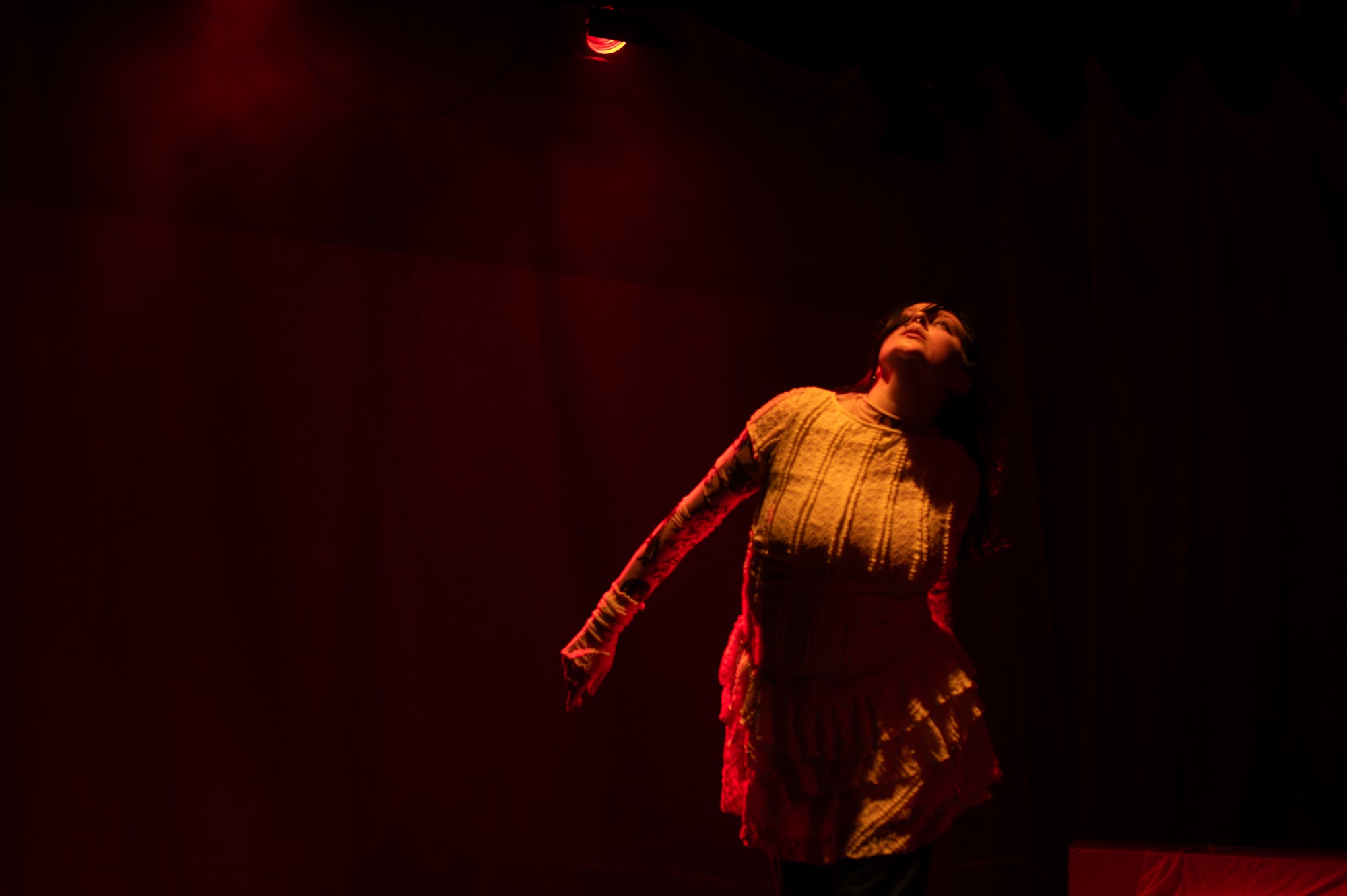
Amelia Jean O’Leary in Sitting Ganaay. Photo: Lucy Parakhina
Before the concepts, embodiment: where does your practice come from?
I trained at the Victorian College of the Arts; I got my Bachelor of Fine Arts in dance and graduated in 2021. Then I had an independent dance career for four years in Melbourne, where I made over five full-length works: almost one a year, and in one year, two. I was producing a whole lot of work, and curating events.
I learned and grew a lot as an artist by just doing, by just making; not necessarily waiting for an opportunity, just going for it. Then I chose to move to Sydney: to slow down a little bit, but also to focus on practice itself, rather than the producing of work. So this work is quite different to my other works, because I’ve spent a lot more time writing and yarning about it.
I guess that’s why it has a lot of concepts. But I realised that’s just the reality of what I’m doing: there’s so much interconnectedness within my culture that it would be almost disembodying, and colonising myself, to simplify what I’m trying to say. I have no interest in minimising my experience for other people to understand.
What I’m interested in is the evolution of my practice, and the evolution of my productions. In the past I’ve really simplified it: I was making work on what it means to be a Yinarr, identity, the concept of being an Aboriginal woman. Now I’m like: actually, there’s so much more depth, and different layers, to being who I am.
And people aren’t pleased anyway, even if you do simplify it. So you may as well just do what you want to do! Right now I’m just trying to be interested in my own work, and do what it is that I actually want to do.
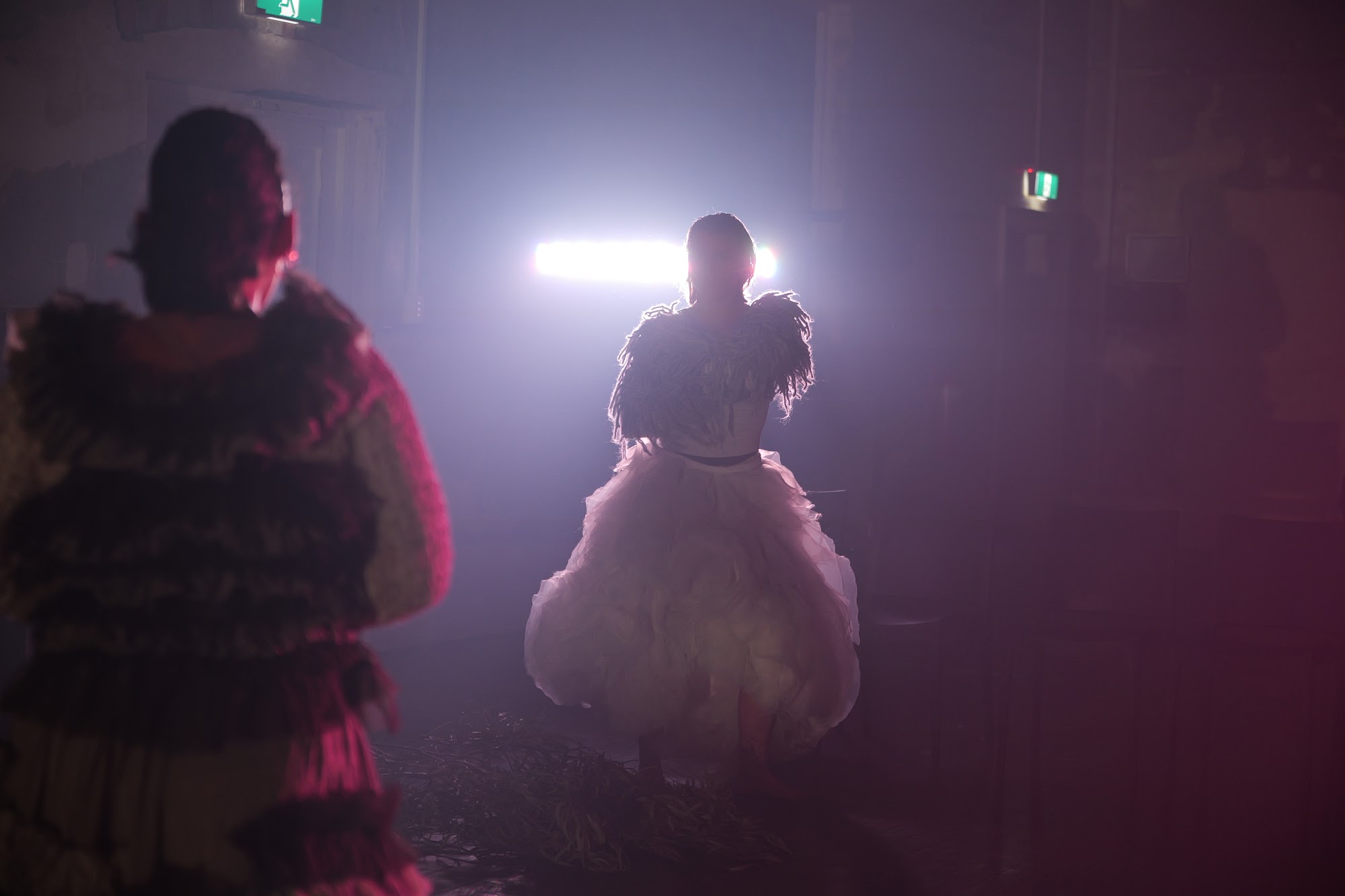
SAD EYES (2025). Photo: Gregory Lorenzutti
You don’t dance until the song man plays
You’ve said you wrote this piece, which is a strange verb for a dance. What does writing look like here: is there dialogue, are there stage directions?
For this work I’ve been writing stories: a lot of just stories, little narratives, and then I weave them together through scenes, almost like a play. I do that with most of my works: build it scene by scene, try to dramaturgically piece them together to make sense to me, and then build the sound. Except with this work, the sound has come a lot before the creation.
Which is actually very cultural, because in my culture you don’t dance until the song man plays the music. So it just feels right. It’s been interesting, building the sound; and I’ve already done three developments of this work, so it’s not like I’m pulling movement out of thin air. I’ve been choreographing different versions, and I have heaps of phrases and different scenes.
Leading up to the production, it’s about mapping out the entire work, figuring out how I want to piece it together, and what’s actually still relevant; what I was feeling in dancing a few months ago isn’t really what I want to be doing now. So it’s asking a lot of questions, being my own dramaturge, and mapping and weaving and sewing it all together.
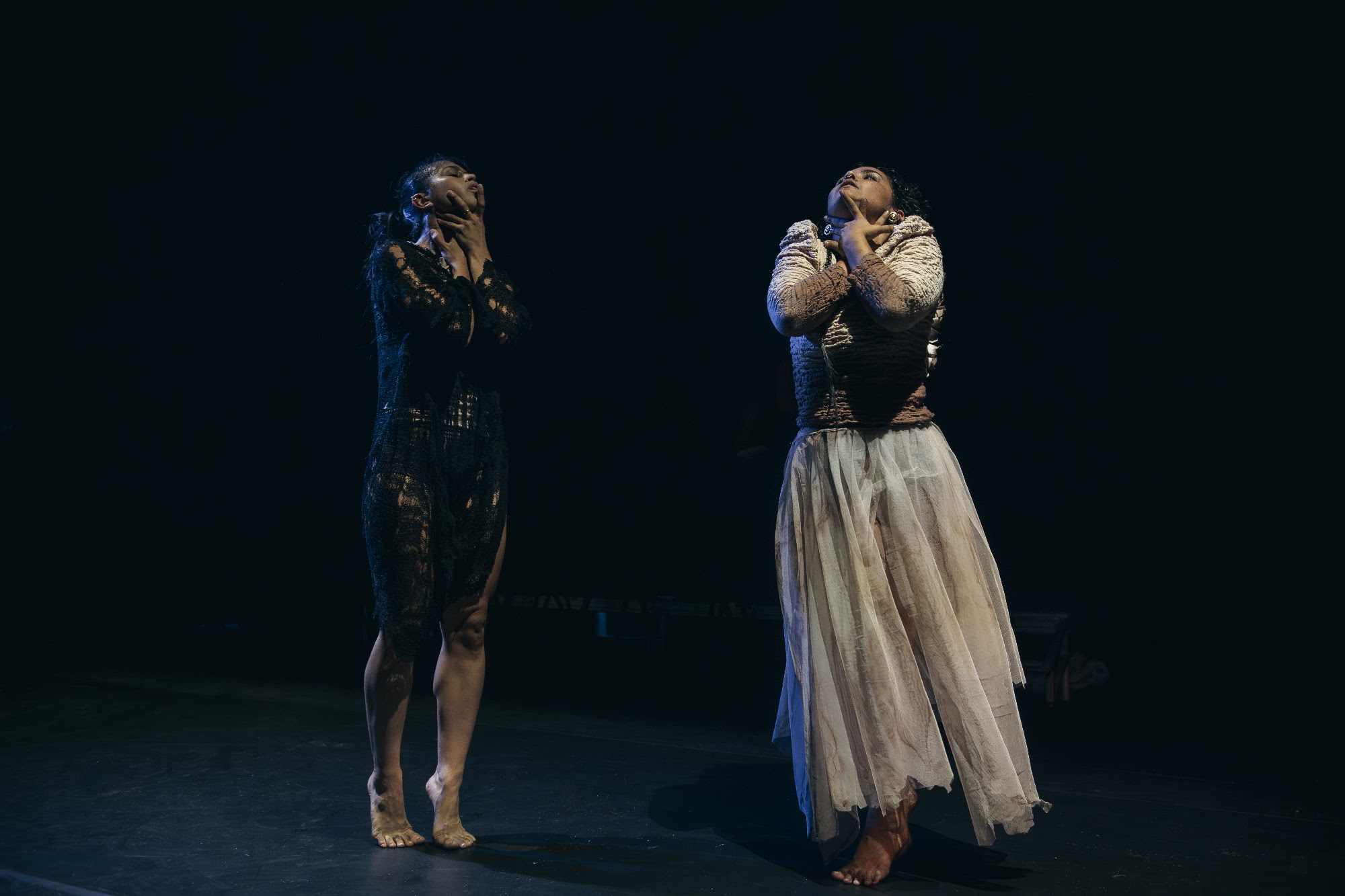
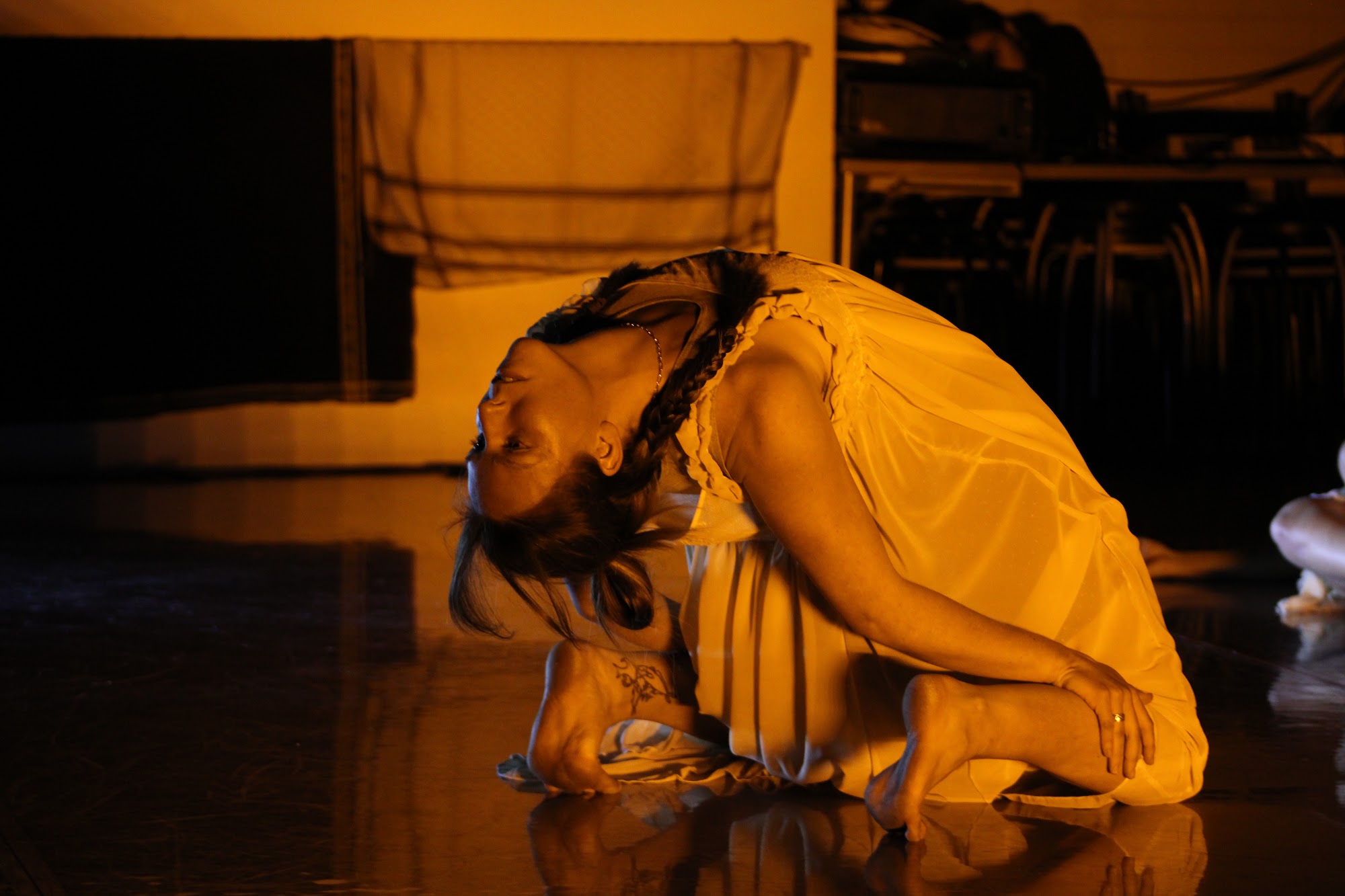
NGAMBAA (2025). Photo: Phillip Trinh
Aunt Shell and Uncle Ted sit in the credits as cultural advisors, a formal name for something that doesn’t sound formal at all. How did this story come to you?
I’m always yarning with my auntie and my uncle, and going out on country with them a lot. Throughout the years I kept hearing this story of the woman on the way to the ceremony, and I kept thinking about it. And I said: well, aunt, I’m wanting to make a work on a simpler premise, of sitting ganaay, of how language survived.
She was like: well, I do have a story. It’s not necessarily about language, but I think you can weave it in there somehow, from your own experience. Then she said the story, and I was like: yes. This is the story I keep thinking about, that I’ve heard little glimpses of; I’d just never heard the full thing.
As she explained it, it was so visual. She’s not necessarily a trained artist, but the way she was describing it (the sound of the whistling trees, the shapes of the trees, the journey of the woman walking to the ceremony) sat with me really deeply. And she wanted me to tell the story. If that’s what she wanted, and wanted for my community, and she sees the importance in that, then I respect that, and I’ll find a way to put it in my work. I don’t see why not!
When she talks to me, she is an artist. She’s already mapping a whole vision out for me before I even get in the studio; I have this whole vision just from her words. I really appreciate that she has these stories.
And Uncle Ted?
My uncle didn’t have as much influence in the meetings we had, just because the stories are quite women’s business based. He let her have full responsibility of telling me these stories, because they’re women’s stories; it felt very intimate, to be able to yarn with my auntie about them.
What does it do to you, being handed stories that old?
I just love having these very clear, ancient stories told to me, and then to be asked after: how does this relate to you? That’s really important, especially feeling quite different to my community (a queer person, living my life very differently to the rest of my family), and then being told these very ancient stories and asked: how do you see yourself in this story? How is this important to you?
Because it’s not of use if it doesn’t relate to you. And I was like: okay. This is how you teach culture. This is how you relate to people: with their own contextualisation of the narratives.
Amelia Jean O’Leary in Sitting Ganaay. Photo: Lucy Parakhina
No hiding behind the body
You keep reaching for craft words when you talk about this: mapping, weaving, sewing it together. What can dance hold that a film or a play couldn’t?
Dance is very underestimated, I think, and can be misinterpreted so easily because of the lack of words. But that’s the most interesting thing. To have an authentic experience of dance, you have to connect to your own body; it can’t be in your head all the time.
Good dance work gives people a kinesthetic reaction: a pull from their own body and their energy. Maybe music can do that (I don’t know how other forms might create emotion), but dance creates a physical synergy and reaction. That’s very important, because a lot of people have disembodied First Nations people and taken the humanity out of the people creating the work.
You can do that in dance too, but it’s a bit harder, because you’re seeing this pure body standing right in front of you. You either have the choice to work against that body, or to sit with that body and be on that story with that body. There’s an authenticity to it: especially in a solo, there’s not much place to hide, even if you’re doing a lot of choreography or the sound’s really big.
At the end of the day, especially in the space I’m in, which is going to be quite an intimate, close audience, there’s no hiding. That’s the beauty of dance, of these solo shows and intimate spaces: you show up, you have to let your mind go, and you have to be there for the journey.
I think it’s also intimidating for an audience member to be in that position; you’re really close to the performer, and the performer has a lot of power. It’s just one person, and a solo performer is very, very, very powerful standing up there. It’s such a big statement, to stand up there and do these stories. Film can hide behind things; other forms can hide behind things. You can’t really hide behind the body too much.
It is a story about abandonment by a crowd, and you have chosen the form with no crowd in it. What does a solo pull out of it that a full cast never would?
If you haven’t made a solo before, it can be quite difficult; I think that’s why people stray away from doing one. There are a lot of questions like that you have to figure out on your own. Because I’ve done two full-length solos, both longer than this one, I’ve had to develop a sense of relationship to the space, and to energy, without people being there.
To be able to visualise an emptiness, or a lot of people around me: spacing is a big thing, and in a solo it means so much. If I wanted to feel more lonely, I would put myself deep into a corner by myself, and then slowly emerge. If I wanted to feel the fullness of people around me, I’d stand straight in the centre of the space.
It’s creating your own mapping of the space, of where energy sits. Images are a big thing in a solo, because you can’t really hide behind five people or whatever; you just have to commit to the shape, to the space.
Another thing that’s really important, and helpful for me, is that I create my own sound. I can create a sense through sound of whether it’s a busy space or a quiet space, whether we’re in more of a dream state or in the city. I can control where I am through sound, and I can control the intensity of what’s happening.
It’s a skill, and a really helpful one: even if you start to do group works, you have such a great understanding of what’s happening everywhere, every detail. You can’t miss it after making a solo, because you had to face yourself in the space a lot.
NGAMBAA (2025). Photo: Phillip Trinh
Sound, choreography, performance, and the costume too, you made all of it yourself. What is the costume, and what is it doing to time?
This costume has gone through multiple versions. This version is a mixture of more casual, everyday clothes into more of a vintage sort of dress that I wear. I like to time-jump through sound and costume; for this one it’s mostly costume: really big jeans and a singlet, to represent me now.
Then I go to the sixties. I like to talk about the sixties a lot, because we didn’t have rights at that time; we weren’t able to vote. So I like to go back to that time: it’s not that far away at all, and it’s a very nostalgic time. It’s when my pop and my auntie and my uncles were living in this really odd colonial sort of time, transitioning into a different time.
And these old vintage dresses: because that’s what a lot of Aboriginal women did, they were taking care of white people’s houses and things like that. And my uncles were always very suave, in these suits. Even though they weren’t even allowed in pubs, they were always done up really nice, and the women done up really nice, all the time, in this society that didn’t even value them.
So I’m interested in costume from that point of view, a time point of view; and then the modernisation, the organic realness of what I would wear, or what I would be doing. And sometimes, maybe, for this one (I’m not sure a hundred per cent) I have a ghostly veil, or something, to represent…
But I feel like I could do this work in track pants and a singlet and still convey the same thing I want to convey. Adding those elements is just a little cherry on top.
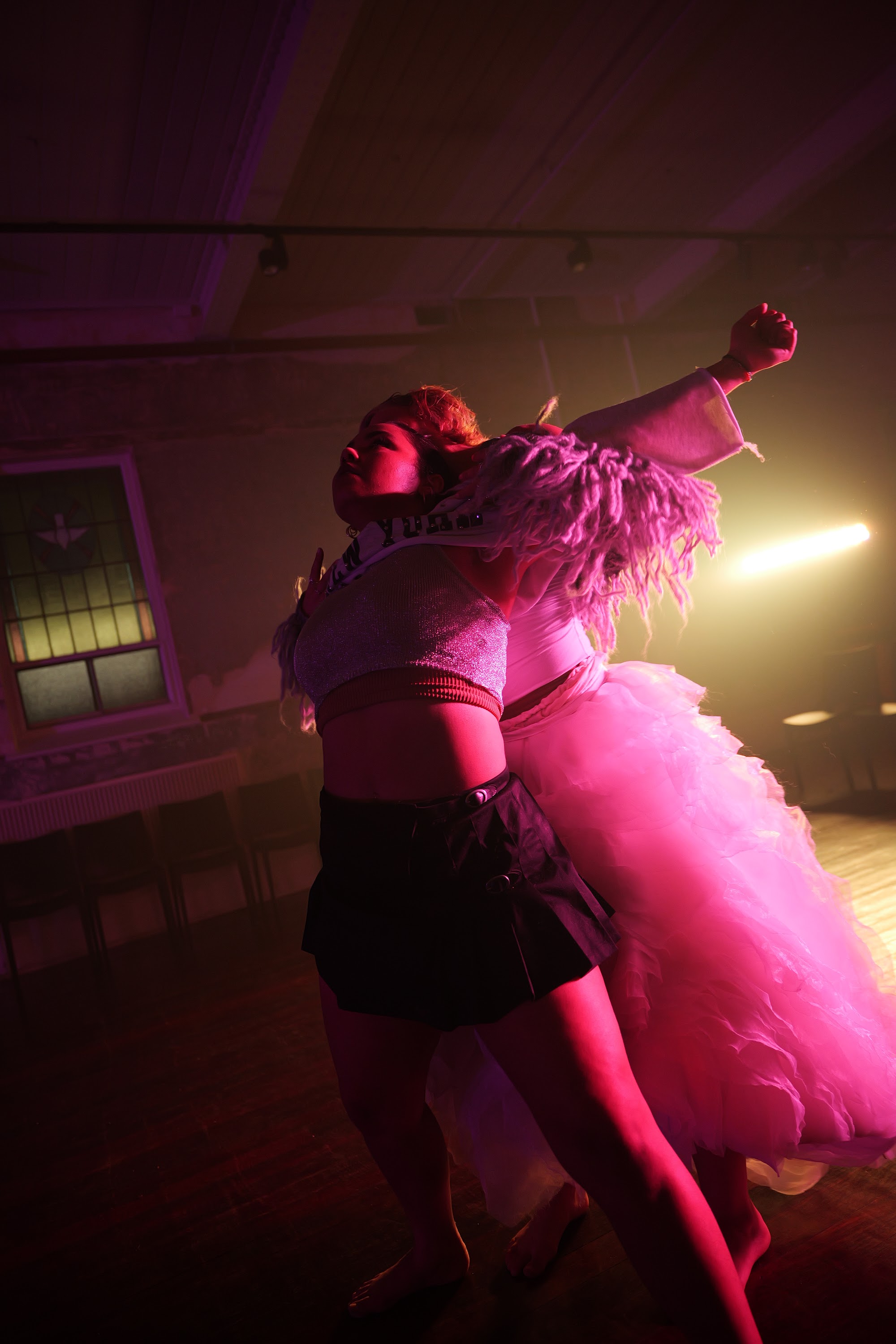
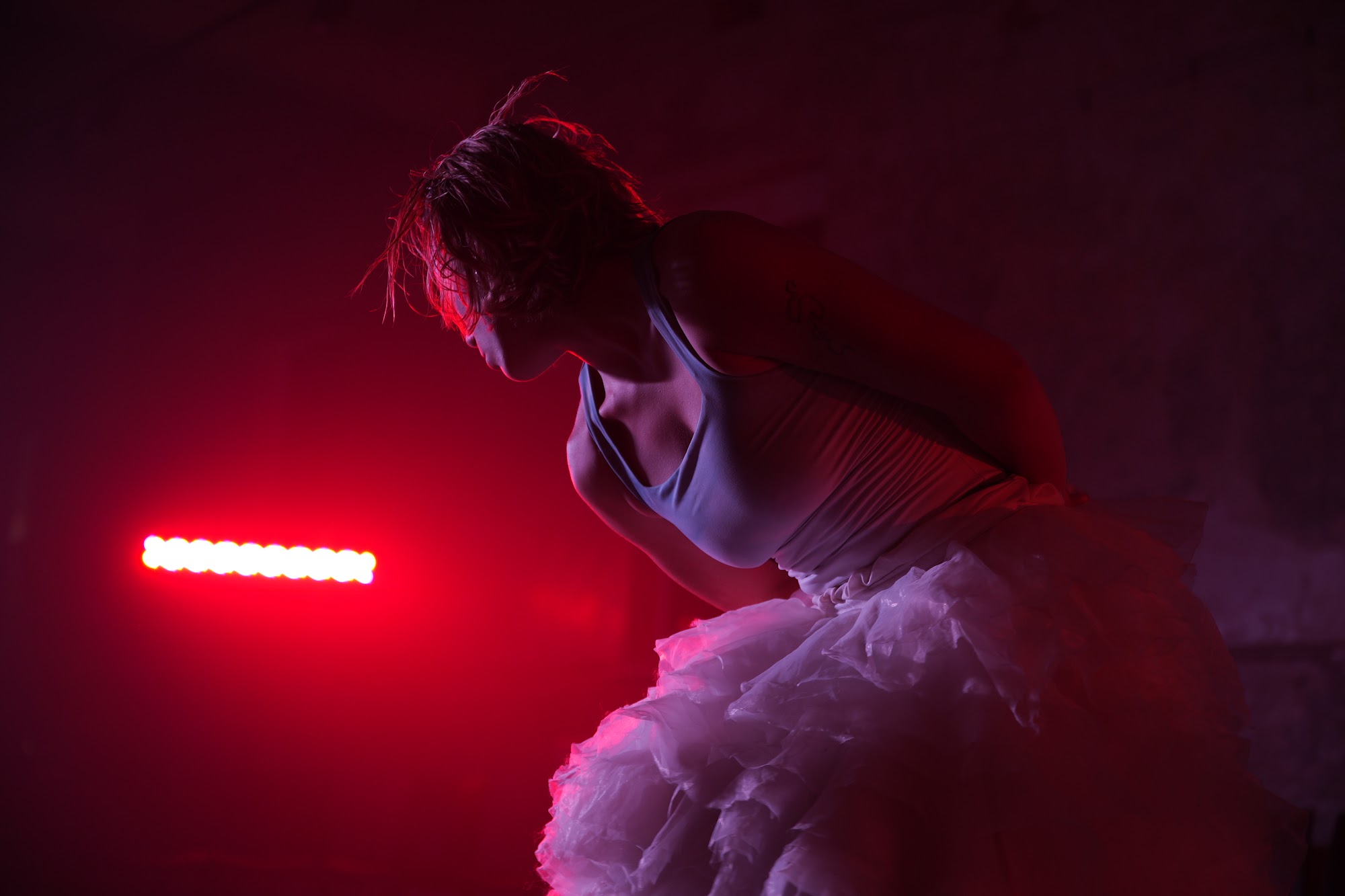
GENERATION WTF (2025). Photo: Ella Clarke-King
Quality over quantity
You grew up in Victoria. Where is country for you, and who is community?
I’m Gamilaroi, from Barraba in Northern New South Wales, on my father’s side. On my mother’s side we’re Wadawurrung, from Ballarat, Victoria; but I grew up more on my father’s side. And I’m also Irish, which is a big identity thing for me, and has a lot of cultural implications for my family, because they’re really proud of being Irish.
I think there’s a connection between the politics of Irish people and First Nations people. That made my family have a little pride in who they were, even though the pride was from being Irish while they were these very Indigenous peoples, which is an interesting context. It makes sense of why I sometimes like to wear very colonial clothes when I perform, very white lacy things: that’s kind of what the women were wearing.
So why leave Melbourne?
I lived in Melbourne from when I was about eight, went to uni and everything there, and left in 2025. There was not much left for me in Melbourne. I would have just been doing the same thing: hitting my head against the wall of overly producing, very small budgets, just burnt out. I just didn’t want to do that anymore.
And I couldn’t really find my artistic community there. I have my pan-Indigenous collective in Melbourne, but that’s all different Indigenous peoples, not just First Nations from here, and I really wanted my own community to inspire me. Since moving to Sydney, I do find there are much more First Nations artists here; much more Gamilaroi, I guess, because it’s closer to our lands. And different multidisciplinary artists, theatre makers, curators, researchers.
I’m interested in taking the time to make work and to research, valuing the process just as much as the production; not objectifying my craft and myself, but taking my time, and having the right people who support me, like here at UNSW, getting the residency. I’ve had so many months to think this through, across the different residencies, and that’s just not very common: it was very “two weeks to make it and put it up” in what I experienced in Melbourne. There are more opportunities to stage things independently there, but I’m happier to wait a little bit longer in Sydney, for the ones that actually have the time and energy to support me.
NGAMBAA (2025). Photo: Phillip Trinh
Everyone moves the other way; Sydney to Melbourne is the pilgrimage, and you did it the other way around, on purpose. What are the issues most alive for you, making art as yourself in 2026?
There are quite a few issues. It’s kind of hard to get an audience, even in Melbourne. There I have more of one, because I’d done so much work and went to uni there; here, people don’t really know me as much. But I’m kind of interested in the freshness of that, and what it will bring. I’ve already met so many people who’ve inspired me, just being here.
I think it’s quality over quantity, and I’m not afraid of starting again. Coming here, people were like: oh my gosh, why would you go there and do independent art? Melbourne is so much better for that. As soon as I got here, people were like: what are you doing here? And I was like: yeah, I get that, I understand.
But that makes me think: what does it mean to have a thriving independent sector? Does it mean they produce a lot, and there are a lot more opportunities that are quite sparse? Is that what the success is? Because if that’s success, then go to Melbourne.
I’m not really interested in having a lot of things, or heaps of chances of making things. I’m interested in actually building a community, building a practice that’s actually sustainable, that I’m interested in. I’m not really interested in being popular by aesthetic, but by my theories, my mind, and what I can actually contribute to dance and to art.
And Sydney, is it giving you that?
In Melbourne I couldn’t give what I wanted to give: I could put my work up at the expense of myself, but I couldn’t fully be the artist I wanted to be. I don’t know if Sydney is going to be able to give that to me; maybe I need to move to a different country. What I know right now is that it’s slower here, and I like that it’s slower, because I was going really fast.
It works for me. But if there are young dancers who want to dance a lot, you’re better off going to Melbourne; there are more independent opportunities. If you want to be an artist, and you want to make authentically, you’re probably better off going where you actually have the time and space to do that, wherever that might leave you. Probably very different for everyone.
NGAMBAA on tour in Vancouver. Photo: Chris Randle, Matriarchs Uprising Festival 2026
One last thing, and I don’t know a neat way to ask it. In the story the Yinarr is abandoned and forgotten, and the telling itself feels like the witnessing she never got: when you think of these women, of the ghosts, what comes up?
Honestly, I can spark on anything; I’m used to having to talk! But when I think of the ghosts, it comes quite somatically to me: a feeling in my body arises when I think of these women. There’s almost a nightmare feeling to the embodiment of it, almost a dissociation of the body. Which is interesting: to choose that sort of separateness from the body while performing, when as dancers we want to be fully in our bodies, and active.
In this work I find myself jumping in and out of that, because these women haven’t been given the opportunity, or the power, to stand fully in their bodies. So I jump between this meditative, otherworldly feeling and this very modern, active, powerful black woman, and then backwards and forwards. Within that story, that movement duality is coming in.
Sitting Ganaay — choreographed, scored, costumed and performed by Amelia Jean O’Leary. Studio One (D8 Theatres), UNSW Sydney, 16–19 September 2026.
Sitting Ganaay plays Studio One (D8 Theatres), UNSW Sydney (Gate 2, High St, Kensington, Gadigal Country), 16–19 September 2026, as part of Sydney Fringe. Running time 40 minutes. Tickets at sydneyfringe.com/events/sitting-ganaay.
Follow Amelia Jean O’Leary on Instagram: @ameliaa.jeann


%402x.svg)

.webp)


