Im Dunkeln sieht man besser Review — Local Grandma at The Brick 2026
Aubrey Wang reviews Im Dunkeln sieht man besser by Leonie Bell and Local Grandma at The Brick Theatre, Brooklyn 2026 — a cabaret of clowning and operatic gore stages a cemetery reckoning with whether we can ever redeem our persecuted dead.
Im Dunkeln sieht man besser (You See Better in the Dark): a Bilingual Schadenfreude Cabaret at The Brick
By Leonie Bell The Brick Theatre, 579 Metropolitan Avenue, Brooklyn Presented by Local Grandma Directed by Leonie Bell and Celia Krefter
★ ★ ★ ★ ★
Reviewed by Aubrey Wang
Photo credit: Walter Wlodarczyk
Im Dunkeln sieht man besser is a play that believes that historical catastrophe cannot be metabolized through polite dramatic naturalism. By fusing the grotesque mockery of bouffon, the visceral shock of stage failure, and an unrelenting poetics of decomposition, Local Grandma argues that when justice is denied in the daylight of history, revenge must be cooked, staged, and literally eaten in the dark.
In Darkness sees one better
I lost my Brick Theatre virginity on October 15, 2026, eight o'clock on a Thursday, in the company of Joey Koo, who runs Pluto Theater. We pulled up bracing ourselves for an ostensibly unpronounceable German title. My first phonetic attempt went: I'm dunking donuts shit wet seltzer. The actual title is Im Dunkeln sieht man besser.
The official English release translates this as You See Better in the Dark, but transliterally, its colder Germanic syntax cuts straight to the bone: In Darkness sees one better.
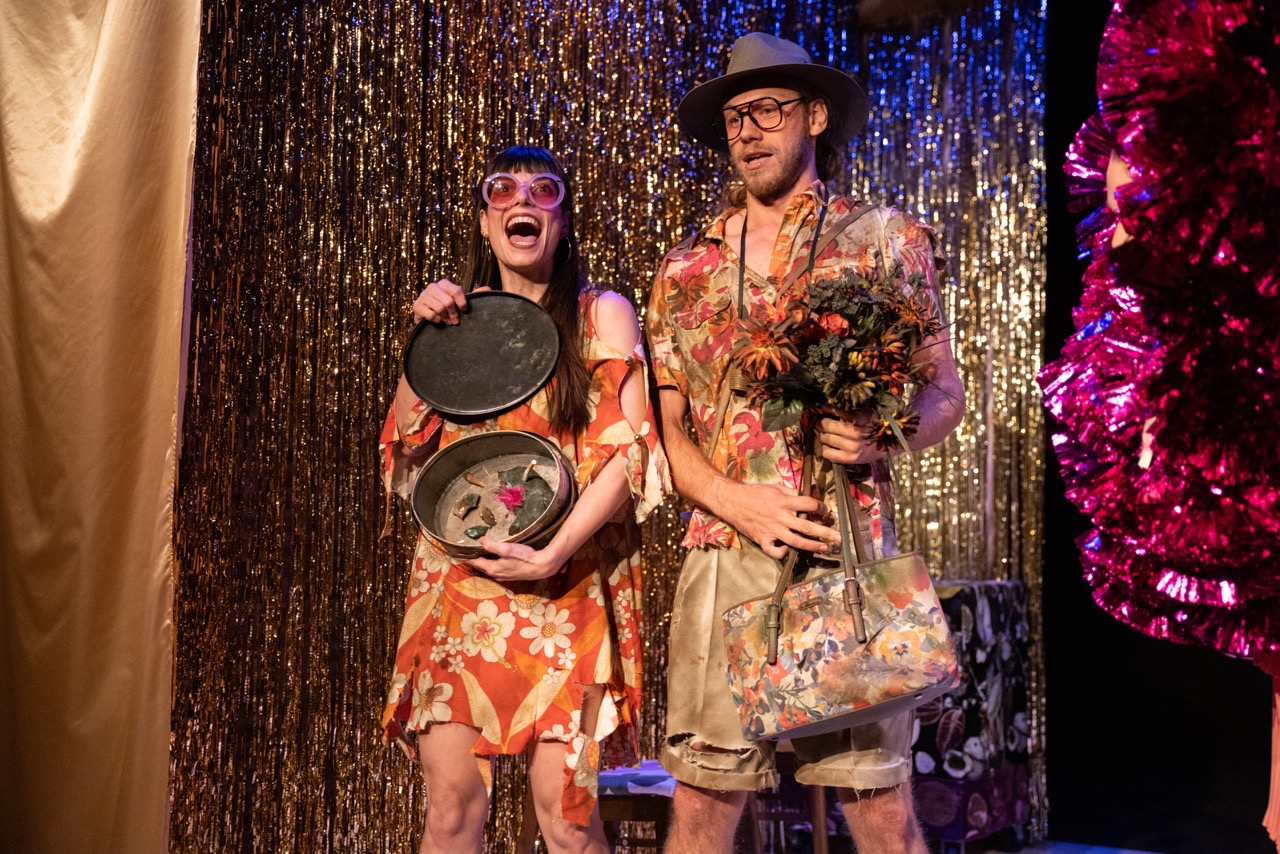
The Brick, for the uninitiated, is one of those tenacious off-off-Broadway rooms in Williamsburg whose survival is a civic miracle. The racked audience seating appears to have been salvaged wholesale from a shuttered Chinese restaurant. The Brick is an enduring institutional spine of Brooklyn off-off-Broadway experimentalism, and tonight its cabaret-scaled black box was sprung in checkered linoleum and curtained from ceiling to floor in glittering golden tinsel foil fringe.
The room projects an aggressive, deliberate unseriousness. And yet — high-focal fresnels and spotlights, I see you. We were about to be baited-and-switched.
A cabaret, a revenge play, a séance
LOCAL GRANDMA, Bell's Brooklyn-and-Berlin ensemble, had reupholstered Bob Fosse's Cabaret for the queer twenty-twenties and then shredded it in a wood chipper. Underneath the tinsel, underneath the clowning and the drag and the cabaret, it is a revenge play and a séance.
We get the backstory in fragments. The real object of grief is, famously, the thing one cannot stand to look at directly. We receive it instead camouflaged in camp.
A synopsis might read as spoiler. It isn’t, really — it is maybe 5% of the genre-defying experience that is Im Dunkeln sieht man besser. There are no synopses for cabarets that operate in partial reveals and highly engineered non-linear storytelling. The backstory came to me instead the next day in a dream. The chronology is realised in hindsight.
Harriet and Nettie met in a Nazi-era German village. Their intimacy was a capital crime. They met in a forest at night. They planned, in the modest, impossible way of all doomed lovers, to flee across the border to Paris. One morning the uniformed neighbors came to Nettie's door and dragged her into the mechanism of state extermination, and that was that. Harriet survived, and in the long afterward she requested her wartime file and discovered that the informant who had destroyed her life was Nettie's own younger brother.
Harriet, our protagonist, does not arrive until nearly thirty minutes in. By the time she enters, you'll have sat through a harajuku disco, a Pinterest crafternoon mime sequence, a Nick Cave suit reimagined as neon coronavirus S protein, erotic prose leaking into Excel tables and email signatures, a cucumber-in-Dennis’s-pocket bit that resolves into him unzipping his pocket to pull out a jacket.
Photo credit: Walter Wlodarczyk
Clowning the Senses at The Brick
Opening. A subterranean bass drops like a kick drum in the sunset room at Berghain, cleaving the tinsel in a single golden column of light. Then the lights and the sound commits a series of theatrical false starts: fade in, cut out, fade in, cut out, (just kidding!) then punctuated by the slapstick crunch of an unseen car crash. There is much laughter. I have never seen lighting and sound design weaponize clowning techniques against an empty stage to such warm reception, yet here we are.
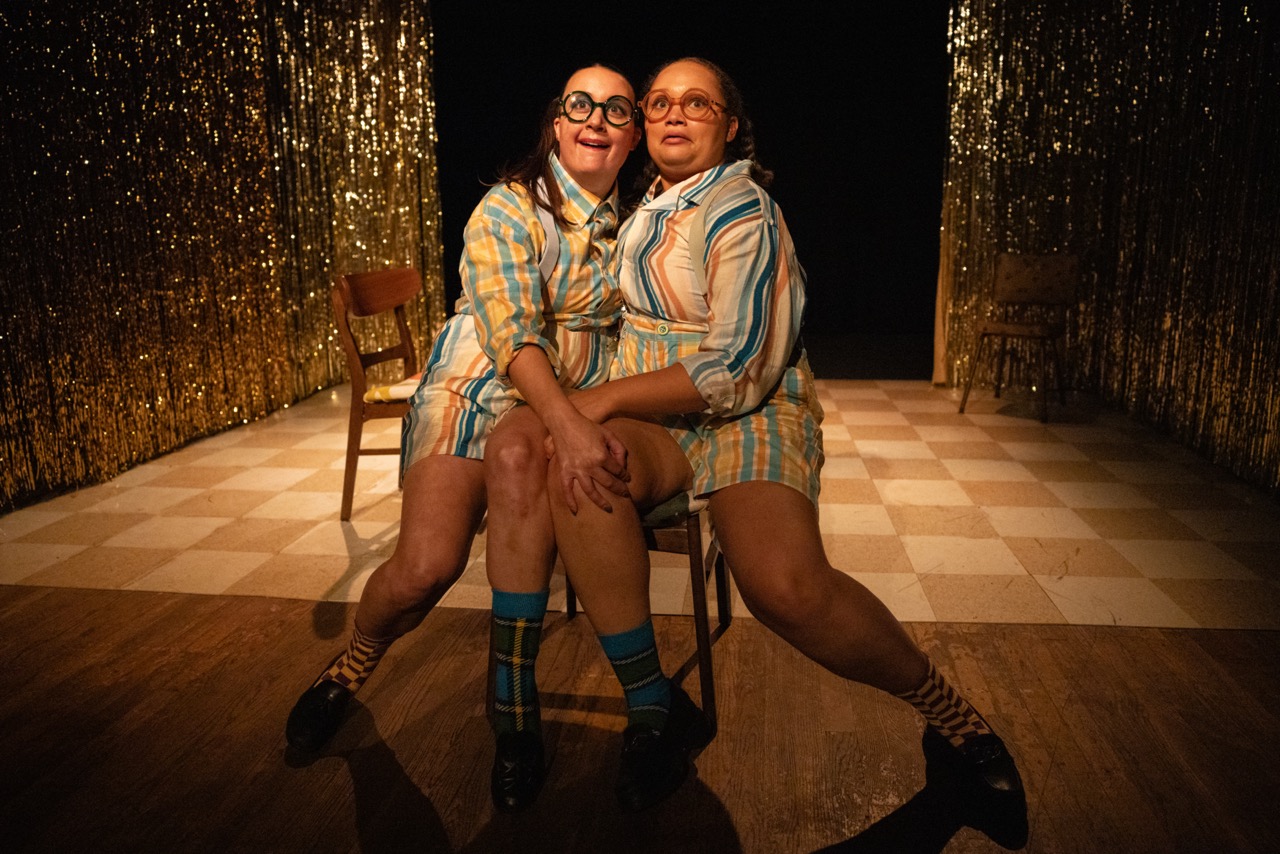
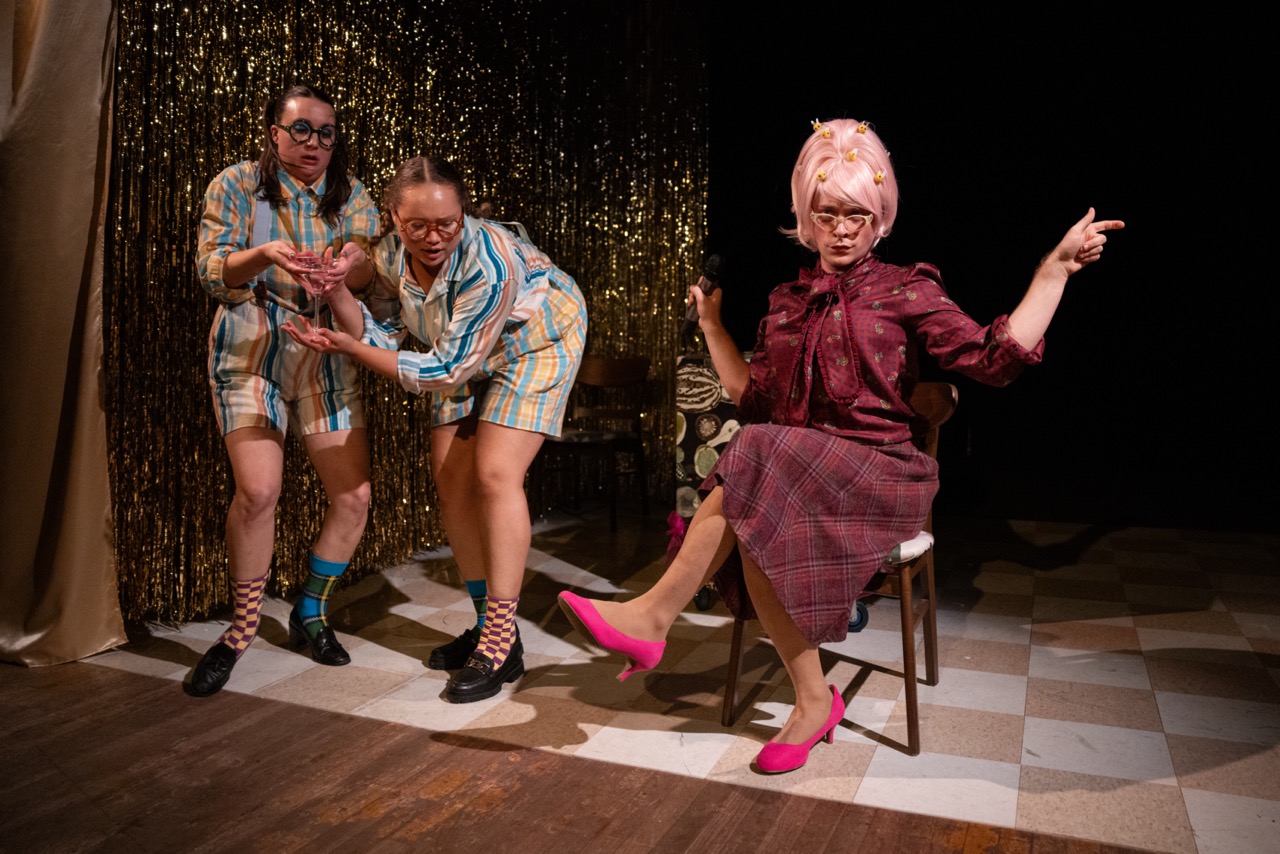
Enter the clowning pair: Juliette Holliday and CHEEKS. Dressed in matching pastel flannel and rolling a papaya-print upholstered road case onto the checkerboard stage, they radiate a morbid, deadpan whimsy reminiscent of Lemony Snicket's A Series of Unfortunate Events colliding with the biplayer survival-dread of Don't Starve Together.
They provide synchronized lip-sync support for Theodor Gabriel's drag queen, Rainer. Rainer's entrance under a scorching follow-spot completely fried my dopamine receptors within the opening ten minutes — one circular foot of light on her pink kitten heels in what would otherwise be theatrical blackout.
Every offer across the footlights seems calculated to stimulate the vagus nerve, swinging wildly between slapstick buffoonery and unbearable tension. At one point, Rainer lifts a microphone directly against their lips while greedily slurping down a martini, their hot breath visibly fogging the cold glass. The production turns somatic manipulation into an art form.
Failure, and the deliberate exaggeration of failure, is the primary operating grammar of the performance. When Stella Oh marches out as the "Screaming Title Maid" — a manic Little Red Riding Hood figure — she unrolls a gargantuan protest banner entirely in German. For non-German speakers in the audience, the gesture is pure alienation; yet the production immediately weaponizes that incomprehension, trading in wild amplifications of sound followed by suffocating pockets of darkness and silence.
Photo credit: Walter Wlodarczyk
Language as Rot
Leonie Bell's text is a masterwork of forensic poetics. English and German share deep philological roots, and as Bell's script demonstrates, their common genius lies in their capacity to describe decay. The word slime is Germanic; so is rot. Mold, rust, stink, maggot, gut — Germanic, Germanic, Germanic, Germanic, Germanic. Bell writes decomposition as a working grammar, a second tongue through which other, more difficult things can be said.
The night before, I had sat through a well-known playwright's class, listening to him insist that language plays can only transcend empty absurdism if they are structured through rigorous internal logics of grids, shapes, and colors. At the time, I was frankly baffled. Yet within five minutes of sitting in Local Grandma's auditorium, the checkered linoleum floor and the color-coded trauma locked into place.
Early in the piece, the direct address demands that the audience zoom in, magnifying-glass style, past human perception into the cellular dirt of the cemetery. Bell christens this microscopic horde "this billabong of bacteria" — a startling, rhythmic linguistic collision pairing the Wiradjuri word for a stagnant pool with ancient Greek root-logic. It is an ecology of rot that mirrors the historical compost pile of mid-century Europe.
Around this biological chaos, Bell builds a grotesque satire of post-mortem NIMBYism. Undead residents hold weekly town hall meetings in the social room at "twenty-one hundred sharp dead time," squabbling over property boundaries, pruning schedules, and biodiversity versus pure pine needles. Local zombies smear dirt over their own tombstones to make them look authentically antique. Even in the grave, gentrification and aesthetic policing are all the rage.
The chief bureaucrat is Hartman Schneider (John R. Howley), a smarmy enforcer lecturing his neighbors that "Rules are tools to keep us safe outside from fools." It is the quintessential banality of evil refracted through suburban pettiness: the same petty compliance that once greased the wheels of totalitarian roundups is now channeled into lawn maintenance.
Photo credit: Walter Wlodarczyk
A Cabaret Staged Inside a Lung
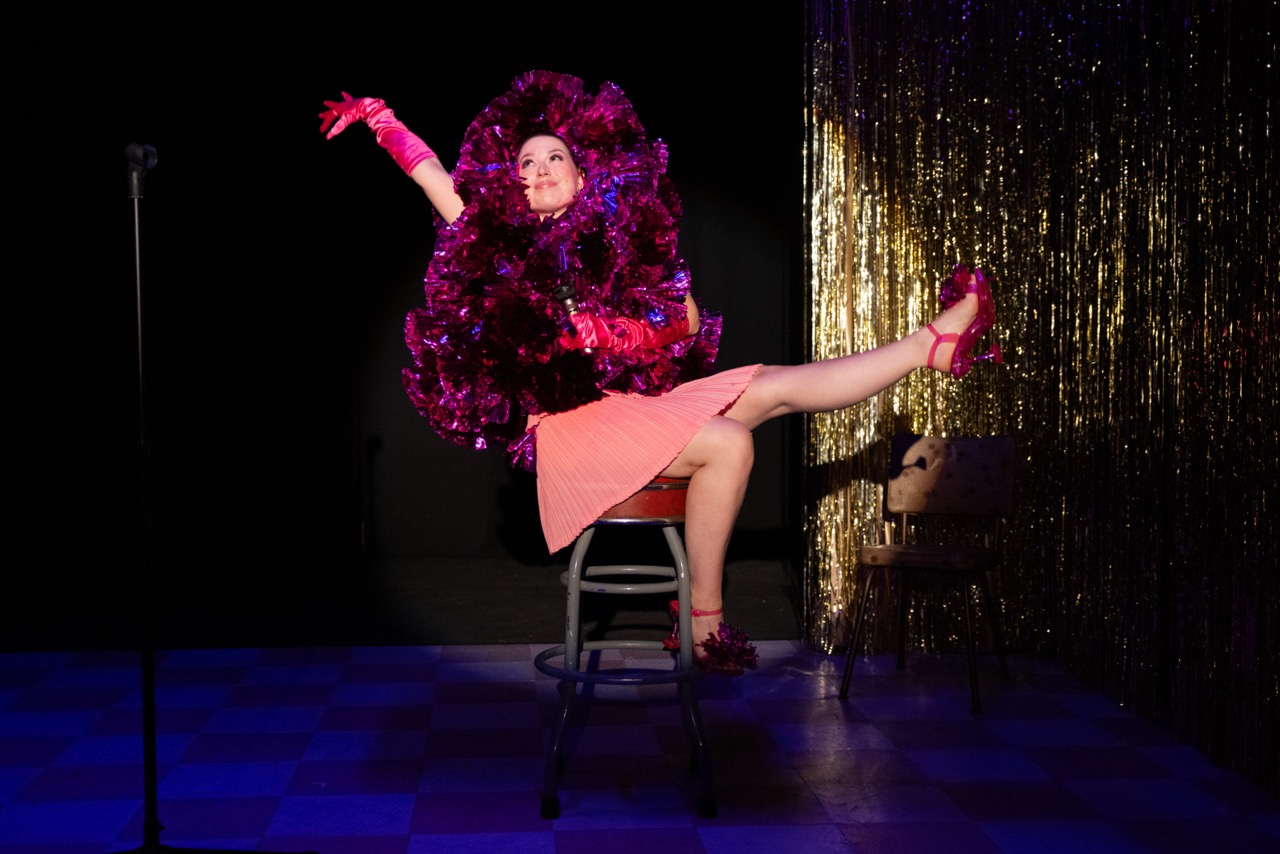
Hanna Westi appears as Biggi wearing a monstrous magenta mylar mane — a mop of metallic tinsel that mushrooms around her like a radioactive moon and that is a clear, loving homage to Nick Cave's Soundsuits. She sings an unforgettable torch song in a key somewhere between jazz lament and rockabilly funeral: "My baby has left me with no one to kiss / My baby has left me with nobody to miss / I used to be a queen, now I'm hanging by a thread."
The sequence culminates in what I can only describe as the greatest, most protracted dramatic death scene I have ever witnessed. Bell and co-director Celia Krefter hold the beat far past the limits of conventional dramatic economy, forcing the audience to sit in the visceral textures of dying until nervous titters morph into heavy silence.
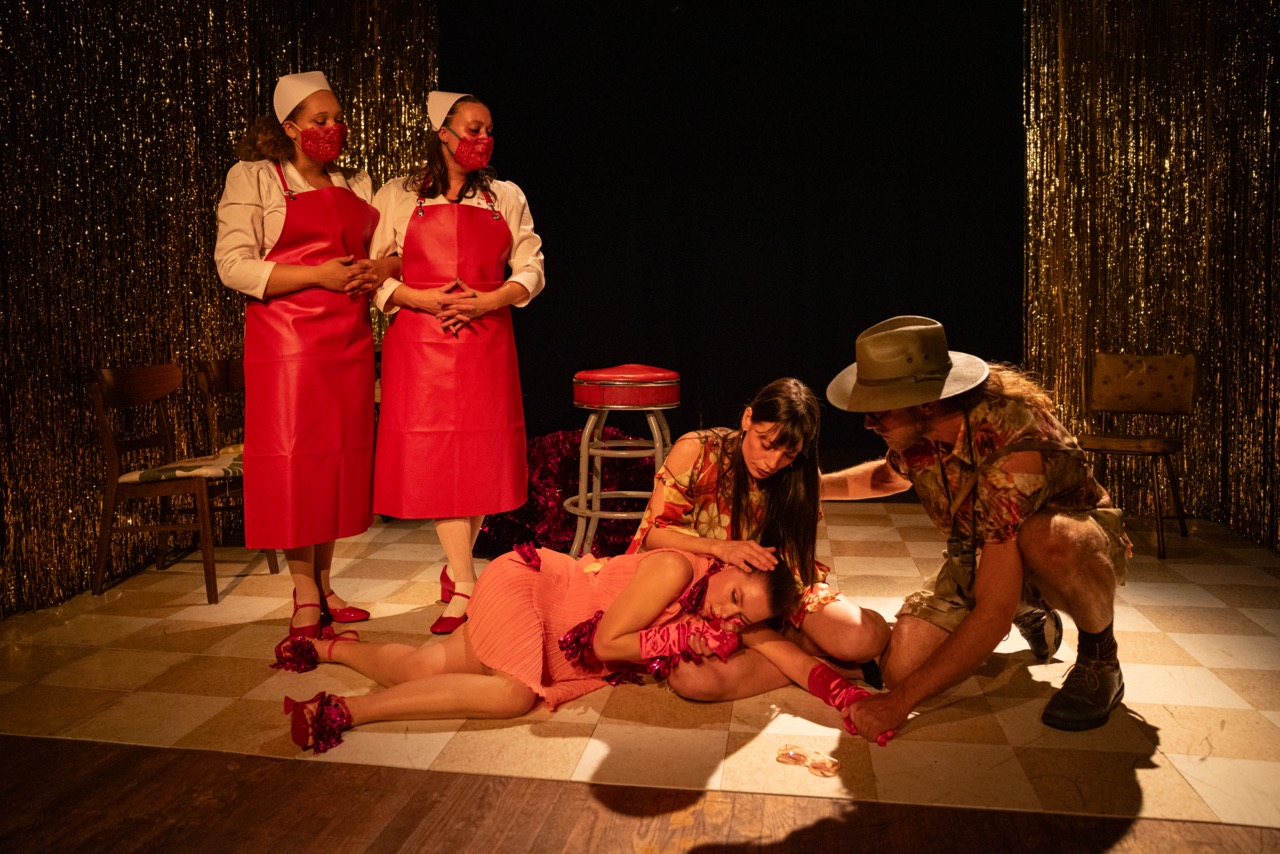
Then — the subversion. CHEEKS and Holliday return, now as two psychopomp nurses in blood-red aprons, humming an indifferent elegy. Just as Biggi suddenly gasps back to life — offering the audience a brief, audible sigh of comic relief — the nurses stoop down to haul her limp body away. As they turn their backs to exit, massive block letters stenciled across their medical scrubs reveal the punchline: DEATH. Reader, I shrieked.
From there the show begins to pivot without warning between registers, from a quick domestic grotesque to a fussy Jürgen sketch with overbearing German parents; a sequence that is best described as Fear and Loathing in German, Indiana Jones. The ground will not hold still. What holds, instead, are the actor-to-actor relationships, which are crystal clear. The surrounding dark is bottomless; the relationships are crystal clear.
Photo credit: Walter Wlodarczyk
The Shakespeare Claw
The peripeteia, if we're being Greek about it, is the entrance of Harriet, played by Marcella Murray. Murray storms the checkered floor as a cultural impossibility (a former corporate tax accountant who has pivoted, mid-life, into producing downtown theater, dance, and music), wearing a cheap plastic flower hairclip tilted across her head at exactly the severe diagonal of a Greek tragic mask.
Murray storms the checkered stage in an eruption of comically exaggerated, unmoored grief, throwing her body across the floor and howling into the void.
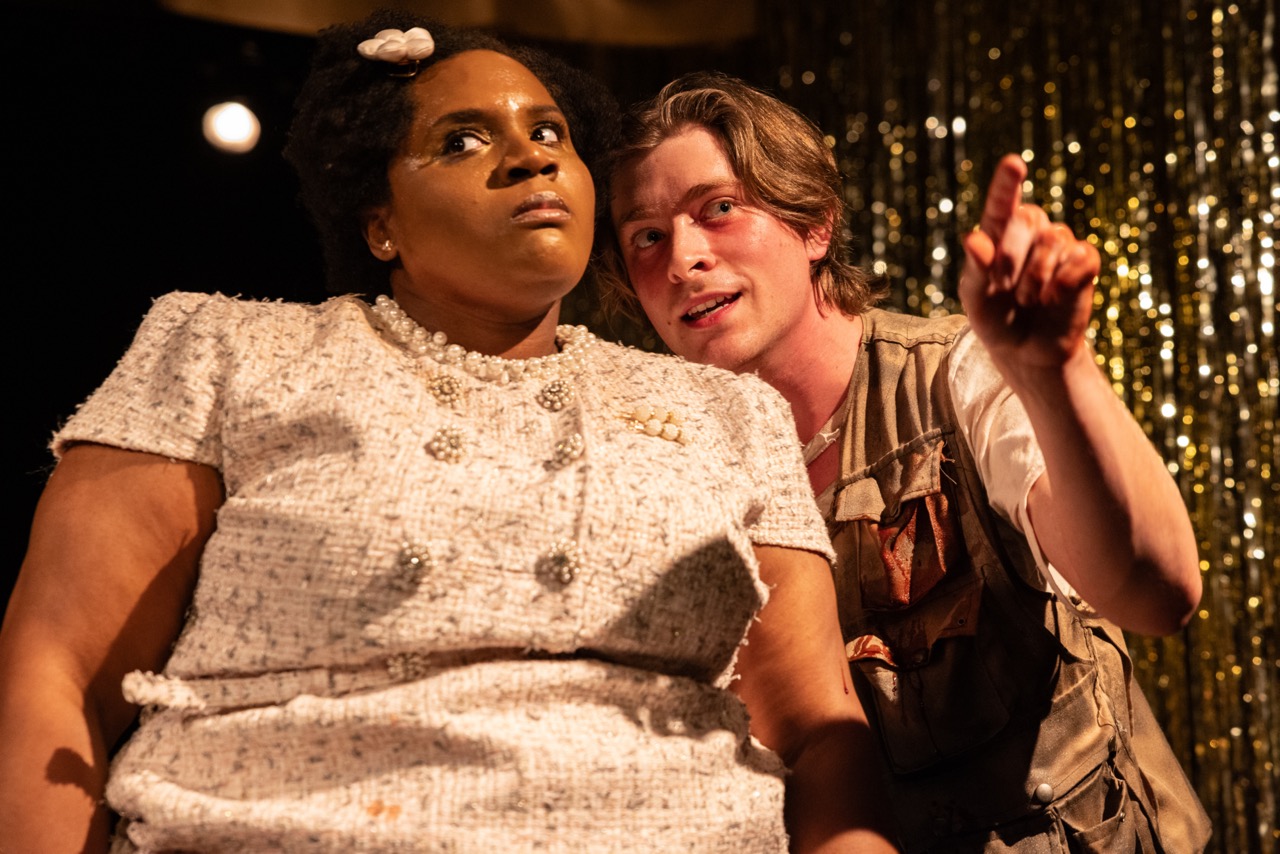
When Harriet encounters Hartman, the drag of the scene is initially comic. Howley plays Hartman as a banal, smarmy middle manager; Murray plays Harriet in what I can only describe, with love, as full Shakespeare claw — punctuating syllables with raptor talons, consonants over-articulated, the vowels bulging out like Elizabethan grapes. I was laughing so hard I was genuinely concerned I would piss myself in a Chinese restaurant chair. The register-clashing sends one clean off their chops.
And then there's a tonal shift. When Hartman blithely asks her, "Are you comparing me to a ghost?" Harriet loses her shit.
The humor instantly curdles into ice as the historical machinery is clocked: Harriet's breakdown, at first, seemed to only be manic melodrama. And then the audience is clued in. It's the unadulterated horror of realizing that the man who destroyed Harriet's life is already dead. You cannot murder a perpetrator who is already dead. There can be no justice after-the-fact.
Harriet identifies Hartman, finally, as Informant PS3478. During the rise of the between-wars fascism, Harriet and Hartman's own sister, Nettie, had met in the dark at the edge of the forest, dreaming aloud about Paris and a literary salon, warm drops of rain running down the ridge of their noses. Hartman turned them in for rank. Nettie disappeared one dawn, led into the morning fog by uniformed neighbors who had, until that week, been boys she ate lunch with. She did not come back.
Hartman survived the war and then, at the very minute Harriet was finally reading his signature on her file, died ingloriously of salmonella, in an outhouse. "Shut up, you self-victimizing fuck," Harriet spits, when Hartman tries the oldest line in the collaborator's handbook, the one about being a cog in a machine. "You took Nettie away from me for a fucking job."
Then, from the sound booth, a revenge guitar riff rips through the room with the swagger of a video-game boss-fight fanfare. The farce is officially over. The reckoning begins.
Photo credit: Walter Wlodarczyk
Hormones in Pink Nylon
Somewhere around the climax, the production detonates its most audacious formal gambit. Leonie Bell fractures her own stage presence, multiplying into a feral gang of teenage schoolgirls clad in matching pink 1980s nylon windbreakers: Blephany, Katie A, Katie B, and Katie C. (Who was Blephany in a past life? What were her parents thinking? These are not questions the play intends to answer.)
The Katies are, we come to understand, Harriet's own adolescent hormones, materialized as a chorus of unleashed id — her rage, in braces, in a shiny windbreaker, swinging a hockey stick. The Mean Girls parody is razor-fine ("What the fuck, Blephany?") and then, without warning, Murray steps into the light and delivers a soliloquy with the furious geometry of Hamlet's Act III, Harriet standing in the archive, Harriet standing in the forest, Harriet reading the file.
And then — and this is where you need to understand that Bailey van Schepen is doing some of the most committed gore design currently happening in New York — the hormones turn carnivorous. The Katies swarm Hartman Schneider and dismember him. The first row is designated as a splash zone. It is sickeningly credible stage blood and tissue and viscera.
Meanwhile, offstage left — and this is maybe the single greatest staging choice in the show — Marcella Murray performs a masterclass in acting. Harriet, having finally gotten the thing she has wanted for eighty years, cannot watch. She looks away. She is pulled back. She dry-heaves. She vomits. She looks away again. She is pulled back. She vomits again. There was a whole show happening in her reactions. Readers, at this moment I simply could not. I simply cease being able to could.
Photo credit: Walter Wlodarczyk
The Mop, the Head, the Guts
"This is a revenge play" is said multiple times throughout. Though cloaked in cabaret glamour, the production hides none of its seams. In true Brick tradition, the stagehands do not scurry in the dark; the house lights remain hot while the labor of theatrical maintenance is laid bare.
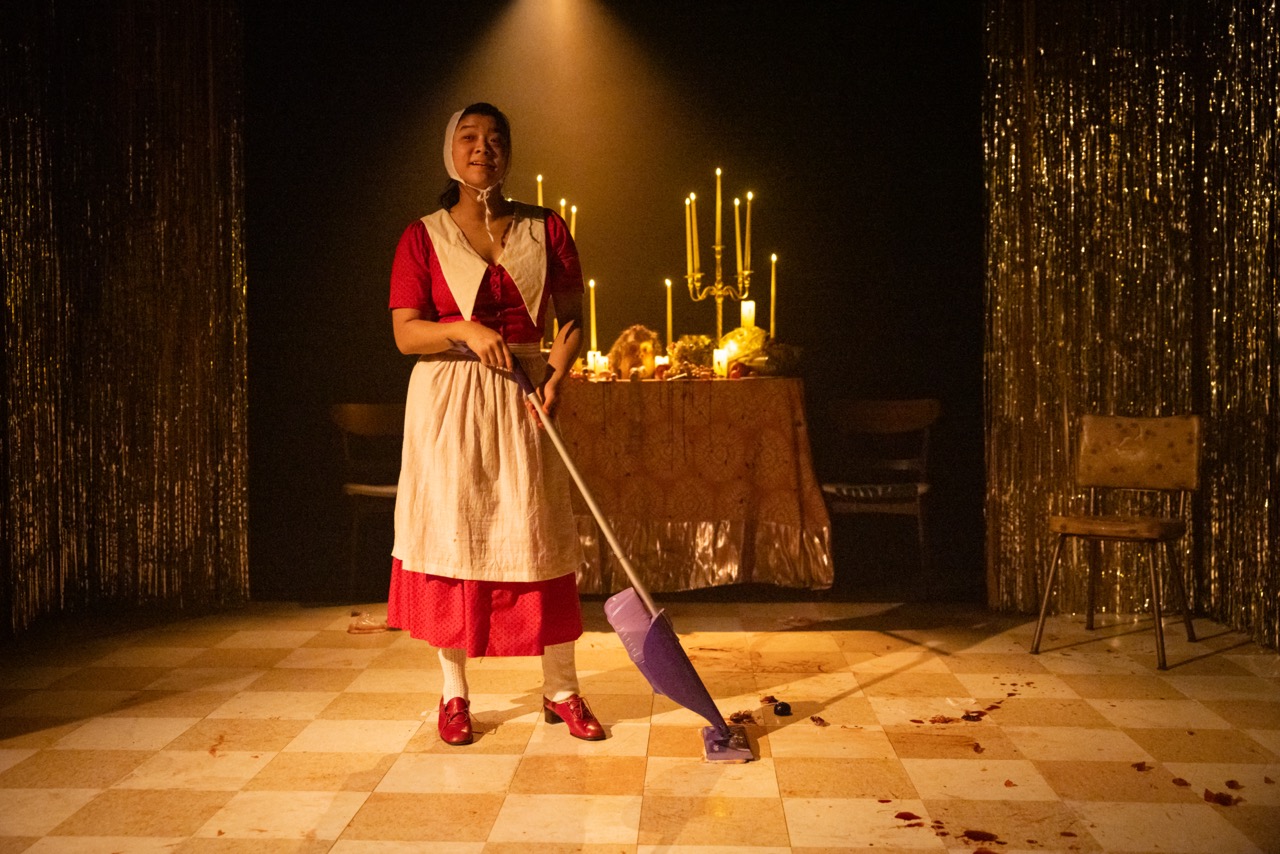
Stella Oh re-enters, in her nurse uniform, pushing an electric mop which hysterically squirts jets of water across the gore-slicked linoleum in a routine of pure, giddy clown precision. It is maybe my favorite ninety seconds of theater all year.
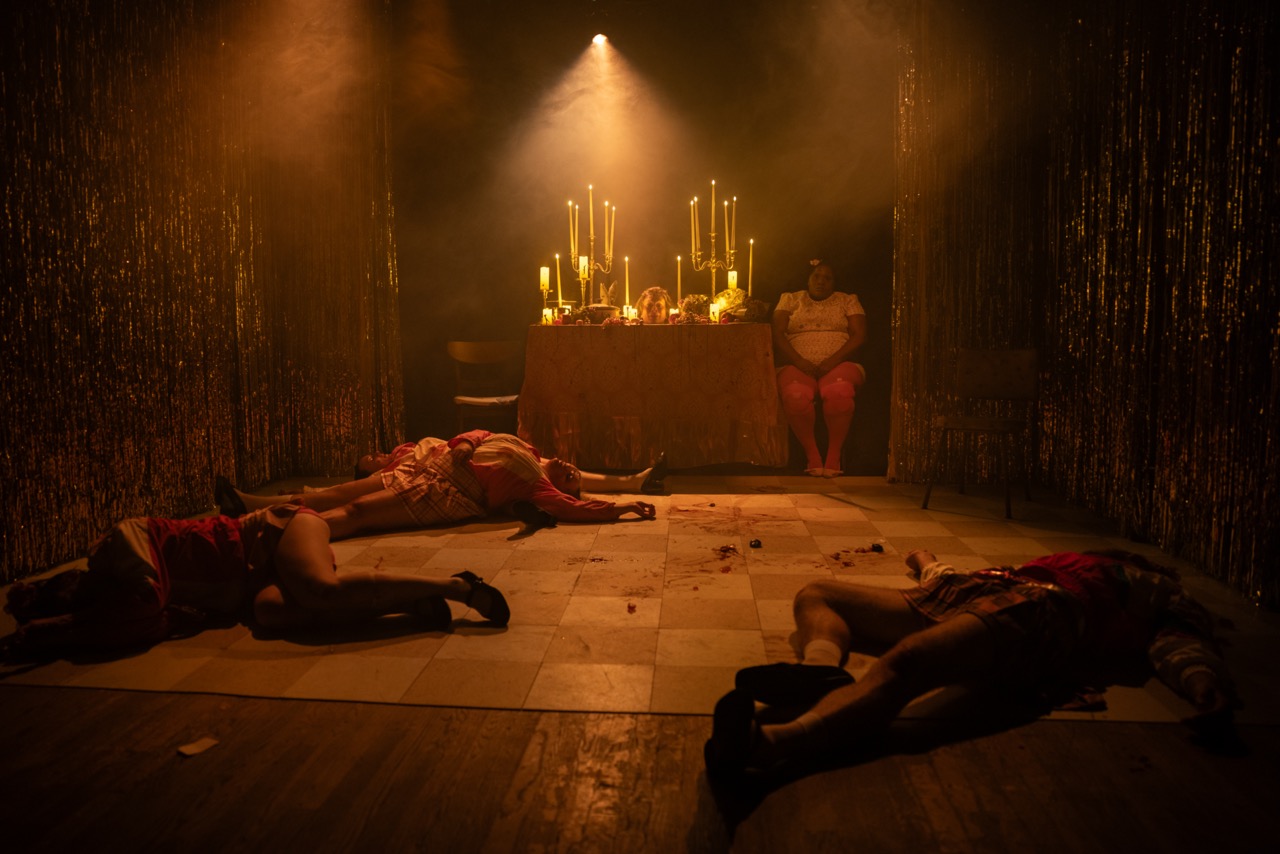
Moments later, Hartman's severed, bloody head is wheeled onstage atop an ornate, candelabra-festooned altar billowing thick clouds of stage fog — an exquisite, gothic scenic centerpiece built by Forest Entsminger and prop designer Jon Schatzberg.
Photo credit: Walter Wlodarczyk
The Final Diagnosis: Delirious Art as the Only Antidote to History
Im Dunkeln sieht man besser is a triumph of radical downtown theatre. Running a disciplined 85 minutes, it demonstrates that true theatrical ambition does not require two-and-a-half hours of self-indulgent pacing.
By anchoring its wild multilingual wordplay, drag numbers, and bouffon clowning to a rigorous geometric structure, Local Grandma ensures that every splash of fake blood and every comical digression serves the larger architecture of grief. The thing that keeps absurdism from becoming merely annoying is precisely its rhizomes, its underlying rhymes, against which the chaos can be heard as music.
The design triumvirate of Karen Boyer (costumes), Celia Krefter (lighting and co-direction), and Forest Entsminger (scenic) crafts a world that is visually hilarious yet emotionally suffocating. Bell's sound design operates as an active psychological combatant, while the fearless ensemble never lets a single beat drop.
My dopamine receptors left the theater charred. My faith in what a small Brooklyn room with a tinsel curtain and some ex-restaurant chairs can still do to a person has been restored. The title is right. In the dark we do see better.
Photo credit: Walter Wlodarczyk
Reviewed by Aubrey Wang
Theatre
Im Dunkeln sieht man besser
You See Better in the Dark
Eighty-five minutes of necro-cabaret, bouffon clowning, and operatic stage gore from the Brooklyn company Local Grandma — a cemetery, a Homeowners Association of the undead, and one long-delayed reckoning with historical persecution.
Hilla and Katey C Leonie Bell Frederick, Kevin, Death Nurse Mathilda, Stephanie CHEEKS Franco, Jurgen, Death Nurse Bathilda, Blephanie Julliette Holliday Rainer and Katey B Theodor Gabriel Harriet Marcella Murray The Professor, Hartmann John R. Howley Biggi Hanna Westi Screaming Title Maid Stella Oh
Text Leonie Bell Direction Leonie Bell and Celia Krefter Costume Design Karen Boyer Fight Choreography and Gore Design Bailey van Schepen Lighting Design Celia Krefter Scenic Design Forest Entsminger Associate Scenic and Props Design Jon Schatzberg Sound Design Leonie Bell Stage Management Akvinder Kaur and Stella Oh Board Operator Akvinder Kaur Run Crew Stella Oh Press and Marketing Privy Producing Collective Producing Team Leonie Bell and Celia Krefter Carpentry Eric Hedlund Costume Support Eliza Voorheis Costume and Scenic Support Clara Gumbart Lighting and Scenic Support Jason Driver Scenic Support Obi Nwako and Mae Schuberth
Langue | Language English and German Durée | Running time 85 minutes, no intermission Avertissement | Content notice Contains stage gore, dismemberment, historical trauma, strobe, and sudden loud sound. Also: please do not bring walnuts.
Venue The Brick Theatre 579 Metropolitan Avenue, Brooklyn


%402x.svg)


.webp)


