

Meltdown Review — Alex Aguirre at Unit J 2026
Aubrey Naur reviews Meltdown by Alex Aguirre at Unit J, Bushwick, 2026 — a cyberpunk staged reading.
Aubrey Naur reviews Meltdown by Alex Aguirre at Unit J, Bushwick, 2026 — a cyberpunk staged reading.
%402x.svg)
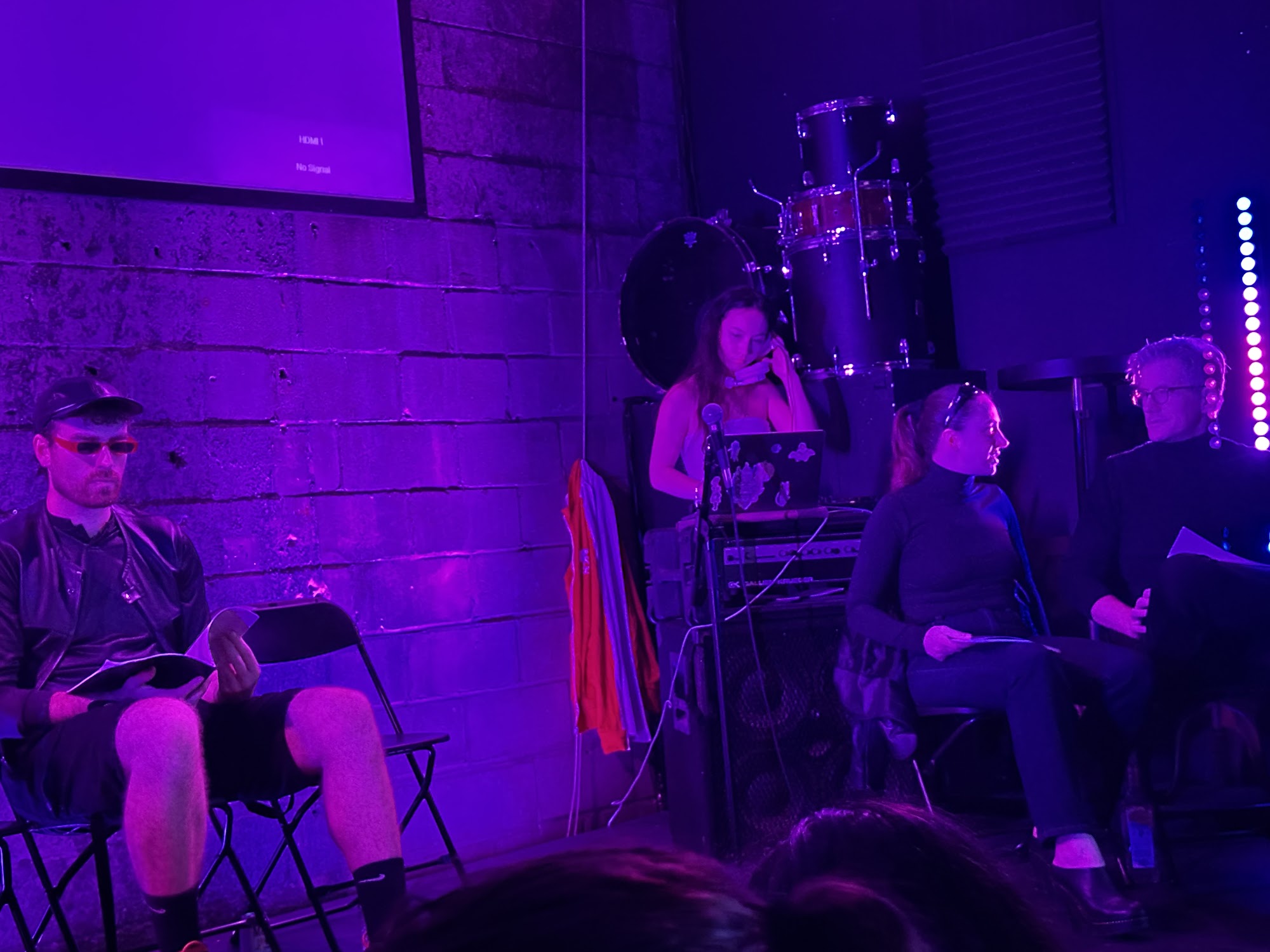
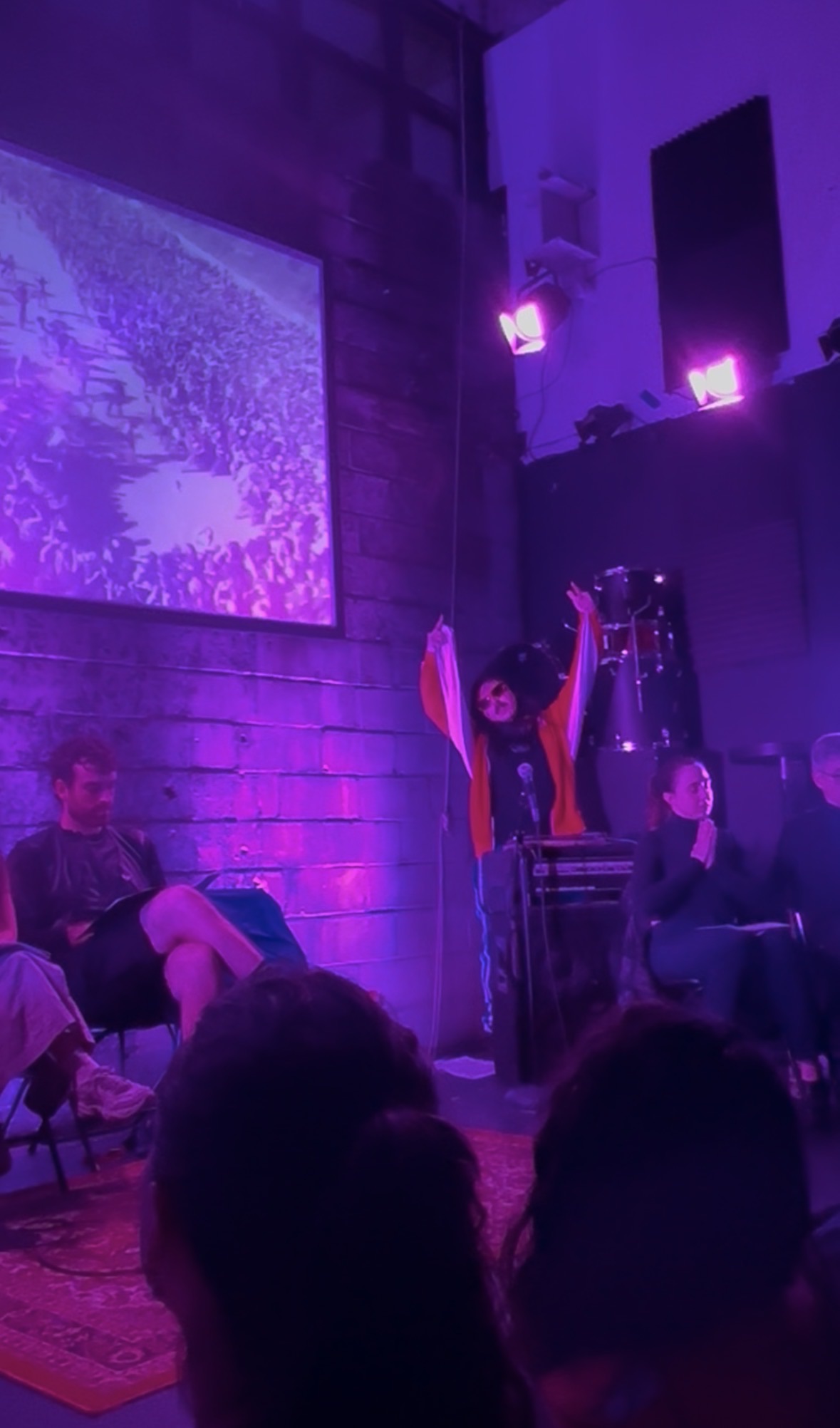
Alex Aguirre, the show's creator and ambient MC, points at the bathroom. He explains that during the show it will be "quiet time," unless you really need to go, in which case, "maybe I won't. I don't know. You gotta find out." The audience, perhaps ninety people slung across human-caterpillar-style directors' chairs in a converted industrial unit in Bushwick, laughs the particular laugh of people who are hoping they are not about to see something embarrassing. Then Aguirre, in wraparound sunglasses and a knockoff Adidas bomber, shouts, "Let's get this fucking shit started," and we are off.
Meltdown is one of the strangest and most assured pieces of indie theatre I've seen since whatever we're calling the post-Dimes Square era began — a de-venue-ized Mad Max wasteland in which the people who used to sublet their lofts to performance artists now sublet them to compliance consultants, and the shows have migrated into warehouses, basements, and the occasional Airbnb. Unit J, which you can only locate if you are already on the right email list, is one of the holdouts.
The event is a staged reading, which is to say that the actors hold scripts and read from them, and an uncredited narrator (she was great) reads the stage directions aloud in the tone of a notary witnessing a will.
The vibe, if I may be gestural: it is a Zoomer reimagination of MySpace blog fever. It is the cultural equivalent of finding a floppy disk in a drawer and running it on a borrowed Dell. It is, as one of my seatmates whispered to me, "Belly by Hype Williams, but with white people." Alice Jokela spins, pre-show, uplifting psychedelic trance beats to study and grind to. The whole aesthetic is a kind of psychedelic flywheel of dude-isms, in which every reference points back to another reference, and the only way out is through.
The plot is this. Somewhere in a dimension called Dimension A two bureaucrats discover that their galaxy is about to be destroyed. On January 1, 2000, it will annihilate every "lesser dimension" in its path. "Lesser" here is a technical term: the universe sorts dimensions not by physical mass but by quantum mass, which is measured in units of human consciousness. Whichever version of Earth has more conscious people, survives. Whichever has fewer, is "quantum cannibalized" — devoured by its denser twin.
Dimension A has one million fewer humans than its counterpart, which the strategist Cormorant (Zach Wegner) and the engineer Sparrow (Tatienne Hendricks-Tellefsen) have taken to calling Pop Earth, "due to its obsession with popular culture from what we've come to know about it in this last week of research." Pop Earth is, of course, our Earth, in December of 1999.
Cormorant and Sparrow — their names so Soviet-era-spy-coded it credibly justifies the turtlenecks — must find a way to kill a million people on a dimension they cannot physically visit. They can, however, hack the primitive 1999 internet. And on that internet, they find Edgar Sand (Nick Walther), a disgraced philosophy adjunct who has reinvented himself as a doomsday blogger, and whose readership is, in Sparrow's lovely phrase, "voracious, hungry for the impetus of self-destruction to be delivered to them by their esteemed cyber prophet."
I need "quantum cannibalised" on a T-shirt.
Edgar is bleary, operatic, mid-monologue at any given moment. Cormorant and Sparrow email him anonymously, posing as an underground fan club with resources. They attach a floppy disk containing a bespoke virus. They nudge him to persuade his girlfriend Phoebe (Alice Jokela), who works at a browser company called Webscape, to swap the disk into her office computer. They nudge him to extort Jill Yates (yes), the CEO of Macrohard (yes), into funding what will eventually become a rave-circuit viral marketing campaign for a drug called sludge.
The premise is a pastiche so straight-faced it horseshoes past parody into pathos. Here is the aggrieved man. Here is the invisible hand on his back. Here is the audience that will cheer when he jumps. The machinery of influence doesn't care about truth; it cares about engagement. The aliens don't need Edgar to be right. They just need him to go viral.
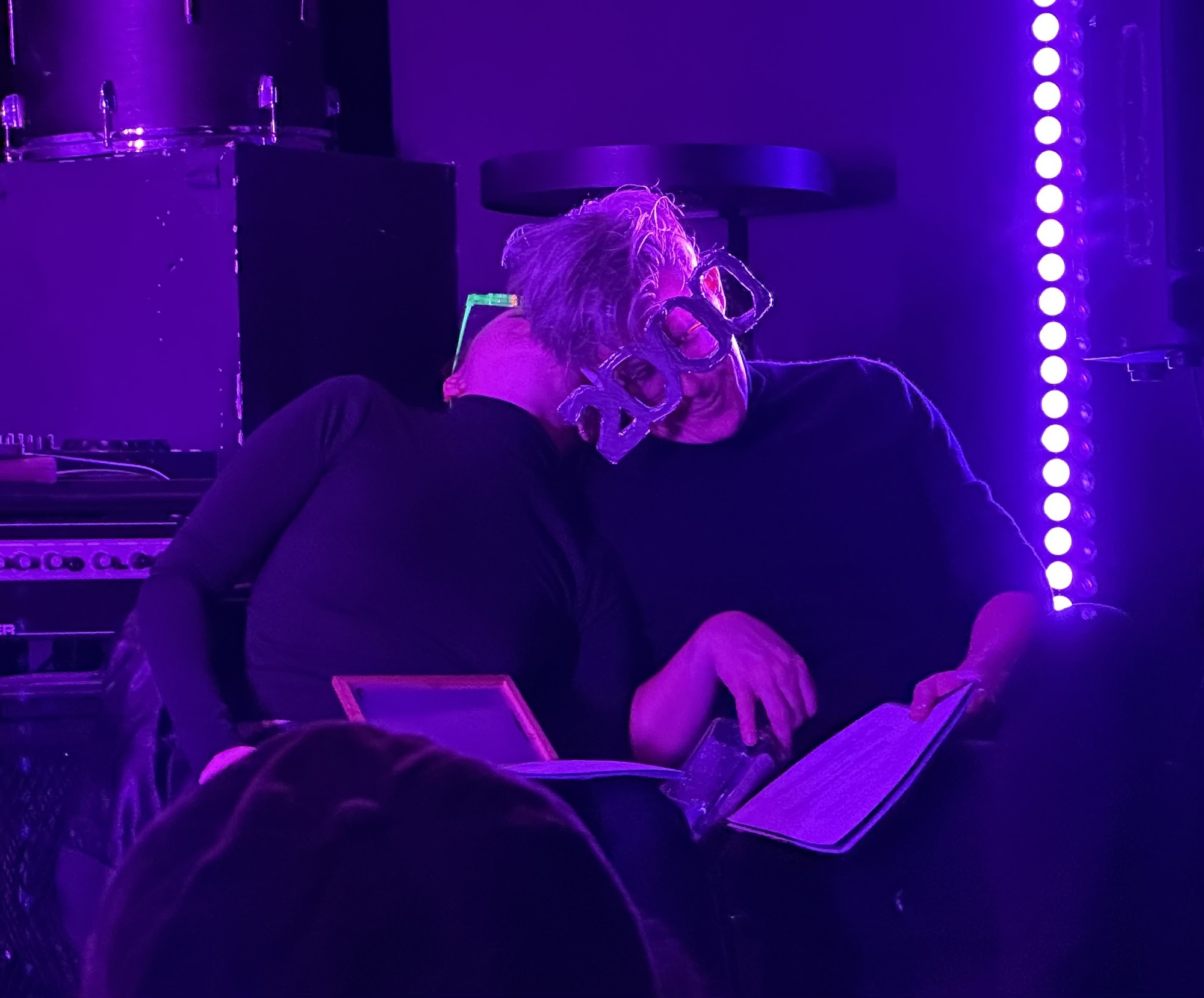
The script is dense. Characters do not speak so much as declaim. Edgar's blog posts, which Phoebe reads aloud in one devastating early scene, are nineties cyber-mystic prose that sounds, when you squint, like it could be either genius or an undergraduate who has just discovered Baudrillard. Walther, delivering Edgar's failed poetry with classical conservatory diction, treats the lines as if they were Milton.
And then there is the narrator — the voice of a court stenographer, or an actuary. By externalizing the stage directions, Aguirre has done something clever and almost unfair: he has turned the production's limitations (no set, no props, no fourth wall) into the production's content. The narration becomes a bureaucratic frame that lets the actors behave with grotesque theatrical maximalism inside it.
Walther's Edgar is the standout. In 2023, Peter Vack's Hamlet at KGB suggested, memorably, that Shakespeare knew nothing of incest trauma the way a New Yorker knows it; in 2026, Walther suggests that the 1999 internet knew nothing of speed addiction the way a modern man with an ADHD prescription and a Substack knows it.
Spencer Crames, as Edgar's drug-dealer DJ pal Cliff, is a wonderful hollow-eyed scammer. Alice Jokela's Phoebe is given the hardest and most thankless job — to be the voice of the normal — and you can tell she has already decided, three scenes before her exit, that she is going to break up with him.
Hendricks-Tellefsen and Wegner, as the aliens, could easily have been a bit. Instead they play Cormorant and Sparrow with the exact contempt-tinged sexual tension of two senior Politburo apparatchiks who have been working on the same wiretap for twelve years. Their scenes are played mostly to the audience, with the two of them perched on tall stools at stage right, scrolling through Edgar's blog with mounting horror.
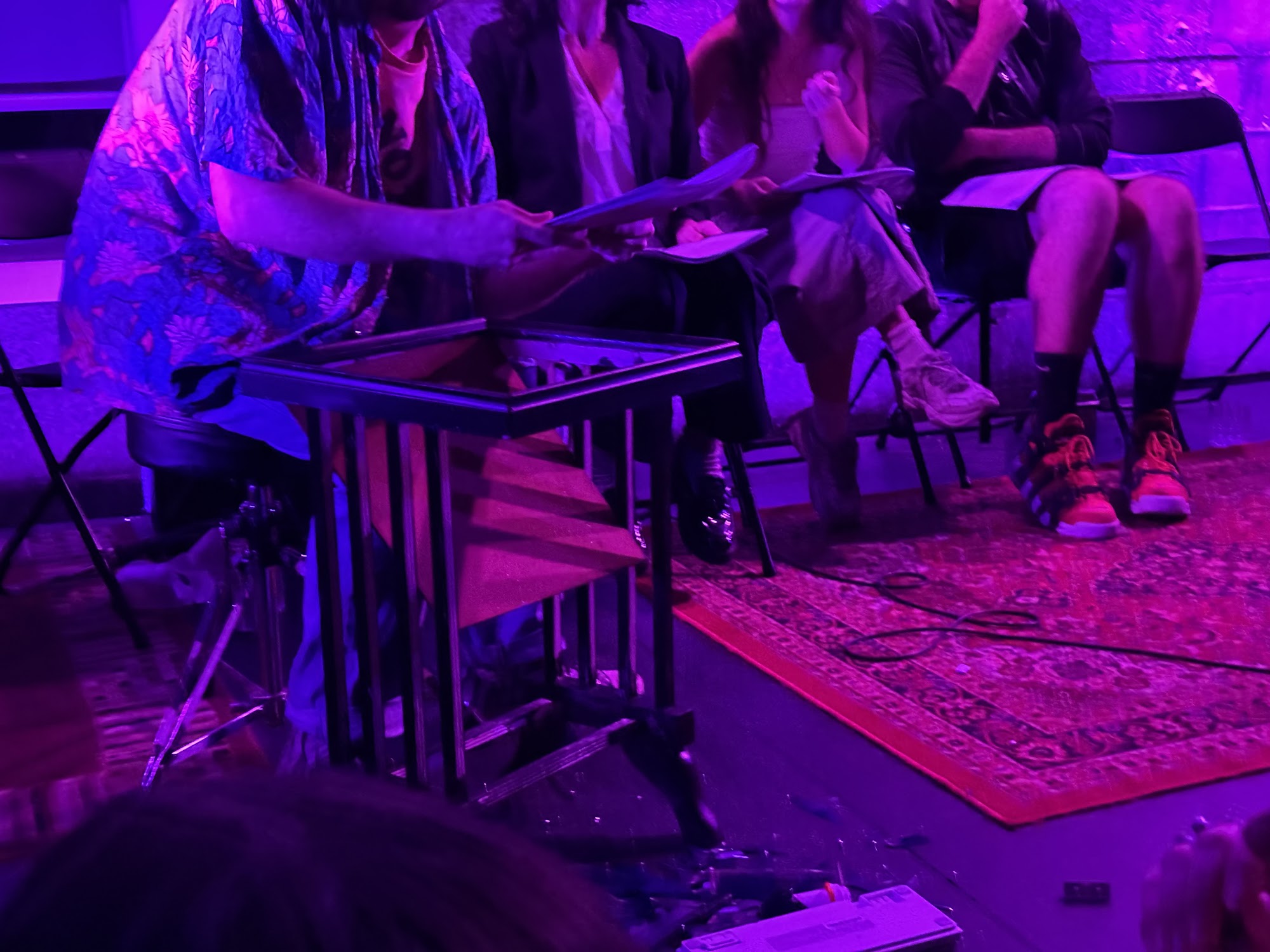
Halfway through, somebody smashes real glass. I don't want to spoil which somebody or whose glass. Not sugar glass, not stage glass, real tempered pane shattering across what passes for the stage. The audience, which had been in a kind of pleasant trance, snapped to attention. Someone behind me said, with absolute sincerity, "That was an epic moment in American Theatre."
The audience at Unit J did not go outside and smoke; it stayed inside and loitered. I overheard, in a single ten-minute span: (1) a woman explaining to a man that she'd found Unit J "through the Hidden Cities mailing list," which, she clarified, was "like some list of DIY venues that have shows"; (2) a man explaining that he'd paid fifty dollars for a Cameo from Bam Margera in which he'd attempted to get Margera to read the first paragraph of the Communist Manifesto; (3) a conversation about a Big Brother–style reality show called Fish Tank, in which, apparently, "a Black chick went in, and they were, like, show us your tits"; (4) a man announcing that this year his nine-eleven party was going to feature Fish Tank on a projector; and (5) a long detour into whether Australians really call pickup trucks "utes."
The intermission at Meltdown is a documentary about who comes to a play like Meltdown. The characters in the show use words like cytomorphic and lemon dicks; the audience in the show uses words like kayfabe.
The second half tightens. Edgar's extortion plot resolves. Macrohard capitulates. Webscape, "creators of the world's leading internet browser," that all of its data has been erased by a virus so advanced that its CEO "shudders to think" of what else such a criminal might do. Cliff and Edgar get paid partially and threaten to leave; Jill Yates double-crosses them; the police arrive; the drug called sludge enters the market; the rave turns into a riot; people die.
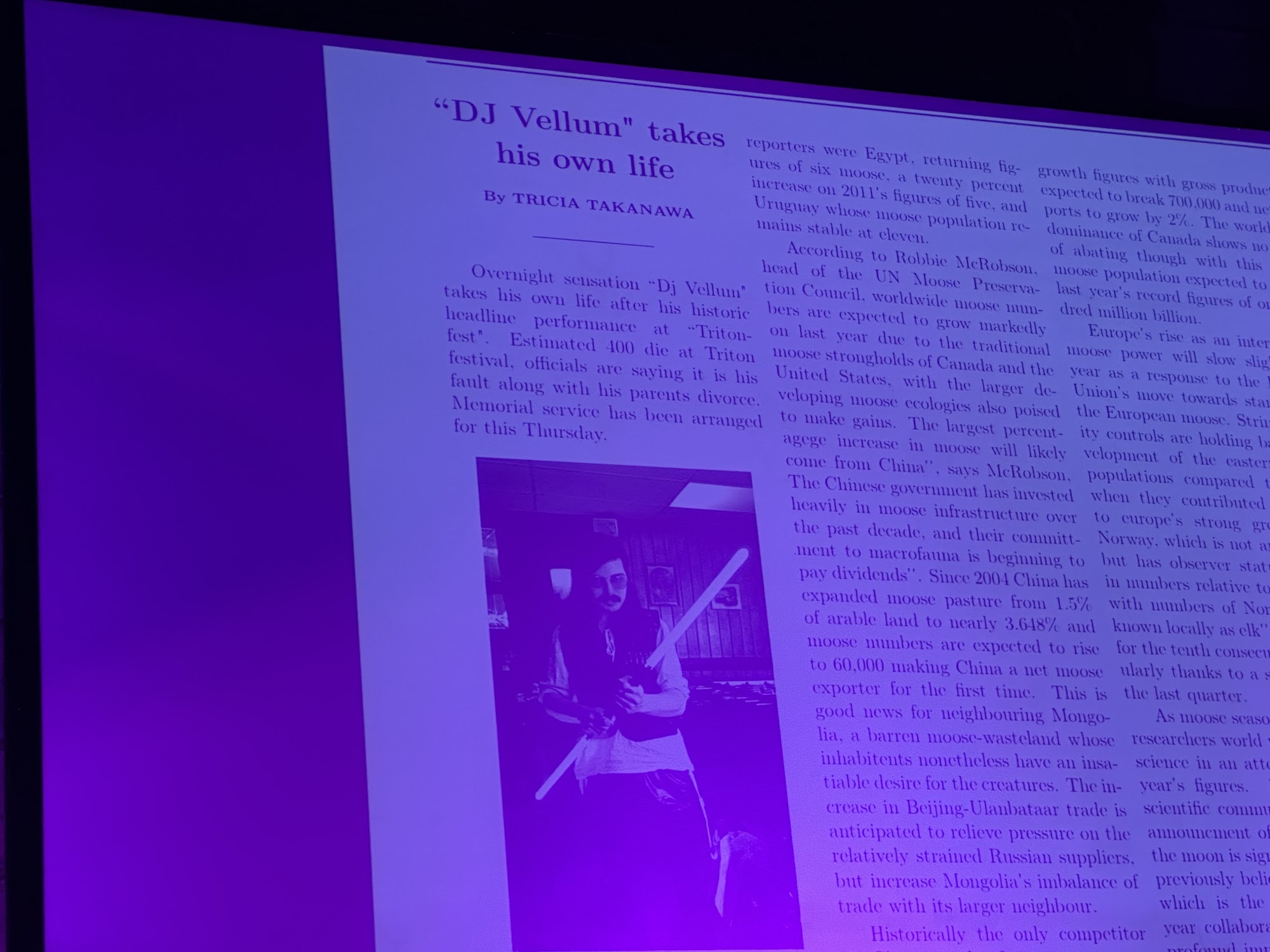
The clock ticks over. Nothing explodes. The dimensions do not cannibalize. Or maybe they do, and we are the losers, and we don't know yet. It's Y2K.
Meltdown is about the fact that we keep waiting for the apocalypse, and that waiting is itself a kind of participation, and that the participation is itself a kind of apocalypse. "The nature of his utopianism doesn't really concern us," Sparrow says to Cormorant, early in the play. What concerns the aliens is only that Edgar keeps posting.
There is simply no other show in New York right now where you can get quantum cannibalization, a blog-induced world war, a Fish Tank recap, an Australian lesson in automotive vocabulary, a real pane of broken glass, and an MC who could credibly sell you Adderall, a ticket to the afterparty, and a polycrene bomber jacket, all in the same evening. Pluto Theater's Meltdown is the rave at the end of the world.
Reviewed by Aubrey Naur
A cyberpunk comedy. It's 1999. DJ Vellum's spinning at Schism tonight. Two dimensions are at war and only one of them knows it. Keep an eye out for Edgar's next blog post and stay hydrated.
Instagram @alchemistaguirre, @tatienneht, @zachwegner, @spencecrames, @lowcloutnick, @alicejokela, @megmaccary
.webp)


