Cimetière des voitures Review — Productions du cours des choses at MTL Fringe 2026
Y'all heard of sex while camping? I heard it's fucking in tents. Le Cimetière des voitures by Fernando Arrabal, adapted by Prod. Cours des choses, Montreal Fringe 2026
Le Cimetière des voitures
Y'all heard of sex while camping? I heard it's fucking in tents.
Montreal Fringe 2026 By Fernando Arrabal L'Aréna St-Michel Presented by Productions du cours des choses Directed by Laurent Forget
Reviewed by Aubrey Wang
Y'all heard of sex while camping? I heard it's fucking in tents.
I'm sorry. I know. I know no one else finds it funny, but I find it hilarious, and I have been waiting since the moment the house lights came up at the Centre du Théâtre d'Aujourd'hui to inflict it on someone.
In tents. Intense. Do you get it? I am, at heart, a dad in a twenty-four-year-old girl's body, and this is the cross I bear, along with a small number of other more consequential ones.
The reason I am insisting on the joke, beyond the obvious pleasure of the pun, which I want you to know I take very seriously, is that it happens to be the most economical possible description of how Fernando Arrabal'sCimetière des voitures has sat with me since the Montreal Fringe on the evening of the twenty-fourth of June: in tents, and intense.
The Original Cimetière des Voitures
Arrabal wrote Cimetière in 1958, in Paris, in exile from Franco's Spain, before he co-founded the Panic Movement with Alejandro Jodorowsky and Roland Topor — a ragtag confederacy of surrealists, ritualists, blasphemers, and pranksters, most of whom would go on to make more famous work than this play.
The play is set in a junkyard, or rather a graveyard for cars, in an unnamed dystopia where music has been outlawed and a militia hunts the poor. A group of itinerants live in the wrecks. At the centre of the group is Émanou, a trumpet player who leads secret nocturnal concerts so that the poor, who cannot afford to attend legitimate spectacles, might still have something to dance to. Then, as Christ figures must go, he is beaten, betrayed, arrested.
If you have somehow missed the reference, Arrabal will helpfully have Émanou explain that his mother gave birth to him in a stable because no one else would take her in, and that a cow and a donkey warmed the newborn with their breath.
Le texte original
Arrabal a écrit Le Cimetière des voitures en 1958, à Paris, en exil de l'Espagne franquiste, avant de cofonder le Mouvement Panique avec Jodorowsky et Topor. La pièce se déroule dans un cimetière de voitures, dans une dystopie sans nom où la musique est interdite et où une milice traque les pauvres. Un groupe d'itinérants vit dans les carcasses. Au centre : Émanou, trompettiste, qui organise des concerts nocturnes clandestins pour que les pauvres, incapables de se payer les vrais spectacles, aient quelque chose sur quoi danser. Il est battu, trahi, arrêté. Au cas où on manquerait la référence, Arrabal fait dire à Émanou que sa mère l'a mis au monde dans une étable parce que personne d'autre ne voulait d'elle, et qu'un bœuf et un âne l'ont réchauffé de leur souffle.
The Accidental Émanou
Here is what happened, as best I can reconstruct it. On the afternoon of the show, the actor cast as Émanou was hit by a bicycle, or hit while bestrode upon a bicycle, fatally-adjacent enough that he could not perform.
Forget, the show's director, came out before the play began, looking like he'd spent the previous three hours making phone calls, and petitioned us to "soyez indulgents avec moi, je ne suis pas comédien" (be indulgent with me, I'm not an actor) and the audience, being a Fringe audience, obliged.
Then he asked, in the same breath, for indulgence avec les autres comédiens qui ont un nouveau partenaire de jeu — with the other actors, who suddenly had a new scene partner. That's the part that got me good, the apology not for himself but for the cast.
This is best thing that could have happened to Cimetière des voitures. Let me tell you what I mean.
L'Émanou accidentel
L'après-midi de la représentation, l'acteur qui devait jouer Émanou s'est fait frapper par un vélo — ou en a frappé un — assez fort pour ne pas pouvoir jouer. Forget, le metteur en scène, est sorti avant le début, l'air d'avoir passé les trois dernières heures au téléphone, et nous a demandé « soyez indulgents avec moi, je ne suis pas comédien », et le public, étant un public de Fringe, s'est prêté au jeu. Puis il a demandé, dans la même respiration, d'être indulgents avec les autres comédiens, qui héritaient soudain d'un nouveau partenaire de jeu. C'est ça qui m'a eue : les excuses pour la troupe. C'est la meilleure chose qui pouvait arriver à cette pièce.
Laurent Forget as Substitute
Émanou is a substitute. He's a character who has memorized the words of goodness, who quotes them back on cue like a well-trained parrot, who does not appear to understand any of them. Je l'ai appris par cœur, he says of the definition of goodness he keeps stumbling through — I learned it by heart.
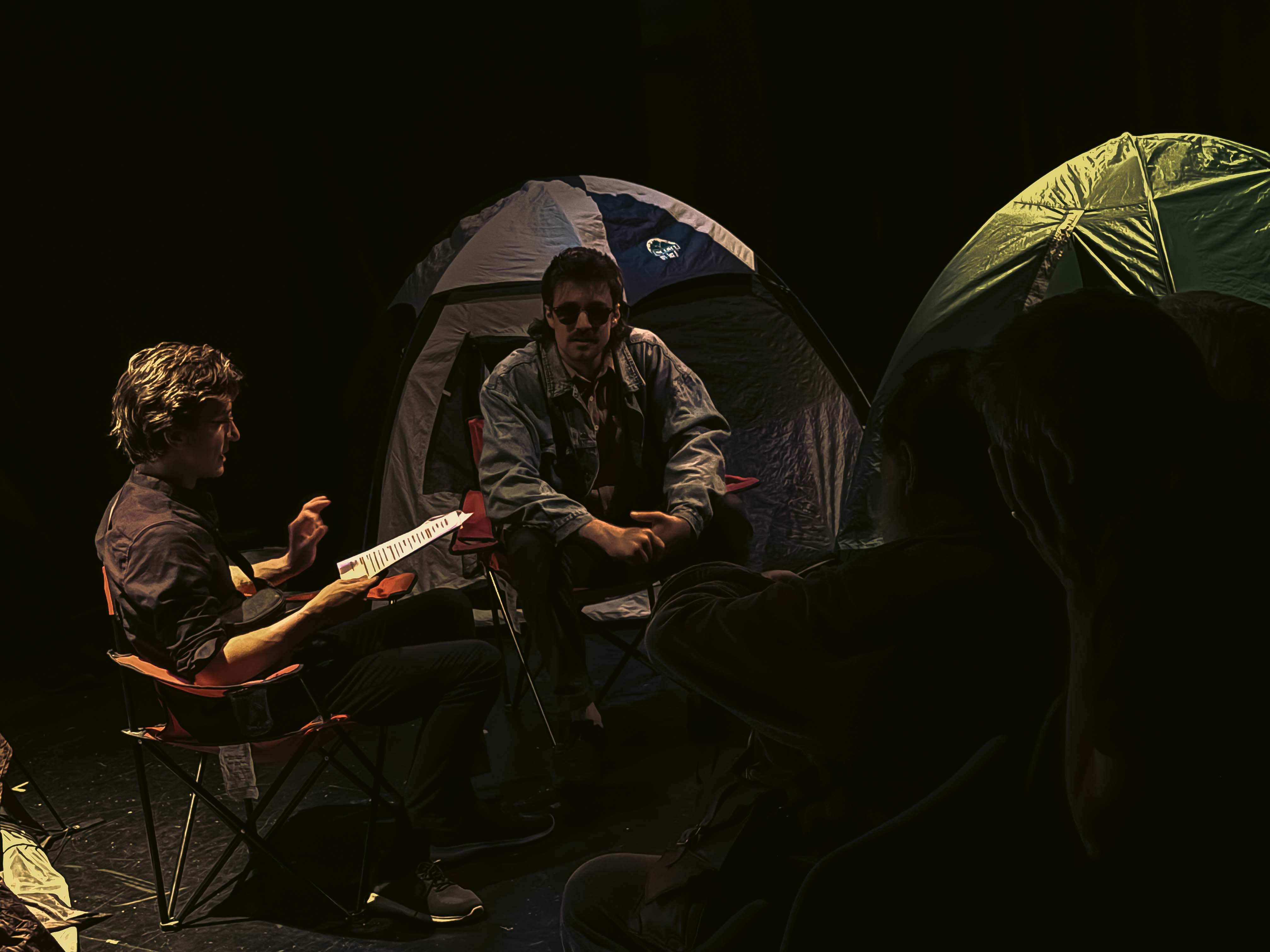
Forget is a slight man in glasses, the kind of glasses that slide down when you get animated, and he had a script, an unbound script, printed on office paper. He held it in front of him for the entire show. Forget did not have his lines by heart. He did, however, know the beats, with the exasperation of a director who has to line prompt nous serons enlacés comme deux ecureuils sous-marins (we will be enlaced like two underwater squirrels) one too many times.
Émanou is a stand-in for a truer, older Christ; the play is a stand-in for the Passion; and now, marvellously, a director named Forget was standing in for the actor who was supposed to play Émanou.
Émanou has been sent by his friends to sleep with Dila, and he explains, gravely, that he needs to become a man, and that he has no experience, and that when he looks at her des trains électriques dansent entre mes jambes — electric trains dance between his legs. Forget delivered it with a script in one hand and, if I remember correctly, a paper cup in the other. He was, at that moment, one of the funniest people I have ever seen onstage.
I don't want to be pious about accidents. Most of them are just accidents. But this one produced the correct Émanou by a perfect accident. If Forget had been reading from a binder as a choice, we would have called it Brechtian and rolled our eyes. But because he was reading from it because a man on a bike had ruined his afternoon, we called it grace.
Forget en doublure
Émanou est une doublure. Un personnage qui a mémorisé les mots de la bonté, qui les récite sur commande comme un perroquet bien dressé, sans en comprendre un seul. « Je l'ai appris par cœur », dit-il de la définition de la bonté qu'il continue de trébucher dessus. Forget est un homme mince à lunettes — le genre de lunettes qui glissent quand on s'anime — et il tenait un script, non relié, imprimé sur du papier de bureau, devant lui pendant toute la pièce. Il ne savait pas ses répliques par cœur. Mais il connaissait les temps, avec l'exaspération d'un metteur en scène qui a dû souffler « nous serons enlacés comme deux écureuils sous-marins » une fois de trop.
Émanou est une doublure d'un Christ plus ancien; la pièce est une doublure de la Passion; et là, merveilleusement, un metteur en scène nommé Forget doublait l'acteur qui devait jouer Émanou. Quand Émanou explique gravement à Dila qu'il doit devenir un homme, qu'il n'a aucune expérience, et que quand il la regarde « des trains électriques dansent entre mes jambes » — Forget l'a livré avec un script dans une main et, si je me souviens bien, une tasse de carton dans l'autre. À ce moment-là, c'était une des personnes les plus drôles que j'ai vues sur scène.
Je ne veux pas être sentimentale sur les accidents. La plupart ne sont que des accidents. Mais celui-ci a produit le bon Émanou par un accident parfait. Si Forget avait lu d'un cartable par choix, on aurait dit brechtien en levant les yeux au ciel. Mais parce qu'il lisait parce qu'un gars en vélo avait ruiné son après-midi, on a appelé ça de la grâce.
The Tents
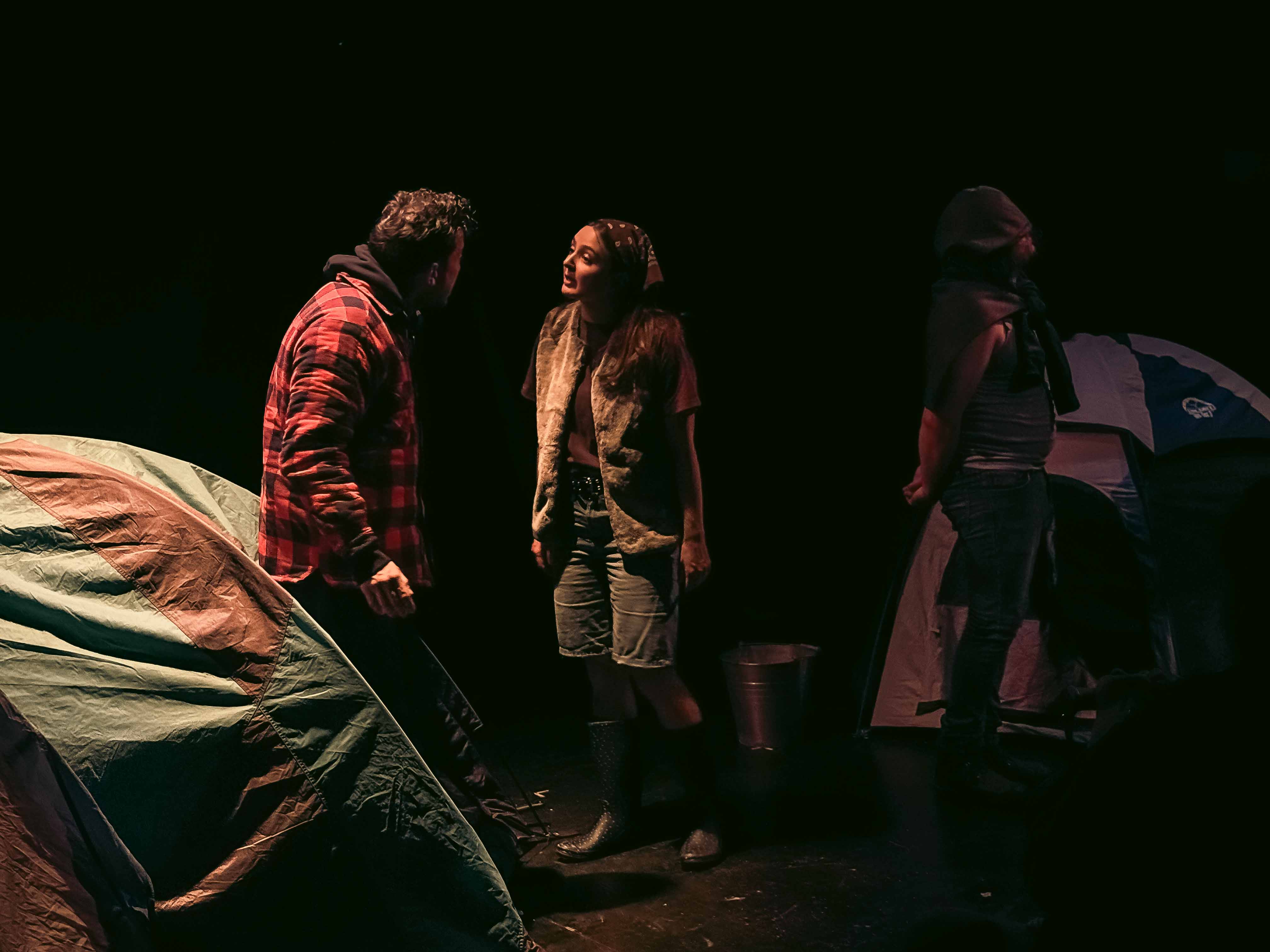
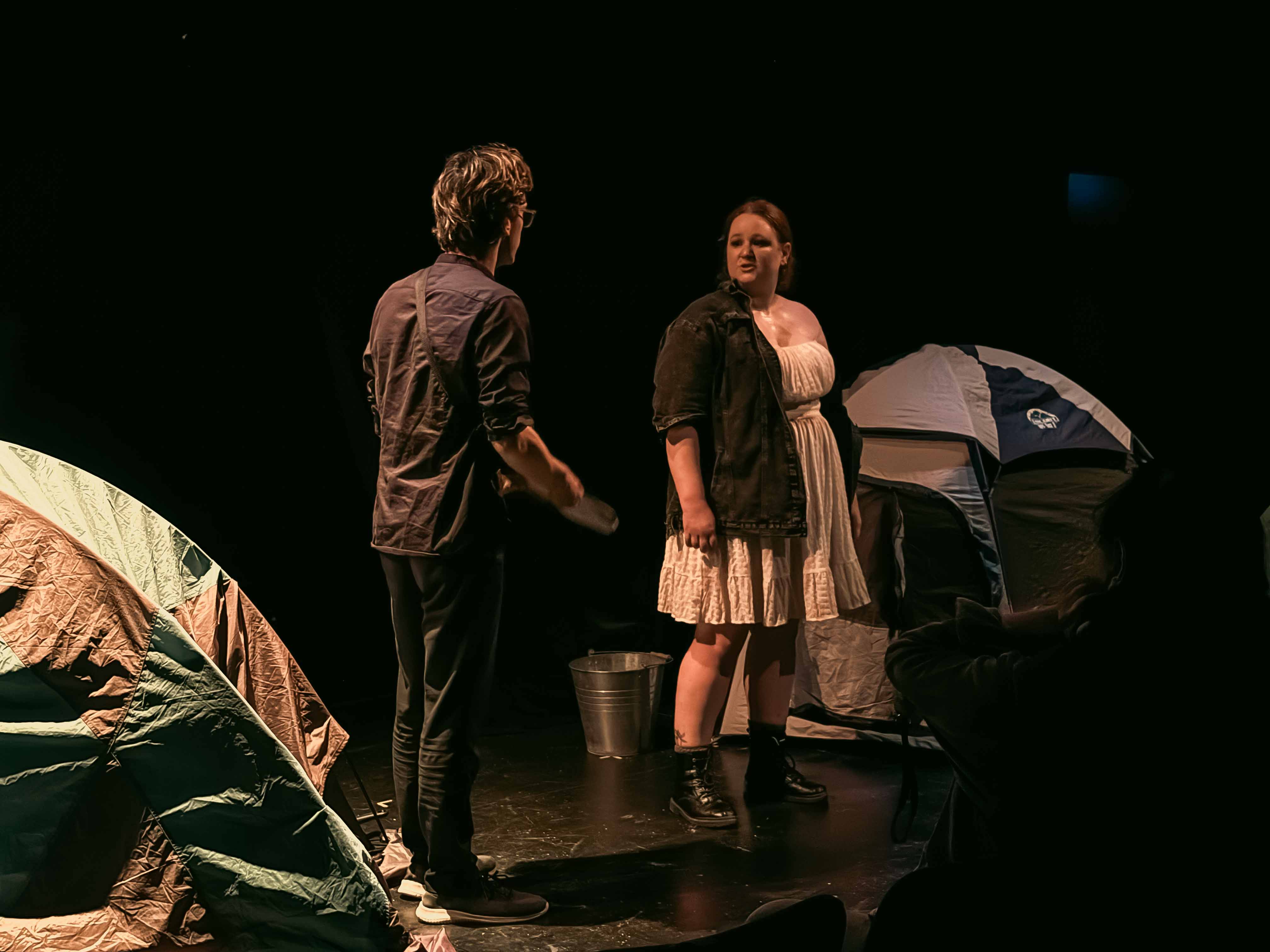
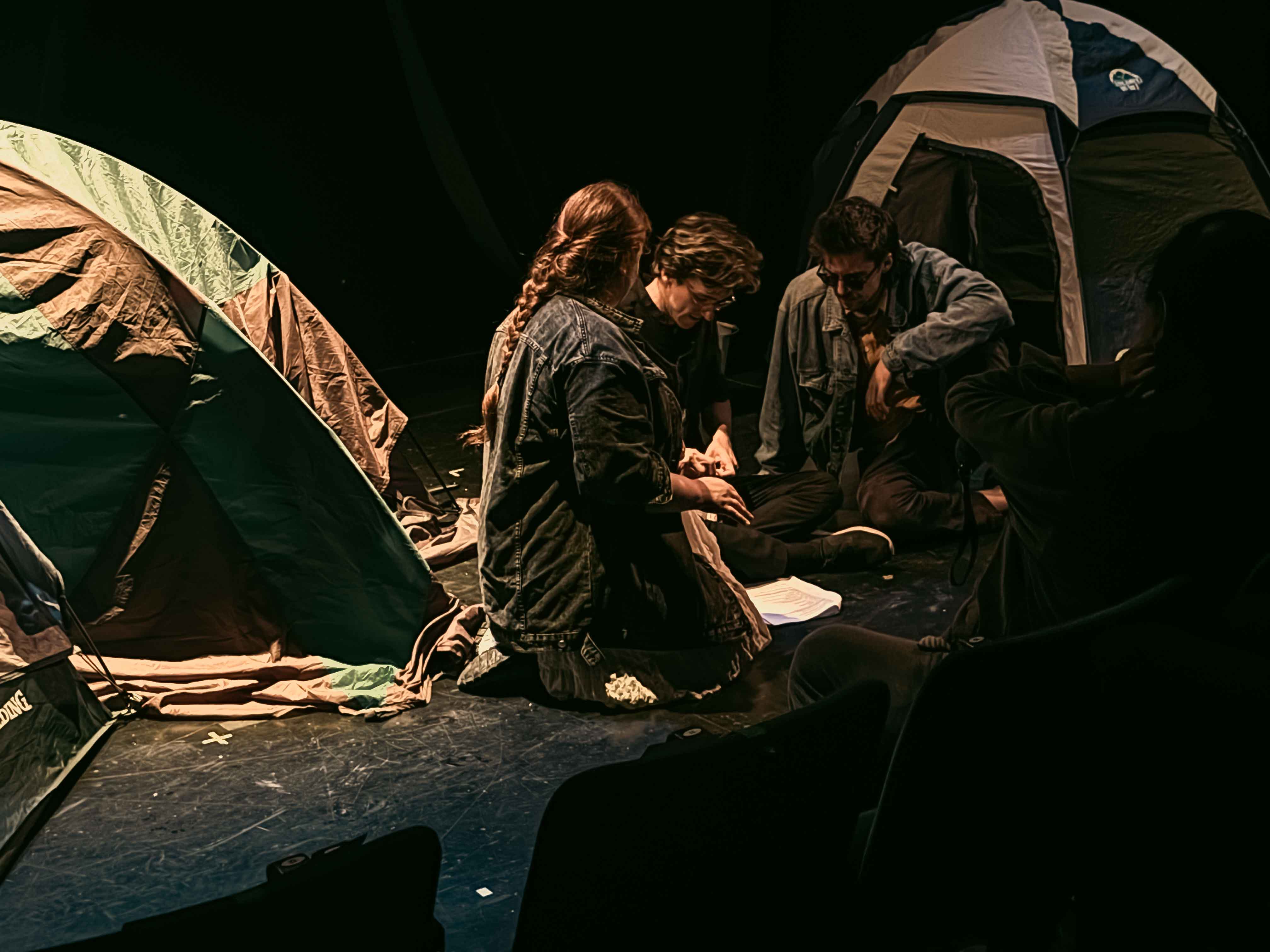
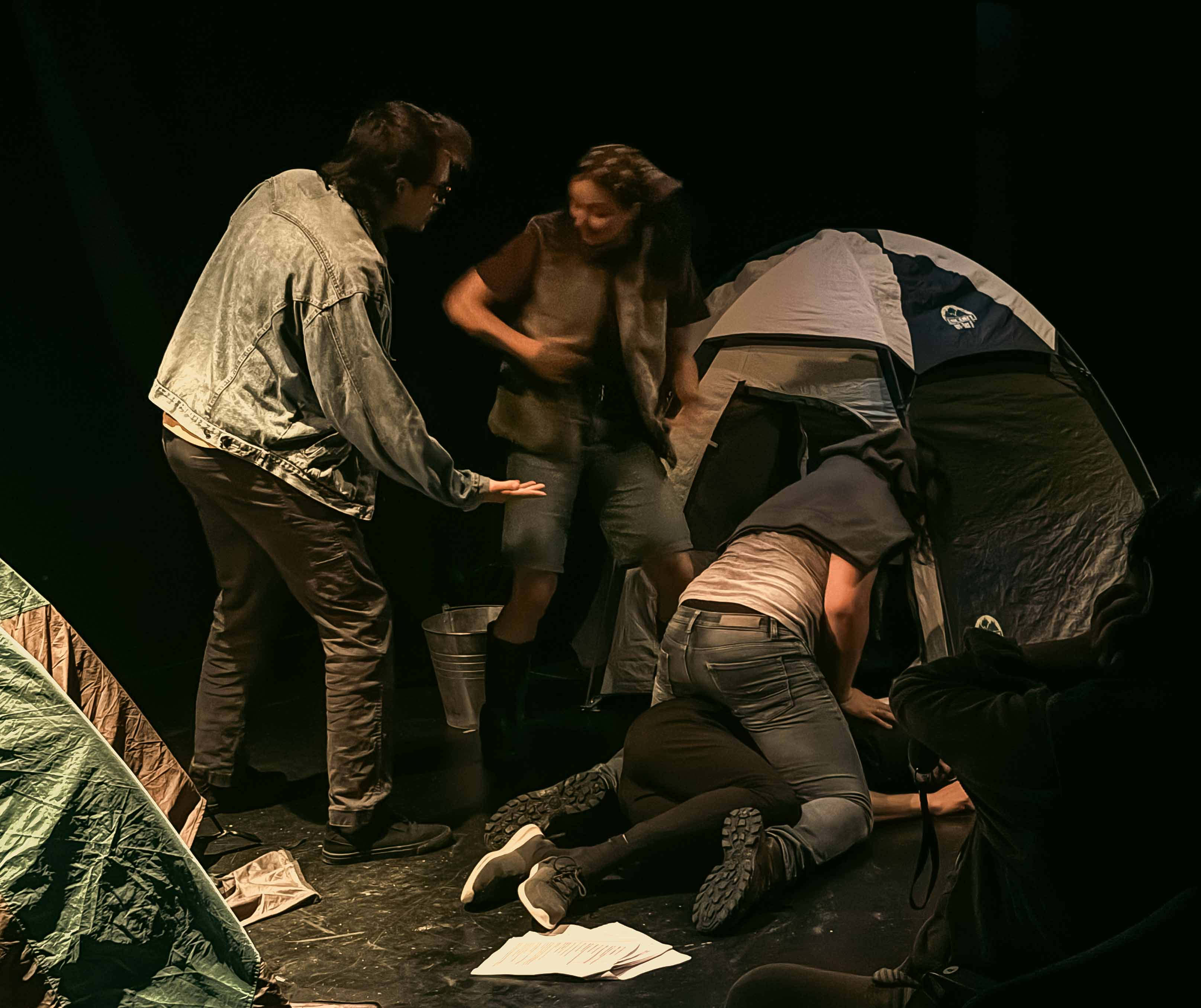
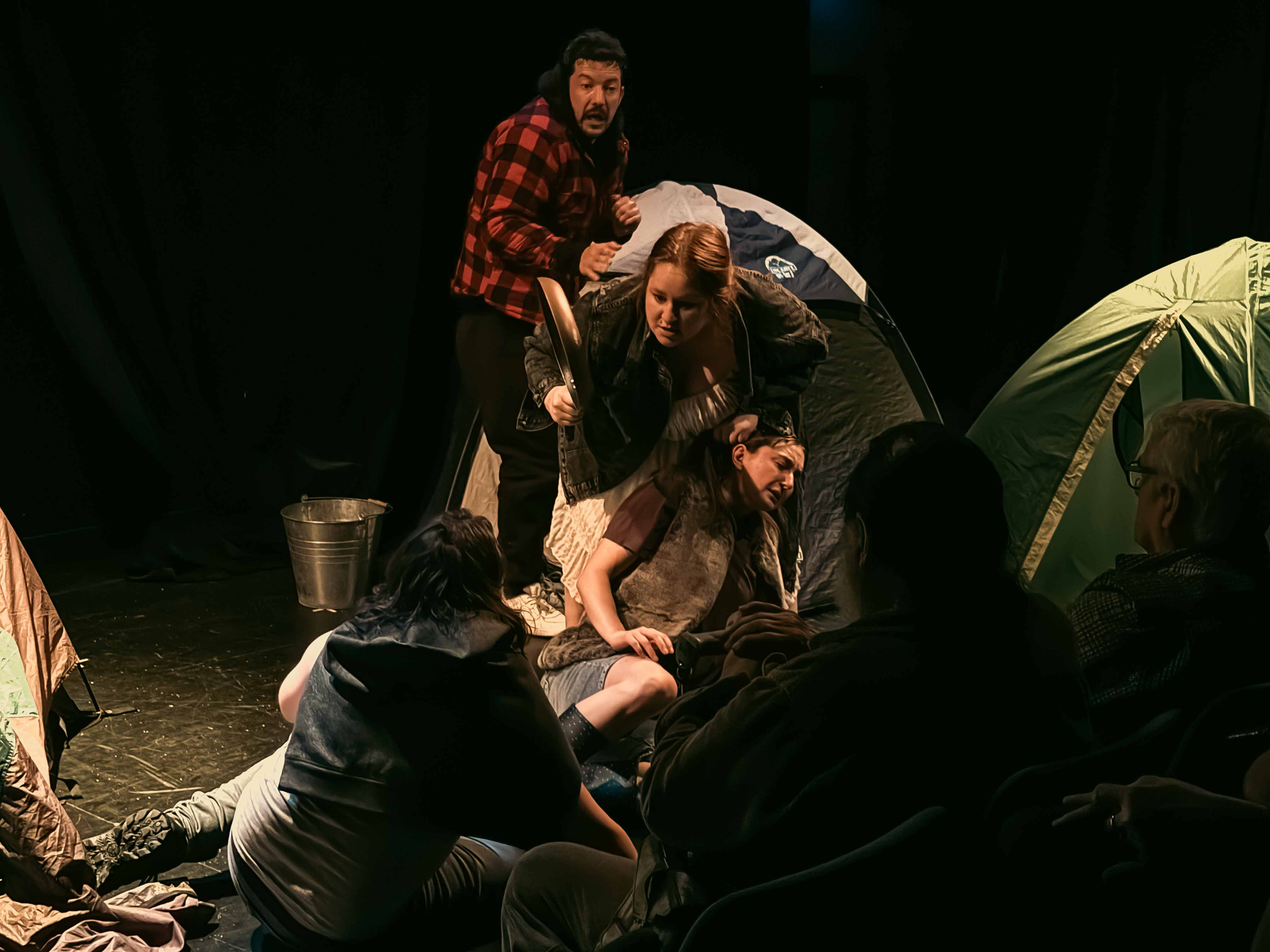
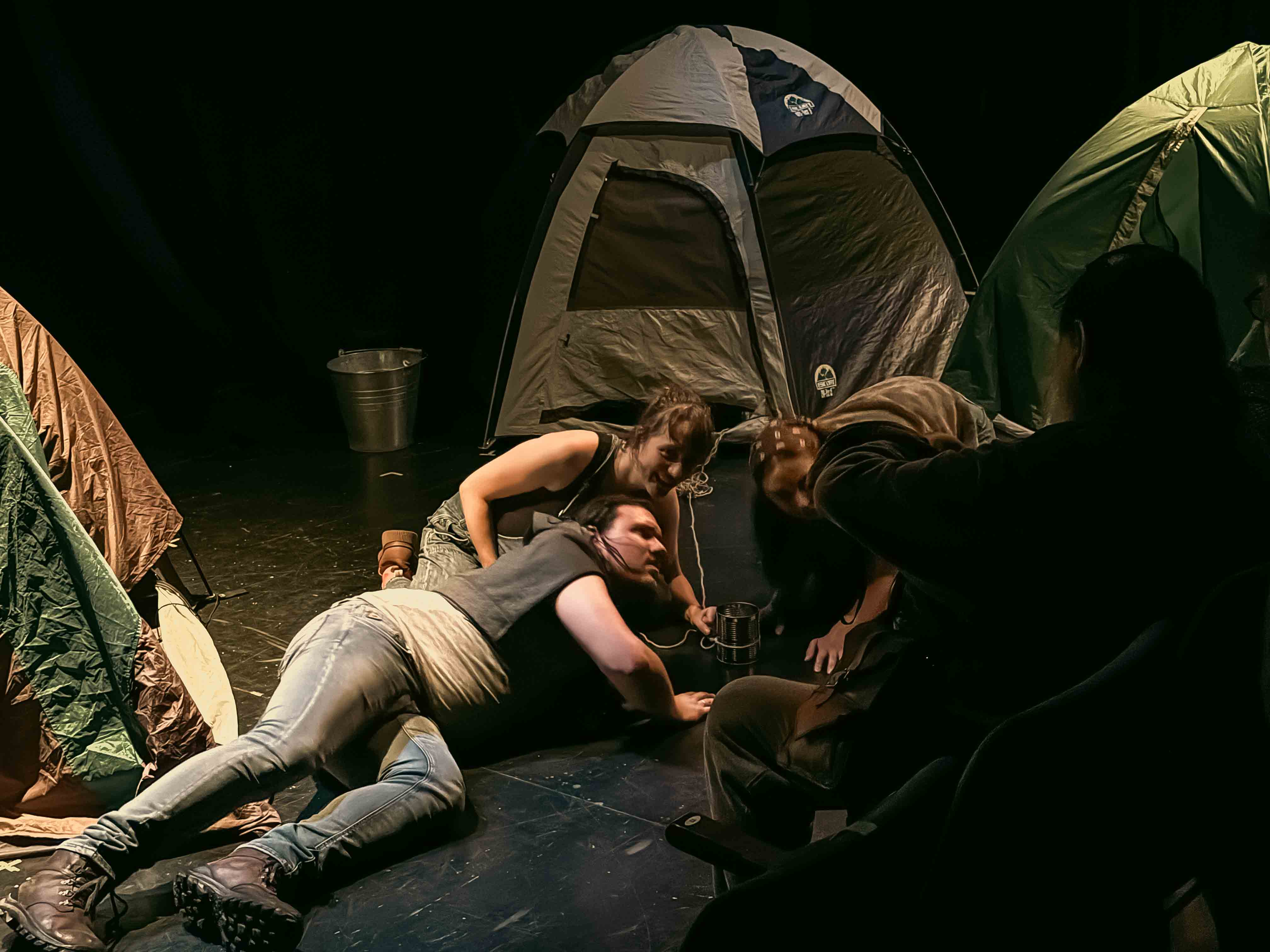
The other thing Productions du cours des choses got exactly right was the set. You cannot, at Fringe scale, on a Fringe budget, in a converted arena in Saint-Michel, bring in six rusting Renaults. So they did the next best thing. Domed camping tents arranged in a loose semicircle around the playing area, unzipped and rezipped and crawled into and shouted out of for the duration of the show.
You could hear what was happening inside them — the fumbling, the crying, the yelping, the whispered argument, the pornography of it, and later the violence of it — but you could not, most of the time, see it. Nylon is translucent from certain angles and opaque from others, and the director had lit the show, as far as I could tell, to maximize the ambiguity. Sometimes you got just the zipper, the long slow zipper, which anyone who has ever camped can tell you is the single most morally suggestive sound in the natural world.
At one point a client, informed the other half of her tent is occupied, complains: ils ne peuvent pas aller baiser ailleurs? Can't they go fuck somewhere else. The valet apologizes and promises to find her a tente individuelle in the morning. The class hierarchy of nylon.
I have a rule I bore my friends with. If you dropped someone into the audience who did not speak the language of your play, they should still be able to follow it. I have decided, on the strength of this production, that I also want the inverse rule. If you dropped a blind person into your play, they should still be able to have a substantial experience of it.
Les tentes
L'autre coup de génie, c'est le décor. On ne peut pas, à l'échelle du Fringe, dans un budget de Fringe, dans un aréna converti à Saint-Michel, faire entrer six Renault rouillées. Alors ils ont fait la deuxième meilleure chose : des tentes de camping dôme disposées en demi-cercle autour de l'aire de jeu, ouvertes et refermées à la fermeture éclair, dans lesquelles on rampait, d'où on criait, pendant toute la pièce. On entendait ce qui s'y passait — le tâtonnement, les pleurs, les gémissements, la dispute chuchotée, la pornographie, puis plus tard la violence — mais on ne pouvait pas, la plupart du temps, le voir. Le nylon est translucide sous certains angles et opaque sous d'autres, et l'éclairage était réglé pour maximiser l'ambiguïté. Parfois on n'avait que le zip, le long zip lent, qui, comme quiconque a déjà campé peut vous le confirmer, est le son le plus moralement suggestif du monde naturel. À un moment, une cliente, apprenant que l'autre moitié de sa tente est occupée, se plaint : « ils ne peuvent pas aller baiser ailleurs? » Le valet s'excuse et lui promet une tente individuelle pour le matin. La hiérarchie de classes du nylon.
This production was Dionysian. Sweaty, embodied, a bit smelly by the end. This was theatre as ordeal, in the sense Artaud meant it. Bodies in a room, doing things to each other, in front of you. And the ordeal, improbably, was fun.
Le théâtre comme épreuve
Je compare cette mise en scène, dans ma tête, au téléfilm français des années 80 tiré du même texte, disponible sur YouTube si vous voulez voir à quoi ressemble l'apollinien sous Xanax. Le téléfilm est beau. Le téléfilm est un diorama. Cette production était dionysiaque. Suante, incarnée, un peu odorante sur la fin. Du théâtre comme épreuve, au sens d'Artaud. Des corps dans une pièce, qui se font des choses les uns aux autres, devant vous. Et l'épreuve, improbablement, était le fun.
Kink as Ambient Condition
At intermission — there wasn't really an intermission, but there was a moment when I stepped outside to smoke — I called Henry, who readers of this column will recognize as the Programming Director of Sydney Dramaturgical. We talked about the show, and we arrived, more or less simultaneously, at the following formulation: ninety per cent of Fringe festivals is just kink.
Arrabal's Panic Movement was always about this, albeit with much higher stakes. Ritual plus blasphemy plus eros, all of them fused to anti-fascism, because it was the fifties and the sixties and Franco was still around. In 2026, in Montréal, at a festival where the neighbouring show involves a puppet giving birth to another puppet, Franco is dead. What remains of the transgression?
Productions du cours des choses understood that you cannot, in a Quebec Fringe venue in the year of our Lord two thousand twenty-six, do Arrabal seriously without producing something faintly ridiculous, so they did him joyfully. The polyamorous sex-worker commune, the cannibalism, the drowned baby, the casual queer sex that goes entirely unremarked upon by any character on stage: all of it presented not as look what we're allowed to say now but as the ambient conditions of the world.
Le kink comme condition ambiante
Le Mouvement Panique d'Arrabal a toujours parlé de ça, avec des enjeux plus hauts. Rituel plus blasphème plus éros, tous fusionnés à l'anti-fascisme, parce que c'étaient les années 50 et 60 et que Franco était encore là. En 2026, à Montréal, dans un festival où le spectacle voisin implique une marionnette qui donne naissance à une autre marionnette, Franco est mort. Que reste-t-il de la transgression? Productions du cours des choses a compris qu'on ne peut pas, dans une salle Fringe québécoise en l'an de grâce deux mille vingt-six, faire Arrabal sérieusement sans produire quelque chose de légèrement ridicule, alors ils l'ont fait joyeusement. La commune polyamoureuse de travailleuses du sexe, le cannibalisme, le bébé noyé, le sexe queer complètement banalisé qu'aucun personnage ne commente : tout ça présenté non pas comme « regardez ce qu'on a le droit de dire », mais comme les conditions ambiantes du monde.
The Quebec-ness
Which brings me, at last, to why this staging felt so specifically, so unavoidably Québécois. The original text has, in its French, a certain metropolitan self-seriousness, the seriousness of Paris in 1958, of the nouveau théâtre, of a young Spanish exile determined to be taken seriously by Beckett. That register would have died on impact at Théâtre d'Aujourd'hui.
What Productions du cours des choses did instead was to translate the text into something I can only describe as battler French. There is a Quebec sensibility that has to do with se débrouiller — getting by, making do, figuring it out, patching the roof with what's in the shed. It is the sensibility of a people who have historically not been rich, who have historically not been listened to, who have historically had to invent a way to have a good time on a Tuesday in February.
It travels well. It travels, in fact, to Australia — which is why the parallel I could not stop drawing throughout the show was to Peter Weir's The Cars That Ate Paris, the 1974 film in which an Australian outback town survives by orchestrating car crashes and cannibalizing the wrecks. Arrabal's junkyard, Weir's outback, Saint-Michel's arena floor: three battler wastelands, three cultures of se débrouiller, all shaking hands across the tents.
The show takes Arrabal's abstract poor and gives them Quebec accents and Quebec grievances and Quebec surnames, and in doing so makes the fifty-year-old French avant-garde feel, for a couple of hours, like something that could only have happened here.
La québécitude
Le texte original a, dans son français, un certain sérieux métropolitain — le sérieux de Paris en 1958, du nouveau théâtre, d'un jeune exilé espagnol déterminé à être pris au sérieux par Beckett. Ce registre serait mort à l'atterrissage au Théâtre d'Aujourd'hui. Productions du cours des choses a plutôt traduit le texte dans un français que je décrirais comme un français de débrouillards. Il y a une sensibilité québécoise qui a à voir avec le se débrouiller — se démerder, faire avec, trouver comment, patcher le toit avec ce qui traîne dans la remise. C'est la sensibilité d'un peuple qui, historiquement, n'a pas été riche, qui n'a pas été écouté, qui a dû inventer une manière d'avoir du fun un mardi soir en février.
Ça voyage bien. Ça voyage, en fait, jusqu'en Australie — c'est pourquoi le parallèle que je n'arrêtais pas de tracer, c'était The Cars That Ate Paris de Peter Weir, le film de 1974 où une ville de l'arrière-pays australien survit en orchestrant des accidents et en cannibalisant les épaves. Le cimetière d'Arrabal, l'outback de Weir, le plancher d'aréna de Saint-Michel : trois terres vagues de débrouillards, trois cultures du se débrouiller, se serrant la main à travers les tentes.
Le spectacle prend les pauvres abstraits d'Arrabal et leur donne des accents québécois, des griefs québécois, des noms de famille québécois, et rend l'avant-garde française d'il y a cinquante ans, pour deux heures, quelque chose qui ne pouvait arriver qu'ici.
Great Commitment
The cast, whom I have not yet named enough: Mathieu Desroches, Mathieu Olivier Gendron, Vanessa Harper, Charles-Olivier Maltais, Elodie Maher, Marion Mignot, Jérôme Mouflin. What they did here, with a director stepping in at four hours' notice, with a set list of REI dome tents, was make one of the most alive things I have seen in a theatre this year.
The commitment, the tents, the moment when Forget, glasses slipping, promised Dila that they would go about entwined like two underwater squirrels, and meant it. Whatever they were doing — cannibalism, polyamory, sex work, drowning a fake baby, learning goodness by heart — they did fully. And doing it fully, at Fringe, is the name of the game.
Cinq étoiles pour l'engagement
La troupe, que je n'ai pas encore assez nommée : Mathieu Desroches, Mathieu Olivier Gendron, Vanessa Harper, Charles-Olivier Maltais, Elodie Maher, Marion Mignot, Jérôme Mouflin. Ce qu'ils ont fait ici, avec un metteur en scène qui a pris la relève avec quatre heures de préavis, avec un décor de tentes dôme, c'est une des choses les plus vivantes que j'ai vues au théâtre cette année.
L'engagement, les tentes, le moment où Forget, lunettes qui glissent, a promis à Dila qu'ils iraient enlacés comme deux écureuils sous-marins, et le pensait. Peu importe ce qu'ils faisaient — cannibalisme, polyamour, travail du sexe, noyade d'un faux bébé, apprendre la bonté par cœur — ils l'ont fait pleinement. Et le faire pleinement, au Fringe, c'est ça.
Reviewed by Aubrey Wang
Théâtre / Theatre
Le Cimetière des voitures
Adaptation de la pièce de Fernando Arrabal (1958). Dans un cimetière de voitures, une communauté d'exclus survit sous la surveillance d'une milice. Émanou, trompettiste, joue des concerts clandestins pour les pauvres.
An adaptation of Fernando Arrabal's 1958 play. In a car cemetery, a community of outcasts survives under militia surveillance. Émanou, a trumpet player, gives clandestine concerts for the poor.
Mise en scène | Directed by Laurent Forget Création et interprétation | Created & Performed by Mathieu Desroches, Mathieu Olivier Gendron, Vanessa Harper, Charles-Olivier Maltais, Elodie Maher [FR?], Marion Mignot, Jérôme Mouflin
Instagram @prod.coursdeschoses
Durée | Running time 48 min Classement | Rating 18+ (explicit sexual content, violence, infanticide, cannibalism) Avis | Content warnings Sexuality, strong language, simulated violence, simulated infanticide, cannibalism, death Langue | Language French
Venue Centre du Théâtre d'Aujourd'hui, Montréal Fringe Dates | Dates 24–29 June 2026


%402x.svg)

.webp)


