Roominant Review — Stories in Spirals at Montreal Fringe 2026
Give these people a blank check. The puppet is well-made, the manipulation is immaculate, the operators are visible characters instead of erased functions. Puppetry gives the light and sound design team new frontiers.
How neurodivergent attachment calls for different beats
Roominant
Montreal Fringe 2026 By Saya Grimm, Ki'ra Jo-Ellen Prentice, Brittany Vo, Rosa Dias, and Niyayesh Golestani Conservatoire de musique et d'art dramatique de Montréal (Studio Jean-Valcourt) Presented by Stories in Spirals Directed by Saya Grimm and Jessica McKnight
Reviewed by Aubrey Wang
Roominant drops us into an invitation to rethink how theatrical relationships are staged. The non-verbal dance and puppet piece opens with a voiceover in French from a former editor, or a family friend with a publication, someone who used to publish Miko's whimsical, autistic children's stories about small funny things. It's patronising, and it tells our protagonist Miko that her writing is no longer cute. It criticises her new piece about a robot, about the daily work of regulating oneself as an autistic adult, for being unnecessarily protracted. In the captivating 45 minutes that follow, we're shown-not-told the revenge to the tune.
The opening is the show's warning to its audience: do not map neurotypical beats onto what you are about to see. The ensemble puppetry piece argues principally, not the cliché that autism is beautiful, or worthy, or misunderstood, but that autistic interiority is a scene structure which rejects linearity for multiplicity. When attachment is neurodivergently organised – as it is in the room above the room where Miko has retreated to work – the factors that ordinarily build a scene are mapped differently too.
Montreal Fringe 2026; then Ottawa Fringe, La Nouvelle Scène Studio A, June 21–28.
The drama lives across a chamber ensemble
Long story short, it's the story of a writer coming to terms with a rejection. We've all been there. But the event is spread across five bodies, multiple (sometimes moving) sound and light sources, and a puppet. Because there is no soloist, there is also no witness position.
The puppet operators in particular do fascinating ontological work. They're black-clad, dressed for a convention of being not-there, but the veils are mesh; you can see faces through them at close range. You can watch the operators smile behind the fabric, see the dimples in their cheeks. It's super Tadeusz Kantor (refusing invisibility for the operator) and it is also very Basil Twist – his puppeteers in Symphonie Fantastique are underwater with the puppet, unmistakably present and characters in and of themselves.
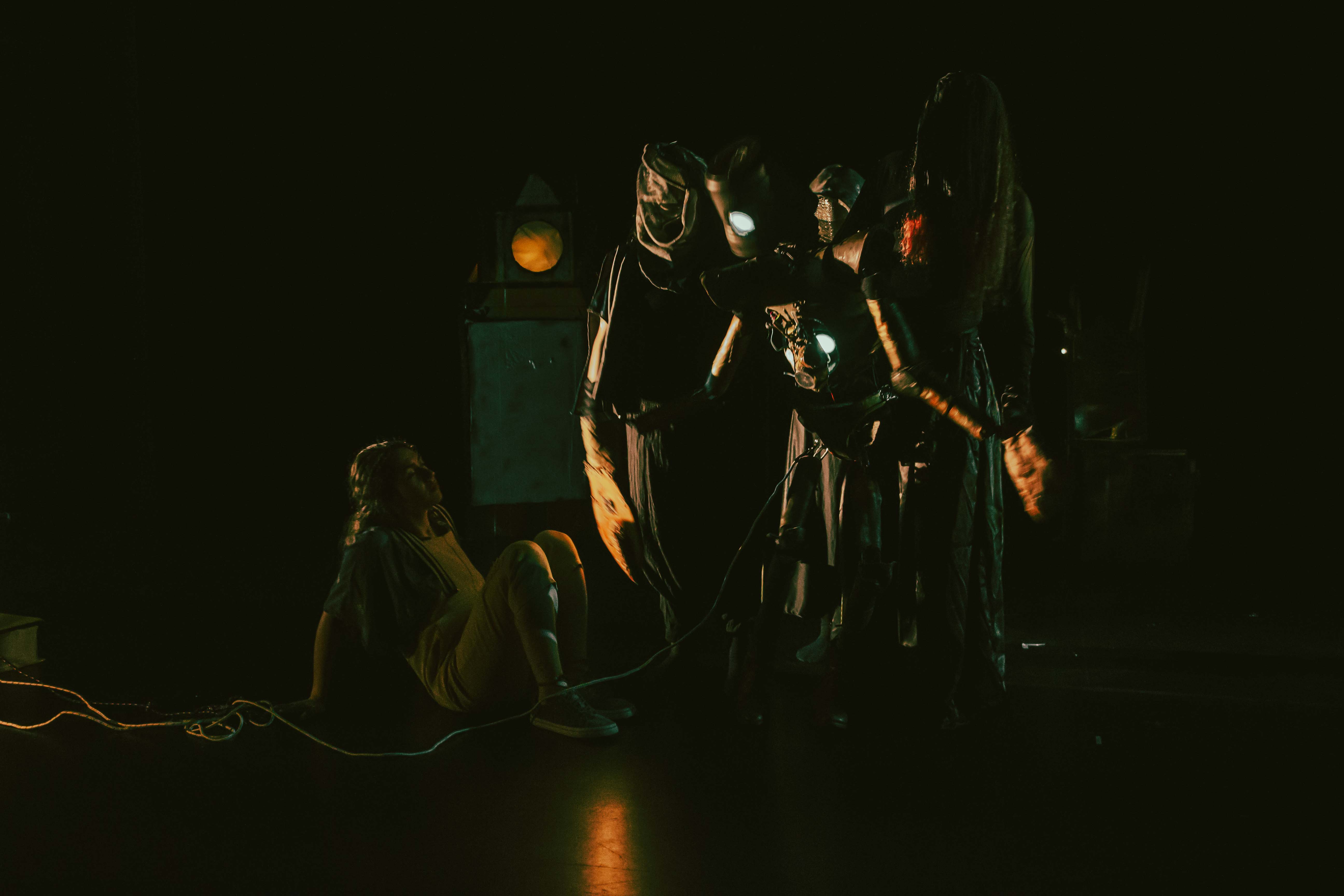
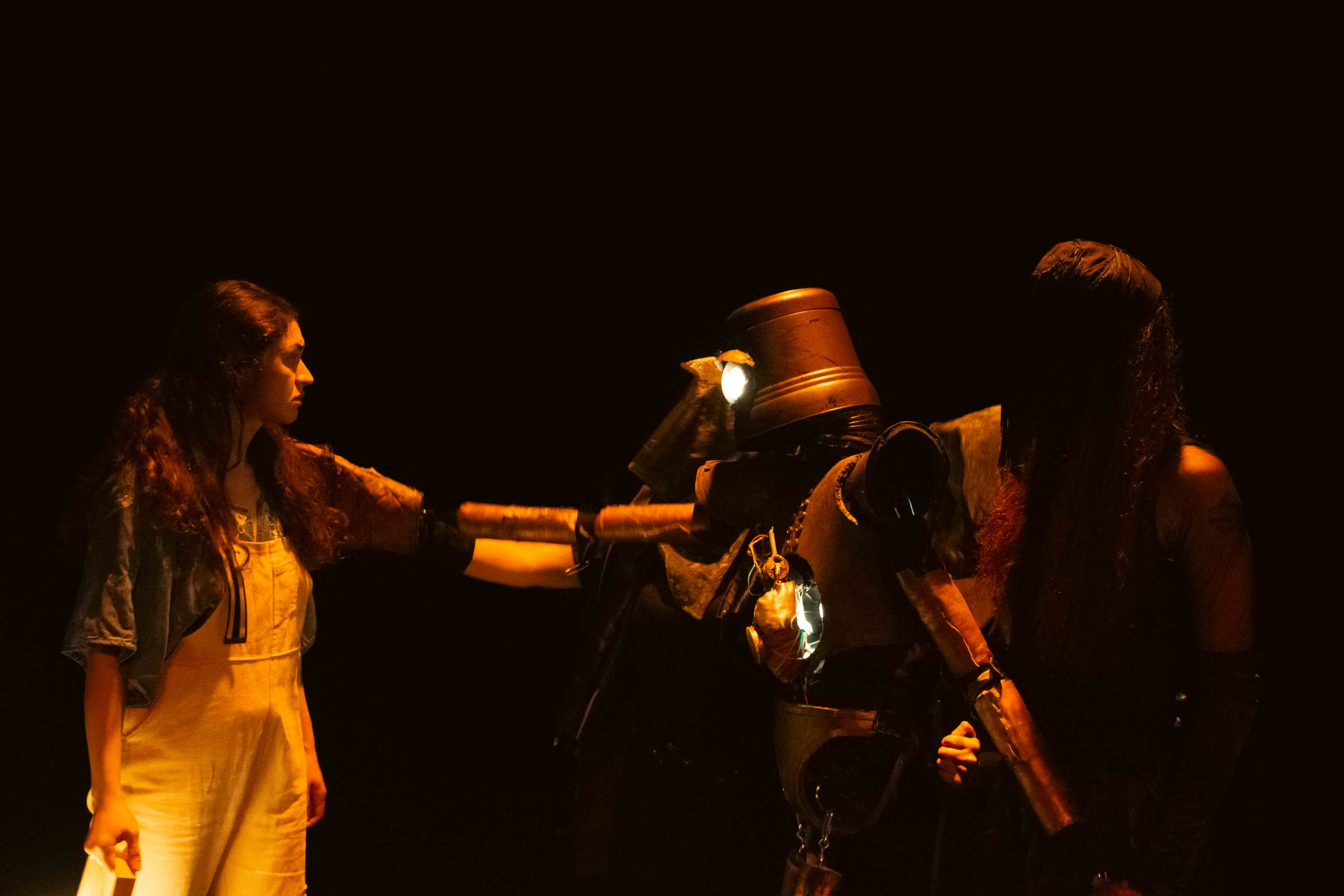
Moi is a full-body puppet, roughly one and a half metres tall, and they are manipulated bunraku-style by three operators. The specific texture of mesh is a material choice that signals that the operators are hidden, but conditionally; they conform to and break with the convention of invisibility at the same time. You are meant to notice them, maybe even to love them. The coordination between the operators is superb. The weight transfers are so clean. When the puppeteers first bring Moi to life onstage, it feels as well rehearsed as a chamber orchestra.
What Moi feels is expressed in the operators' expressions and the gestalt of the whole thing. The puppet does not have a face, but it doesn't need one because the feeling is in the mis-en-scene – affect is distributed.
In Roominant, the negative space itself is animated. In a naturalistic staging the composition goes from equilibrium, to disturbance, to resolution. In Roominant the composition goes: multiple sources of light and sound continuously blinking, pulsing, and shifting at different frequencies, each representing a different interior state.
Attention is a field, not a line
On a naturalistic stage, characters look at the thing that matters and the audience follows the gaze. That's what we understand as exposition: someone is always pointing at the important object, and it's why a lot of well-made plays feel like museum tours.
Roominant is more like walking through a room where several small things are happening at once, where your own attention keeps drifting in ways that feel productive rather than distracted.
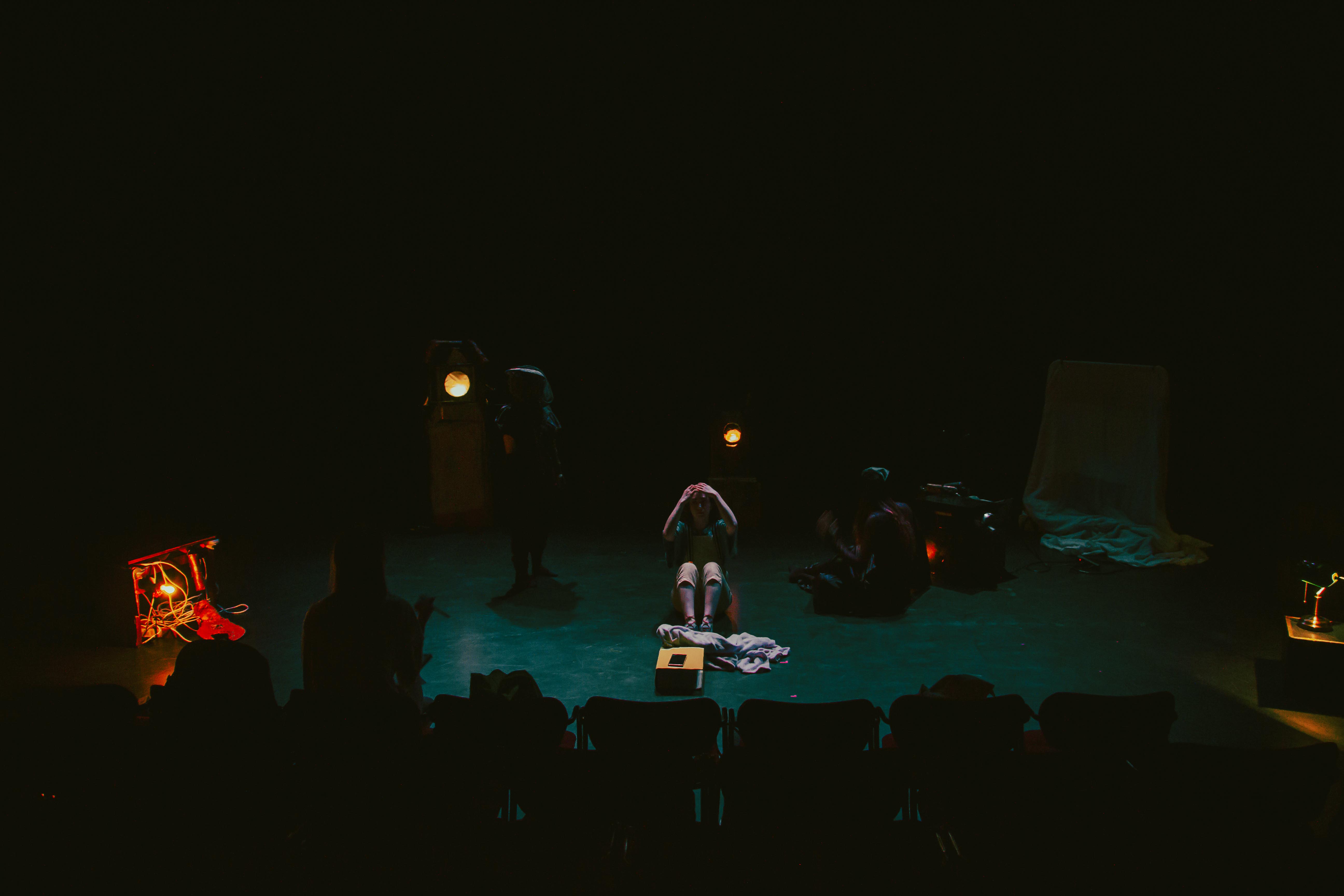
The set, or the puppet – and the blurring of this distinction is what makes the piece so genius – is a jumble of what I want to call luminous junk, and they're lit from within rather than from above. The Conservatoire is decked out with an expensive lighting rig, but the production has mostly eschewed it for practicals, to wondrous effect.
The empty space between the objects is where the states are staged. When Miko is doing nothing in particular, the room is doing several things at once, and you get the sense that her inner life is atmospheric rather than contained. That's why we experienced the generous sprung floors of the Conservatoire, in their velvety vastness, as beautiful rather than austere.
I was sitting near the tech booth too, close enough to hear the stage manager whispering standing by cues with an emotional investment that read as inside the piece rather than servicing it. I thought about how cool it must be to cue lights built into a puppet – even more so than motorized lights, because of how close the cues sit to the choreography.
At seven minutes in I found myself asking, of a small twitch in a metal component upstage, are the leg plates moving?
Regulation is the story; dysregulation is one instrument
We often see a lot of media that treats autistic interiority as alien, that requires it to explain itself, that treats regulation as an achievement. In Roominant, the interior is already inhabited, already home. Miko is stimming while Moi falls into completion. Self-regulation and self-construction are staged as the same thing, and Miko's hand-flicks receive the same amount of stage time as her larger emotional beats.
Neurotypical dramaturgy tends to condense internal states into single dominant registers because it works on the assumption that the audience is able to follow only one thing at a time. Roominant stages internal states not as binary switches but as multiplicities of small simultaneous events, a shift in the soundtrack, a small adjustment of the operator's grip, as a dim in one lamp, a pulse in another.
Later, when a complication arises, we see Miko and the operators working together in a scene of maintenance. Regulation is not a state you reach and remain in. It is a state you keep restoring. Restoration is labour, but the labour can be shared.
Cause and effect run through matter
The naturalistic scene resolves through someone saying the thing...confession, revelation, ultimatum. Neurotypical media forces autistic interiority into verbosity that doesn't suit it, into monologue and meltdown. The puppetry lineage that Stories in Spirals has tapped into allows autistic time to unfold on its own terms.
Late in the show, we watch a projected animation: a fairy notices a dragonfly, and a mean small boy catches the dragonfly and crushes it in his hands. The image plays without commentary. It could be a fragment from Miko's earlier writing (the whimsical children's-story register the family friend praised in the voiceover) or it is yet another narrative that unfolds laterally, not hierarchically, that contributes to the whole without forcing a resolution.
The most imporant technical decision Roominant is actually built into Moi's head. The head is a copper-painted drum, and the crown of the drum houses a bulb mounted inside. When Moi looks at Miko, the light falls across her face. Their gaze literally illuminates the person seen – meaning that proximity comes with visibility. Where we see Miko's face lit up by Moi's gaze, an intense and brilliant island of recognition in the darkness, it is quite moving.
A second practical sits in Moi's chest, smaller and cooler, and it backlights Moi's heart.
The sound design is a kind of mechanical, iterating syntax, with a palpable sub-bass that hits the audience in the sternum before the ear registers it.
Attachment is a distributed field
In naturalistic scene grammar, object-attachment is either fetish (uncomfortable), delusion (pathological), or metaphor (the object stands in for a real person). But in Roominant, it's not certain that the subject-object distinction is even all that helpful. What we see is real attachment and the scene is organised around a multipolar reciprocity rather than around a missing human counterpart.
Miko's attachments in Roominant are plural. To Moi, primarily; but also to the operators, who are with her in the work of assembly and repair, who react to her at the edges of scenes, who are helping her without erasing themselves; and to the room, to her reading lamp and the doodads and the calico projection screen. The piece stages a distributed field of attachment, of which the bond with Moi is the most concentrated but not the only one.
I'm not sure that the kuroko operator-characters can be reduced to a projection of Miko's interior. They are characters, helpers, forces with their own responses. The world is inside your head makes a different claim than the world can be organised around you attentively, and they're also two very different claims about care.
Moi as a puppet may come from the marionnettes manipulables tradition of the Théâtre de l'Œil in Montreal, where the puppet is heavy enough to require a shared body-load between operators. Moi is substantial. When Miko leans on Moi, Moi is there to be leaned upon.
While the production is steampunk at the outset, Moi feels much closer to Mexican folk art, as hand-made, bright, structurally durable, with Alebrije durability, with the patina of an object that has been picked up a thousand times.
Verdict
Give these people a blank check. The puppet is well-made, the manipulation is immaculate, the operators are visible characters instead of erased functions. Puppetry gives the light and sound design team new frontiers. The piece builds an argument non-verbally, through the craft of object theatre, and through a preference, all the way down, for multiplicity over binary. One of the best externalisations of autistic subjectivity I have seen on any stage. Roominant teaches you a new way to build relationships in a show.
Reviewed by Aubrey Wang
Marionnettes / Puppets, Première mondiale / World Premiere, Pluridisciplinaire / Multidisciplinary, Jeunesse / Young Audiences, Mouvement / Movement
Roominant
Miko, qui rêve de devenir écrivaine, tente de surmonter un rejet. Se repliant sur elle-même, elle se retrouve face à d'étranges créatures de l'ombre et à un robot sympathique nommé Moi. Ensemble, ils explorent ses expériences passées et son fonctionnement intérieur pour l'aider à traverser cette période difficile.
Roominant follows wannabe author Miko as she works through a rejection. Withdrawing into her internal world she comes face to face with odd shadow beings and a friendly robot named Moi. Together they work through her past experiences and internal wiring to get her through this rough patch.
Retardataires | Latecomers Tout au long | Throughout Langue | Language Non-verbal Lumières clignotantes | Flashing lights Yes — bright lights during the first 5 minutes.
Venue Conservatoire de musique et d'art dramatique de Montréal (Studio Jean-Valcourt) 4750 Av. Henri-Julien, Montréal, QC H2T 3E5


%402x.svg)

.webp)


