Decadunce Review — Marshall Lorenzo at Qtopia's Substation, Sydney Fringe 2026
Marshall Lorenzo's Decadunce is a lush and campy sketch comedy showcase, targeting the vanity of the internet era and threading its impact on annoying co-workers and ethically questionable jurors. Will Winter reviews Lorenzo's hour at Qtopia's Substation, 15–19 September, as part of Sydney Fringe 2026 — finding remarkable depth in the caricature even as the show's own fascination with prettiness and skinniness occasionally traps it.
Decadunce Review — Marshall Lorenzo at Qtopia's Substation, Sydney Fringe 2026
Too dumb to be rich, too pretty to be poor
Marshall Lorenzo's Decadunce is a lush and campy sketch comedy showcase, targeting the vanity of the internet era and threading its impact on annoying co-workers and ethically questionable jurors.
Reviewed by Will Winter.
A Decadunce, in the world of Marshall Lorenzo's thusly titled sketch hour, is someone who is 'too dumb to be rich and too pretty to be poor.' It's a handy coinage, and in Lorenzo's show, held at Qtopia's Substation from the 15th to 19th of September 2026, this endearing but bone-deep stupid persona is key to the comedy hour's characters.
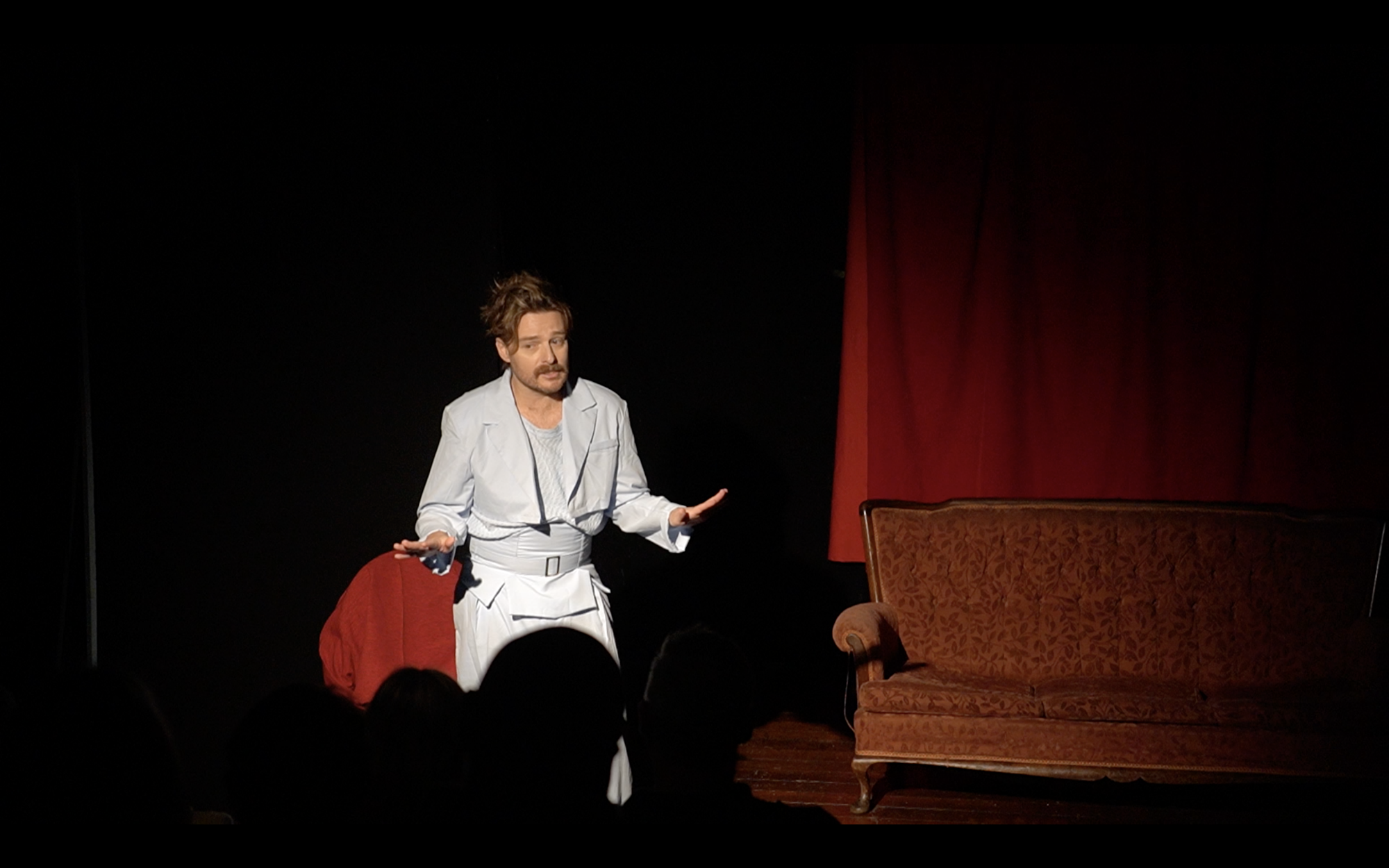
Lorenzo, a Kiwi export, performs in a plush baby blue corseted suit one could only dub 'mental health ward chic'. He is bouncy and quick on his feet, tearing through terminally-online-millennial coded sketches with limber physicality, and his niche electropop interludes are a playlist only a gay man in his late-twenties to early-thirties could truly appreciate.
The opening number sets up the extravagance of the Decadunce's dreams, desiring rich people things like 'jetski sex' and 'hitting people with your car with no consequence'. The caricature is the bread and butter of Lorenzo's writing framework, and he spends the rest of the night testing the morals and manners of the Decadunce, who often fails.
The juror, the friend, the co-worker
The best study of this is a character I'll dub 'the juror'. We meet him mid-case, deliberating whether an alleged murderer could be guilty based on how attractive the accused and the victim are (hot and not respectively, very Luigi Mangione-coded).
He shows up in two more scenes, first as a 'friend who's just lost a lot of weight and is feeling themself too much', then as an annoying coworker who wears excessively click-clacky cowboy boots.
The friend role tickled me deeply, the overcompensating queer drawing excessive focus to their tiny waist and how fuckable they must be to the waiters because of this. As an oblivious co-worker, the juror is deliciously shattered, faltering socially in the hands of his own vanity. His come down is a glamorous indictment of the digital belief that anyone can be famous if they're sexy.
There's some modern fable buried here, a Decadunce who first projects their aesthetic ideals, then lives with them embodied, before facing external pressure and realising that their worth has to exist beyond simply the image they present to the world.
'Lorenzo's depth here is remarkable, his grounded and campy comedy well-studied and thoughtfully structured.'
Lorenzo's depth here is remarkable, his grounded and campy comedy well-studied and thoughtfully structured, with clear tact in heightening premises and characters while remaining believable.
Trapped by its own idea
Not every character is afforded this same breathing room. The funeral celebrant who just can't seem to read the room is a cracking idea which doesn't return as often as it should; several other characters return simply for the sake of a callback.
You almost wish more of the layered characters returned in a complex capacity, leaning into character growth in sequel sketches and not just the twist that 'this is the same character you watched earlier'.
The most egregious example of this is the double appearance of an overzealous Lush employee. The big final punchline is that their high-energy rapport is because they work on commission, but Lush employees don't actually work on commission, they're just like that.
It's a small slip, one which disguises the more interesting and stranger truth of the retail world behind an easy punchline. These missed moments are when Decadunce feels most trapped by its own idea, more taken with prettiness and stupidity than what happens underneath it all.
Gross-outs and GLP-1 heroin chic
There's a more unforgivable habit in the show, though. Lorenzo relies heavily on gross-out moments (mostly retching) and punchlines about losing weight, jokes which wear thin before the hour is out.
There are versions of this which work, like the aforementioned juror's obsession with thinness in the age of GLP-1 heroin chic. But talk too much about wanting to be skinny as a critique of social norms and suddenly the funny gay friend becomes the wine-drunk weight loss town crier who you genuinely believe doesn't respect you because you don't have abs.
Some more restraint with deploying bodily functions as gags would make the show's fascination with skinniness feel more like satire and less like pressuring the audience to lose weight as an ailment for an unfulfilled self.
Overwhelmingly, though, Lorenzo holds his own. His range is no fluke, playing a frazzled Harvey Norman salesman and the Nordic voice of a sleep app with the same all-in commitment as the juror.
A cautionary tale, surprisingly close to home
A cautionary tale is hidden somewhere in here. While the Decadunce is an elusive comedic figure, it's also surprisingly close to home. We've all flown too close to the sun in believing our opinion is a holy grail, or that our prettiness could be worth more than our brains.
We're charmed and repulsed by the Decadunce's stupidity because we're all capable of fulfilling that role. It's a lesson I'll remember the next time I catch myself sounding like the ditzy juror, valuing a man's attraction over the very obvious red flags in front of me.
Decadunce — written and performed by Marshall Lorenzo. Qtopia's Substation, 15–19 September 2026.