

Bathers Review — Rinehart-Jones at Theatre 154 2026
Aubrey Naur reviews Bathers by Charlie Rinehart-Jones at Theatre 154, New York, 2026 — ninety minutes of foreplay, then a baptism. Worth the wait.
Aubrey Naur reviews Bathers by Charlie Rinehart-Jones at Theatre 154, New York, 2026 — ninety minutes of foreplay, then a baptism. Worth the wait.

Theatre 154 · Independent Production · Written & Directed by Charlie Rinehart-Jones.
★★★★ (4/5)

During a moment in Charlie Rinehart-Jones's Bathers, now running at Theatre 154 on Christopher Street, when a character shakes brown lake water onto a sun-warmed paperback copy of Joan Didion's The Year of Magical Thinking, another character, with the delicateness of someone watching their inheritance liquefy, cries, "You just got water all over A Year of Magical Thinking!"
Didion is survived mostly by her merch, and none of the nine lakeside twentysomethings onstage have any legitimate claim on the serious work of mourning. I felt that this line is, in fact, what the play's first act keeps doing to its own emotional subject matter: dousing it, drowning it, blotting it, laying it out on a rock to dry. By the second act, miraculously, the book is still intact. More than intact. We were doing something close to reading it.
Bathers is strong prestige-television writing adapted for the stage, and the sheer, astonishing brilliance of Act II completely redeems the messy, over-caffeinated foreplay of Act I.
At first, sitting in Theatre 154, I was literally texting myself: girlies, can we cut the entire first act. Do Act I as rehearsal prep, put everyone in a warm-up circle, and just let us start at dusk.
On the other hand, the parasocial empathy that shatters you in the second half strictly depends on watching these nine unbearable people fake their way through the afternoon first. There's some kind of redemptive ordeal in witnessing them posturing, recycling Twitter takes, and desperately indicating their nonchalance before you can care when their egos snap in half.
At its thematic core, Bathers is an ensemble drama about literal baptism — a genuine before-and-after snapshot of performers who have been plunged into freezing water backstage and violently jolted back into their physical bodies.
Whether it's the physiological shock of cold water (from Finnish sauna plunges to high-end cryotherapy, we know the somatic vascular reset puts people directly into their present tense) or the communal prop cocktail being chugged from a mason jar — a foul, cloudy cyan concoction the characters dub "measles vaccines" (traditionally White Monster, cranberry juice, blue curaçao, mezcal, lime, and a prayer to RFK Jr.) — something breaks the first act's intellectualised shell during intermission.
In Act I, we get "acting", i.e. actors straining to demonstrate their neuroses. In Act II, we get pure, unadulterated behaviour.
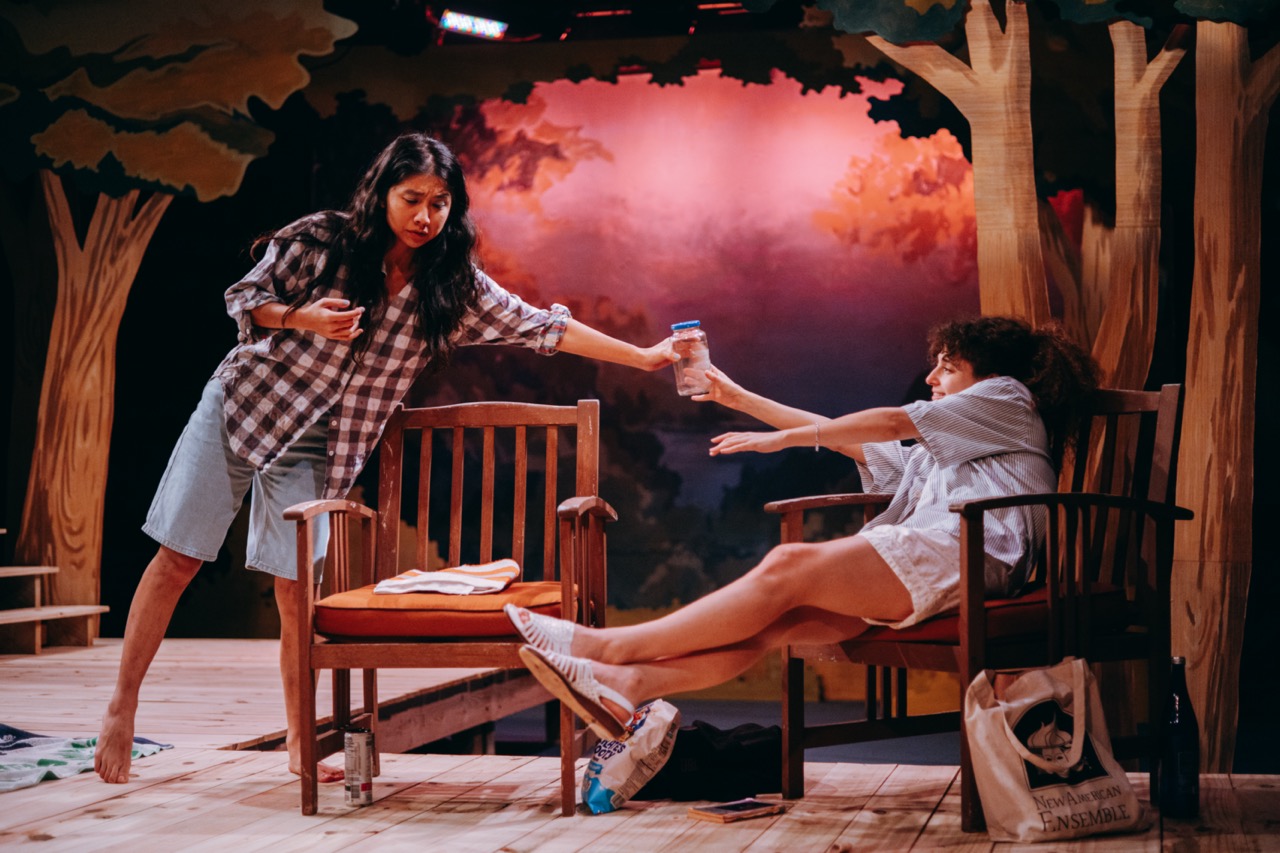
The success of Bathers is rooted in the architecture of television comedy. In a multi-cam sitcom or streaming dramedy, the characters do not experience linear moral elevation, do not experience dark nights of the soul and come out the other end as better people. They always end up back where they begin; each episode is a reset; their stubborn flaws and chronic unadaptability are precisely what make them lovable, and the satisfaction lies in seeing them smash into each other and bounce right back into their designated archetypes.
It is A Midsummer Night's Dream, if everyone in A Midsummer Night's Dream had microplastics in their brains: an enchanted lakeside gathering fuelled by mistaken emotional coordinates, unreciprocated crushes, and severed loyalties, except everyone is lost in iPhone and desperately searching for the emotional vocabulary to unhaha themselves.
When the lights rise on Act II, Rinehart-Jones abandons the sitcom setup for a breathtaking, almost mathematical geometry of liquid truth. Under a bruised upstate dusk, the conversational ping-pong collapses into a chain reaction of emotional detonations.
It plays out like a domino rally of psychic collapses: one person's unhinged confession unlocks somatic terror in the person next to them, escalating until the entire social fabric of the friend group tears open.
The apex of the show — and candidly, the scene of the New York theater season — is the diamond argument between Portia (Isabelle Phillips) and her tech-bro fiancé George (Jordan Coley). What begins as a passive-aggressive debate over whether Portia's engagement ring should feature a lab-grown gemstone metastasises into an eviscerating takedown of performative moral superiority.
Phillips is electric here, trembling with an accumulated lifetime of having her desires intellectualised out of existence. When George haughtily parades the ethical sourcing of lab-grown alternatives, Portia strips away the veneer of affluent progressive aesthetics: they buy ugly heirloom tomatoes and fret over rugs because guilt is an aesthetic lifestyle for them, a way to deflect true intimacy and exert domestic control.
Phillips's monologue stopped my breathing. Her shaking indictment that George's conscience is actually domestic authoritarianism, that she has lived for years on bare floors because he is afraid of child-labour rugs, that she has vanities, godammit, and she wants a real diamond, dug by sinners out of the actual earth — I felt that the play, which had heretofore been WASPish deflection-via-hot-takes, turned a corner here and started showing us something of the reality we came for.
Coley plays George's deflation with a true-to-scale patheticness: the enlightened tech worker who cannot hold his partner's irrational, human heart.
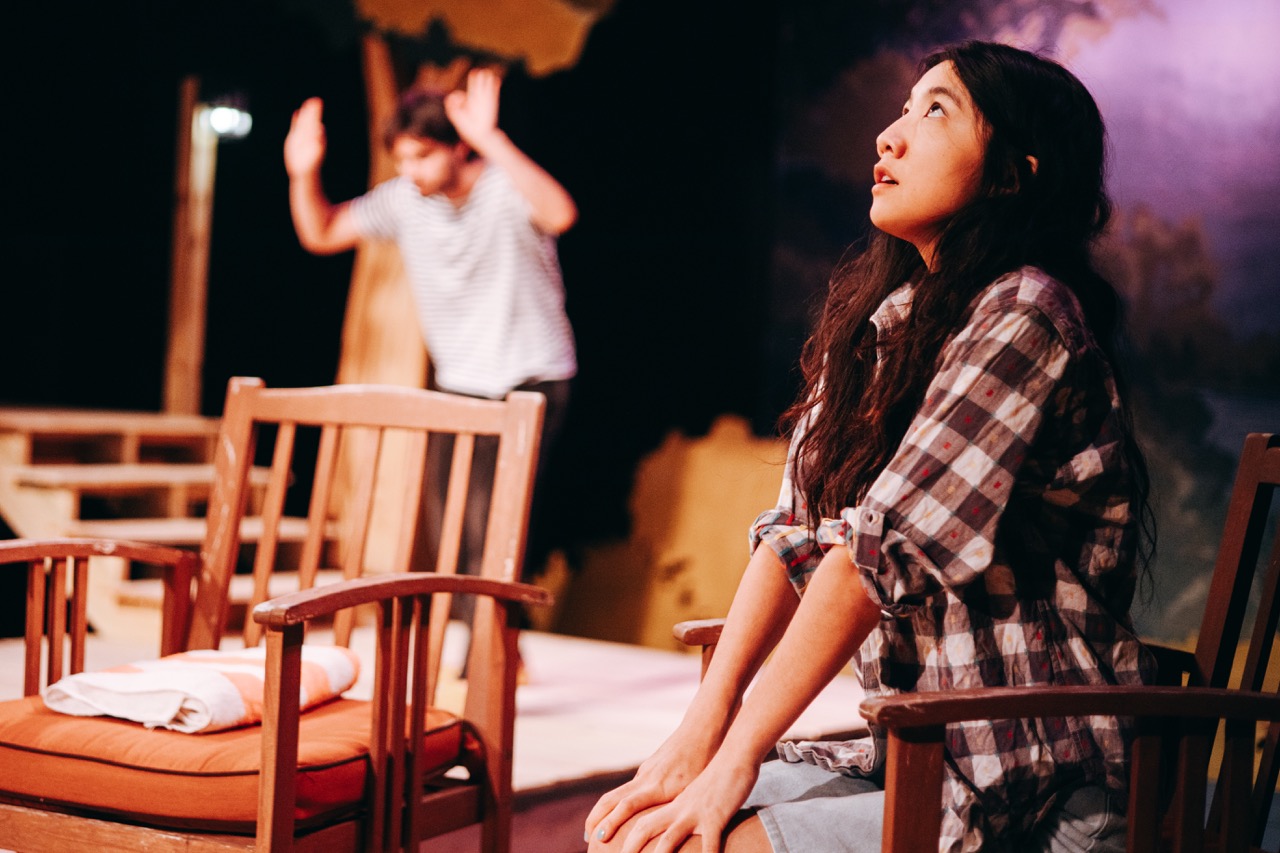
From that marital fissure, the fallout cascades with brutal momentum. George, humiliated and unable to fight back, turns around and violently crashes out at his perpetual-slacker freeloader buddy Sammy (Evan Dominguez) — the mooch, the clown, the one who last week asked Taylor for a hundred and fifty dollars as a "mural advance" from a mural that will never be painted.
Sammy, in the way of all injured clowns, then turns and fixes his manic crosshairs onto Kit (Willa Cuthrell-Tuttleman), the softest person onstage. Kit — small, blinking, superstitious about dropped pills touching the ground — cracks under the attention and tells Josie (Nina Bloomgarden) that she kissed Josie's recently-ex-boyfriend Eddie (Luke Kissick) on the dock that afternoon, approximately four hours after Eddie learned his estranged alcoholic mother had choked to death on her own vomit.
What follows is a masterclass in showing hurt without indicating it. Josie, drunk on orange wine, pauses. She receives the confession. Then she asks, with all of the menace of a cornered animal: "Isn't it weird that we're friends with someone like you? Like how did someone like you end up here?" It is the beat that chilled the room.
In 2026, the groupchat is the polis, the fundamental apparatus of social life for privileged twenty-somethings in Brooklyn and Manhattan. To be frozen out of the collective is to have the bone pointed at you. It is identical to Antigone suffering social death long before physical death.
Kit doesn’t come back. The others do, and the play gets on with its business: Taylor decides Aaron is a pedophile on the strength of a childhood crush on the animated Lizzie McGuire; nobody can process that George works in tech at a company with no AI product and no data centers; there is a long debate about going back in for one more swim; Lou swallows a whole Adderall by mistake and comes apart at the news that Punch the Monkey has died (the death is the play’s invention; at the time of my writing this, Punch the Monkey is alive and well. Knock wood).
The only news of Kit arrives secondhand: she’s at a rest stop on the highway. She's still there, we assume, while the ensemble tries to joke itself back to comedic equilibrium.
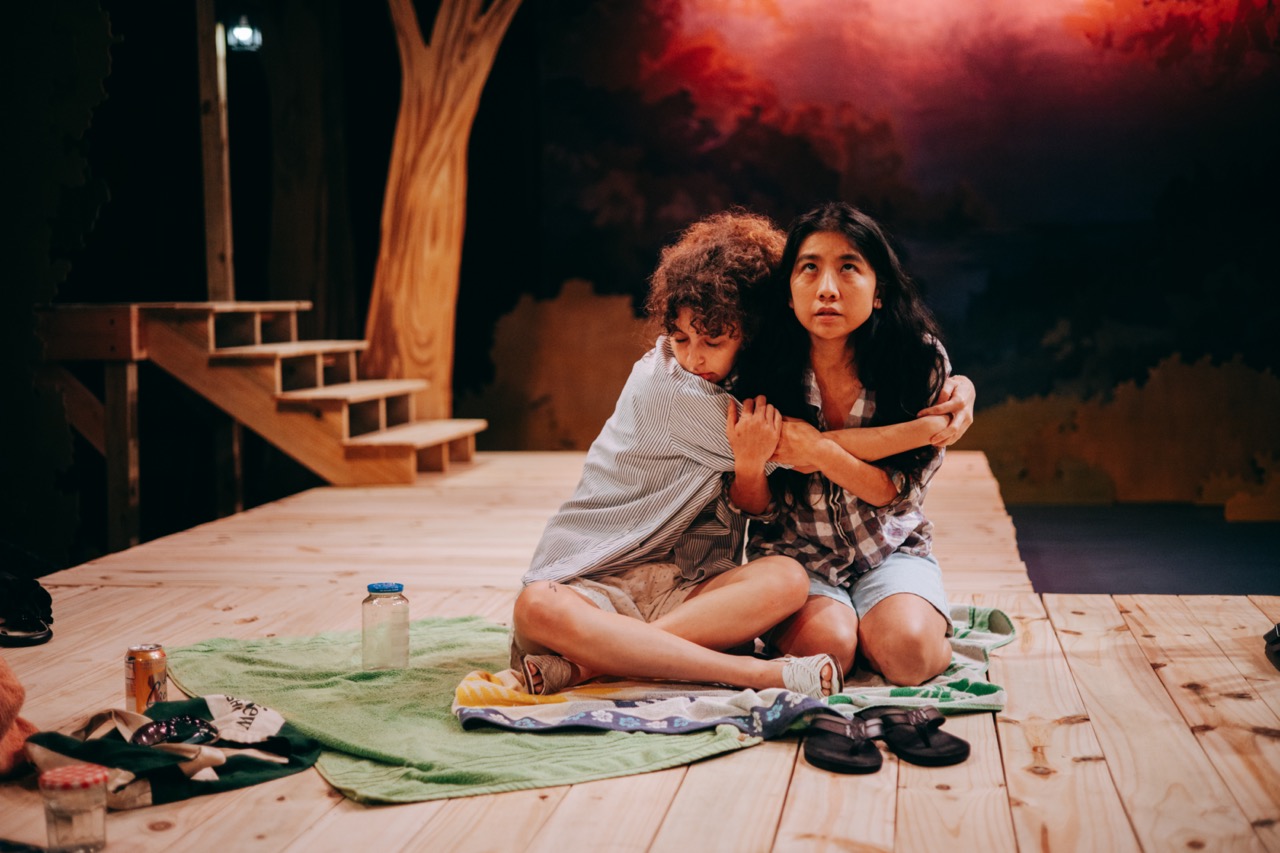
If Act II is the raw, agonising sex, Act I is an interminable ninety minutes of awkward comedic foreplay. Rinehart-Jones suffers here from the classic television writer's anxiety: the compulsion to parade the entire ensemble onstage in the pilot episode, forcing every character to declaim their quirky personality profile within three minutes of entrance.
The result is a chaotic cloud of "indicating": performers showing us how eccentric, neurotic, or aloof their characters are supposed to be, rather than actually inhabiting their circumstances. The actors hit their overlaps like synchronised swimmers hitting a count. At one point, Sammy — exasperated by too many friends trying to pair their phones to a portable JBL speaker — snaps, "There are too many people trying to connect." I wrote this down in my notebook with three exclamation points. Yes, exactly. There are.

The structure of the first act feels trapped in a mechanical loop: awkward social encounter → unresolved confrontation → sudden micro-rejection → glum solitary brooding → half-baked pop-psychological analysis of family trauma → clunky exit.
The play, in Act I, wants to critique a generation that armors itself in Twitter-honed aphorism, the critique every play under two hours in this city is currently making, often in Twitter-honed aphorism. Which, fine. Whatever.
The topical jokes are hilariously written and badly aged. The characters discuss, in roughly this order: the Oliver Tree assassination conspiracy; whether trans people are now allowed back in the military; the pharmaceutical capture of Humira; Ozempic analogues sold out of Discord servers; the Mamdani administration's pothole PSA. None of this is the play’s fault, exactly. A joke pegged to the week has the week’s life expectancy, and the week keeps getting shorter.
The first act's irony is so unbroken that I began, in private, to fantasise about the production abandoning naturalism entirely. If every line is going to land like a Seinfeld button, bring in the laugh track. Better: bring in a Looney Tunes foley artist. Give me an AWOOGA when Taylor steps out in the bathing suit that makes her look like she is in the military. Give me the anvil-on-piano whenever George enforces a boundary. Give me a flock of twittering cartoon birds circling Kit's head whenever an SSRI is mentioned. The indie-folk playlist that drifts through the speakers — a playlist that I regret to report is identical to my personal Spotify — is doing atmospheric labour that should have been done by directorial choices.
Yet when the ensemble locks into behaviour, behavioural reality, the individual performances reveal extraordinary psychological texture. The absolute moral north star of the production is Sadie Scott as Lou.
Scott is the only actor on stage who never indicates for a single fraction of a second; he arrives completely grounded, radiating effortless, lived-in ease. While the script's references to trans identity occasionally brush against box-checking tokenism, his late-night confession around the bonfire — that after all of the years lost to being not trans, he just, please, "wish you guys could stay in that part of young discovery with me for like, a second, because I just got here" — made me remember a sentence I had not thought of in years.
I once took an acting class with a well-known actor, who told the room that his private crying mantra, when he needed tears on cue in an ensemble, was simply the sentence "I just want to have a nice holiday." I thought at the time it was a joke. I understood, watching Scott, that it is actually the most devastating sentence in the English language.

Willa Cuthrell-Tuttleman's Kit provides the perfect counterweight. Rather than reducing Kit to a clinical DSM checklist, Cuthrell-Tuttleman builds a masterclass in avoidant, compulsive agony.
Her panic over dropping an ibuprofen on a dirty beach towel, her fear that brown lake water carries brain-eating amoebas, and her frantic, stuttering rationalizations after kissing Eddie are excruciating because they stem from a terror of contamination. She cannot bear to be viewed as "dirty" — socially, physically, or morally. Her compulsive hand-reaching after betraying Josie feels torn directly from real life.
And accolades for the rest of the ensemble. They construct a vivid menagerie of L-train casualties:
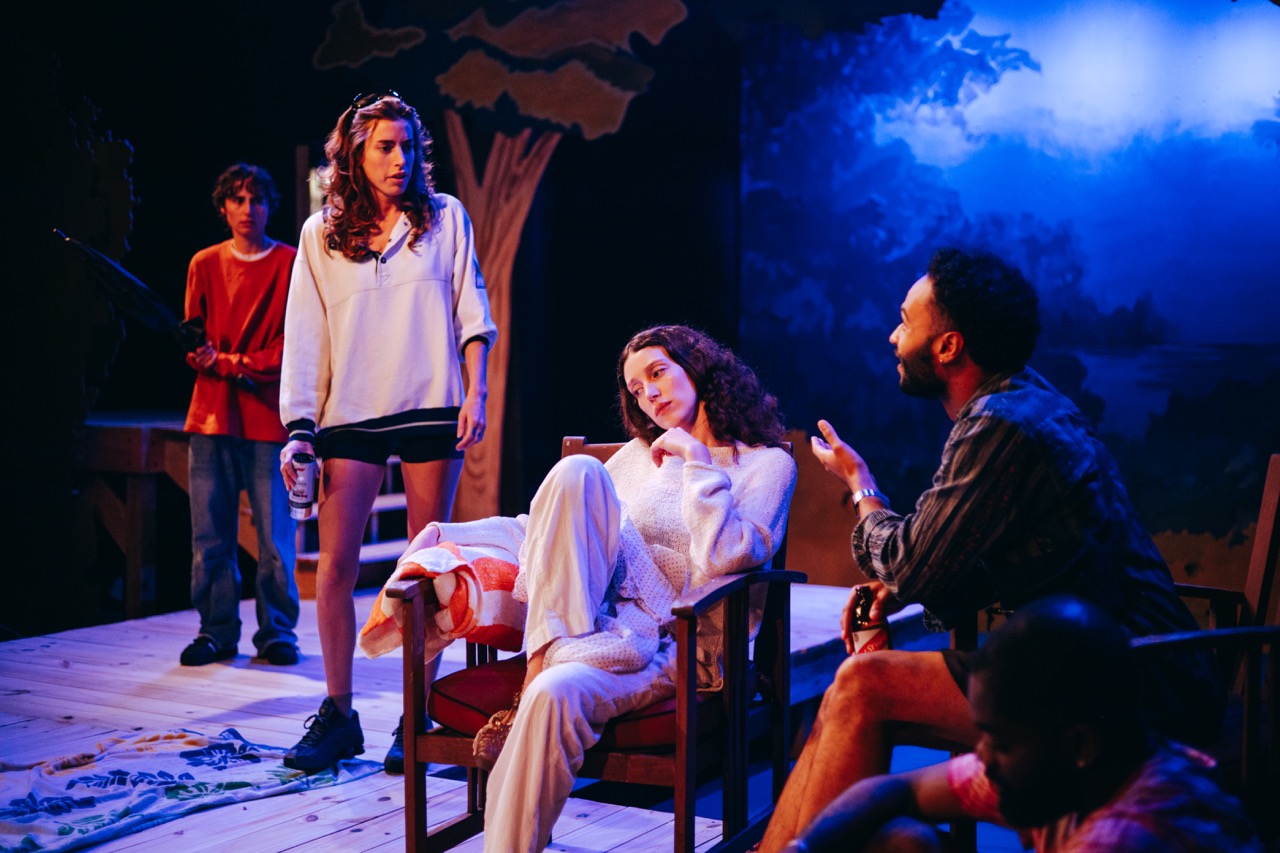
The scenic design by Sarisha Kurup, Ben Ray, and Nathan Ashany elevates what could have been a claustrophobic living-room drama into something operatic. Dominating the Theatre 154 stage is an expansive, architectural footbridge constructed from pale, treated pine timbers mounted on graduated risers against a stylised, painted woodland backdrop.
The construction directly evokes the hashigakari — the sacred bridgeway of traditional Noh theatre that connects the spirit realm of the dead to the temporal stage of living actors.
In Rinehart-Jones's hands, the hashigakari becomes the threshold between prolonged adolescence and adult consequence.
To cross the timber footbridge is to leave behind the safety of the collective dorm-room hivemind and step onto the terrifying plank of individual accountability, where trust funds, corporate jobs and material class divides make arrested development no longer quirky, but actively grotesque.
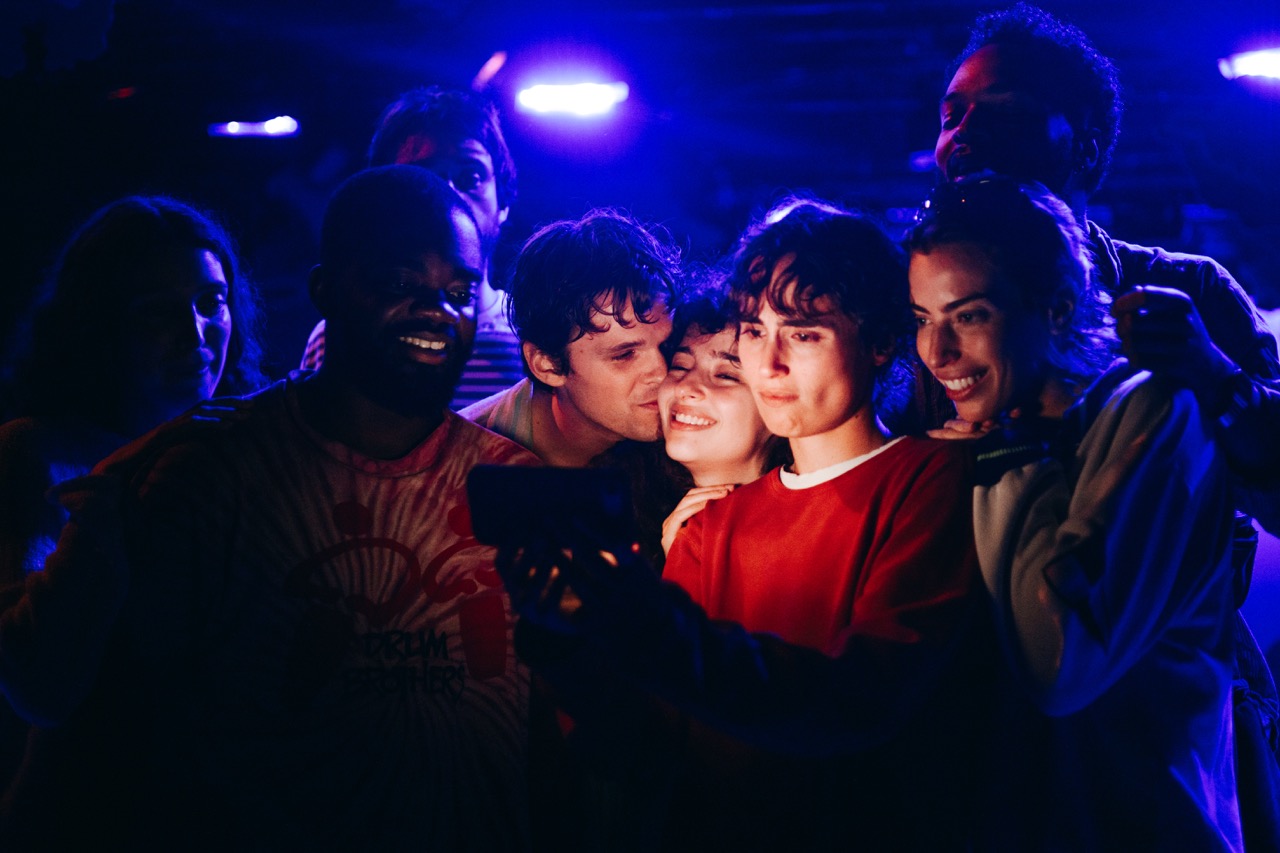
Outside in the Theatre 154 atrium, before the show and during the intermission, there is a companion exhibition (also titled Bathers) of lush, slightly camp pastoral paintings of models in retro swimwear, co-curated by scenic designer Sarisha Kurup and Miles Brautigam, alongside chilled natural orange wine for sale at a long table. We come to understand that for young artists in New York, friendship is not a passive luxury — it is an economic, psychic, and artistic survival strategy.
Rinehart-Jones emerges as a serious, tender philosopher of camaraderie, examining how our chosen families simultaneously sustain our dreams and ruthlessly tear us apart.
Playwright & Director: Charlie Rinehart-Jones
Producers: Nathan Ashany, Madeline Donahue, Ben Ray, Sarisha Kurup
Scenic Design & Build: Sarisha Kurup, Ben Ray, Nathan Ashany
Lighting Design: Nathan Ashany
Sound Design: Jack Fay
Costume Design: Natasha Manya Simchowitz
Stage Manager: Emilie Osborne
Casting Director: Violette Trotter
Publicist: Kaila Hier, Exile PR
Cast:
Noah Anderson (Aaron)
Nina Bloomgarden (Josie)
Jordan Coley (George)
Evan Dominguez (Sammy)
Luke Kissick (Eddie)
Clara McGregor (Taylor)
Isabelle Phillips (Portia)
Sadie Scott (Lou)
Willa Cuthrell-Tuttleman (Kit)
Content warnings: Bereavement, alcohol and substance use, disordered eating, referenced suicidal ideation, mental health crises.
Reviewed by Aubrey Naur


