The Whisper Review — Carl Caulfield at Newcastle Civic Playhouse 2026
The Whisper by Carl Caulfield at the Civic Playhouse, Newcastle, UpStage 2026 — a haunted-lodger premise redeemed by idiomatically Australian writing and Matthew McFarlane's magnificent, unsentimental grandfather.
The Whisper
UpStage at the Playhouse 2026 By Carl Caulfield Civic Playhouse, Newcastle Presented by Stray Dogs Theatre Company Directed by Felicity Biggins and Carl Caulfield
Reviewed by Aubrey Naur
Photos by Andrew Thurnham of T visuals
On the train to the world premiere of The Whisper, I'd been reading Hamlet in French, which is a sentence that I recognise as insufferable even as I write it, so let me soften it with a confession: I managed to get through one whole chapter of the thing when the 5G started working again north of the Hawkesbury.
A revenant has come home
Foreign language speakers have an easier time with Shakespeare, because his syntax is native to them. "To be or not to be" doesn't require the language to hold its breath. What you get, reading it that way, is the play stripped of its own reputation. You experience the ghost scene as a ghost scene. The dead father cannot speak. A revenant has come home, and the household will not survive his return intact.
Caulfield's play, though it never quite says so, is a Hamlet play. A stranger arrives at the door of the Ellin family, somewhere in the suburbs of Sydney. He has answered an ad on AirBnB. He is, disconcertingly, the same age, the same build, and has the same name as their dead son.
It is the oldest device in the realist playbook: the stranger who walks into a house and, simply by being there, forces every buried thing to rise. Every concession to the new guy reads as a betrayal to other members of the family.
The ghost shows up when you are not ready
Carl Caulfield's new play is produced by Stray Dogs Theatre Company (now in its thirtieth year) as part of the UpStage program at the Newcastle Civic Playhouse.
Photos by Andrew Thurnham of T visuals
The play flirts openly with Chekhov, and, in its middle sections, with Michael Haneke's Caché, a film about a surveillance camera that sees more than the family who owns it. There is even, in Caulfield's version, an actual security camera, installed by the husband on the young lodger's suggestion like a piece of household Catholicism: someone is watching, someone is always watching, be good.
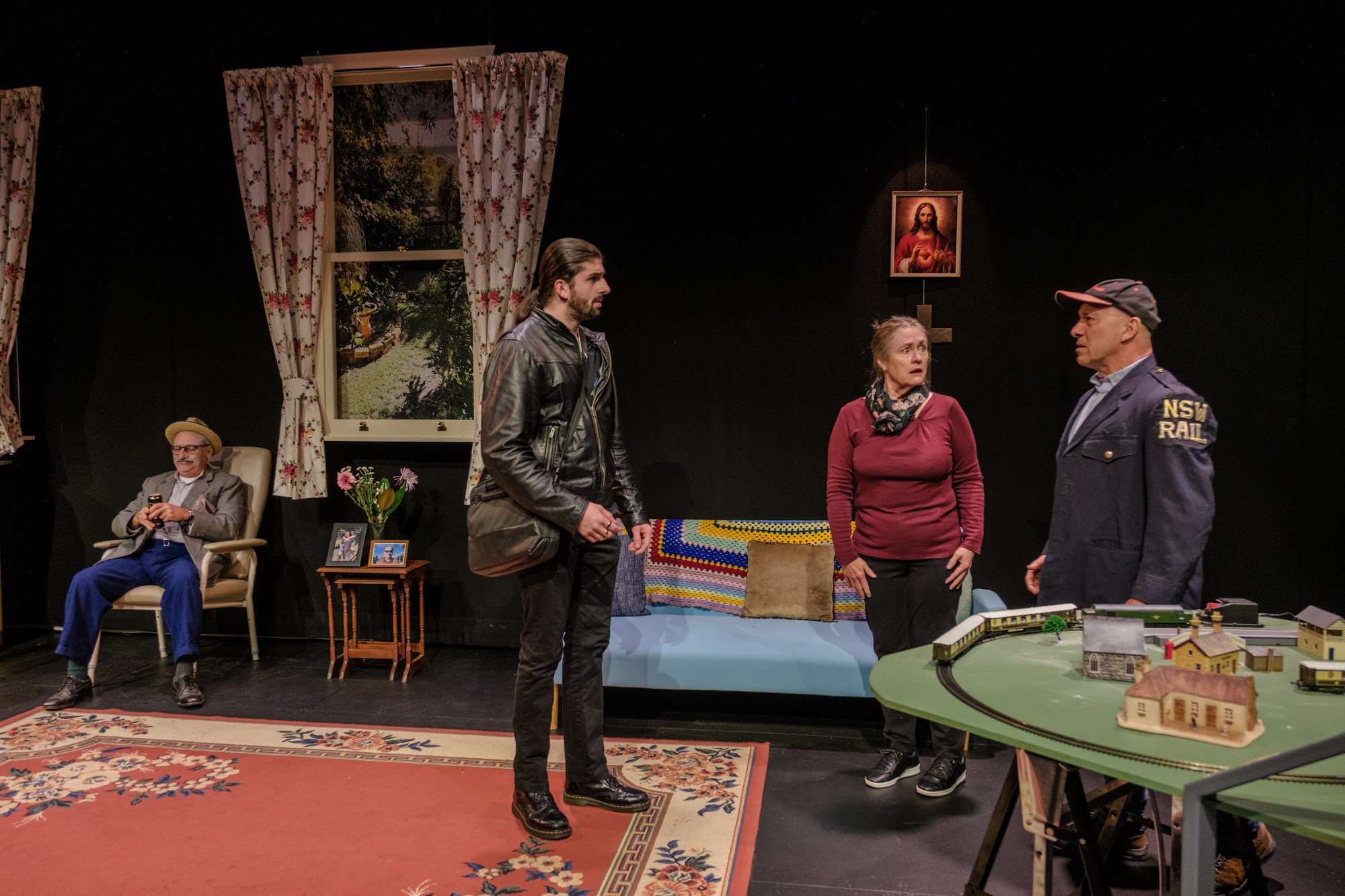
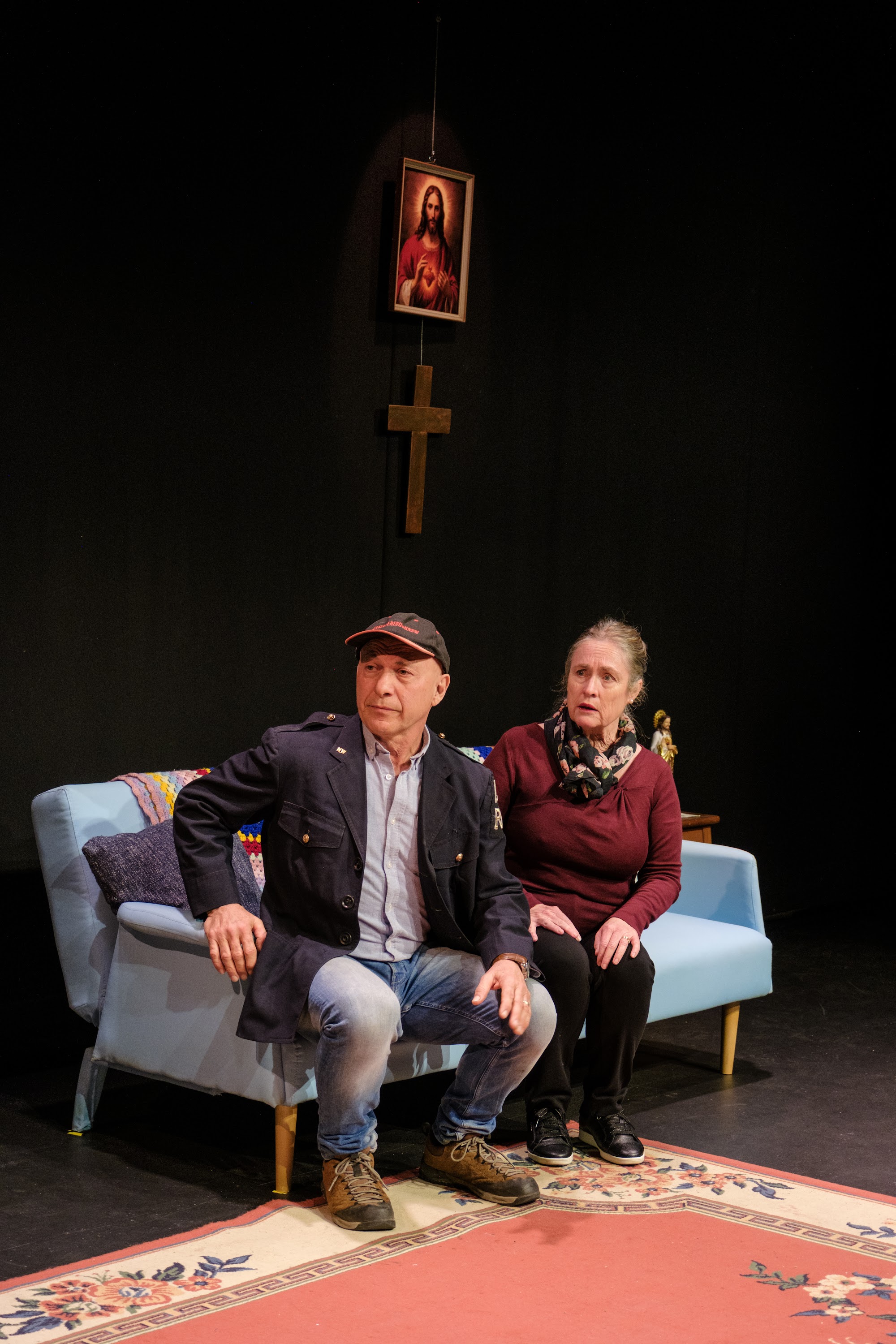
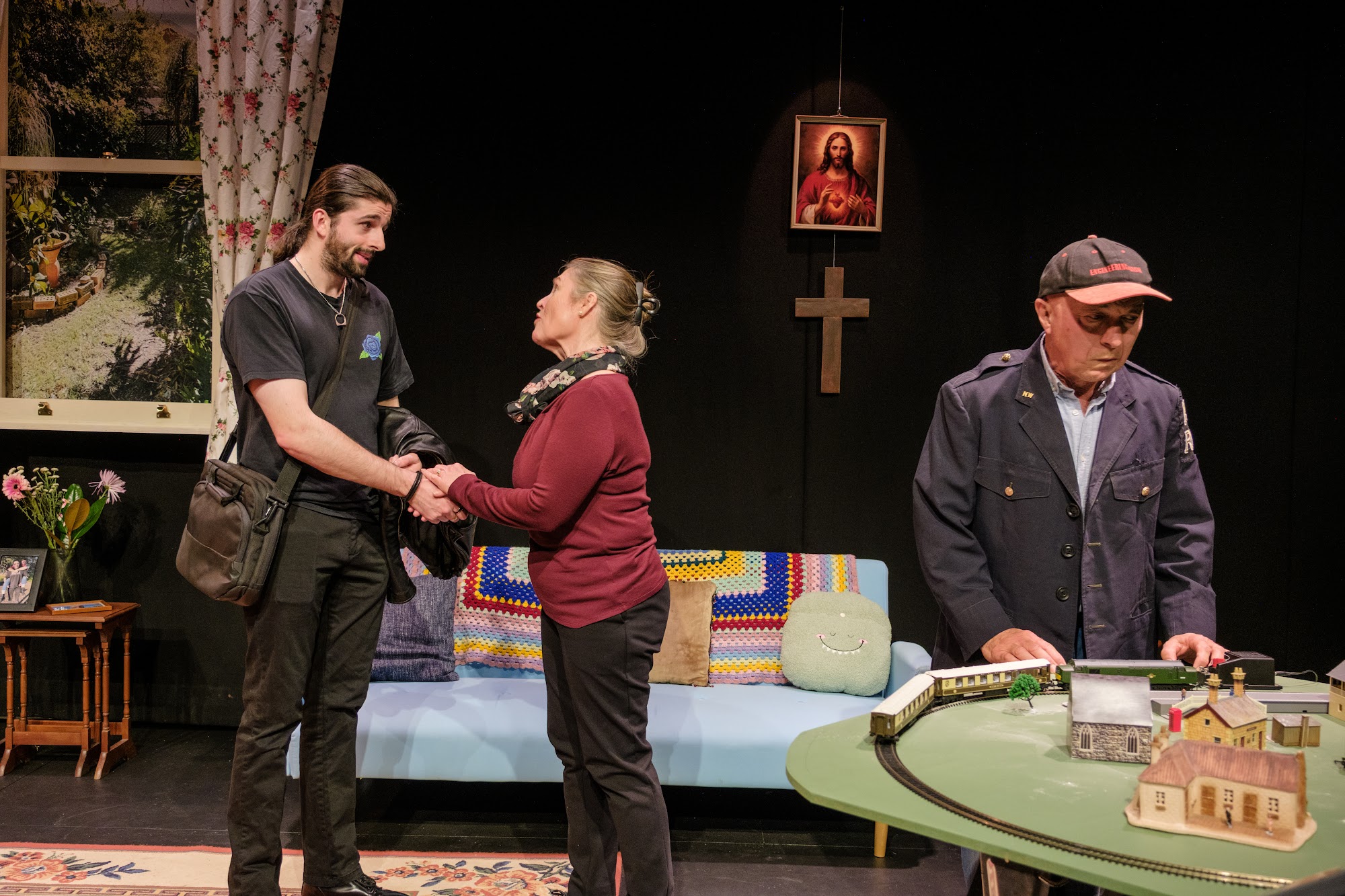
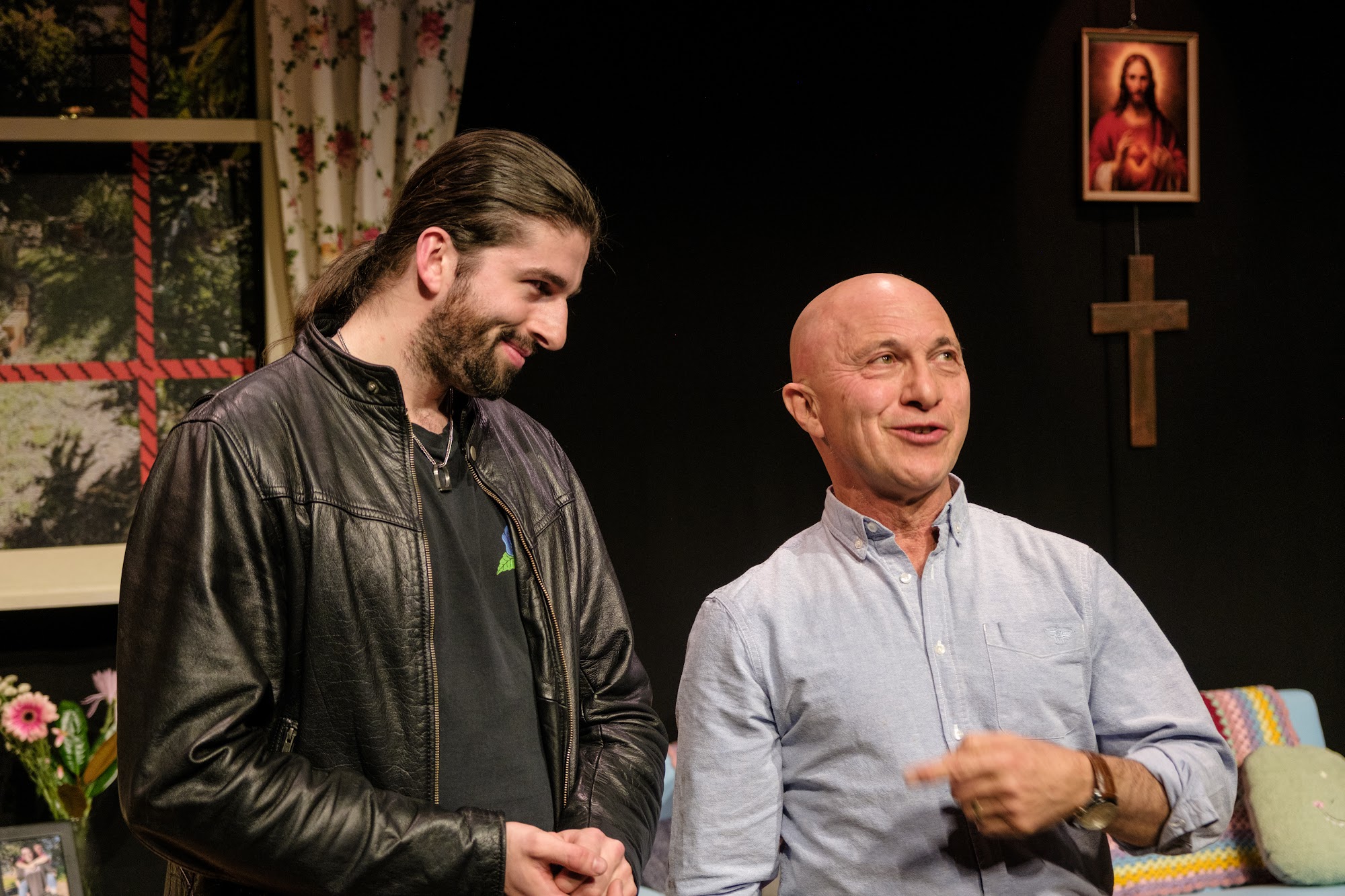
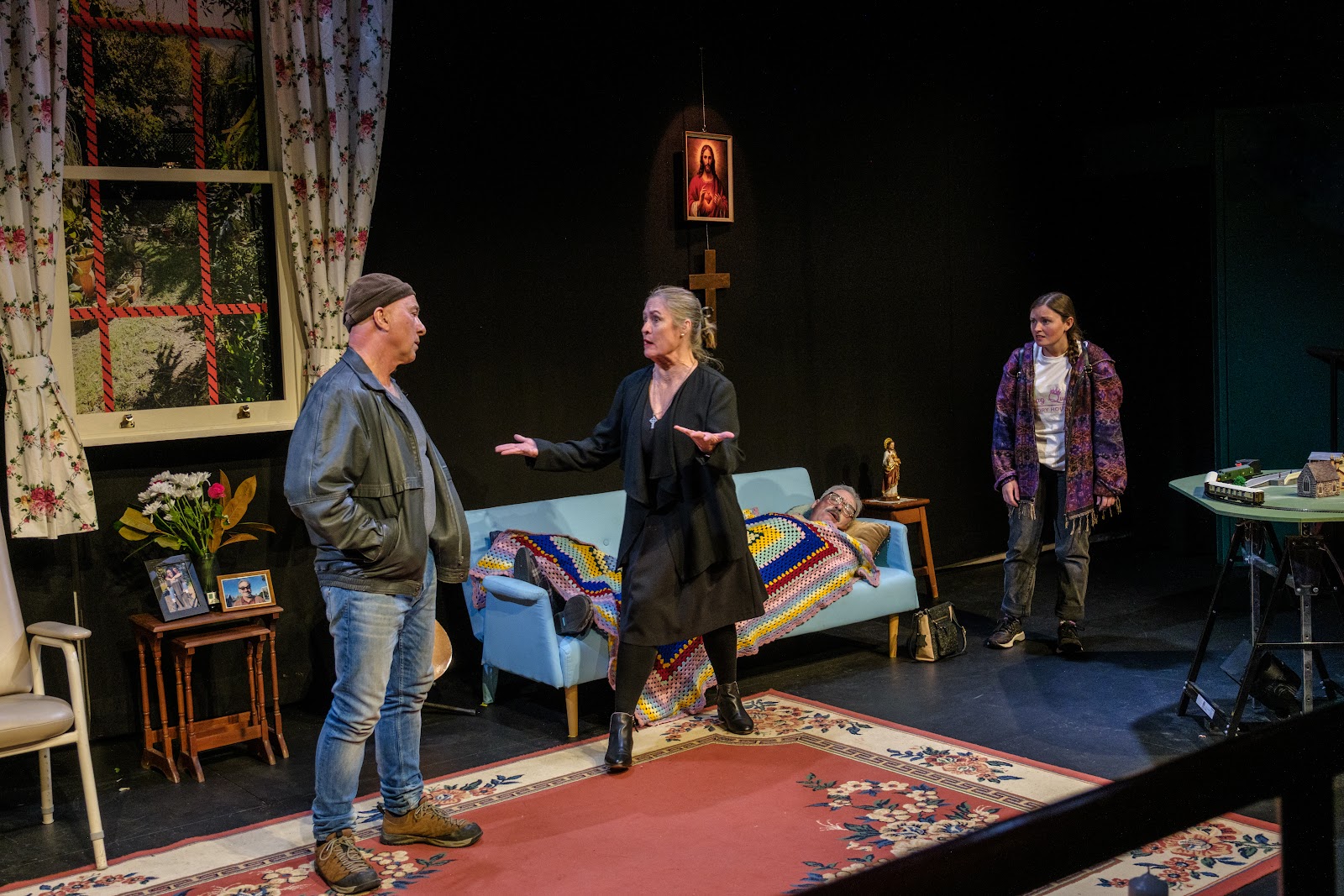
The walls of the Ellin house are hung, in Roger McFarlane's remarkable set, with a crucifix and a print of the Sacred Heart. The dead son's journals are in a box in the attic. The dead son's sexuality is in a box somewhere else, less clearly labelled.
The theological problem of the suburbs
This is a play that knows where the floorboards creak. The delusions of its characters are so gripping because they are our own.
Any intrusion into the suburban dominion can and will be used as a plot device. The young man from AirBnB is a mirror. Everyone in the family sees in him what they need to see.
The mother sees a sign from God, or from her son, or from the talking bird she is convinced visited her in the garden and which the father cannot bear to hear about ("a talking bloody bird, same thing," he snaps, when she insists the bird did not talk, it communicated, a distinction so Australian I nearly wept).
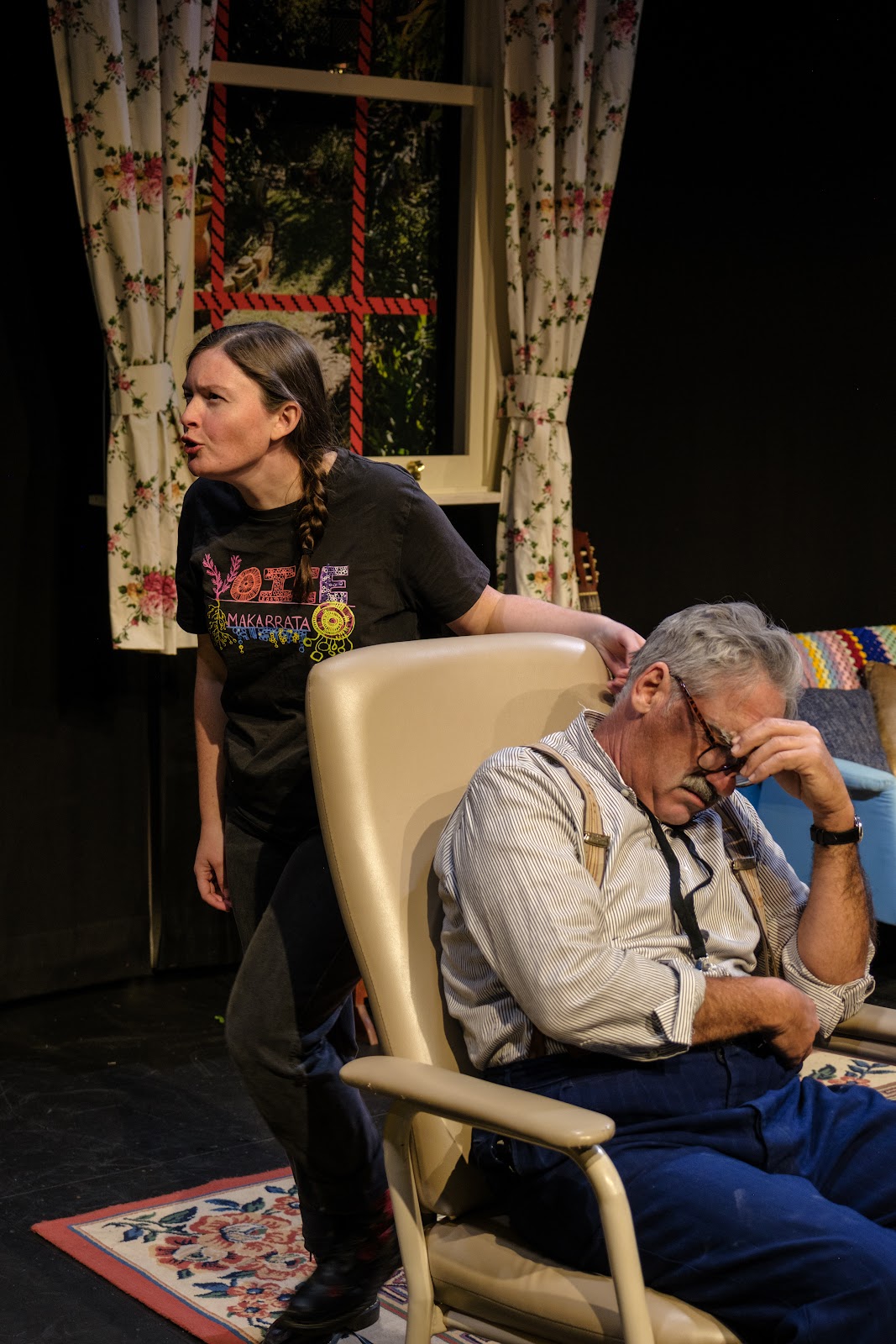
The father sees, I think, the son he failed. The daughter, Cassie (Isabella O'Brien, forensic-science student, the play's only working bullshit detector), sees a creep with a lock on his door and a story about "classified government work" that does not survive five minutes of cross-examination. Is he ASIO? ATO? Centrelink? A fantasist? A grifter? Something worse?
A grief that needs to know when to shut up
This is a beautiful and unnerving premise for a play about Australian grief, because Australian grief is famously the grief that will not say its own name — the grief of The Babadook, the grief in the recent stage adaptation of Grief Is the Thing with Feathers, grief conducted almost entirely through the medium of embarrassment.
Grief that cannot be spoken because to speak about it would be to make a scene. You put a lock on the door, you buy a GPS tracker for grandpa, but you never speak of the grief.
It comes out as paranoia, as conspiracy, as blame, as the peculiar British-inherited tendency to talk around the thing.
Photos by Andrew Thurnham of T visuals
But this grief needs silence to work. It needs tea kettles and misplaced dentures, and then more silence. Caulfield gives us the kettle and dentures. And then he cues sad girl music in the scene transitions. Every single one of them. Weyes Blood and Nick Drake do work the play should have done.
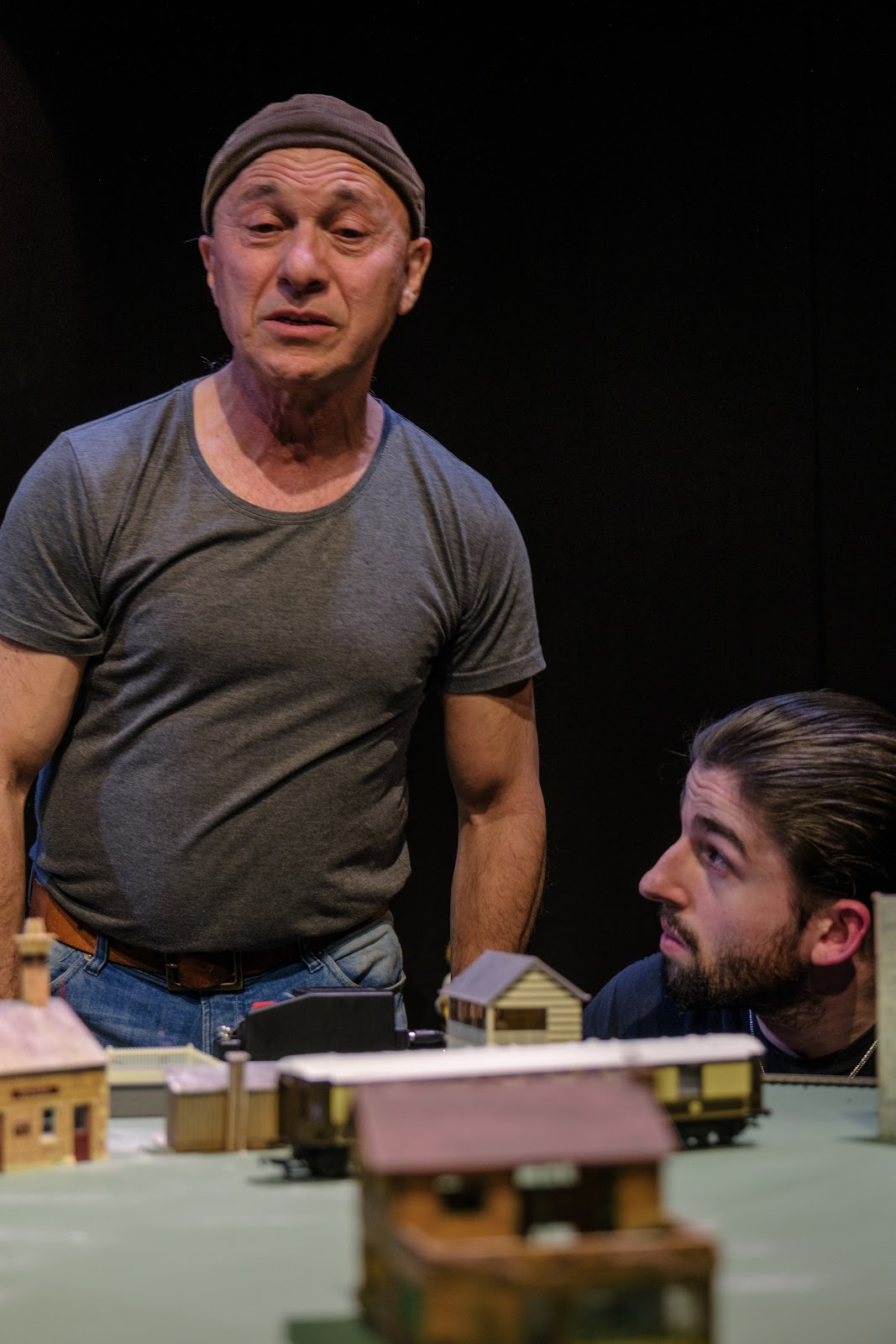
Give me that play. Give me the play in which Denholm's miniature train set is the same instinct as Cassie's forensic-science obsession and Cameron's red-pill epistemology — the instinct to reduce the unbearable to something that fits on a table.
Idiomatic Australian writing
There are other moments where the writing catches fire, and they are almost all moments where the writing lets itself be Australian. What about the shit we don't know.
Caulfield writes with real feeling for the way Australian families quarrel — the flat vowels, the way an argument about whether a bird talked can become an argument about whether God exists can become an argument about whether it is time to sell the house.
The conversation loops, there are malaprops, and the characters fold each other's words back on themselves with a wit that reaches for Shakespeare, and sometimes very nearly succeeds.
There is no whistleblower. But what about the whistle? What if there's no whistle in the blower? What if there's no blower on the whistle?
For all its wordiness in the first act, The Whisper is a machine of reveals, and Caulfield has hidden its levers well. There are three or four moments in the play that retroactively rewrite what you thought you were watching.
Photos by Andrew Thurnham of T visuals
Bring your own red pen
I suspect (and here I am guessing about a development process I did not witness, so take this with the appropriate quantity of salt) that what happened to The Whisper is what happens to a lot of Newcastle indie theatre, and, for that matter, a lot of Australian new writing everywhere: the workshops were too polite.
There is a scene, late in Act One, where the daughter turns to her mother and says, in effect, You are so flaky and naïve, and the mother replies, in effect, I know, but I need to believe in something, and the moment closes up like a mimosa at dusk.
Half the dialogue could be cut. Two-thirds of the exposition. Every single time a character explains why another character left the room.
Photos by Andrew Thurnham of T visuals
Who is to blame?
This is a line of Denholm's in Act Two. By this point, I'm wondering the same thing about what went wrong in the workshopping stage.
If I had to venture: everyone in the room liked Carl. Everyone in the room liked the premise. It's a fantastic premise.
But here's the thing. A dramaturg's job, on a script like this, needs to be the one person in the room who is not the writer's friend for the afternoon. Nobody said what needed to be said, which is that a play about a family unable to speak the truth cannot have everyone saying everything, all the time, immediately.
There is also a suicide vest in Act Two. Reader, I sighed.
Not because it was totally out of the blue or wouldn't happen in real life, but because it was legible as a cop-out from writing that didn't trust the suspense that it had already created.
Chekhov's rule about guns applies with even more force to explosives. Someone in the play eventually says: "Take off the suicide vest, dad." This is both an excellent line and, unfortunately, an accurate note to the playwright. Let the ghosts speak for themselves, Carl. You do not need to strap them to anyone.
Photos by Andrew Thurnham of T visuals
The reason to see this show
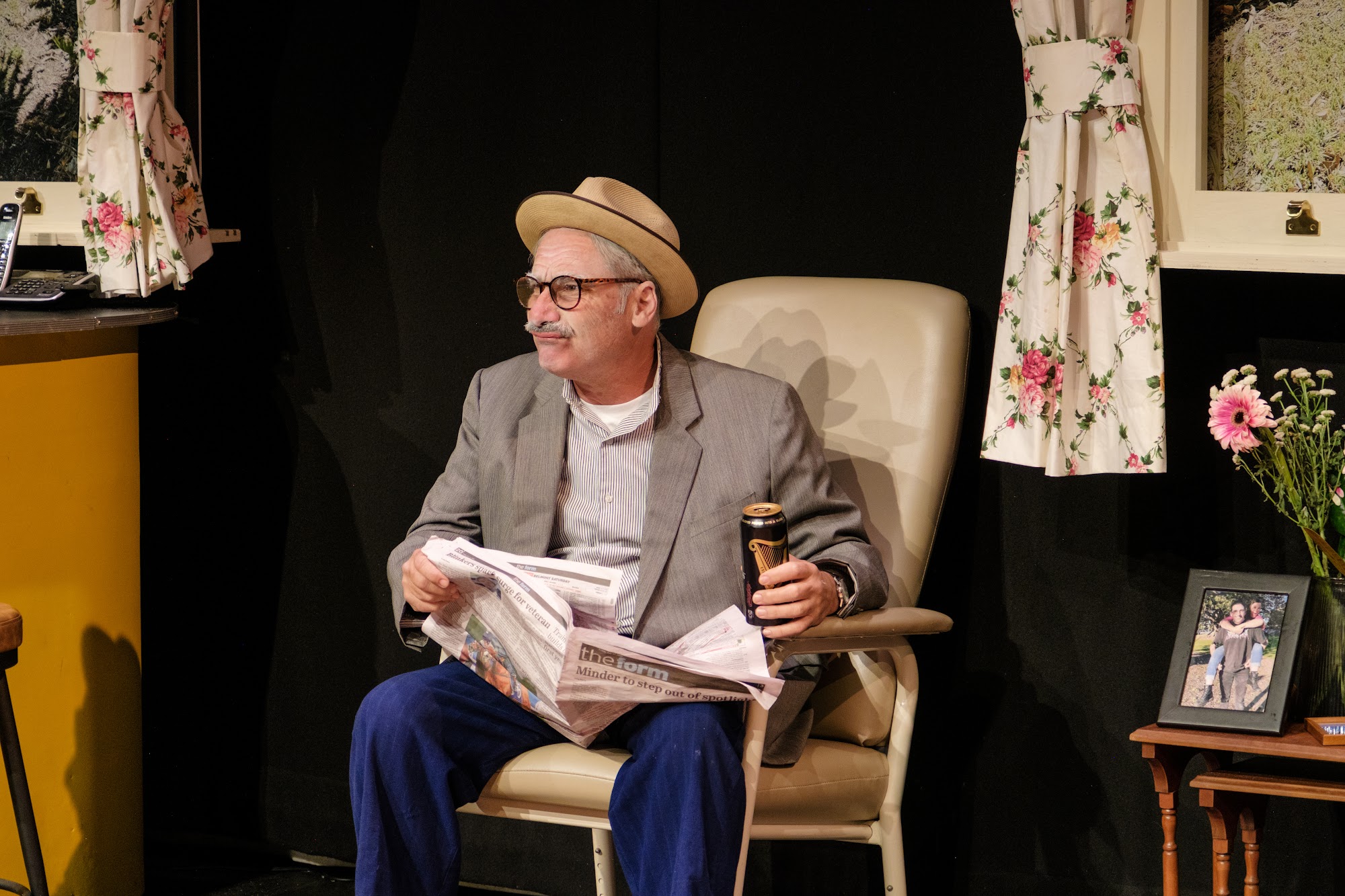
Matthew McFarlane plays Ned, the father-in-law, and he is the reason to see this show. He is the reason to catch the last train home rather than the second-last. He shuffles on early in Act One in an "Ali shuffle" — the family's name for his small, dehydrated stagger, said by them as if in reference to a Labrador — and proceeds to steal the entire production out from under everyone else's feet.
McFarlane has a vaudevillian's instinct for the beat before the punchline. He plays each of his exits as if he might not be coming back, which, for a character with dementia, is always on the brink of being true.
"You can't just pack me away like a Christmas fairy lights. I'm on all the time."
Photos by Andrew Thurnham of T visuals
And McFarlane is, in fact, on all the time. He gets the best lines: "What am I? An African Violet?" A King Lear in a living room while the Melbourne Cup plays on a TV nobody is watching.
McFarlane's Ned is magnificent, funny, cruel, needy, and lucid by turns, sometimes all in the same beat.
The Cast
For all its structural knots and its unmistakable first-act bloat, Stray Dog Theatre's The Whisper has an ace it plays really well: its cast.
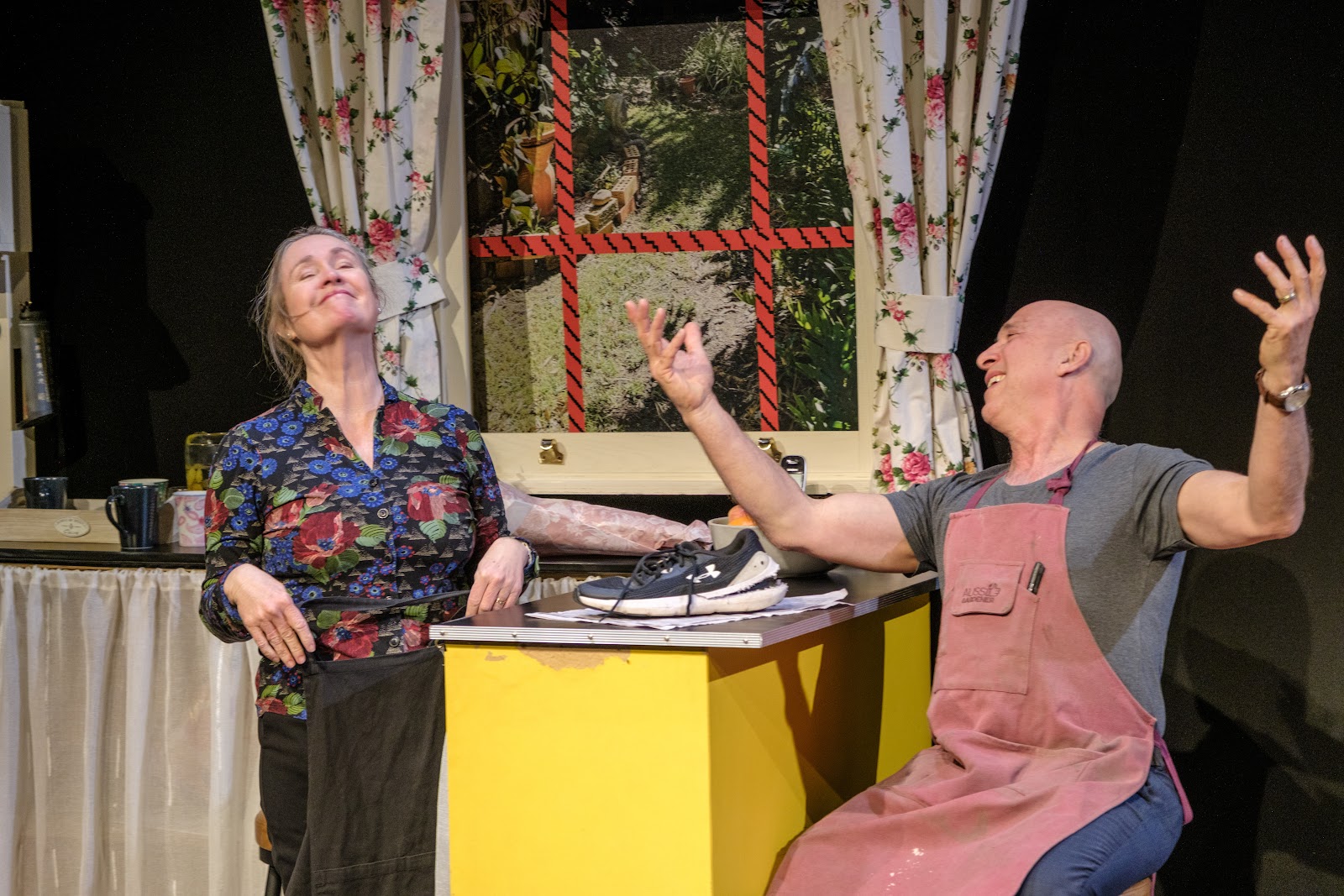
Tony Jozef, who plays Denholm Ellin, trained at the École Philippe Gaulier in Paris. What clown school gives an actor is a face, and Jozef has one of those faces: mobile, sensitive as a seismograph, generous in defeat. In the second act, when Denholm is required to listen to the family's increasingly unhinged fights from his kitchen island, there is an entire play in his reactions. He is watchable to the point of upstaging.
And his genius bit of stage business: gluing a pair of ASICS back together, ferried in on a single tabloid sheet like a raffled meat tray. This is the kind of activity I would have liked to see for the rest of the cast.
Tracey Gordon plays Norma Ellin. Her Norma is broad, warm, near-camp — the housewife-as-archetype cranked to a working boil. She has also understood something about the part that a subtler reading would miss: Norma is a woman performing a role, playing camp as devotion, camp as survival. She gives the play its temperature.
Photos by Andrew Thurnham of T visuals
Isabella O'Brien is Cassie, the Ellins' daughter and the only member of the household not immediately charmed by their new lodger. O'Brien's brief is to play the unreasonable man, and the young actress sure holds her centre. O'Brien has, according to the program, been on the Newcastle stage since she was ten, and she has dedicated this performance to her late father; there is, unmistakably, a quality of listening in her scenes that cannot be faked.
Austin Cooper plays Cameron Crimp, the stranger who arrives at the Ellin door wearing the dead son's face. Cooper is twenty-three, and a twelve-year veteran of Hunter Drama — when the play asks him for stunt work, the choreography is credible and, more importantly, evidently safe. He holds down a neutrality throughout his funniest lines: "Your brain's like a sieve. All these potholes where your mates have fallen through."
Photos by Andrew Thurnham of T visuals
Move more, yell less
The actors project beautifully. But the Playhouse of the Civic Theatre is no Shakespeare in the Park. It is a raked half-octagon of a miniature symphony hall where you can hear a pin drop.
In a play titled The Whisper, the actors can afford to let go of the equation that anger equals volume. The more interesting anger works through withholding.
Some of what works on stage works because it looks like real people fighting: fingers twitching at the ends of stiff arms, the passive-aggressive bad posture, the jaw jutted forward, the tension held in crumpled shoulders.
But the stiffness in the body forces the voice to work overtime. If the body carried more movement, the voice could be freed for range and nuance.
Australian reticence might be the subject matter of the play. It doesn't have to be the stage direction too.
The Verdict
It's a compelling premise. But in practice, there is too much dialogue. Fifty percent of the dialogue in this play could vanish and no idea, no image, no reversal, would be lost.
The actors would have room to breathe. They would be able to notice each other, which is what realism, properly done, actually is: the moment when two people on a stage see one another instead of the audience. Instead, they are talking, talking, talking, over each other.
What's unforgivable in Shakespeare — characters telling us what we are watching while we are watching it, with our own eyes — is no more forgivable in 2026. Exposition destroys intimacy, and it destroys the trust between the production and the audience. The audience needs to be trusted to fill in the holes.
In Hamlet, the ghost of the father is about to speak when the cock crows. And we're left wondering: what would he have said with just ten more minutes of silence?
Reviewed by Aubrey Naur
Théâtre / Theatre
The Whisper
A young man responds to an advertisement for a lodger in a suburban family home. He not only bears an uncanny resemblance to the family's late son, brother and grandson, he shares his first name, Cameron. The devout Catholic mother, struggling with her grief, is captivated by his charm. Her withdrawn husband soon grows enamoured too. Their daughter is wary but also feels alienated by her family's refusal to confront the truth about her brother's death. The grandfather, slowly succumbing to dementia, yet still sharp enough to view the intruder with deep suspicion, raises the alarm, but his voice is rarely heard.
The Whisper, by award-winning Newcastle playwright Carl Caulfield, is about an ordinary Australian family questioning their beliefs and values at a time where two plus two equals five, cognitive dissonance is deafening, and the tech bros are surveilling us through our phones. From the team that brought you Dali: Hallucinogenic Toreador, Creativity and Karma Kafe, comes a dark tragi-comedy for our age.
Auteur | Written by Carl Caulfield Mise en scène | Directed by Felicity Biggins and Carl Caulfield Dramaturgie | Dramaturgy Michael Ewans and Felicity Biggins Production | Produced by Stray Dogs Theatre Company Productrice | Producer Felicity Biggins Scénographie | Set Roger McFarlane Consultant chemin de fer miniature | Model Railway Consultant Larry Greentree Interprète | Cast Tony Jozef (Denholm Ellin), Tracey Gordon (Norma Ellin), Matthew McFarlane (Ned Boyle), Isabella O'Brien (Cassie Ellin), Austin Cooper (Cameron Crimp)
Durée | Running time 2 hrs 20min, including interval Langue | Language English Âge | Age Strictly 15+ (MA15+) Contenu sensible | Content warnings Suicide, mental illness, and references to abuse
Venue Civic Playhouse, Newcastle Presented by UpStage at the Playhouse 2026, Civic Theatre Newcastle
Dates 6–15 August 2026 Prices Standard $49 / Concession $39


%402x.svg)

.webp)


