lacuna Review — Eric Jiang, Essential Workers at Belvoir Downstairs for Griffin Lookout 2026
Aubrey Wang reviews lacuna by Eric Jiang at Belvoir Downstairs, Griffin Lookout 2026. A freelance psychopomp harvests the memories of the living on contract to the goddess of oblivion. An Orphic English-Cantonese three-hander about queer and diaspora grief, and the gig economy of forgetting.
lacuna
Griffin Lookout 2026 By Eric Jiang Belvoir Downstairs Presented by Griffin Theatre Company & Essential Workers Directed by Nicole Pingon
★ ★ ★ ★ ½
Reviewed by Aubrey Wang
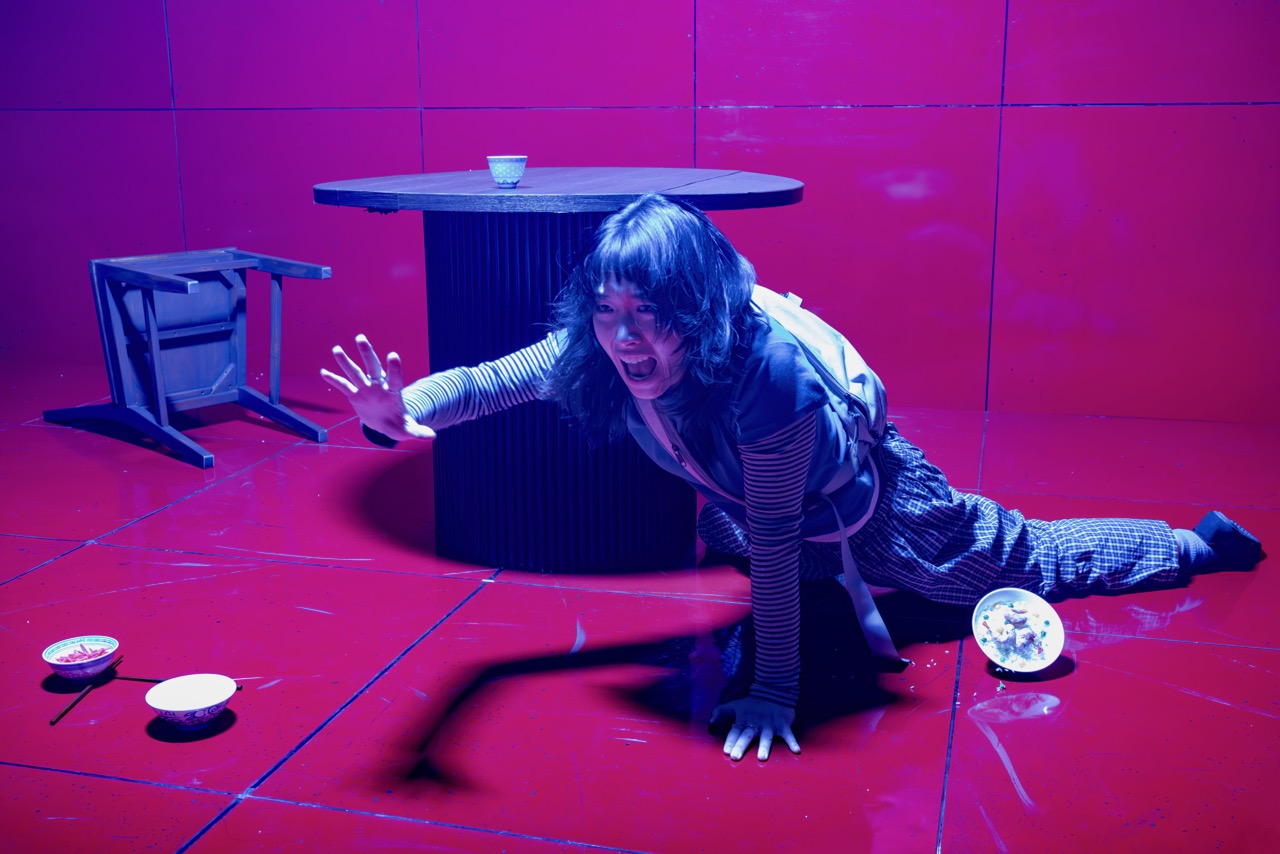
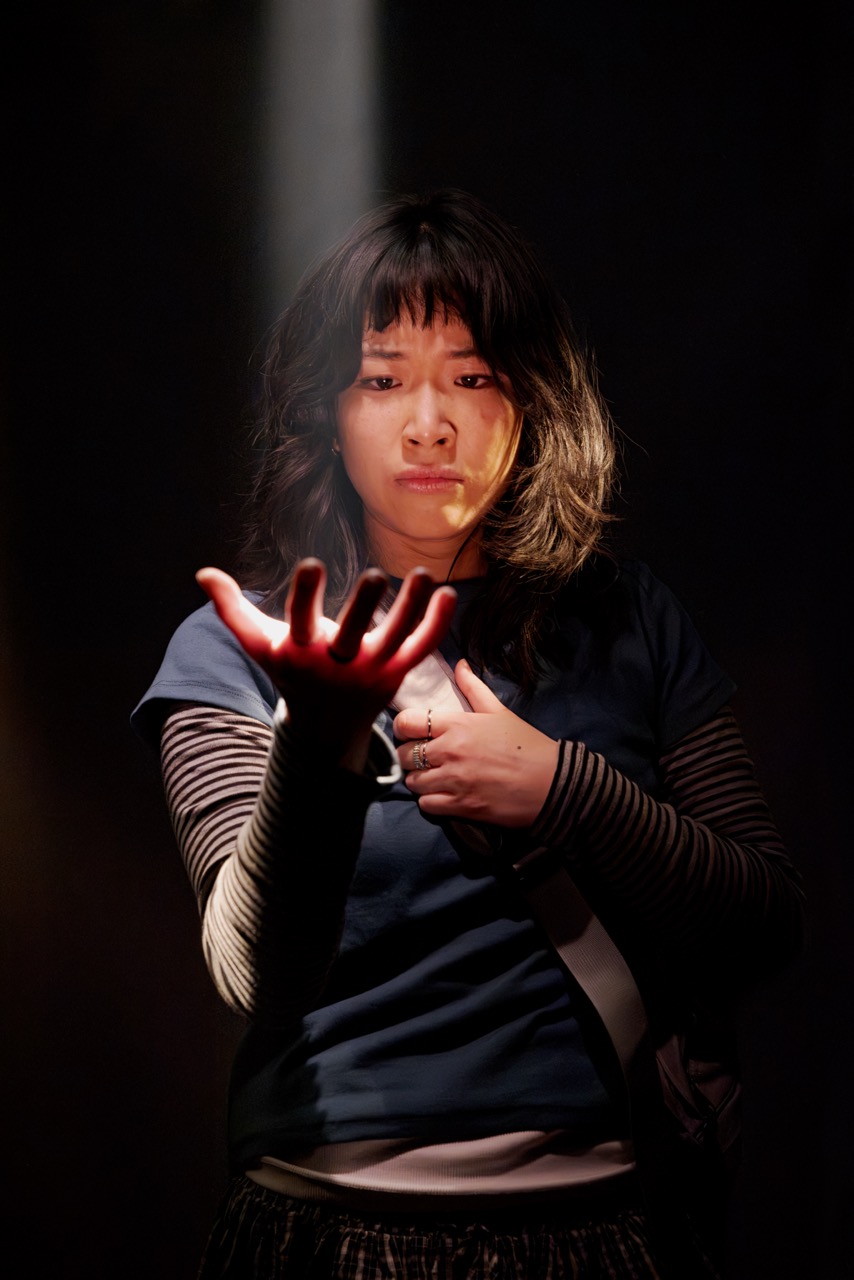
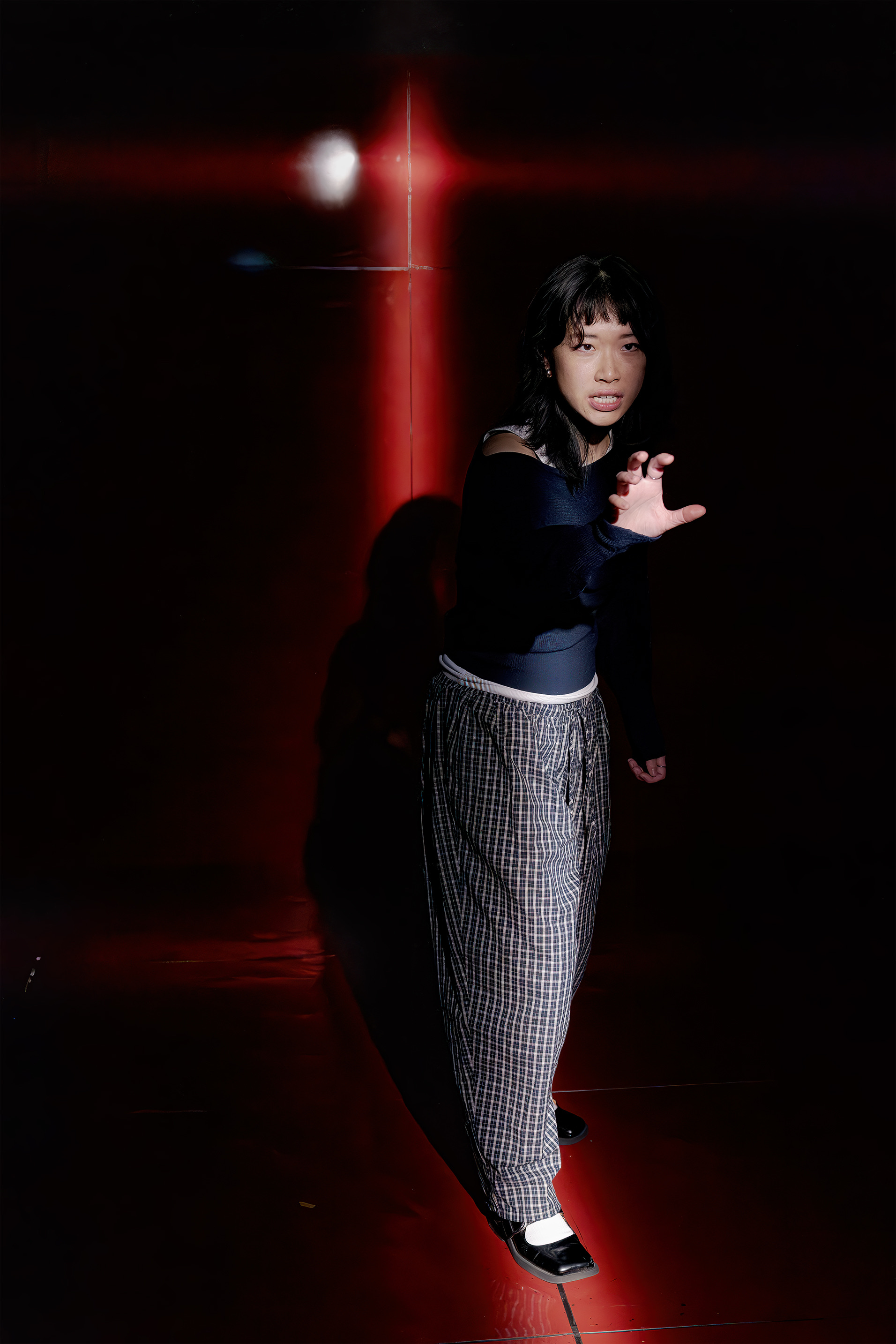
Rachel Seeto stars in lacuna, a Cantonese three-hander by Eric Jiang at Belvoir Downstairs, part of Griffin Theatre Company's 2026 Lookout program.
The Diaspora Art Test
I watched lacuna the week I was searching for a co-founder for Sydney Dramatological, which I have built mostly by myself in the evenings, in exile in French Québec.
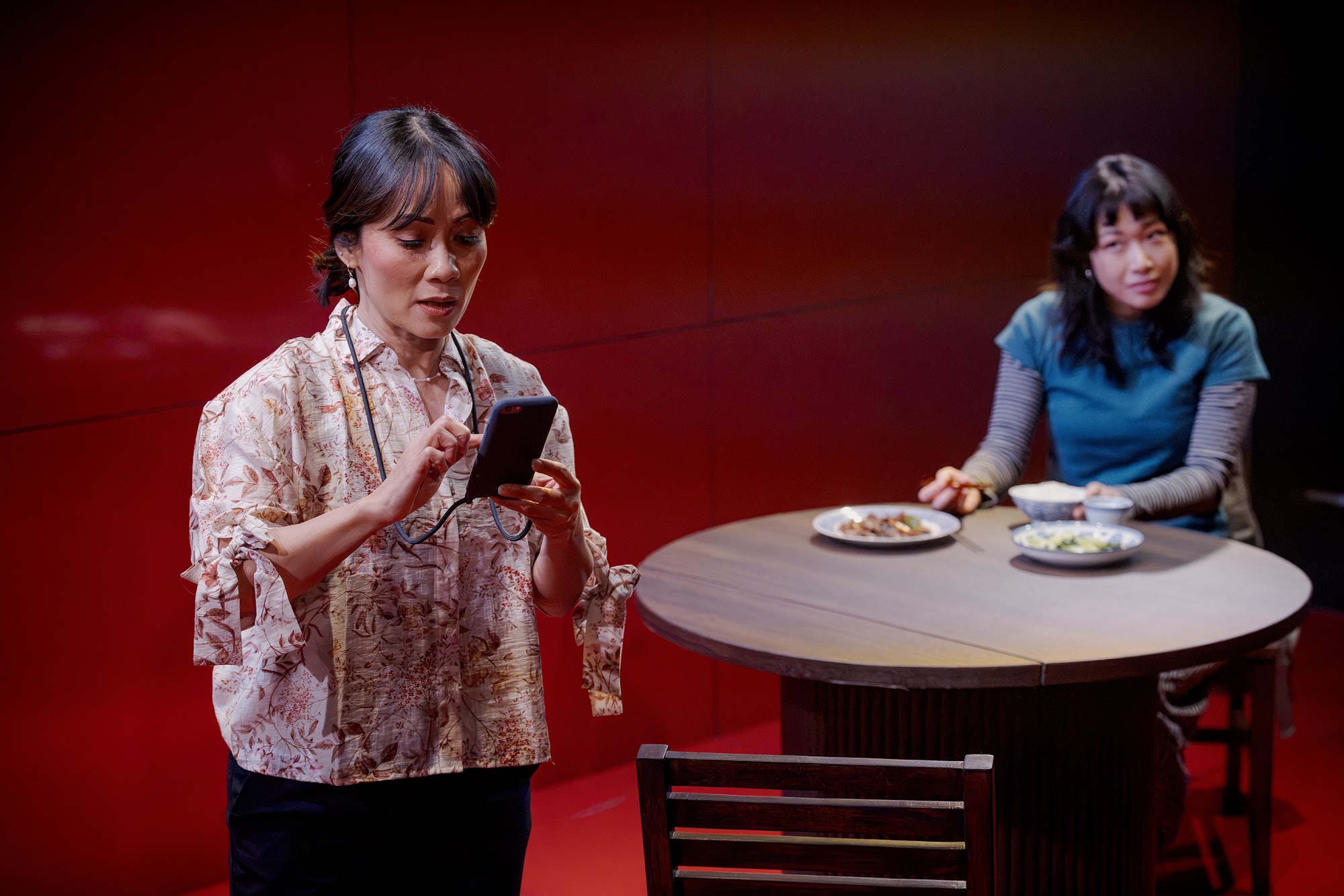
When Claudia's mother told her that it is bad luck to visit the cemetery alone, I felt that she was not talking about luck. It was about the shame, in Chinese life in this country, of being seen to be by yourself. The unspeakable sorriness of solitude. The psychosocial effect of being on the dole, because one would prefer to be lonely than to openly discuss the fact of being unemployed.
The diaspora art test: could I have written it?
Could I have written this? I ask it in the theatre, in the dark, with a small mean pencil in my hand, and I ask it of novels and films and, God help me, of restaurants. I went to lacuna with Henry, who was my scene partner in Chinese Restaurant two years ago. Our joke on the way to the theatre was that we could have done it in Mandarin and better. But we as we walked out the Belvoir to catch the 374, I mumbled, twice, with my hands in my pockets, something to the effect of "I couldn't have written that."
This was an understatement, and it was all the more absurd because what we had watched was not really a piece of writing. It was a piece of audiovisual design, a stand-up comedy, a piece of Chinese opera acrobatics performed in Surry Hills that leaves you walking of the black box forgetting that you have a body. lacuna is a play the way a magic trick is a card.
The play's philosophy of memory, I think, is also a philosophy of witness, of witnessing, of being witnessed. This is why Claudia's job as a psychopomp for the goddess of oblivion has a moral aspect that most gig-economy plays flatten into pathos. To erase a memory is to foreclose the possibility of it being witnessed. And it's especially in the erasure of queer memories that the play shows its stakes.
Wok-Hei Fast
Eric Jiang's dialogue is wok-hei fast. The writing imparts fever-pitch flavours in a matter of seconds. The scenes come off the burner aromatic and sizzling at the tips. The play moves from punchline to punchline so quickly that the slower, more descriptive scene-setting prose is experienced as a small mercy; the audience had forgotten to breath.
In parts, the prose is rich in a way that would sink a lesser production; but in the hands of Nicole Pingon, Jiang's descriptions are staged as visual events. You start to hallucinate the actual boulevards running through Rookwood Cemetery onto the blackouts. The exposition, delivered spoken word, is played like music, always on top of visible action and experienced as rhythm.
The company producing this on the Belvoir Downstairs floor is Essential Workers (stylised, on their materials, as es. wrkers, serif, lowercase — a graphic-design choice I have complicated feelings about but which is, I concede, very hot). It is a small operation run by Zoë Hollyoak, whose previous formula has been the high-production solo show; I Watched Someone Die on TikTok, which came to Sydney after picking up awards in Melbourne and Perth, is the piece by which most of us know them.
lacuna is their departure into a three-hander. Their philosophy has always been verbal storytelling with the audiovisual strategy of a magic show — if the magic show also had someone silently weeping in the third row.
An Orphic Play, Inverted
lacuna is an Orphic play, inverted.
Where Orpheus descends into the underworld to retrieve a beloved, Claudia descends to take on contract work, with Meng Po, the goddess of oblivion, and the job description involves harvesting the memories of the living and incinerating them at the end of the shift.
Claudia optimising her routes, batching her jobs, discarding multiple memories in one trip, gamifying her own incentives the way gifted people at boring jobs do.
lacuna is not advertised as a technofascism play or an AI play, or a late capitalism play, and Jiang is scrupulous never to use those phrases. The play is rather about what the technology does to our desire.
The gig-economy conceit gives the play its comedy and it gives the play its horror. The horror is that Claudia is very good at her job, and she is enjoying it.
The Cast
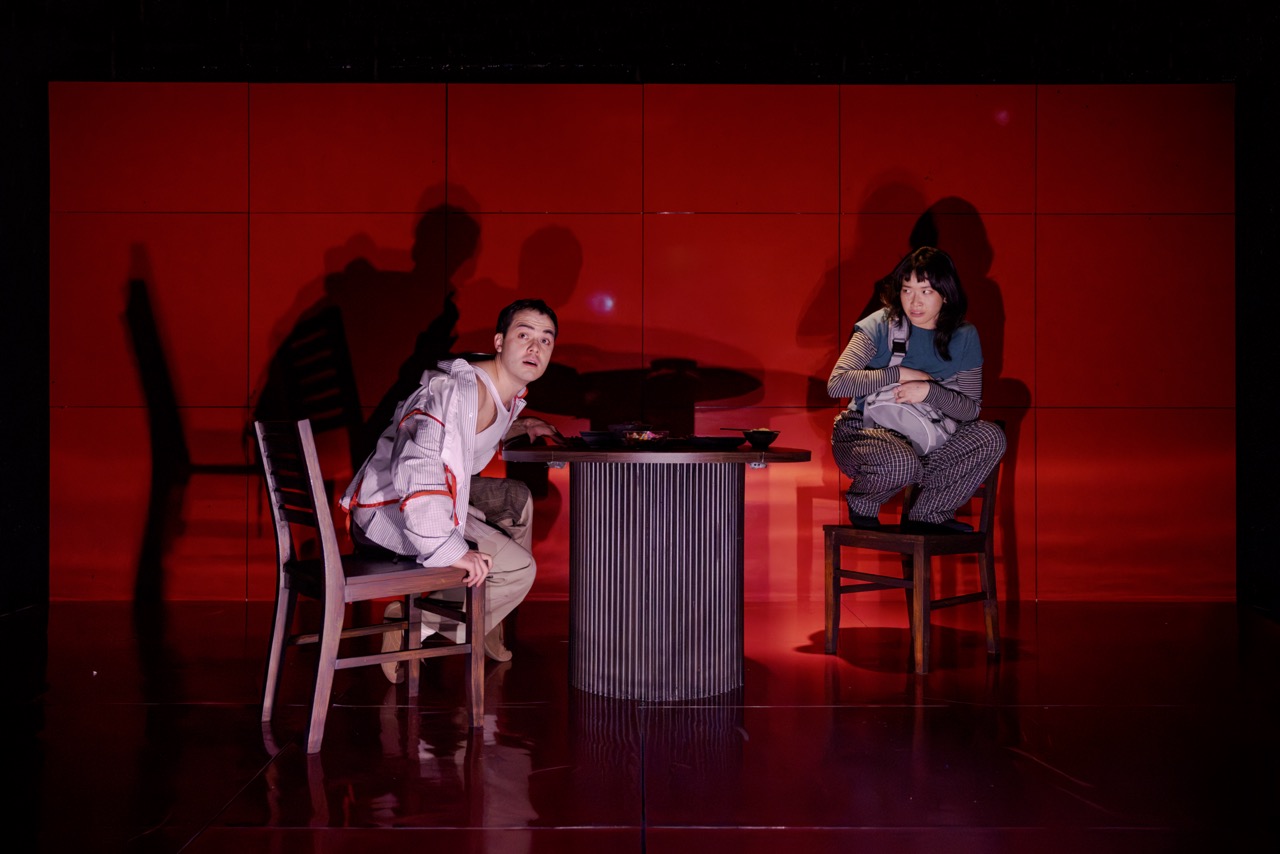
Every performer in this cast has, somewhere in their training, an Asian performing-arts tradition that makes the physical comedy fill every square inch of Belvoir's black box.
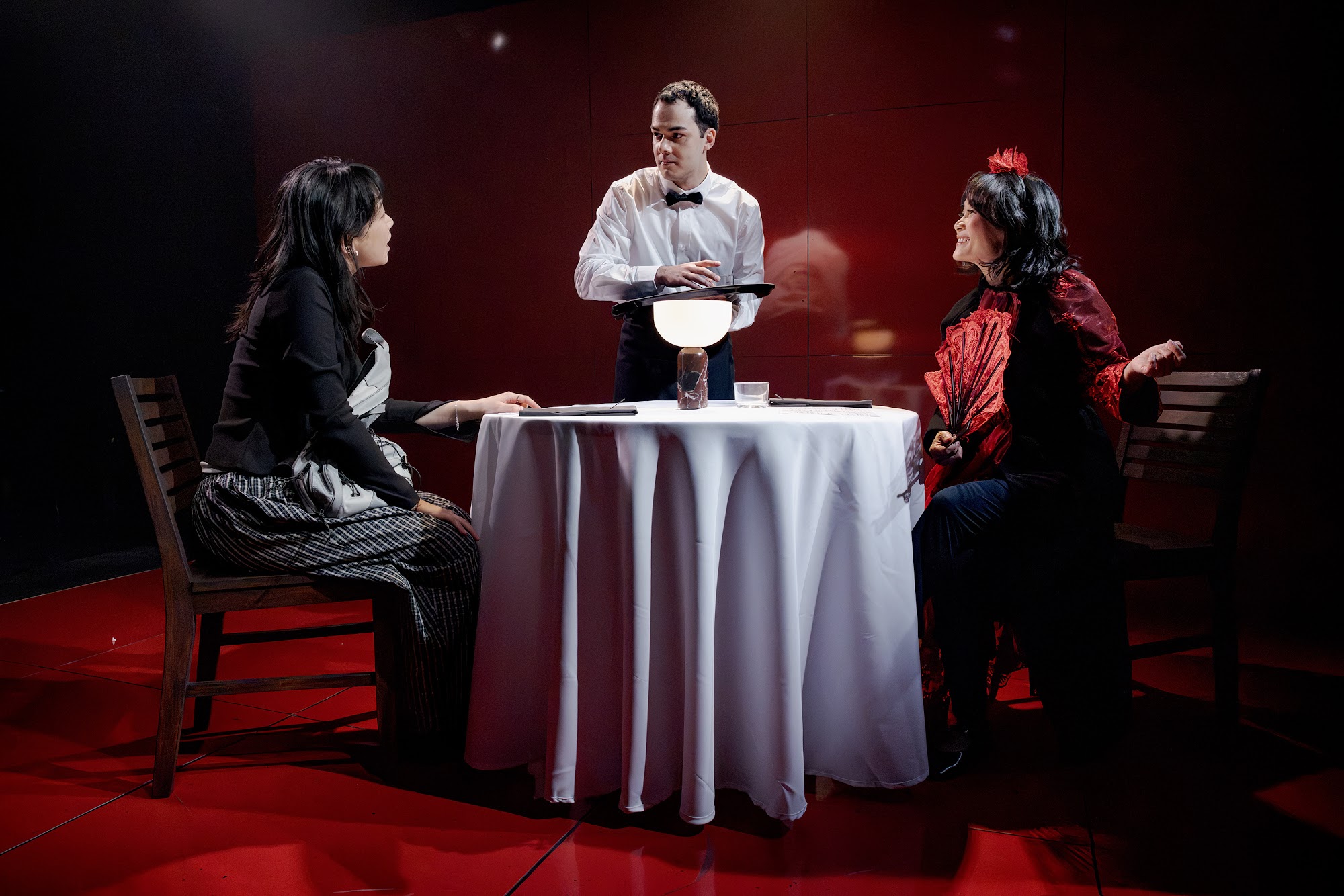
Loretta Kung, as Meng Po, has an IMDB profile that lists, under skills, close quarter knife combat — I had to read this twice, screenshot it, and send . She never handles a knife on stage. She does not need to. Her expressions and her gestures are, on their own, weapons-grade. There is a moment when she flicks her fan across her collarbone and I felt personally reprimanded for a decision I made in 2019. She is terrifying, and she is magnetic, and I would like her to play every mother in every play in this country for the next five years, if only so that some of us finally get around to therapy.
Dominic Lui plays the Rabbit God — Tu'er Shen, patron of queer love in the Chinese folk tradition — and, later, the housemate, and, later still, a whole cascade of spirit forms. He has been trained, I think, in Chinese opera acrobatics, and at one point he simply walks on his hands across the stage in a way that made the woman next to me exhale a small, involuntary "oh." He spends the rest of the evening bouncing around the black box like a slinky released down a stairwell — agile, boneless, and, when he wants to be, unexpectedly still. The stillness is what breaks you. He is a shape-shifter playing a shape-shifter, and Jiang has given him a monologue about desire — "I can be whatever you want, I can shape and change what you desire, and what it means to you" — that Lui delivers with the faint, exhausted patience of a person who has done this job for several thousand years.
Rachel Seeto holds the centre, and it is not the kind of holding that shows. She is on stage for the entire ninety minutes, and the play never leaves her body. You can see her think. You can see her decide. It is thinking made visible, interior life audible, and it is done without a single one of the tricks that lesser actors deploy to indicate cogitation — no thumb-on-chin, no long stare into the middle distance. She simply is thinking, and we are simply watching, and it is unfair how easy she makes it look. Her face carries the weight of every memory she has erased and the joy of the ones she has chosen to keep, and by the third bow at Rookwood Cemetery, when she cannot find her grandfather's grave, she has broken us into small quiet pieces and reassembled us before we noticed.
The Memory Lights
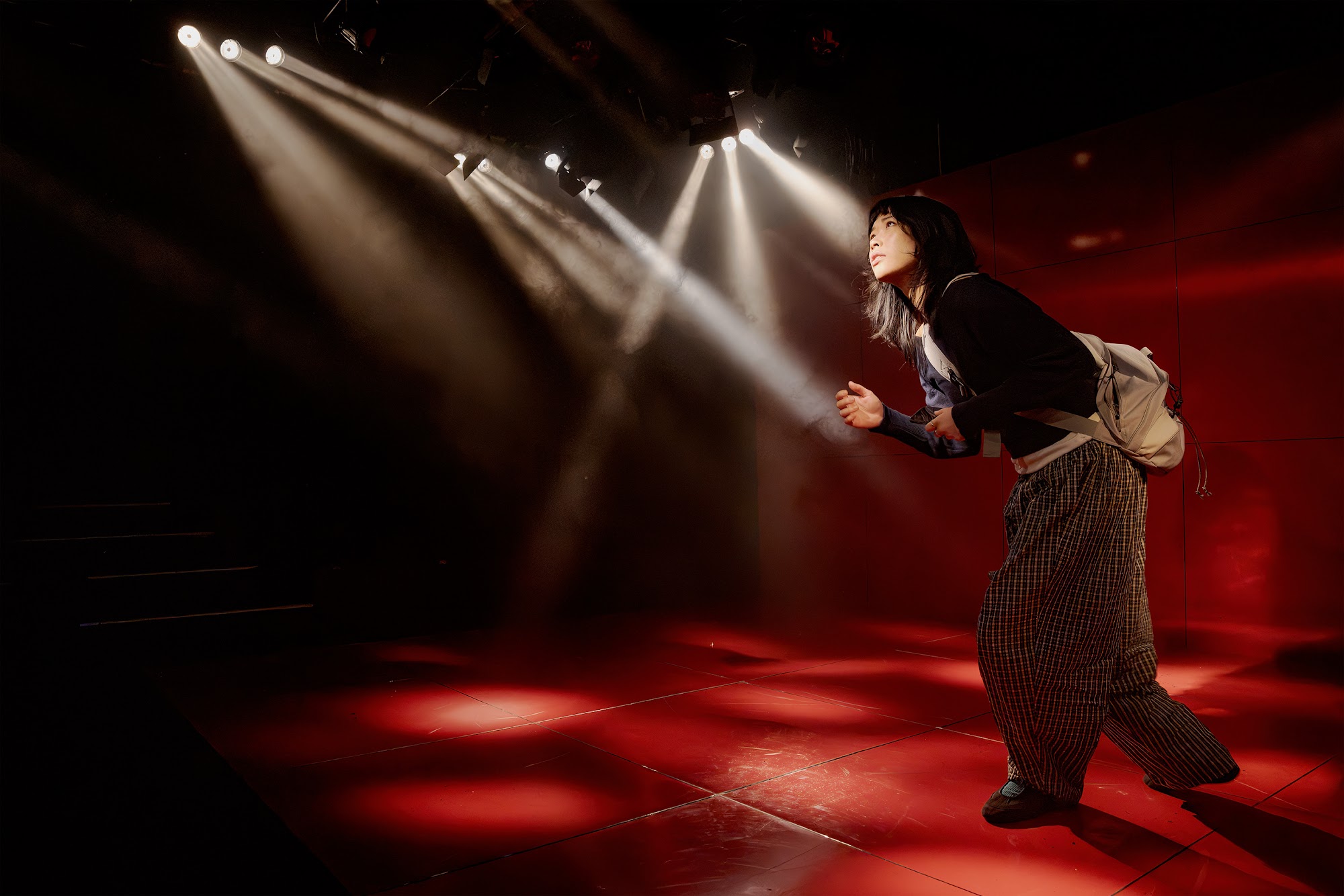
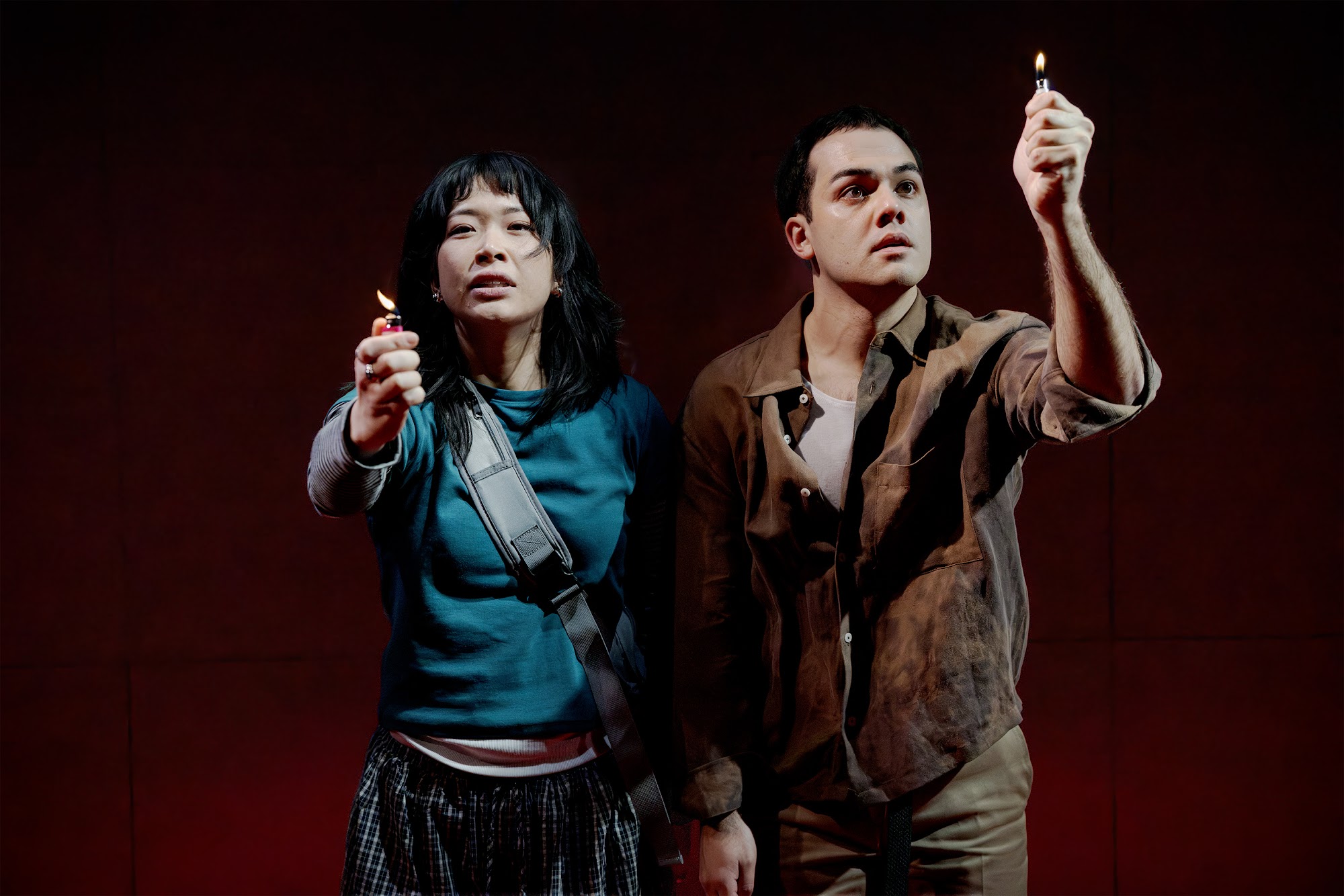
I need to talk about the lighting. Morgan Moroney, whose work at the Old Fitz — done, memorably, with two halogen floodlights and a demo unit that looked like it had been rescued from a house fire — has been quietly upgrading the ambient lighting standard of Sydney independent theatre for some years now, has been given the full Belvoir Downstairs infrastructure to play with, and it is like watching someone who has been sketching in ballpoint get, for the first time, a full box of pastels. Moroney returns with their trademark mix of the industrial and the maverick, but the parcans — which do the standard theatrical work — are not the interesting design. The interesting design is what Moroney does with the tungsten-filament bulbs. The memory lights.
They flicker. They have filament. You can feel them. With fake smoke and very narrow warm beams, the stage becomes a laser-attack room in which each shaft of light is somebody's memory, laid out like a corridor to be walked down and, one by one, snuffed out. There is a moment where Moroney turns Belvoir Downstairs into a Cantonese kid from Hurstville playing Final Fantasy — every side quest lit, every save point lit — and I laughed out loud, because I was that kid, and no one has ever put that specific interior on a stage before, and here it was, being made out of gels and gobos and warm white LEDs.
The reason no set is needed is that your body remembers lighting. Moroney reproduces, with alarming accuracy: what a Chinese restaurant looks like from the inside at 2 p.m. on a weekday; the chink of hallway light coming through a door left slightly ajar; Rookwood Cemetery on an overcast afternoon in August; the strobe of a queer nightclub at two in the morning, when the strobe has stopped being decorative and has begun to feel medical. You can smell the texture of the lighting. That is not a sentence I have written about a lighting designer before.
The FOH strobe warning, incidentally, is not a joke. Pejoratively speaking, the strobe is excessive. It is not, however, overused, and the distinction matters. Give this designer everything you have. They deserve it.
Engineered Consent
The play's cleverest philosophical move is a single line.
Claudia, who has by now realised she can extract and destroy memories, decides — with all the tenderness and all the arrogance of a child who loves her mother and has recently learnt a new trick — to Theseus-ship her mother. To pull out, one by one, the memories that make her mother homophobic, and to leave in place everything that makes her mother her. She does the surgery. It works. The mother, waking, blinks a few times, looks at her daughter, and says: but you never asked me if you could do that.
One line. An entire philosophy of engineered consent. Most contemporary dramas would need an act to build to that observation; some would need a whole trilogy. Jiang deposits it, without ceremony, and moves on. I sat forward in my seat. The woman next to me — the same one who had exhaled at the handstand — put a hand to her sternum, as though something in her chest had shifted position.
The Ending
The closing sequence is an action movie. It is fast, exciting, and perfectly choreographed, and it is staged with nothing but lighting, three bodies with Chinese martial-arts training, and an empty stage. At the rite grave, Claudia and her housemate have nothing to offer — none of the traditional joss, none of the paper money, none of the fruit. Claudia produces a pack of original-packaging Esse menthols, the kind now banned at Coles. Her housemate offers one single ACON condom. That is the joke, and it works, because it is also the offering. It is what they have.
Dominic Lui then takes on multiple spirit forms in quick succession, culminating in a passage in which his body carries Claudia's face — the play's cleanest visual statement of its own theology, which is that there is divinity in all of us. In the avoidant mother. In the gay housemate. In the freelance psychopomp on the way home from her shift. It is a lovely little psychedelic Orpheus journey, and had the play ended here, on this note, I would have been the crying woman two rows behind the woman with her hand on her sternum, and this would be a five-star review.
Why 4.5 and Not 5
The play did not end there.
The mother comes back into the room after the Orpheus journey. The mother scenes are funny, and they are touching, and they are also — I say this with love — redundant. Everything you needed to know about Claudia's mother was already in the way Meng Po talked to Claudia at work. The mother, as a character, was best when she was the negative space around the boss.
I wanted to cry. I would have liked catharsis. I did not, quite, get it. I teared up. I did not weep. My rubric here, refined over some years and against my better judgment, is that a five-star play sends me home using the seat in front of me as a tissue; a four-and-a-half-star play sends me home with a slight sting behind my eyes and a very sharp pencil.
The play we would have had without the mother scenes — the play in which the mother is only ever the negative space defined by the boss — would have been the five. What we have is a four-and-a-half. Catharsis missed by a whisker, and that miss was, I want to be fair, the play's deliberate refusal. Claudia was in survival mode, and so, by design, were we. Fair enough.
Still, and I do not say this lightly: this is the best diaspora work I have seen in the last year. Possibly two. Go. Take the 374. Take a friend from a play you did two years ago and haven't quite forgiven. Sit in the dark with your small mean pencil, and let Eric Jiang and his ensemble show you what a card trick, in the right hands, can do.
Reviewed by Aubrey Wang
Théâtre / Theatre
lacuna
Une psychopompe freelance récolte les souvenirs des vivants pour le compte de la déesse de l'oubli. [FR?]
A freelance psychopomp harvests the memories of the living on contract to the goddess of oblivion — an Orphic Cantonese three-hander about queer memory, diaspora grief, and the gig economy of forgetting.
Autrice·eur | Playwright Eric Jiang [FR?] Mise en scène | Director Nicole Pingon Décors et costumes | Set & Costume Designer Hailley Hunt Conception lumières | Lighting Designer Morgan Moroney Composition et conception sonore | Composer & Sound Designer Sam Cheng Assistant·e à la conception lumières | Assistant Lighting Designer Luna Yuet Yee Ng [FR?] Dramaturge | Dramaturg Jules Orcullo Productrice créative | Creative Producer Zoë Hollyoak Régie | Stage Manager Jonathan Ogilvie Distribution | Cast Rachel Seeto (Claudia) · Loretta Kung (Meng Po / Mother) · Dominic Lui (Rabbit God / Housemate / Spirits) Présenté par | Presented by Griffin Theatre Company & Essential Workers Presse | Media & PR Kabuku Public Relations (Sean Radecki, Briana Carboni)
Durée | Running time 90 minutes, no interval Langue | Language Cantonese and English, with surtitles Lumières clignotantes | Flashing lights Yes — strobe warning in effect Avertissements | Content warnings Strobe lighting; themes of grief, queer identity, intergenerational conflict


%402x.svg)

.webp)


