Interview · Antigone — James Collins II, Lauren Cleary, Marcel Forrer and Thomas Henderson
The University of Sydney's Classics and Ancient History Society Gaius Gracchus staged three sold-out nights of a full-chorus Antigone from 1–2 May 2026 at the Chau Chak Wing Museum. The project was begun by James Collins II and Daisy Levell. This piece is drawn from written responses by four collaborators — composer-translator-chorister Thomas Henderson, lead choreographer Marcel Forrer, chorus leader Lauren Cleary, and Duncan Eddy-Soros (Creon) — plus an hour-long Zoom with Collins between Sydney and Montreal in July.
Antigone Comes Back to Sydney
A full-chorus Antigone at the Chau Chak Wing, 69 years after USYD's last.
The University of Sydney's Classics and Ancient History Society Gaius Gracchus staged three sold-out nights of a full-chorus Antigone from 1–2 May 2026 at the Chau Chak Wing Museum. The project was begun by James Collins II and Daisy Levell.
This piece is drawn from written responses by four of the collaborators — composer-translator-chorister Thomas Henderson, lead choreographer Marcel Forrer, chorus leader Lauren Cleary, and Duncan Eddy-Soros (Creon) — plus an hour-long Zoom with Collins between Sydney and Montreal in July.
Interviewed by Aubrey Wang.
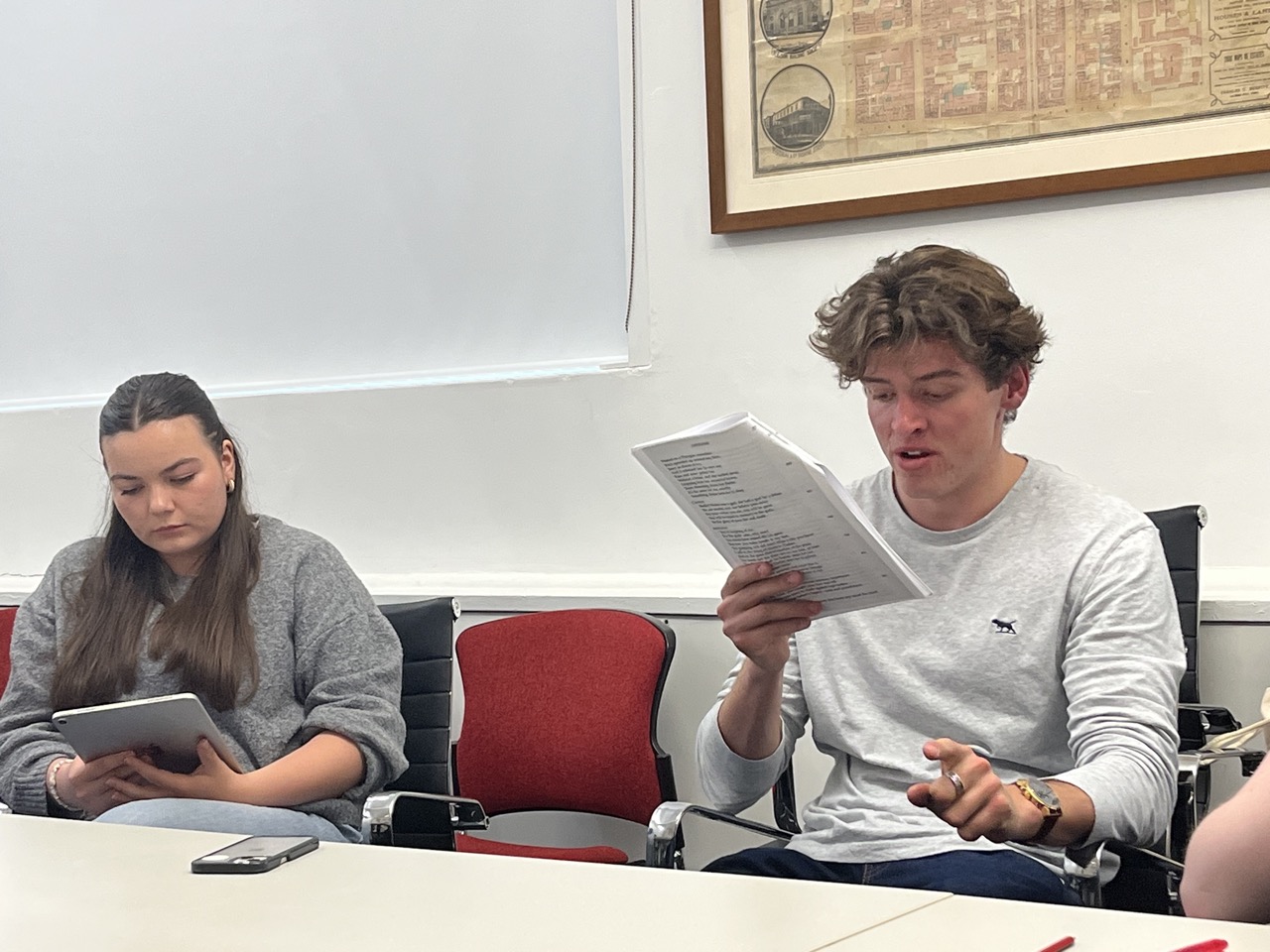
Isabelle Le Map (Antigone) and Duncan Eddy-Soros (Creon) read aloud from their scripts. Photo: Xavier Swann.
The University of Sydney's first full production of Sophocles' Antigone in 69 years was set against real-world events that Dr James Collins II — Senior Lecturer in Ancient Greek Language and Literature — calls a "high-stakes Antigone."
In the Democratic Republic of the Congo in early 2026, families burying their Ebola dead have been prohibited from touching the bodies, since the virus remains highly infectious in a corpse. Under protocols enforced by the DRC government and the WHO, specialised teams in protective gear conduct the interments, attendance is capped at fifty, transport of unverified bodies between regions has been outlawed, and morgues Ebola-test the deceased before releasing any remains. This has a particular resonance for a new production of Antigone, where the right to bury the dead becomes a conflict between individual conscience, familial duty and the authority of the state.
Collins came to Sydney by way of the University of Southern California and Stanford University. He founded and runs the Performing Wisdom program, which has staged Greek tragedy and comedy over more than two decades with school students, university students, military veterans and working professionals. His most recent article, "Dancing Democracy: How Ancient Greek Choruses Can Heal Modern Communities" (Cambridge, 2026), argues that the classical chorus was not decoration but civic practice — a claim this production had a chance to test in real time.
He Only Had One Ask: A Fully Realised Chorus
As far as leading academics on university productions go, Collins is pretty laissez-faire: "I came in and pitched the idea of bringing the Greek play back. I said, you all can do this as a blank slate."
He only had one specific ask: a singing, dancing chorus. "I want to see what that's like. I want to see what that feels like. I want to see what kind of community comes from that experience. And I got far more than I could have ever hoped for."
But a brief, no matter how hands-off, still takes serious labour between blueprint and product. As the students were about to discover — well-documented productions of Antigone favour pruning back the chorus, or cutting it entirely.
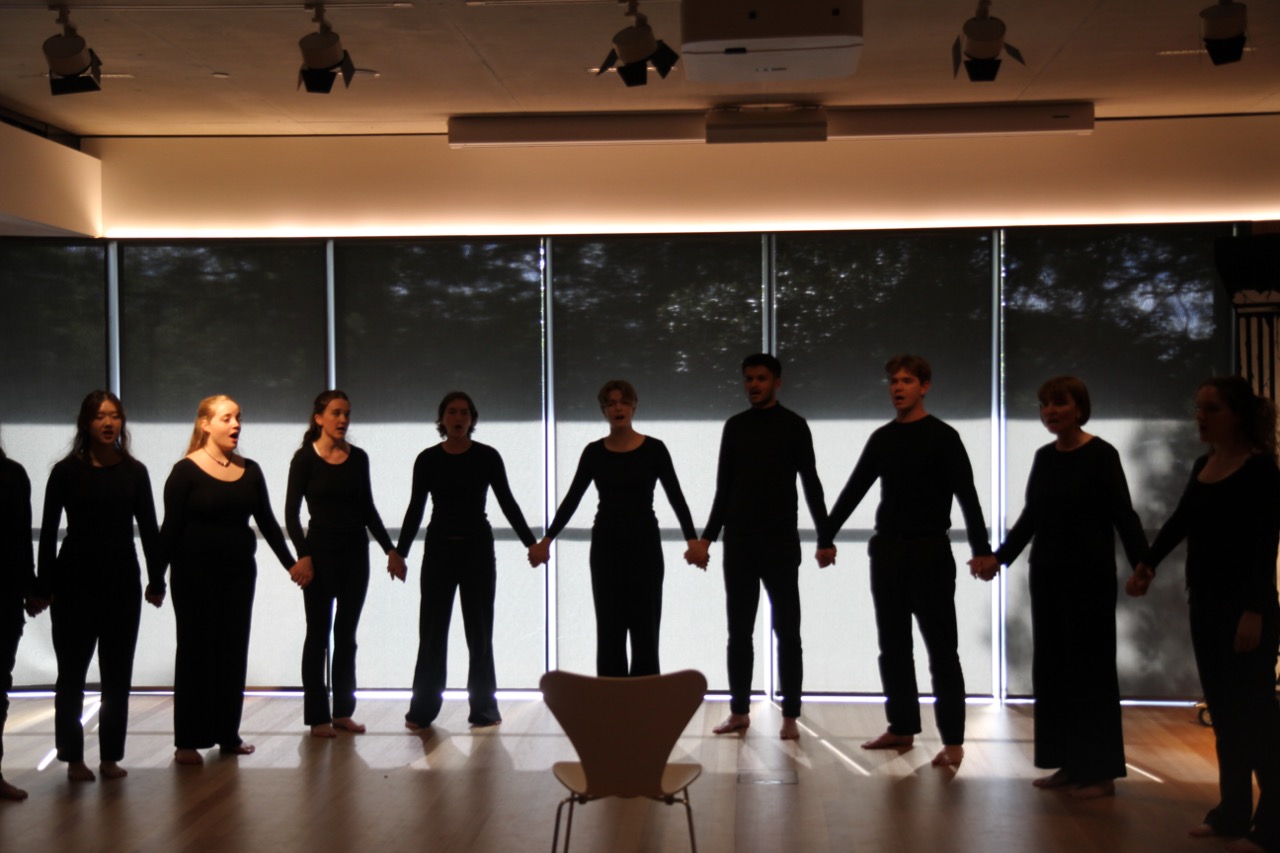
The full ten-person chorus in a line during a stasimon, joined hand-to-hand across the stage. Photo: Xavier Swann.
Q: Expectations versus reality of staging Antigone with a full Chorus?
Thomas Henderson (Chorus, Music, Translation): "We were making it up a lot along the way, using our best knowledge of Greek rhythm, pitch and strophe/antistrophe structure."
The reality of a ten-person chorus on a compressed timeline meant the group had to teach each other to sing and to dance, mostly for the first time. Henderson credits the process with turning the ensemble into close friends.
Marcel Forrer (Chorus, Lead Choreographer) felt both the euphoric "fellow feeling" and the crisis of faith. "Other days, I thought there was no chance people would pick up the choreography. There's not a lot of examples of dancing choruses out there, so I felt like I was going in partially blind."
Lauren Cleary (Chorus Leader, Assistant Choreographer, Vocalist) was realistic about the material differences. "The ancient chorus was a chorus of young men whose sole responsibility was training for choral performance for months ahead of the production, who were housed together, fed, and salaried."
Rather than force one form onto every ode, they solved each one differently. The parodos was sung live in march time. The Ode to Man was sung live in Greek and then danced to a pre-recorded English track. The third stasimon split into a live chorus of eight with a two-person danced duet.
The other problem was more spatial than logistical: what do you do with ten chorus members present on stage at all times? The answer came from Dr Grace Gunning, a Cambridge scholar visiting Sydney in anticipation of her successful PhD defence.
Gunning's suggestion was something like an orchestra, which for the ancients had always been about the chorus and not the string ensemble. In fact, the word "orchestra" means "the dancing place" that the chorus occupied in the ancient Theatre of Dionysus. The students ended up embedding the chorus in the front row of the audience. For Henderson, it was the intervention that made the staging viable.
Gunning also pushed the choreographers toward circle formations to echo Dionysic dance. "Circles for Dionysus," as Cleary remembers her phrasing it, ended up shaping the closing of the fifth stasimon and the end of the parodos, where the chorus revolves like maypole dancers.
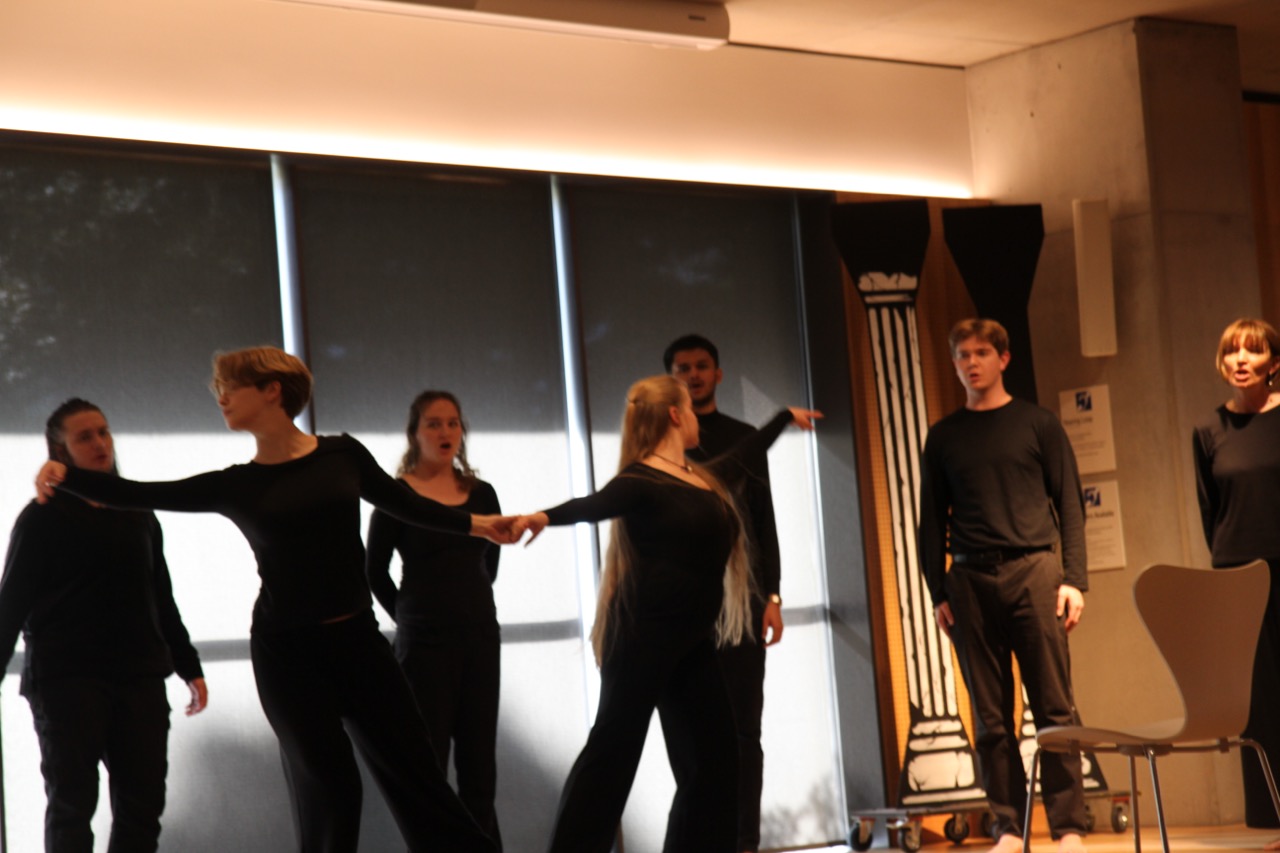
The chorus mid-movement during one of the stasima. A classical column stands at right. The extended arms and mid-turn belong to Marcel Forrer and Lauren Cleary's semi-mimetic choreography. Photo: Xavier Swann.
Collins, watching from the outside, was struck by how much the choreographers and Henderson were having to problem-solve on the fly. "The choreographers had to show the steps, but then they were showing people that couldn't necessarily do the things that they could do. And so they needed to change the choreography to accommodate everyone."
Forrer noticed another consequence of the compressed timeline: the chorus almost never rehearsed with the cast. "This meant our chorus seemed to work as a live intermediary between audience and cast, translating our emotions and the thematic tensions in a very immediate way."
Bespoke Odes: Woodruff, Wagner, and an Embodied Translation of the Ode to Man
For the solo roles, the cast worked from Paul Woodruff's 2001 Hackett translation. Cleary notes that Woodruff was Collins's teacher when he was a student. (Woodruff, the American philosopher-classicist and Vietnam veteran who spent fifty years at UT Austin, died in 2023; he was also the author of Reverence: Renewing a Forgotten Virtue (2001).)
Woodruff's translation went live, with the exception of Eurydice's part — and the choral odes. Henderson built each one from the Greek, ode by ode, for a ten-voice student chorus with mixed timbres. He calls the process "composite": preparing the ancient Greek for singing, dancing and performance in the same act. In practice, each ode got its own solution.
The parodos he set in English iambic stanzas for a 4/4 march. Pitching it and practising with the others, he realised he'd stretched the tune too wide for the voices he had, which sent him back to the question of what the original chorus of trained male singers actually sounded like.
For the first stasimon (the Ode to Man, the most famous choral song in Greek tragedy) he wrote a metrically identical English twin of the Greek. The third stasimon (Sophocles's Eros Anikate Machan, Eros unconquerable in battle) he retitled "Eros Irresistible" and set in 3/4 to Wagner's Liebestod (Tristan und Isolde, 1865).
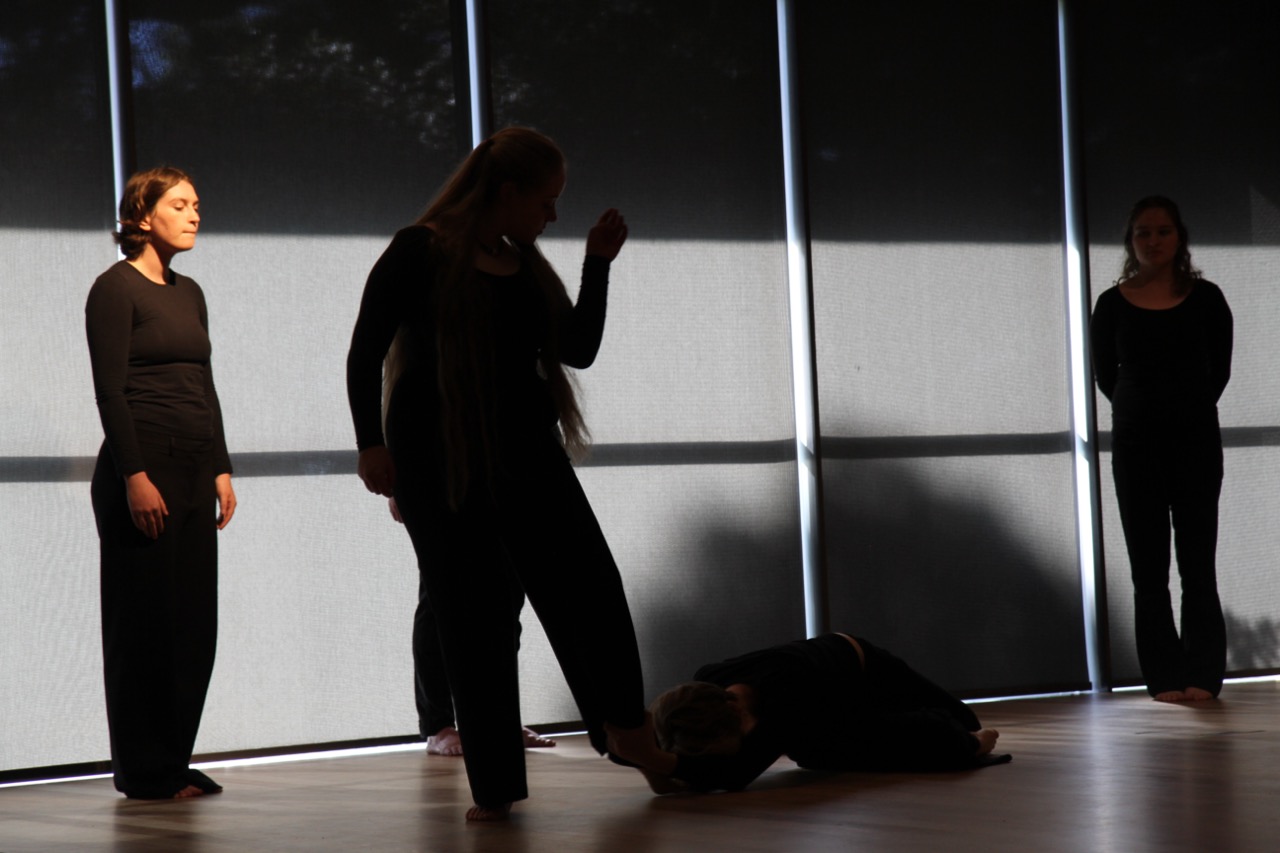
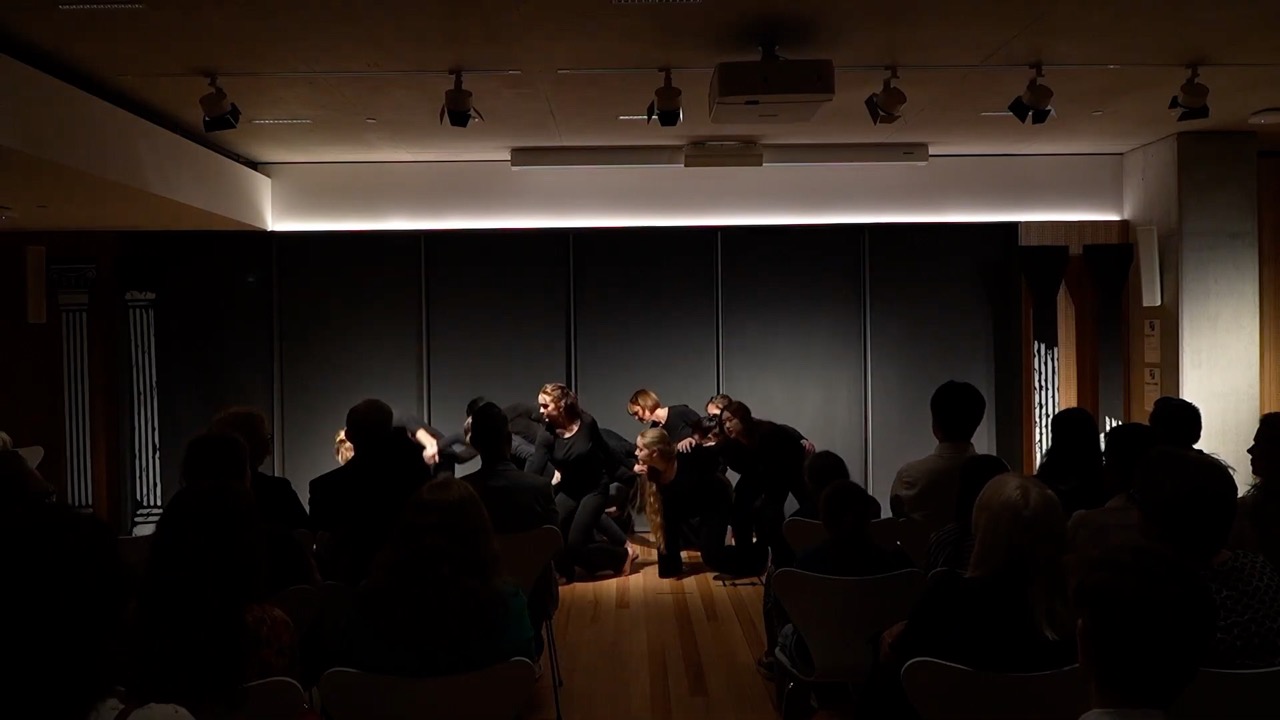
A moment of collapse in the Chau Chak Wing auditorium. Photo: Xavier Swann.
For the fifth stasimon (the hymn to Dionysus, "A God of Many Names") he made a translation and then decided not to use it. The chorus danced to his musical setting of the untranslated Greek. Their final address to the audience was, in his phrase, "a kind of speaking in tongues" — an invocation of the god of theatre himself, "desperately cried out for, but just too late."
Collins, reflecting on Henderson's work: "What he's done is absolutely extraordinary."
What the Ancient Chorus Was, and What Muscular Bonding Feels Like
Ask Collins how he feels about the musical and choreographic side and he warns you at the outset — "probably too much. I'm finishing a whole book about it."
In antiquity, the chorus was the heart of the show, and training it was a massive undertaking. Recent calculations by his colleague Peter Wilson and by Eric Csapo suggest an ancient chorus of young men trained in residence for between five and eleven months of the year. It required them to leave their homes and tribes and move into a rich man's house to focus exclusively on learning to move and sing together.
Sadly, it's not a program that can fit into a modern university student's schedule. "The closest I've ever come is with this Antigone," Collins says, was "with weekly rehearsals for a few months." He came in insisting on the singing-dancing chorus because he wanted to see how close a group of contemporary students, mostly total beginners, could get to a form we now have no literacy for.
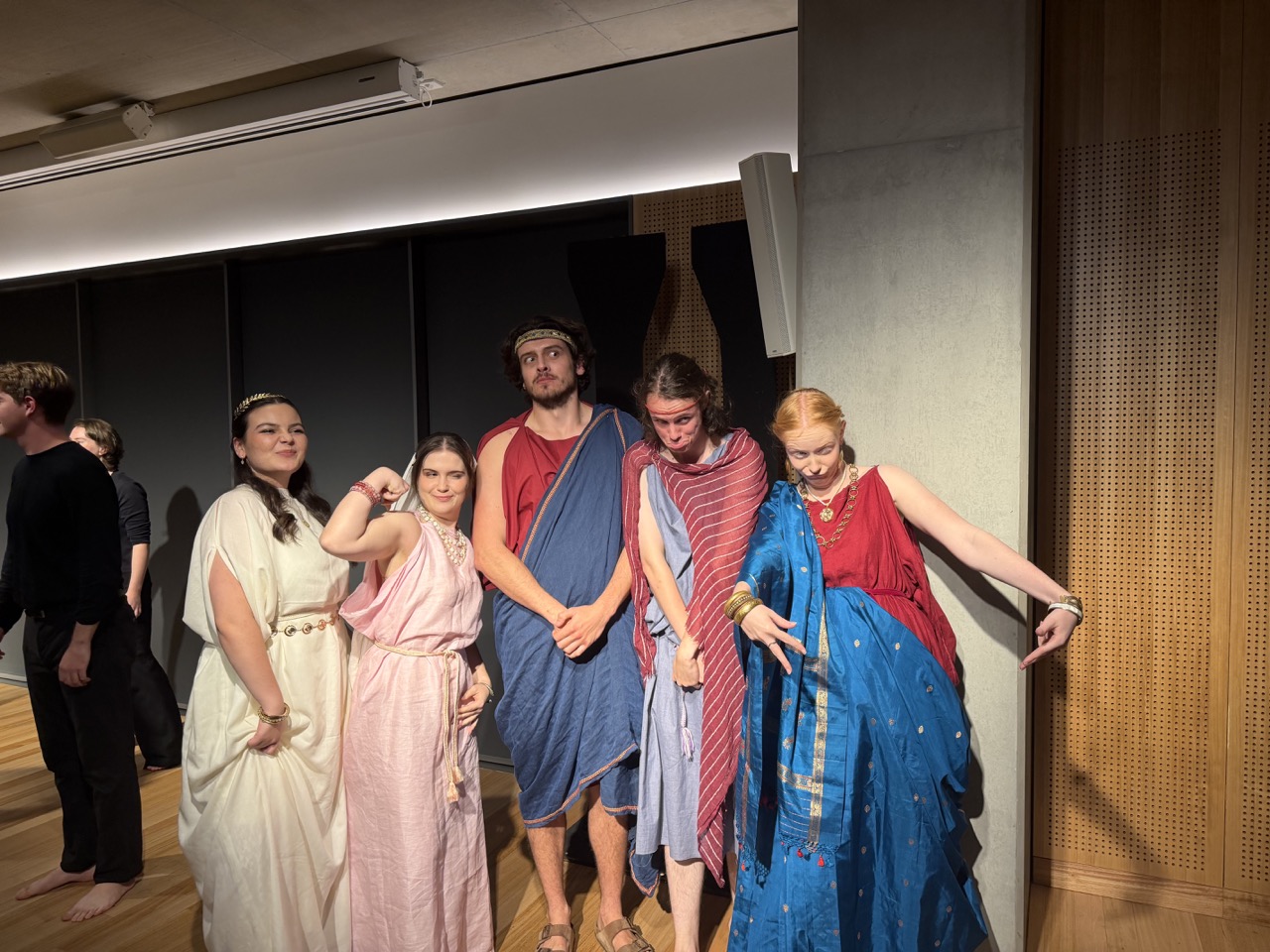
The cast in Greek costume acting silly (Isabelle Le Map as Antigone, Zoe Gaynor as Ismene, Duncan Eddy-Soros as Creon, Finlay Mitchell as Haemon, and Imogen Evans as Eurydice) between performances. Photo: Xavier Swann.
What they had made, in Collins's account, was the closest thing to a phenomenon his own work with a dance lab at Western Sydney describes in cognitive-scientific terms: the feeling, in synchronised movement, of ego dissolution and shared agency, "like you're moving other people, and they're moving you."
The phrase Collins keeps returning to belongs to the late historian William McNeill: the "euphoric fellow feeling" of "muscular bonding," of keeping time together. That, he says, was always on the horizon.
What we now describe as a cascade of endorphins was described by the ancients in their own language: something outside was moving them. When Aubrey reached for the word "sacred" to describe it, Collins agreed: "But I like that you used the word sacred."
Playing Creon Without a Reference Point
And now to the scenework. For Isabelle Le Map (Antigone), Duncan Eddy-Soros (Creon), and the rest of the cast, the deep collaborative work was with student director Daisy Levell, not Collins. "She engaged with them as a director director," Collins says. "I wasn't a part of that process."
The one actor-side response we did get is worth quoting at length.
Duncan Eddy-Soros (on playing Creon): "It was difficult to source examples of previous performances of the character, so the learning process involved close reading of the text alongside some of Sophocles' other plays and continual discussions with fellow cast members."
Every serious Antigone in the last fifty years is on tape: Fiona Shaw, Isabelle Huppert, Juliette Binoche, Lena Papaligoura. The role of Creon has been less archived. Going in blind, Duncan found that his first read of the character was wrong.
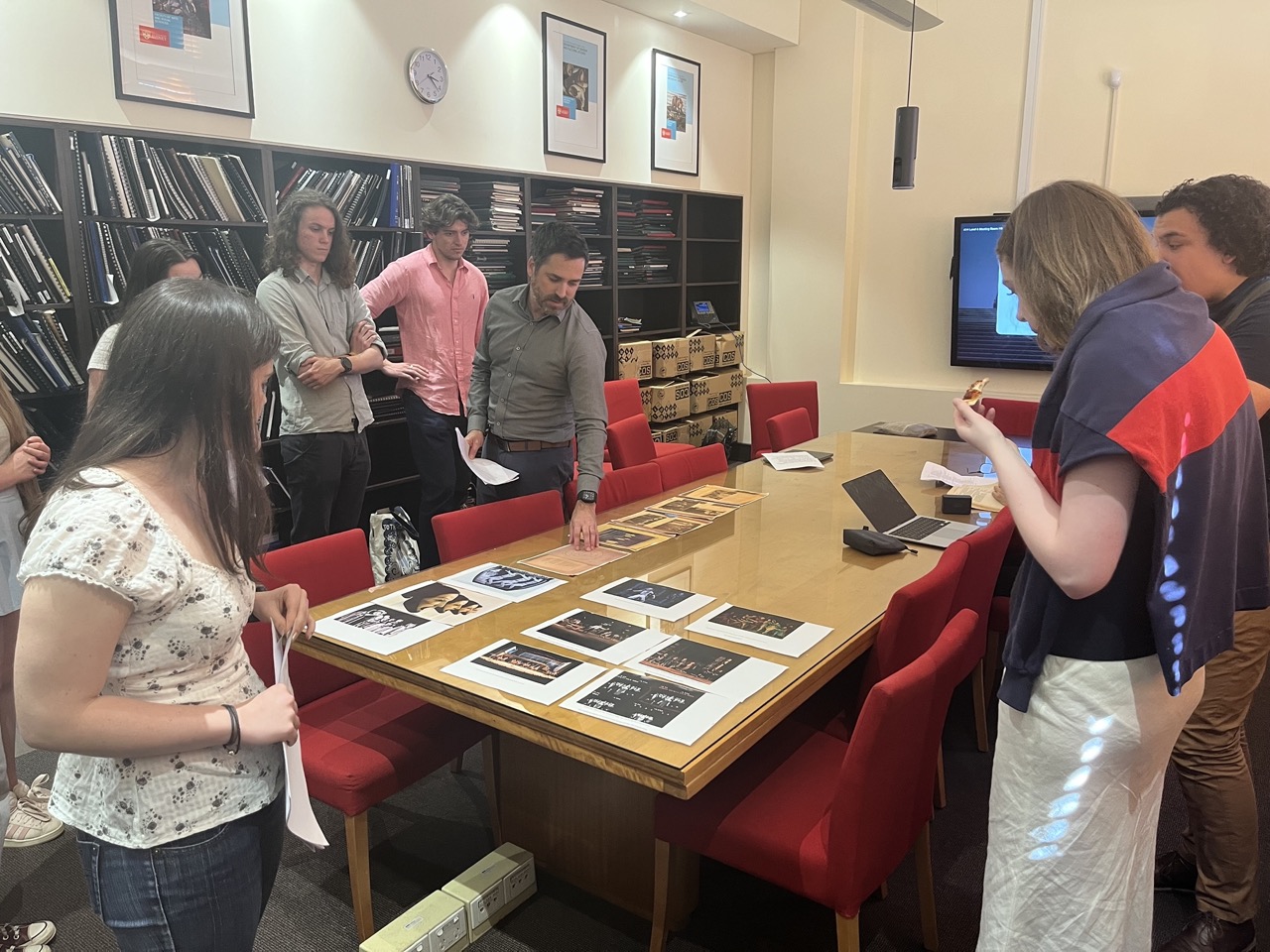
A working session around a table strewn with photographs. Collins prefers this kind of collaborative research and collective decision-making to direction. Photo: Xavier Swann.
Duncan: "Originally I came to realise how my anachronistic conception of Creon, derived from a strict reading of his lines, didn't do justice to Sophocles' aim of the play. As a tragedy, aiming to inspire both fear and pity, Creon's final scene must evoke fear and pity in equal measure."
Pity's a tougher nut to crack than fear. Duncan's solution turned on the chorus — treating it as an internal audience whose reactions could guide the real audience toward a pluralist Creon rather than a flat one.
The tangible bond between Isabelle Le Map and Zoe Gaynor (playing Antigone and Ismene) showed him what the corresponding bond between Creon and the chorus had to be. "The interactions between Creon and the chorus had to be close both emotionally and spatially."
Ancient Play, Contemporary Museum
The Chau Chak Wing is the University of Sydney's museum. On level 2, the Nicholson collection of ancient Mediterranean antiquities houses funerary objects from graves and cult objects from shrines. Performing Antigone, the play whose central action is the proper burial of the dead, inside such a building looks like a deliberate dramaturgical choice from the outside.
It wasn't. The truth, as Collins puts it, is that "we were desperate for a space."
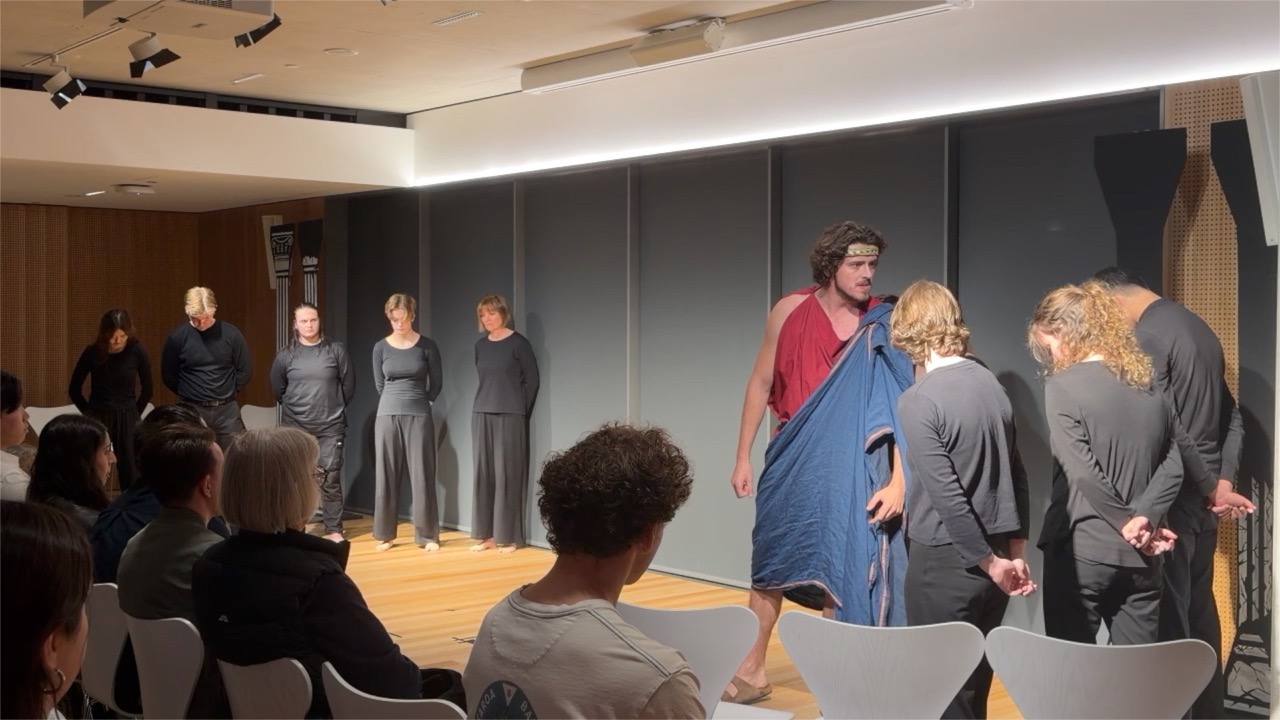
Duncan Eddy-Soros as Creon, in classical costume, mid-confrontation. Behind him, the chorus in grey stand as Duncan's "internal audience," whose reactions were meant to guide the real audience toward a pluralist Creon. Photo: Xavier Swann.
Q: Did you engage with any of the Chau Chak Wing's collection while making the show? Or did you black-box the space and treat it as neutral?
James Collins: "We had friends in Chau Chak Wing, so they kindly offered us the space, and it wasn't ideal."
It's not even a theatre. Ambient daylight was behind us the whole time, and there was no lighting we could depend on to counter that.
Marcel Forrer: "I wish we did, but the venue was confirmed very late into the process."
In fact, the venue inhibited a lot of the choreographic formations I was hoping to include.
Lauren Cleary: "The auditorium we were in doesn't have many artifacts on display, but being in the museum space certainly brought a sense of importance and historicity to the production."
Thomas Henderson: "No, but I wish we did."
Greek tragedy was of course designed for outdoor daylight performance on the side of a hill; the script demands no lighting or technology at all. If anything, staging the parodos, "A Ray of Sun," outside might have used the sun itself as prop.
None of them, including Collins, had really thought about what the venue was doing philosophically until asked. Once he did, he ran with it. "Maybe people did show up because of the awe and reverence people feel for very old things, or for Sophocles and his wisdom."
Around the corner from the theatre, the Chau Chak Wing had been simultaneously exhibiting a photographic series of Indigenous subjects whose faces had been darkened — the colonial ethnographic gaze on display as its own object of critique.
Not Directing, Motivating: Collins's Actual Role
The academic presence in the rehearsal room was Collins, joined for a stretch by Grace Gunning. So what was Collins doing there?
Not directing.
"I think I was there to motivate," he says. Collins's and Gunning's contributions were what he calls "pointers" rather than a framework. Cultural and historical suggestions where they could see an opportunity for something from the ancient context to move things along, or observations from a spectator's seat.
The rest was student-led, student-directed. "They were really directing their own aspects and bringing that into the group."
He was also, by his own account, aggressively encouraging.
James Collins: "Every day they were getting closer and closer to something, and I would just say, you rock. I'm getting goosebumps watching this. No one's tried to do what you're doing in this way before."
The chorus mid-formation. Photo: Xavier Swann
He watched them take risks and be vulnerable with each other. He celebrated the failures too, "because I was just so amazed that they were willing to go certain places."
What he offered as an alternative to direction was more like pastoral care. Two decades of teaching had put a few tricks up his sleeve. "If we're trying to build that euphoric fellow feeling, we've got to know each fellow. Everybody has to be a part of it. Nobody gets left out."
Forrer sees two possible readings of the hands-off approach: "them showing their willingness to let go of their authority and let younger minds lead the way"; or "some sort of mysterious indirect pressure to do well. We definitely made jokes about that."
Cleary, more directly: "They try to prompt conversation rather than dictate, by way of extending the dynamic they tend to protect in undergraduate tutorials. The academics we worked with never felt like Creon figures."
Drunktigone, or: The Cast Party as Coda
The clearest evidence that Collins was in no way a Creon figure was what happened after the show closed.
Henderson wrote a satyr-play titled Drunktigone — a parodic burlesque of the tragedy, in the ancient Greek tradition where a comic afterpiece followed a tragic trilogy. He put parodies of all the Antigone characters into it, along with parodies of the choral songs the chorus had spent months learning.
At the cast's final dinner party, they performed it. James Collins played Drunk-Creon.
Henderson: "James is an excellent actor, which people do not often get to see when he is in 'scholar-mode.'"
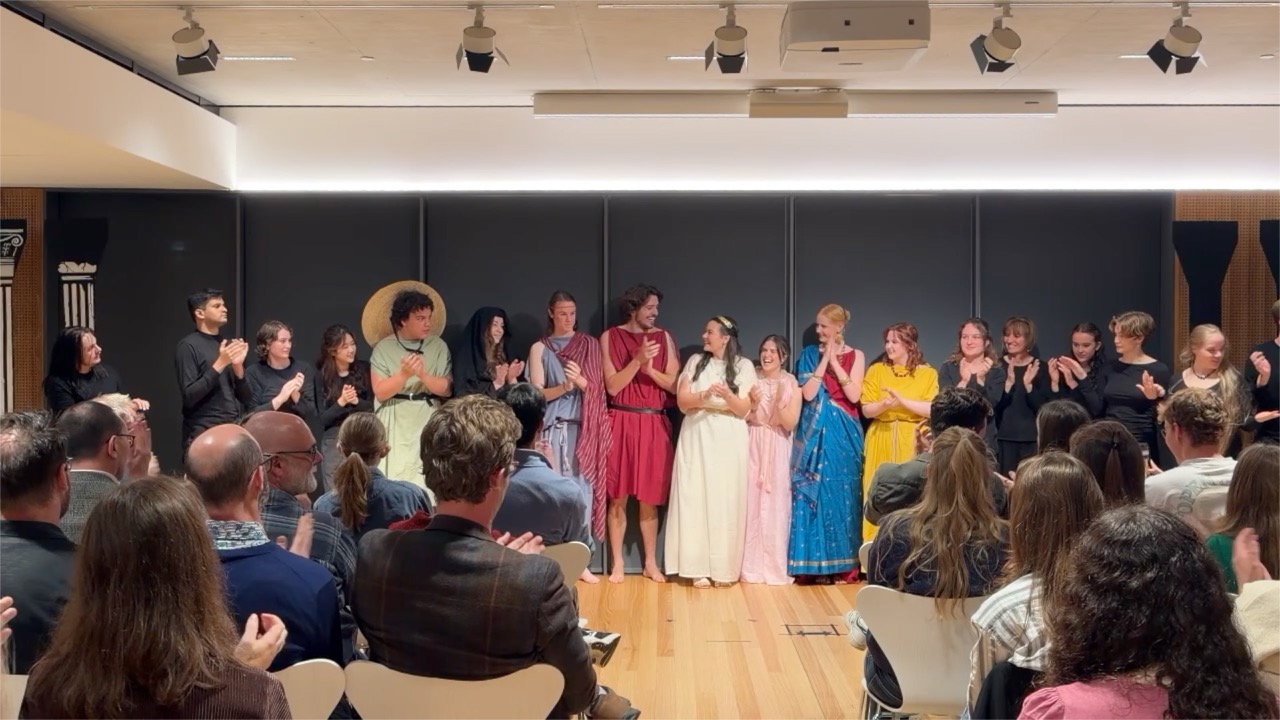
The cast and chorus in classical dress and drama blacks, applauded by a full auditorium. Photo: Xavier Swann
Here is the opening speech Collins delivered as Drunk-Creon:
The city is safe again! We may thank — me! With my creative, crafty, critical acumen; Cognition, cognisance and other cunning qualities, I, Creon, quashed that war in an instant. Both those bothersome brothers are dead! And you know what: let's just leave both of them unburied. Why not?
Collins offers it as evidence of something bigger. "All of those chorus members, they want to go see choruses now. That's all it takes." His argument, worked out at length in "Dancing Democracy" and modelled here in miniature: the threshold for creating a literacy for this old way of doing theatre isn't high.
Make a new kind of audience that wants to keep doing this and seeing this and being part of it. As Collins put it: "In the chorus cast-party, when we sang new words to our old songs that we knew so well, it felt like magic!"
Credits, and What Comes Next
The full chorus and creative team: Chorus Leader Lauren Cleary; Chorus Master James Collins II; Composer, Translator and chorister Thomas Henderson; Lead Choreographer and chorister Marcel Forrer; Sound Designer and Vocalist Madeleine Charters; and chorus members Clare Ainsworth, Rebecca Barlow, Ivy Downes, Adam Pearce, Jane Pedroza, Adeel Shams and Mulan Xu.
An early marketing error illustrated exactly the ordering problem the whole production was trying to solve. The original posters credited the actors but omitted the chorus. Collins, with Henderson, Forrer and Cleary, adapted the design so the chorus was credited alongside the actors — which Cleary notes was "the most unique aspect of our production."
Not that it mattered commercially; the show sold out before there was much of a marketing campaign to speak of. But it's one for the record.
One name from the ensemble surprised even Collins. Thomas Henderson, the composer-translator-chorister who effectively built the show's spine, walked into the production not knowing what to expect, but bringing a background in orchestral music. He plays the bassoon. He's a law-and-classics student, active in the student orchestra. Collins was surprised by how creative this interdisciplinary project was becoming, bringing in passionate students of drama, music and dance, all united by a fascination with the ancient world.
Collins said: "He mentioned on the side, 'I want to be part of the chorus.' He'd asked me to be his honours thesis advisor to write something on Plato and music. He started working on that thesis while also writing music for this show and working out things like choral responsion and metre. And I said finally, 'This is what you should be writing. This isn't a side project. This is the project.' And it just filled him with so much joy to switch gears."
The production has an afterlife brewing. Grace Gunning and Collins are writing a piece about the rehearsal process for Didaskalia, the journal of ancient theatre and performance.
The Australasian Society for Classical Studies has asked members of the cast whether they'd resurrect something for its annual meeting in January. Collins is game. So are the students.
Classical drama has been part of USYD's intellectual life since 1886. The last full staging of Antigone was in 1957. Gaius Gracchus was relaunched in 2024 by Daisy Levell, who co-initiated and directed this production with Collins. The show sold out in 48 hours. The added matinee sold out just as fast.
Antigone — by Sophocles, directed by Daisy Levell and James Collins II, produced by Gaius Gracchus (USYD Classics and Ancient History Society). Chau Chak Wing Museum, University of Sydney, 1–2 May 2026.
Writer: Sophocles; translation by Paul Woodruff (spoken parts) and Thomas Henderson (choral odes); Eurydice's lines rewritten by Imogen Evans Co-Directors: Daisy Levell, James Collins II Antigone: Isabelle Le Map Ismene: Zoe Gaynor Creon: Duncan Eddy-Soros Watchman: Nicholas Disher Haemon: Finlay Mitchell Tiresias: Madeleine Charters Messenger: Hannah Manhood Eurydice: Imogen Evans Chorus Leader: Lauren Cleary Chorus Master: James Collins II Chorus: Clare Ainsworth, Rebecca Barlow, Ivy Downes, Thomas Henderson, Adam Pearce, Jane Pedroza, Adeel Shams, Mulan Xu, Marcel Forrer Set Design: George Lyden Costuming: Della Gondwana Make-up: Xavier Radovilsky Lighting/LX: Angelina Young Sound: Byron Rowley Music: Thomas Henderson, Madeleine Charters Choreography: Marcel Forrer, Lauren Cleary Crew Manager: Xavier Swann Props/Set: Emma Rapeport, LLyr Bloom Lighting Support: Quinn Derlacki Graphics: Brendan Hurwood Photography: Xavier Swann Additional video: David Parada Visiting scholarly input: Dr Grace Gunning (Cambridge) Society: Gaius Gracchus (USYD Classics and Ancient History Society), President Daisy Levell
Language: English and Ancient Greek. Runtime: ~1 hour 40 minutes, no intermission. Tickets: $10 (Gaius Gracchus members) / $15 (non-members).


%402x.svg)
.webp)


