Grow Review — Segal Centre at Sylvan Adams Theatre, Montréal 2026
Grow is much more than a high-concept premise; it is a journey that blooms through an exploration of belonging, identity, personal fulfilment, and the choices of adulthood. Melanie Schaffer reviews the Segal Centre's new Canadian musical from the creative team behind Come From Away, running at the Sylvan Adams Theatre May 24 – June 14, 2026.
How Grow Turns an Unlikely Premise into a Heartfelt Musical
Grow is much more than a high-concept premise; it is a journey that blooms through an exploration of belonging, identity, personal fulfilment, and the choices of adulthood. From the Segal Centre at the Sylvan Adams Theatre (May 24 – June 14, 2026), the new Canadian musical from the creative team behind Come From Away proves once again that hyper-specific stories are the most universal.
Reviewed by Melanie Schaffer.
Cast of Grow. Photo: Marie-Andrée Lemire.
“Please turn off your phones, as it is not very Amish,” was the pre-show announcement of Grow. This message immediately invites us to step into the world of the musical and sets the humorous tone for what comes next.
Grow is much more than a high-concept premise; it is a journey that blooms through an exploration of belonging, identity, personal fulfilment, and the choices of adulthood.
Created by the award-winning team of librettist Matt Murray, composer Colleen Dauncey, and lyricist Akiva Romer-Segal, and produced by the same creative minds behind the international hit Come From Away, Grow continues their study of ordinary people navigating extraordinary circumstances. Like Come From Away, Grow looks beyond the unusual setup to examine what connects us as human beings, proving once again that hyper-specific stories are the most universal.
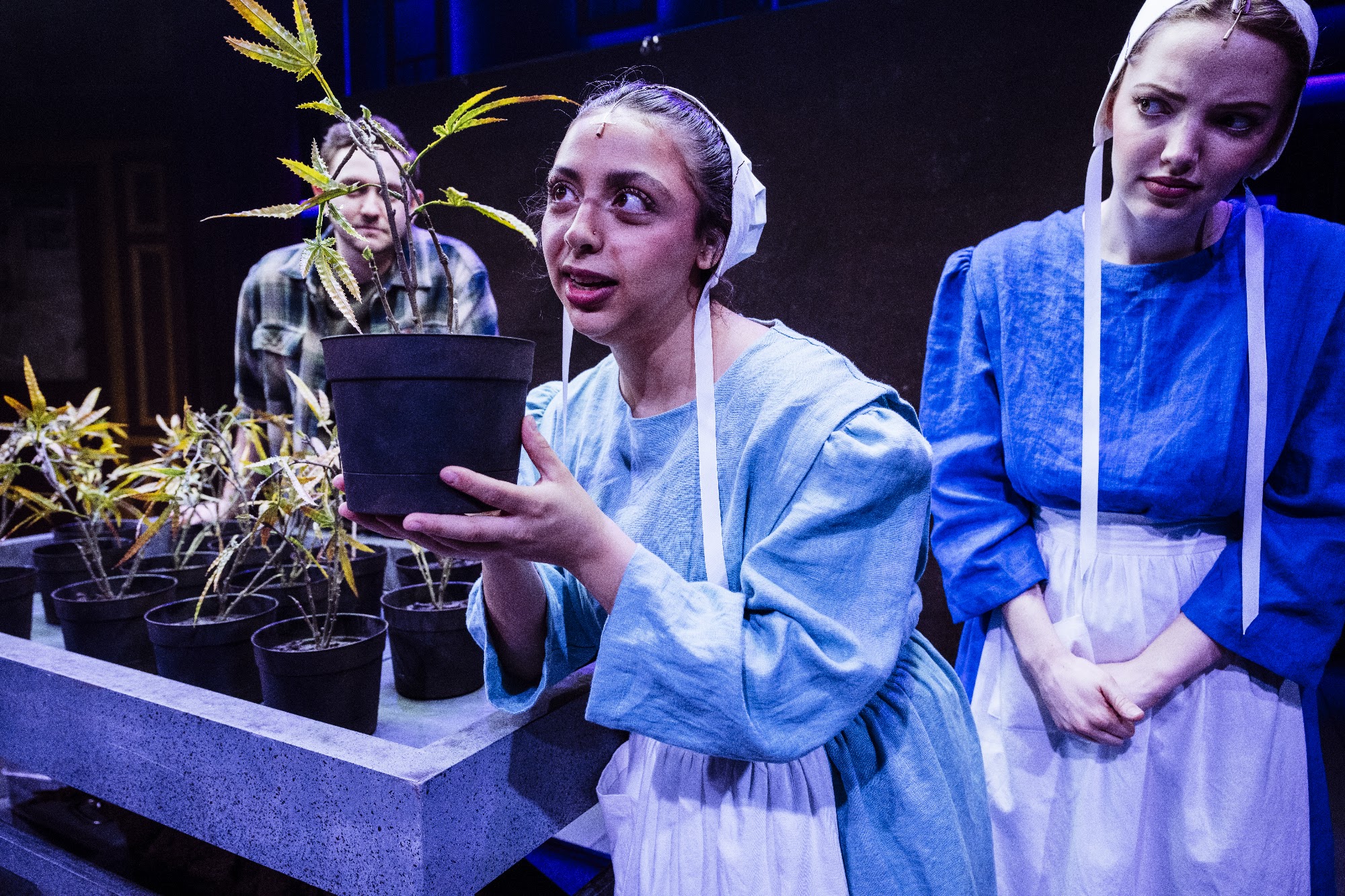
The musical follows nineteen-year-old Amish twins, Hannah and Ruth, as they embark on their Rumspringa, leaving their close-knit community to experience the modern world before deciding whether to commit permanently to their faith. Stranded in the city, their remarkable farming skills lead them into an unlikely partnership with a struggling cannabis dispensary owner. This hyper-specific foundation is the seed the creators use to explore how the twins begin to question not only their upbringing but also the futures they imagine for themselves. This idea flourishes throughout the musical, ultimately allowing the twins to make their own choices through individual agency. It is a classic coming-of-age story set against an unusual backdrop.
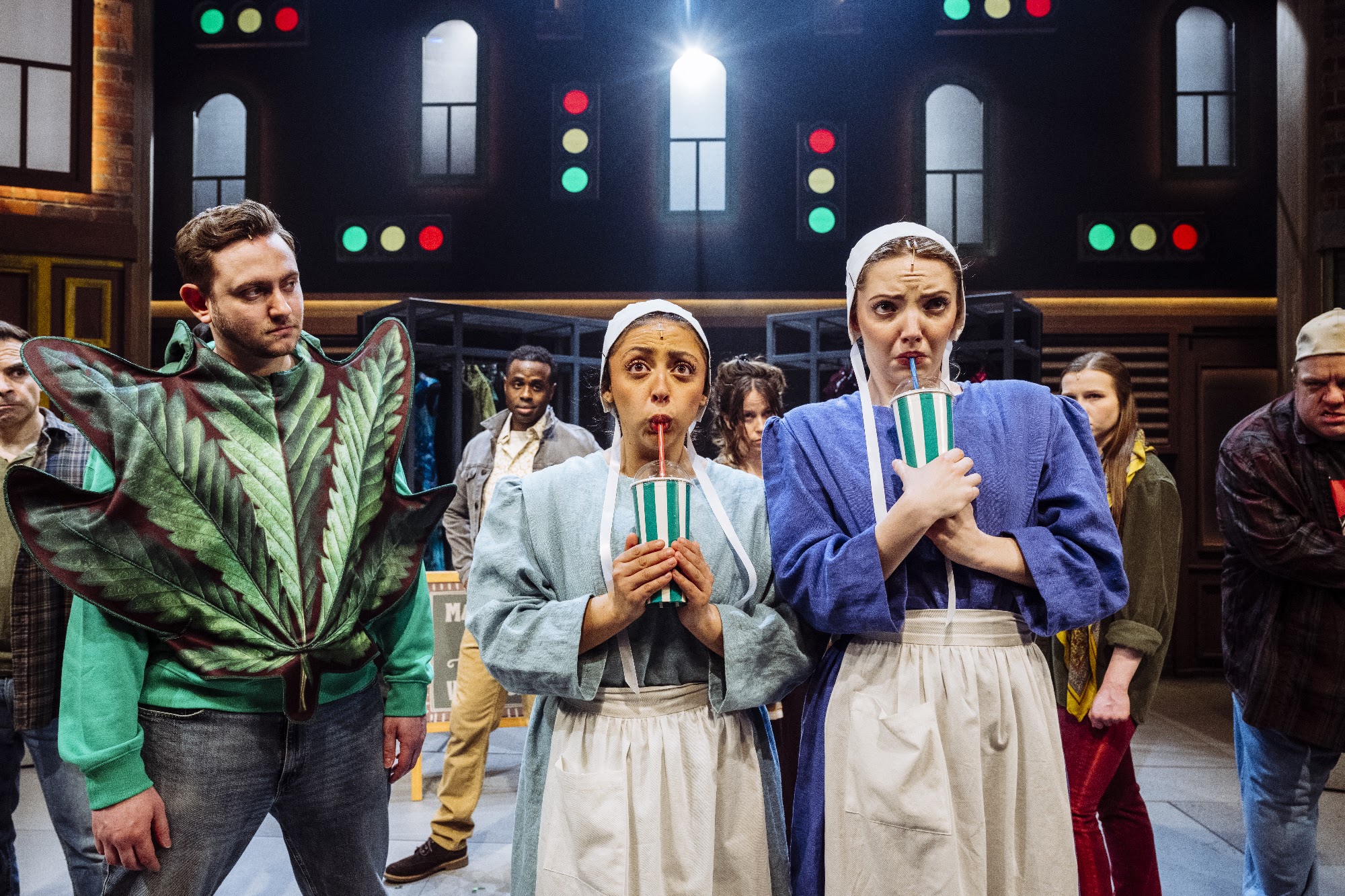
Julia Pulo, Annelise Forbes, and Seth Zosky. Photo: Marie-Andrée Lemire.
The musical treats each world, the Amish way of life, and the contemporary world, without derision and ridicule. The two worlds are never pitted against one another and are nuanced; their positives and negatives are both shown. Instead, the production uses familiar stereotypes as a starting point to ground the story before gradually revealing greater complexity.
Just like the premise, the creators plant multiple juxtapositions throughout the play: community is contrasted with individualism, chosen family with the family into which we are born, small independent businesses face off against large corporations, simplicity confronts consumerism, and tradition clashes with progress, and so many more. Everything in the show is in constant opposition, but nothing is designated as a clear winner. Rather, each represents a different path, choices, and sacrifices that every character makes. This is ultimately what makes the characters and the story grow.
For example, Ruth becomes a successful corporate professional woman, and at the same time, we are shown the loneliness, consumerism, constant competition, and lack of personal time that often accompany that ambition. She yearns for the support offered by her Amish community.
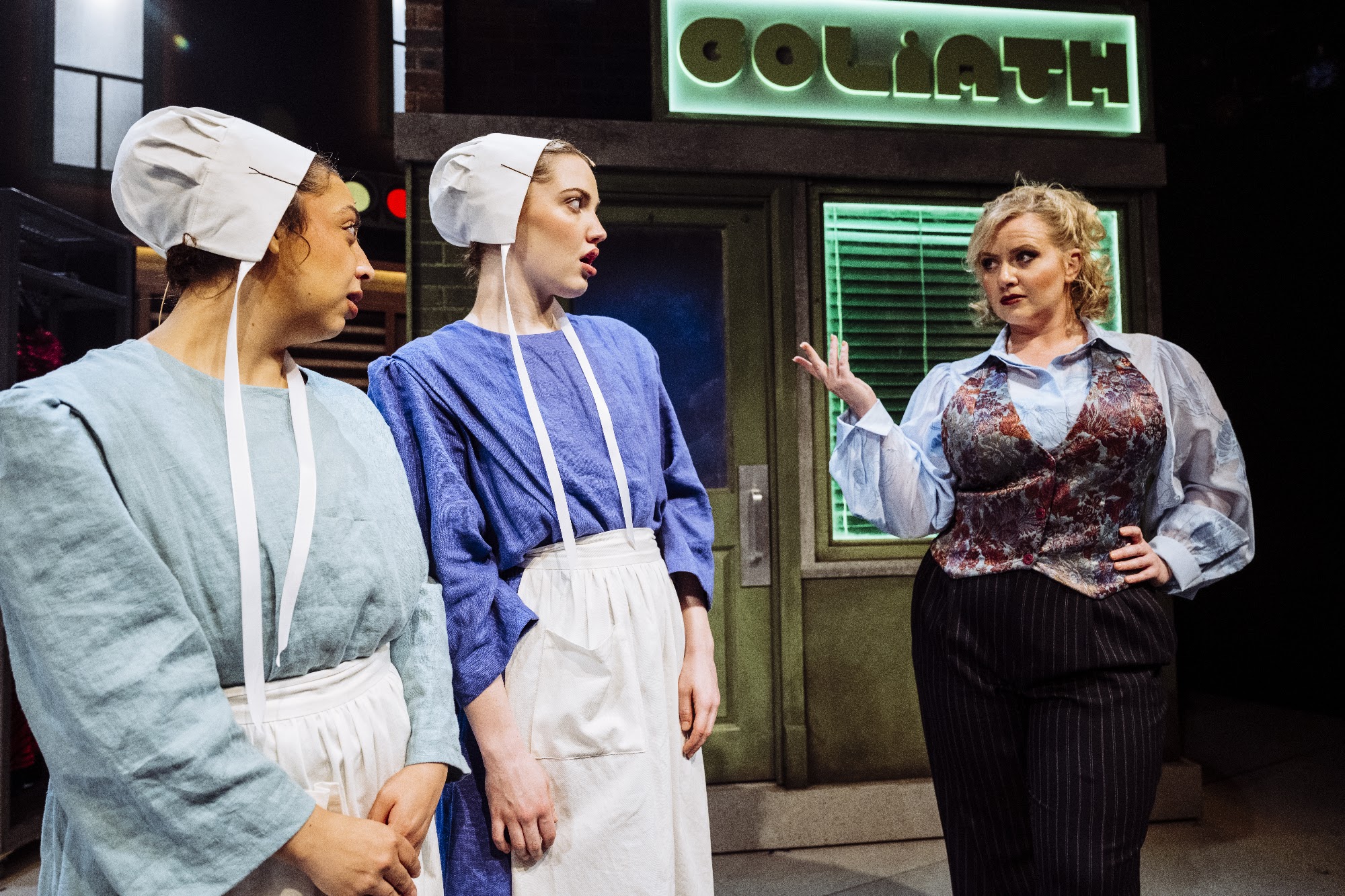
Julia Pulo, Annelise Forbes, and Jamie McRoberts. Photo: Marie-Andrée Lemire.
The humour of the play is rooted in cultural collisions, but the characters are never the butt of the joke. The comedy comes from the characters’ attempts to navigate unfamiliar waters. Even the cannabis industry, which could easily become an overused punchline, functions primarily as a backdrop for conversations about small businesses versus large corporations and the industry’s place in society.
The score by Colleen Dauncey, paired with Akiva Romer-Segal’s lyrics, mirrors the twins’ trajectory, taking us through different genres, such as acoustic folk influences, contemporary rock, and classic Broadway-style ensemble numbers. The songs are catchy and linger in your head after the show. The title number, “Grow,” performed as a duet between Ruth and Skor, becomes the emotional centrepiece of the musical, using the literal cultivation of plants as an elegant metaphor for the growth of relationships and personal identity. Meanwhile, songs such as “Wherever You Go, I Will Go” provide a feel-good finale.
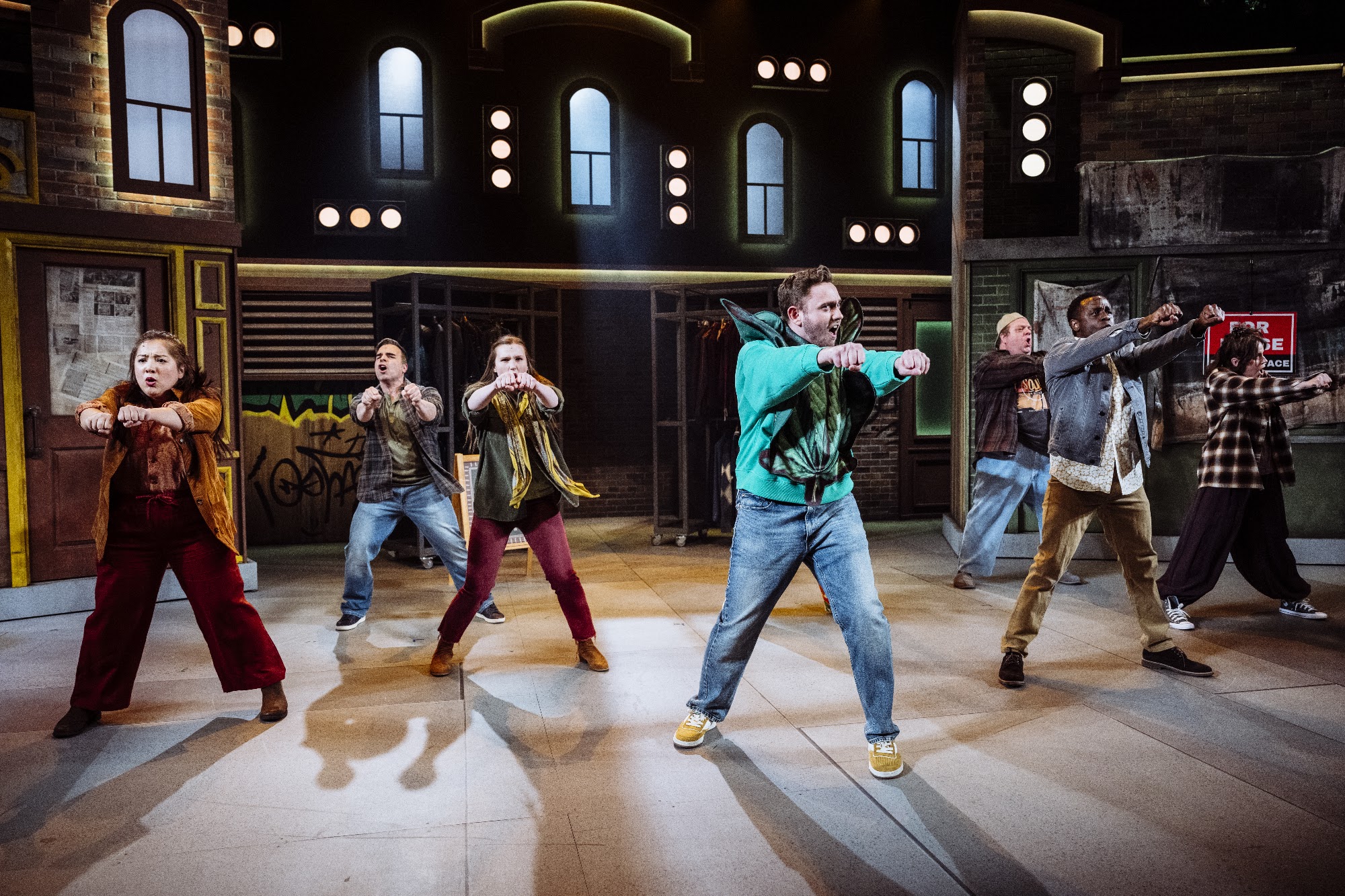
Cast of Grow. Photo: Marie-Andrée Lemire.
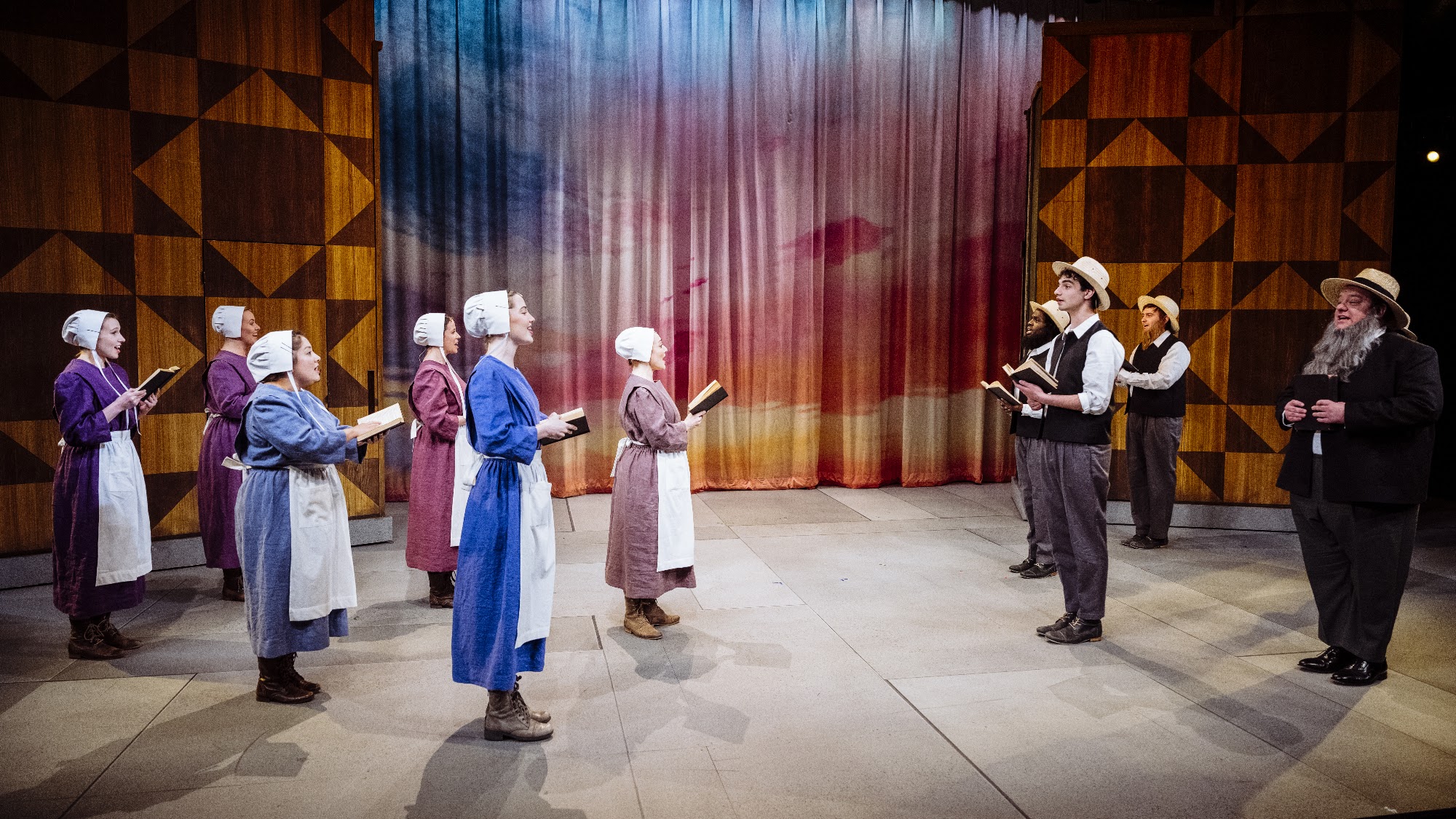
Cast of Grow. Photo: Marie-Andrée Lemire.
Visually, the production embraces effective simplicity. Bruno-Pierre Houle’s versatile set allows scenes to shift seamlessly between rural farmland and the city, clearly establishing two contrasting worlds through simple rotating design choices. Similarly, Sarah Balleux’s costumes chart the sisters’ evolution. Red nail polish represents the desire for change, independence, and the transition from girlhood into womanhood. Likewise, the shift from traditional Amish attire to contemporary professional attire shows the characters’ venture into the corporate world.
Cast of Grow. Photo: Marie-Andrée Lemire.
Ultimately, Grow is a delightful musical that treats its characters with compassion rather than reducing them to caricatures. Its highly specific premise becomes the doorway to universal questions about family, love, belonging, ambition, and the lives we choose to build. Like Come From Away, it demonstrates that the more particular a story becomes, the more deeply it resonates with audiences from every background.
Grow — a Segal Centre production. Sylvan Adams Theatre, Montréal, May 24 – June 14, 2026.
Book by: Matt Murray Music by: Colleen Dauncey Lyrics by: Akiva Romer-Segal Director and Choreographer: Tracey Flye Arranger, Orchestrator and Music Supervisor: Wayne Gwillim Music Director: Jonathan Corkal-Astorga Set Designer: Bruno-Pierre Houle Costume Designer: Sarah Balleux Lighting Designer: Eric Champoux Sound Designer: Joshua D. Reid Associate Choreographer: Rohan Dhupar Associate Costume Designer: Louise Bourret Stage Manager: Elyse Quesnel Producer: Michael Rubinoff Cast: Julia Pulo (Ruth), Annelise Forbes (Hannah), Kyle Brown, Alicia Ault, Lauren Bowler, Jake Cohen, Holly Gauthier-Frankel, Katie McMillan, Jamie McRoberts, Mike Melino, Daniel Williston, Seth Zosky Production photos: Marie-Andrée Lemire


%402x.svg)
.webp)


