The show is about growing up in the Catholic Church and a JROTC military high school, and how identity breaks through in institutions where you can't be who you are. Claire and her director David Resnick found the show's final shape by cutting fifty notecards apart and rearranging them until they made sense, which is kind of like being trans itself. CRACKS opens June 13 at the Montreal Fringe.
CRACKS: An Interview in Notecards
Claire Lochmueller on military school, Catholic mass, and all the ways you're trans before you know you are
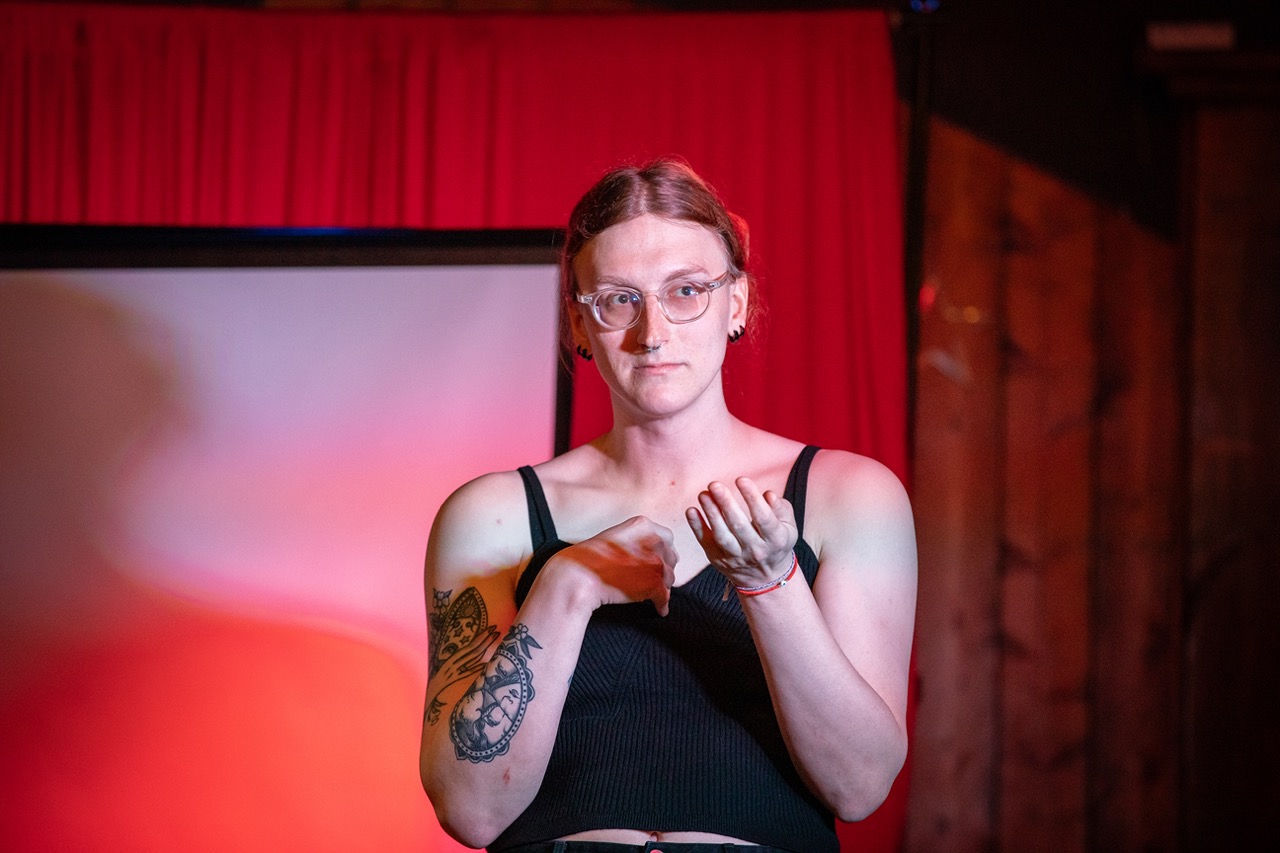
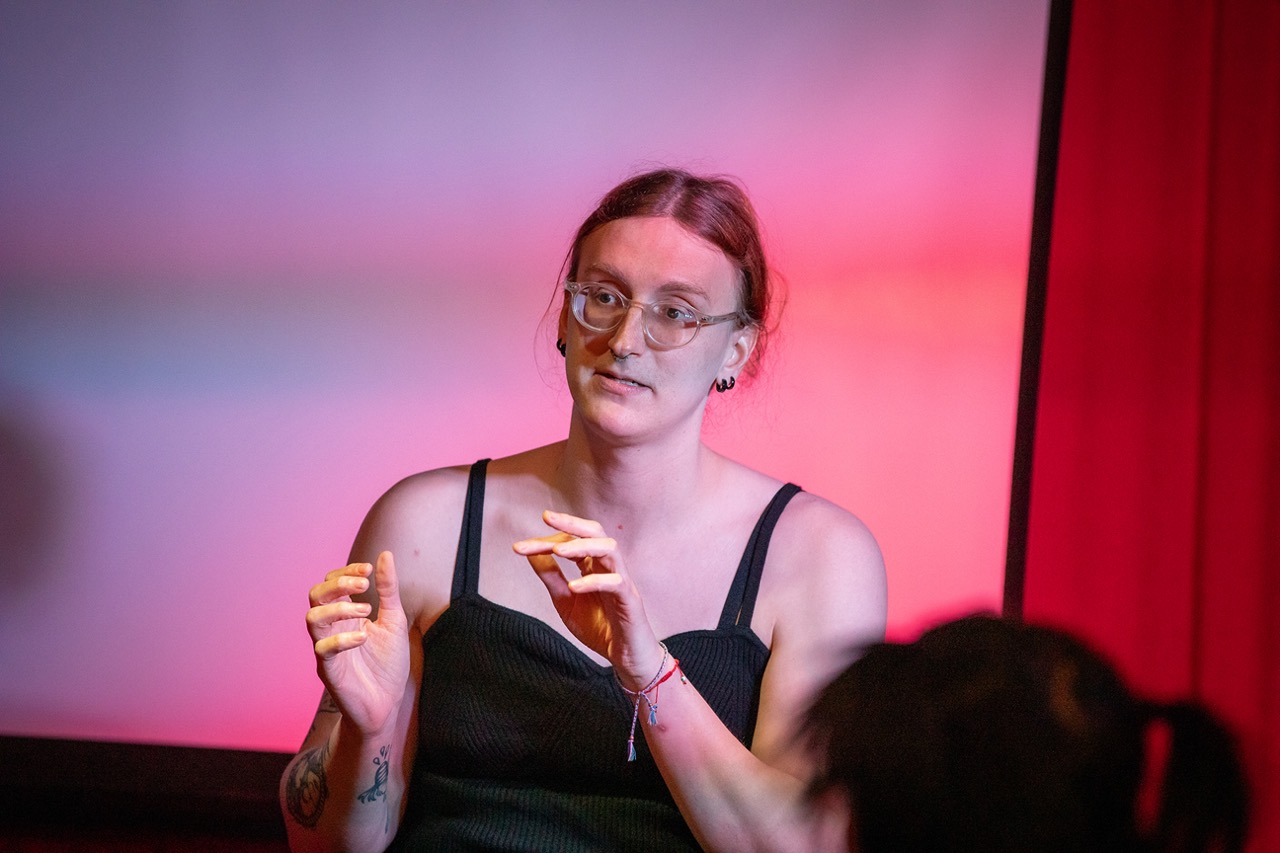
Claire Lochmueller is a Chicago-based theatremaker — her word, and we'll get to why — touring CRACKS, her one-trans-woman dark comedy memoir, back to the Montreal Fringe after its Canadian premiere here last year.
The show is about growing up in the Catholic Church and a JROTC military high school, and how identity breaks through in institutions where you can't be who you are. Claire and her director David Resnick found the show's final shape by cutting fifty notecards apart and rearranging them until they made sense, which is kind of like being trans itself.
CRACKS opens June 13 at the Montreal Fringe.
CARD 31 — the thesis
"It's a dark comedy memoir show about growing up in the JROTC — Junior ROTC — high school, and the Catholic Church, and about the way identity breaks through in conservative institutions...where you can't be who you are, but how that shows up anyway."
"For me it was being a trans woman, and how identity comes through — that was the idea, the brain dump of all the writing I was doing before the script was formed. Where did this all show up in my life, before I knew what it was and had the words for it?"
CARD 7 — the form
Claire's background is Chicago improv. iO, where Tina Fey and Amy Poehler have their roots, plus the Annoyance tradition. But CRACKS was her entry into theatre proper, and her first solo show.
The genre question took an audience member to settle. "It's like a third comedy, a third storytelling, and a third theater. Someone was like, oh, you're like a storyteller — and that was in Montreal, actually, last year — and I was like, okay, yep, that is how I should describe the show."
On the label for herself: "I like the word theater maker the most. The goal is a one-hour theatrical product that encompasses these different elements. And the maker part of it is where I was like, okay, no, that part resonates."
CARD 44 — the military is for theatre kids
I put it to Claire that military school is, in some sense, actor training. She'd beaten me to the bit — it's her lead-in to the military stories on stage.
"Military high school is just a lot like theater. We're all playing pretend in a way, and maybe some of us don't know we're acting, but we are. We are wearing a costume — I'm wearing the costume I'm told to, I have my uniform, got my medals. And marching being very similar to stage directions — I'm still doing the same thing in this career, moving in the way I'm supposed to."
"We didn't have a theater program at that high school," she added, "but we all would probably be really good at it."
Filed evidence, card 44a
JROTC: Junior Reserve Officers' Training Corps, run under the US Army, with active military instructors.
"Going in it, I didn't think it was intense. And then after, I was like, okay, no, that did sink in — like, early in my 30s I was like, oh yeah, that put some ideas in my head about who you are and what you're supposed to do. It took a little bit to be like, oh no, maybe all that wasn't great."
Isaac Harrell Photography
CARD 2 — the structure, or why none of this is in order
At first, the story was told linearly. Then Claire and David Resnick took the script apart and put the story back together again.
"That switch to it being a nonlinear show is, I think, the best direction I got from my director. Me and him had all these like 50 notecards that we were cutting and trimming and rearranging and shaping. That was the best thing we could have done for making this story into the shape it's in now."
The logic underneath is therapeutic in origin.
"One of the first big source materials I was pulling from when I was writing the script was — I go to therapy, I was journaling a ton, and even those journal sessions, they don't go in order either. How you unpack the way you've become who you are — that's not happening in order. So the story about that is not gonna happen in order either."
The coming-out is split into three. "The first scene starts where I'm like, no, I'm out, I am fully out, this is who I am, I'll tell you all about what I was like before that. The coming-out scene, I broke that into three different parts, and that's the way we flash to it in three different moments."
CARD 50 — a craft secret about verb tense (laminate this!)
The show's emotional engineering runs partly on grammar.
"In the storytelling, I'll switch tense. I'm talking about something in past tense, being very clear — you know that happened, maybe some jokes about it. And then when we're getting to the moments where we want the heavy emotions to hit, we try to have that organically switch into present tense, and really be there with the audience for it. Having that moment shared when I'm saying it the same time the audience is hearing it."
Sparse, mirrorless theatre has to lean on the structures the smoke-and-mirrors side of the artform neglects — grammar, tense, all the ways a sentence could be angled and positioned.
CARD 19 — what touring rewrote
CRACKS debuted at Cincinnati Fringe in 2024 as a one-night development piece, was self-produced in Chicago, and has since played Portland Maine, Richmond, Orlando and beyond. The biggest revisions weren't the scenes, but the seams — the transitions (ba dum tss).
"It's really been the transitions that have changed the most. Sometimes even a really small thing — a blackout here, waiting a little bit to start the next scene to give the laughs a chance to die down before starting to talk about a more serious thing."
Performing it over and over helped. "There'd be those moments of discovery where it was like, okay, that was a joke I riffed, and it got a really strong response, so it came into the script."
"And same thing for the heavier moments — I talk about substance abuse and gender dysphoria, and finding how to package those, the language around them, to make them an accessible thing to hear about. I got to get the reps in to fine-tune that language."
Montreal presented different challenges around context and assumed knowledge. While a Chicago crowd comes briefed from birth on US history, an international audience doesn't.
"I'll kind of trickle it in earlier to try to hide that I'm teaching the audience what they need to know to know my punchline. After my first night in Montreal I was like, okay cool, I need to add those. It was a quick little addition before the second show, like the next day."
There was also the matter of permission to laugh. Fringe audiences, she found, are politer than comedy-theatre ones. "There were some things that I added into the script to be like, no, we can laugh — I'm gonna say funny things. We'll both have a little more fun if we're laughing together. We don't need to stifle it."
CARD 12 — Cincinnati, where it got better
The show keeps coming back to Cincinnati, where Claire lived before Chicago. Turns out, Queen City's a terrific place for healing.
"That was the first place where I was getting better. Even though I wasn't ready to come out as transgender and didn't know what transgender was, I was around people that let me be myself. Those were the little seeds that were planted at the time I needed them to."
That's also the hinge of the show. The comedy of Catholic school and military school "all lead up to one of the heavier moments, and then right after that is when the show gets to switch, and I get to talk about how do you get better, how it happened for me, and what parts of getting better were happening before I was fully aware of it."
CARD 36 — the rehearsal audience is two cats
A solo show before a Fringe run is rehearsed in an apartment, to whoever's there.
"There's so much rehearsing by yourself in a room with a solo show. I'm just like, all right, I'm gonna do the show to my cats. My partner, who I live with, is doing her own thing in the rest of the apartment, and I'm over here being like, all right, we're gonna stay in this hour by myself."
CARD 1 — why Montreal (this should have been first)
Last year was Claire's first Canadian fringe.
"The thing that makes Fringe so appealing to me is that it's this theater laboratory where people are not waiting for someone to give them permission to make their show. And Montreal's Fringe just embodied that in such a cool way. A really strong community of people who really value making the thing, and not waiting for a gatekeeper — like, nope, it is time, get that thing up on its feet and put it in front of people."
"Really felt welcome there, as a creative and just as a person," she said. It's the fringe she's kept in touch with the most people from.
This year she's giving herself two extra nights in Montreal after the Ottawa run, with no show to worry about. "That's the treat for after the two fringes."
CRACKS — written and performed by Claire Lochmueller, directed by David Resnick. Montreal Fringe 2026, opening June 13, then Ottawa Fringe. Lochmueller came up through Cincinnati's comedy scene and Chicago's iO and Annoyance traditions; CRACKS has toured Cincinnati, Chicago, Portland Maine, Richmond, Orlando and Montreal since 2024.


%402x.svg)

.webp)


