Interview · Balcony Scene — Leslie Beedell and Francesca Esguerra
Balcony Scene: Turn Your Romantic Failures into Showstoppers. Two recovering theatre kids (Leslie Beedell and Francesca Esguerra), one federal bureaucrat, one drama therapist, and the high-school Romeo & Juliet flunk that still lives in their heads rent-free
Balcony Scene: Turn Your Shakespearian Failures into Showstoppers
Two recovering theatre kids, one federal bureaucrat, one drama therapist, and the high-school Romeo & Juliet flunk that still lives in their heads rent-free
Dramatis personae
LESLIE BEEDELL — federal bureaucrat, Department of Transportation. Romeo. Has kept up improv and clowning as a theatrical outlet. Currently the subject of a single poster on an otherwise empty office bulletin board.
FRANCESCA ESGUERRA — drama therapist at a nonprofit supporting victims of domestic violence; eight years a true-life storyteller in Montreal. Juliet.
SDC — your interviewer, recording on a phone, internet connection unstable.
Setting: a video call, one week and a day before opening. Balcony Scene opens June 11 at O PATRO VÝŠ, 356 Mont-Royal Ave, Montreal Fringe 2026. Both performers have taken five weeks off their day jobs to do this, to the visible confusion of their colleagues.
HIGH SCHOOL INT. UNKNOWN HOUR. Golden and insufferable.
Scene One: Danger
(In which the original wound is described.)
SDC: Tell me about yourselves, your characters, and what "bringing yourselves into the play" means.
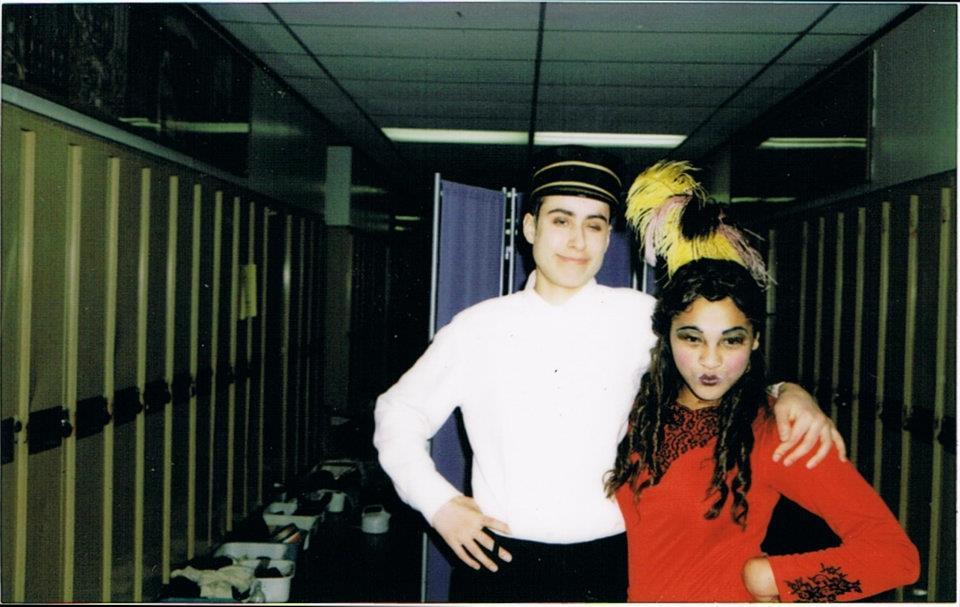
FRANCESCA: "We went to a pretty intense performing arts school for high school. It kind of made you feel like you're going to graduate high school and immediately be on the red carpet — it would always talk about the famous alumni that went to our school. So when we finished and decided not to pursue theater full time, this was kind of our way back into it. We decided to revisit this failure that we did really have — we were assigned the scene in high school."
LESLIE: "Romeo and Juliet."
FRANCESCA: "We did horribly. When we think about high school we have so many good memories, but this is really the one that we cringe about."
(A beat.)
FRANCESCA: "There was also an exercise they had us do in our last year, where if everyone in the class agreed, they would tell you if you have a future as an ingenue or as a quirky best friend. We each got quirky-best-friend typecast. And then, like, a couple weeks later, they're like, okay, now challenge yourselves to do something totally different, and do Romeo and Juliet. It just felt like such a mind-fucking, basically."
"So the conceit of our show is that we're trying to have a moment as ingenues — break out of the roles we were cast in and take control of our destiny by writing our own play and casting ourselves in it."
SDC: And now you're doing it to yourselves.
(They are. Leslie plays up the day job: "I'm in a soul-sucking cubicle, nobody understands me, I'm just a faceless bureaucrat — and then reveal myself as this loving Romeo is gonna be this shocking self-discovery.")
(For the record, the theatre training does transfer to the public service industry. Leslie: "I presented something in a very standard, boring manner, and multiple people said, like, wow, I didn't know you were so good at presenting." Francesca: "People are shocked that I can speak to more than one person at a time.")
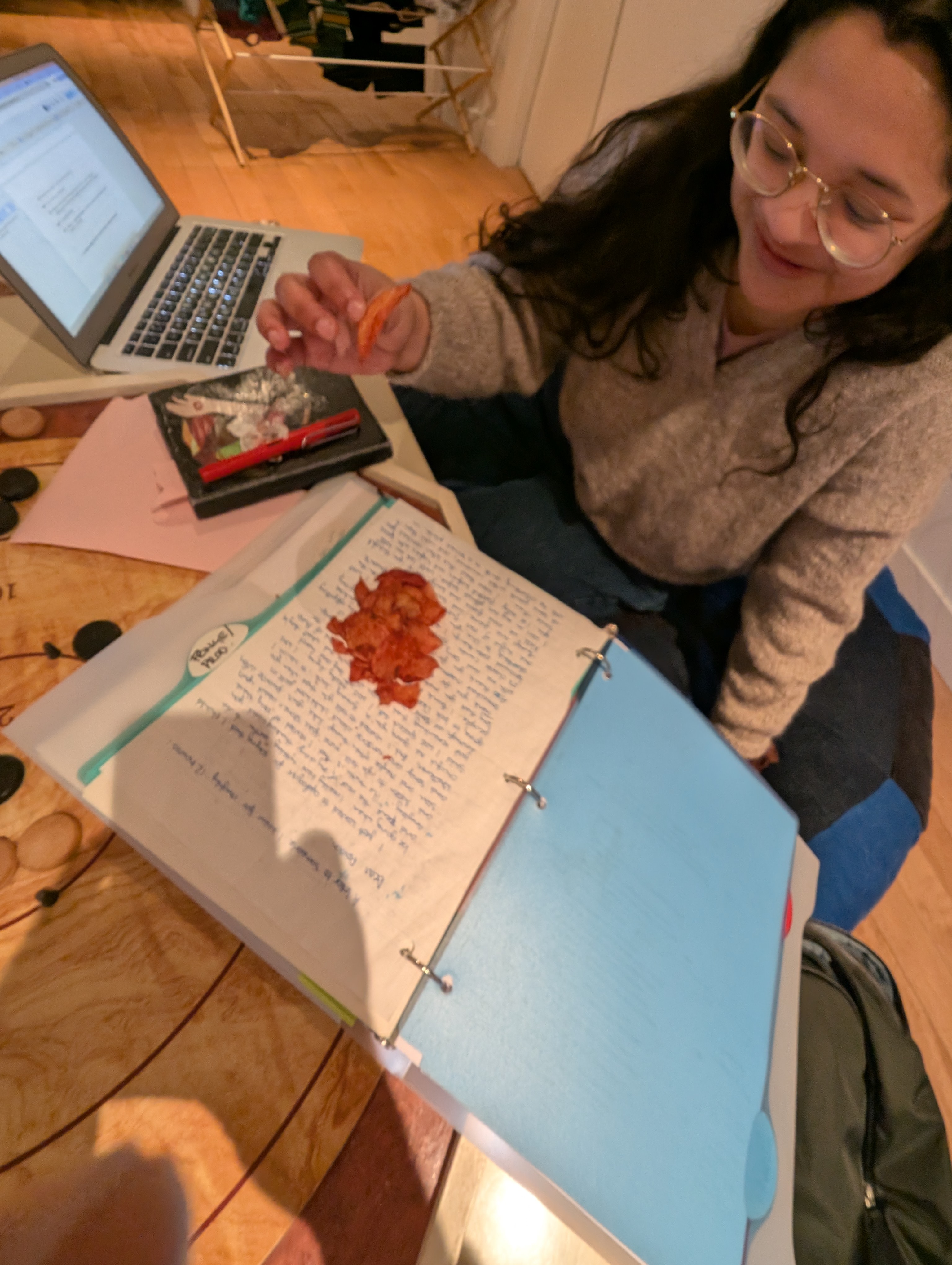
FRANCESCA sits, eating chips, supremely unbothered. This is weeks before a single line of dialogue exists. The "rehearsal" is in fact a show-and-tell: each performer presenting evidence at a tribunal, the documented failures of their romantic lives
Scene Two: Intimacy
(In which the writing process is reconstructed, with interruptions.)
SDC: Is it a direct rendition of the balcony scene, or have you put your own spin on it?
FRANCESCA: "It's both. The first section is very starting and stopping and restarting — we are doing a lot of the actual text from the balcony scene. And I still think ultimately we are performing a love story, it's just a different kind of love story. We acknowledge the fact that our partners are okay with us regressing for six months and becoming high schoolers again to play in the park and rehearse our play."
LESLIE: "We kind of rekindle our friendship through the play, which mirrors real life — we were in high school plays, and then we're like, we should do a play together."
(The idea marinated for two or three years. Francesca does true-life storytelling in Montreal; when she googled herself recently, the photo that came up was of a different Asian colleague, which she has decided to find funny: "I love the description of myself, so I'm not even that offended that it mixed me up.")
FRANCESCA: "At first we would each, on our own, write our own responses to the scene — memories, things we associate with that original failure from high school. I wasn't envisioning that we would actually write a full play with a consistent narrative."
LESLIE: "We came up with this bank of different stories — I went all the way from elementary school to university. Kind of embarrassing moments, things where I was pouring my heart out or got really embarrassed."
(They organized the material into three groupings.)
FRANCESCA: "Danger, intimacy, and electricity."
LESLIE: "Electricity being like the sparks of romance."
(And then the discovery that reconfigured everything:)
"It's kind of funny that we thought growing up would give us the insight we need to connect to Romeo and Juliet, when it actually does the opposite. The fact that we've experienced heartbreak and long-term relationships and actual real adult romantic relationships actually makes it a lot harder to give in to the naive Romeo and Juliet character." — Francesca
(They would read the balcony scene aloud together and react to it, line by line.)
FRANCESCA: "Juliet has a line where she calls him the god of her idolatry, and I'm like, I would never in my life tell someone that. And then I would tell him a story of why, or what moments did I almost say stuff like that. And then we wrote it in the script."
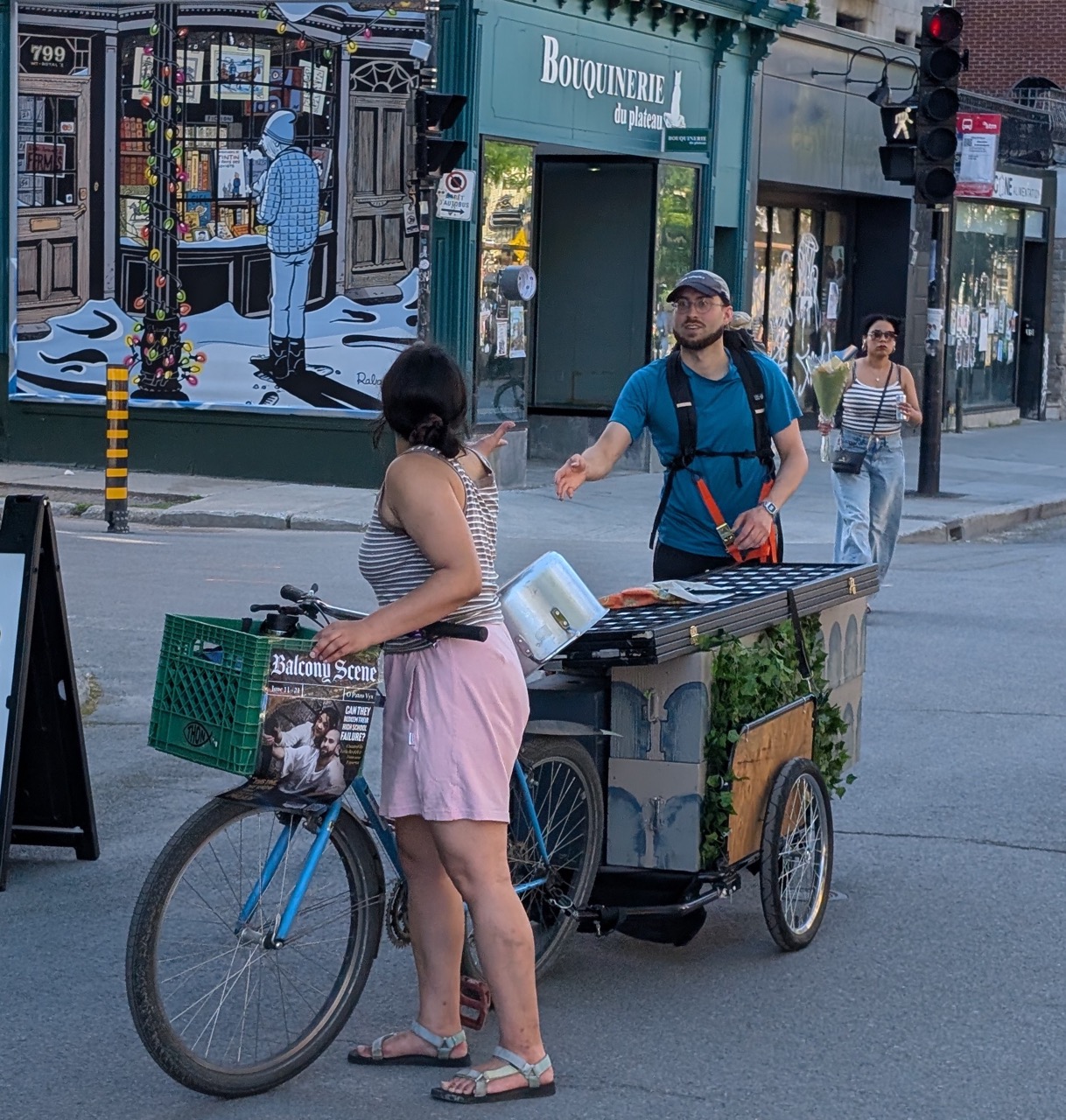
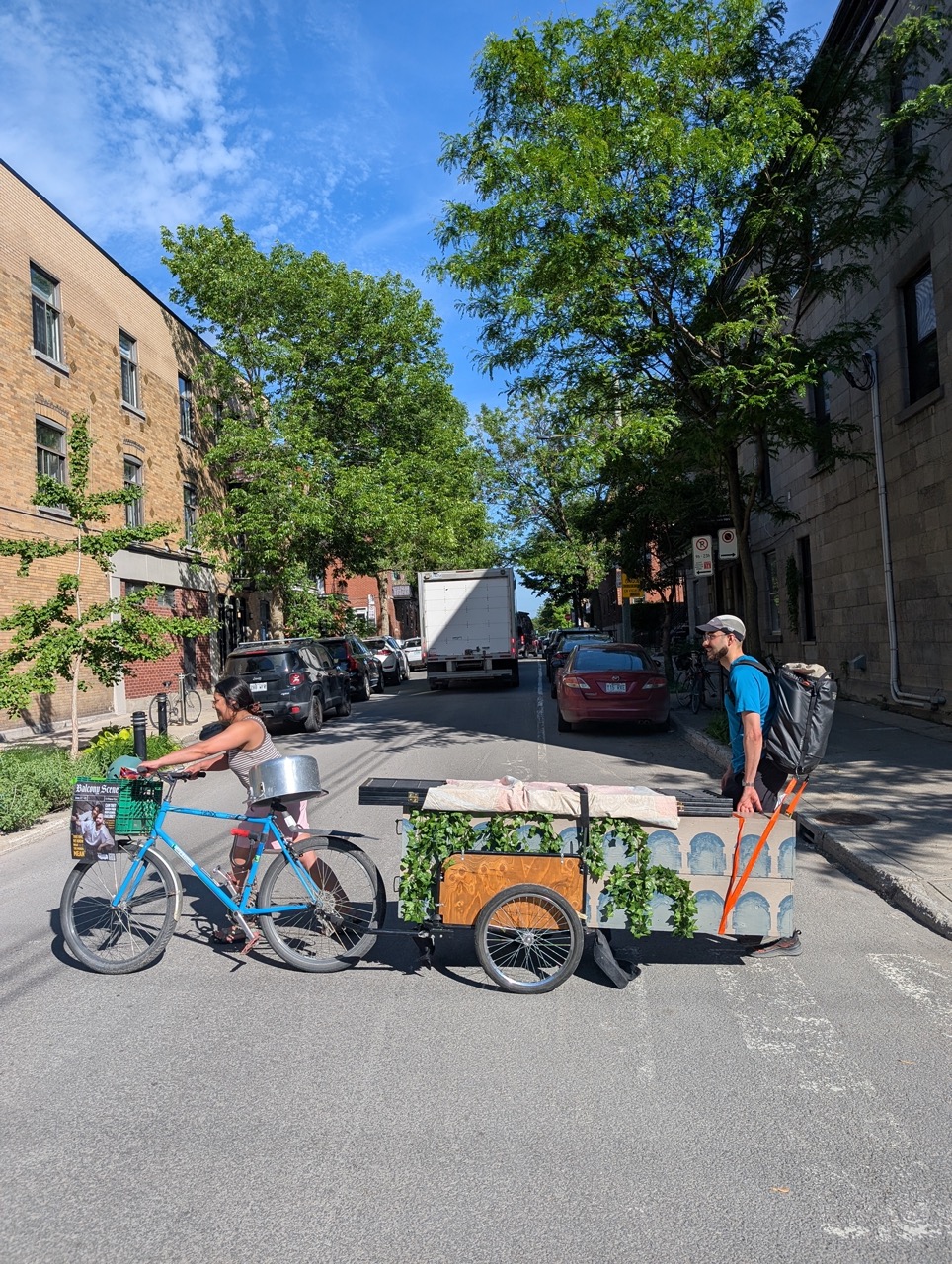
FRANCESCA and LESLIE cross the city on foot, carrying an entire set, having elected (freely, with full knowledge, and well ahead of their tech time) to walk it to the venue themselves. They are living with this choice.
Scene Three: Electricity
(In which a fight that never happened was still truthful.)
LESLIE: "Maybe I'll take credit for this one — when I said, we need a fight. I had told a very vulnerable story of this girl I was in love with, that kind of becomes our Juliet in my mind, and at the end we have the rekindling of our friendship — but how do we get from one to the other? It would make narrative sense if there's some kind of rupture, where I pour my heart out, she doesn't take it seriously, we get into an argument — our whole play breaking apart — and then I come back so that we can rekindle."
FRANCESCA: "The fight didn't really happen, but it does mirror a real dynamic, where I felt like you were very comfortable being vulnerable and telling me all your sad heartbreak stories, and I remember having moments where I was like, okay, I'll talk about this in our meeting — and then I'd be like, no, I actually don't want to tell you this intimate thing, being pathetic. I felt myself chickening out a little bit. So we do that in the play. I chicken out of the vulnerability stuff. And that moment towards the end is actually directly a conversation that we had for real."
SDC: Francesca, you're the second drama therapist I've interviewed this festival. It sounds like staging the rupture has been a kind of therapy for the friendship itself. Trauma work often means revisiting the damaging thing inside a safe container, and the container here is the play.
FRANCESCA: "I don't know if you've heard of something called self-revelatory performance, but it's a big drama therapy thing. It's a creation process in which you're working through something right now — a question you might have about yourself — and you start to create a piece about it, but still with an eye on esthetic. It's not just getting on stage, bleeding heart, all your thoughts and feelings. It still has to be theater."
"I knew that the boundaries of the therapeutic exploration were the Romeo and Juliet script. It made it safe to do that exploration — we're not going beyond these themes. The parameters is the balcony scene." — Francesca
LESLIE: "I've liked improv because it's these quick, superficial, funny, full-throttle moments — I'm so serious in my day job, I want to have these silly moments. And while being vulnerable through the writing, we've realized that we've had to pull back some of the silliness. My instinct is often to make a joke in every serious moment."
FRANCESCA: "We both have that. We have to sometimes decide: are we doing that joke for the story, or are we doing that joke because we just feel more comfortable in that mode?"
(The note came from outside eyes. A comedy-writer friend and their director both said versions of the same thing: you're funny, you succeeded at that, now we need the story.)
(As an Australian, I totally get the affliction of hiding everything beneath a joke. Sitting with the discomfort of disclosure is good dramaturgy and cheaper than therapy. Well. Francesca would know better than me on that.)
Curtain call
Programme notes
(Asked for shout-outs, they blanked, then remembered the band. Leslie's brother has made the show original music based on Henry Mancini's Romeo and Juliet score. "Some great remixes," Francesca clarifies. "Calling it original music," Leslie concedes, "but yeah.")
(The show was kept a complete secret from both of their partners during the writing.)
Balcony Scene — created and performed by Leslie Beedell and Francesca Esguerra. O PATRO VÝŠ, 356 Mont-Royal Ave, Montreal Fringe 2026, opening June 11. Esguerra returns to the venue after her Fringe 2023 debut; Beedell returns to the stage after several years of distinguished service to the Department of Transportation.
Comédie / Comedy, Première mondiale / World Premiere, Théâtre / Theatre, Conte / Storytelling
Balcony Scene
In a live attempt at redemption, two former classmates revisit their butchered high school performance as Romeo and Juliet. This interactive, genre-bending romp blurs past and present as they reenact their failure in real time.


%402x.svg)

.webp)


