

The Last Days of Downtown by Matthew Gasda at Studio 17
Review of Matthew Gasda's new play The Last Days of Downtown (CTR, April 2026), read as a contemporary adaptation of Euripides' Bacchae.
Review of Matthew Gasda's new play The Last Days of Downtown (CTR, April 2026), read as a contemporary adaptation of Euripides' Bacchae.
%402x.svg)
A review of Matthew Gasda's The Last Days of Downtown at the Center for Theatre Research, co-directed by Sofia Whetstone. The third and final installment of the Dimes Square trilogy, and a downtown New York Bacchae where subtext is over-text.
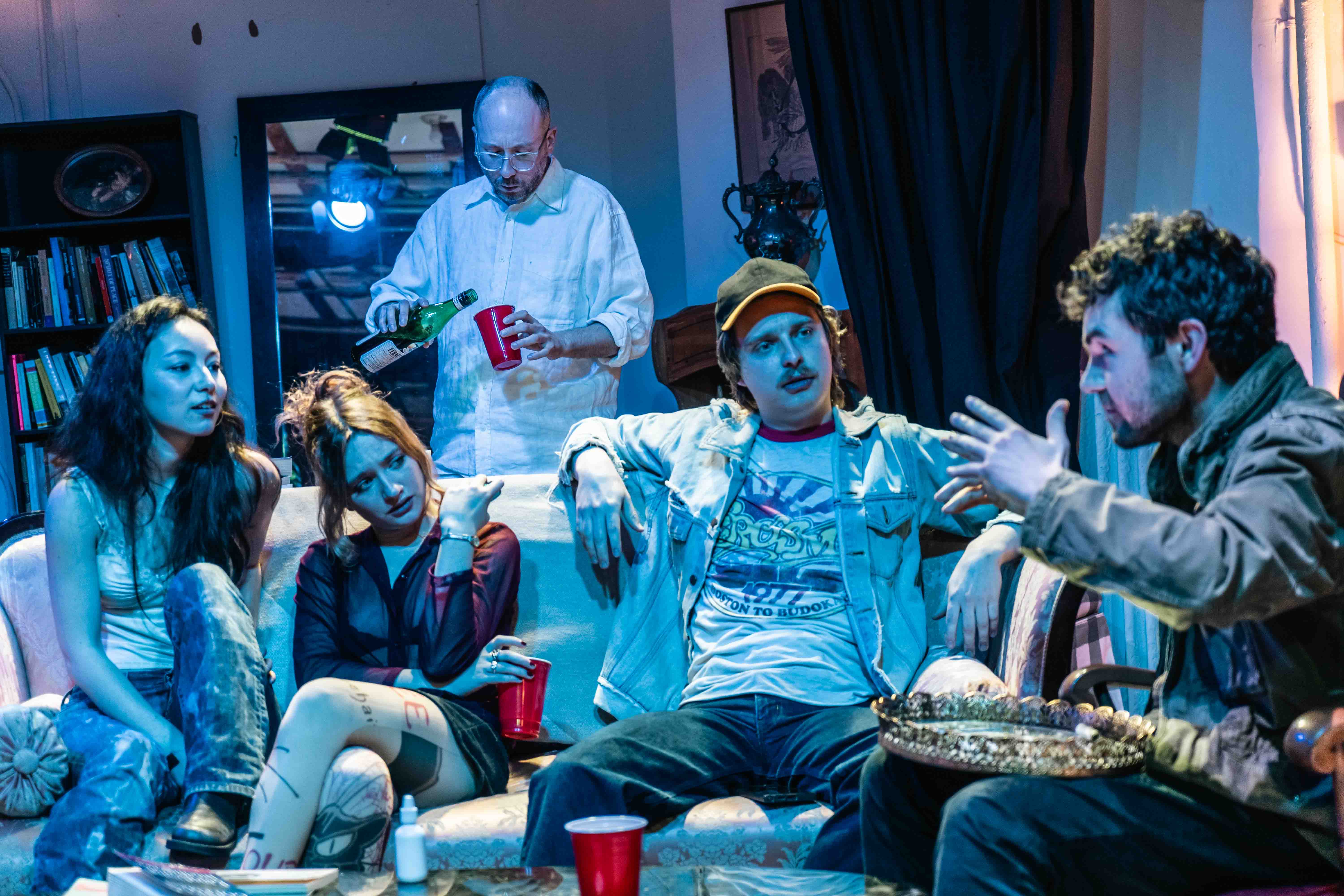
Billed by Gasda himself as "a night that might be the end of an era," The Last Days of Downtown is the third and final installment of his Dimes Square trilogy. It is the kind of play that knows exactly where it is and exactly when — an X-ray of post-post-pandemic New York that is dense, learned, at once celebratory and damning, and manically funny.

Gasda's 2015 adaptation of Euripides was commissioned by SUNY Oswego and went to the Kennedy Center American College Theater Festival, and it appears to still be in stock on Amazon. Officially, that is the one Bacchae on his record.
The Last Days of Downtown is his unofficial Bacchae. It's a two-act bender that builds, across eight scenes, into a a literal sprawling bacchanal. Narcotics and booze abound.
The promotional copy for the play pleads satire. Like Fellini's Satyricon — that other late-Roman party at the end of civilisation — The Last Days of Downtown is grotesque, carnivalesque, twenty-seven actors deep. But the marketing doth protest too much. This one's a feast for the senses, even if it offends good sensibility.

In Euripides, the chorus is not separate from the polis; it is the polis, displaced and made strange. Gasda has framed his relationship to his own subject in similar terms. Speaking to Office Magazine around the 2024 Dimes Square revival, he described his evolving position:
"I'm not directing a play that feels like it's part of the scene anymore, but one that's outside of it. One that we can approach artistically and professionally."
The audience at The Last Days of Downtown is a room full of people who have made the same set of decisions as the characters onstage. Stay in New York after the pandemic. Stay after the election. The audience is the chorus is the polis is the doomed.

Take Jessie (played by West Coast native Annabel Boardman), fumbling toward a self-description:
"I don't want to come off as needy; um — I want to come off as like… a sophisticated urban bisexual."
The play has caught, faithfully, how a certain kind of New Yorker actually thinks — identity cobbled out of a soup of available adjectives, branding in lieu of being. The interiority that the nineteenth-century novel handled through free indirect discourse (narratorial voice merging with a character's thoughts) has been de-internalized and given back to the actors as lines.
Talking becomes the symptom of a possession everyone tries to exorcise by talking more. Dionysian frenzy in Euripides is not an absence of mind but a surplus of mind. Post-2020 downtown is at maximum semiotic differentiation. Every vibe has a name, every name has a discourse, every discourse has a Discord.
Gasda's characters perform confession. They talk as if to fill the silence. But what this production does well is show how noise only adds to the pervading sense of isolation.
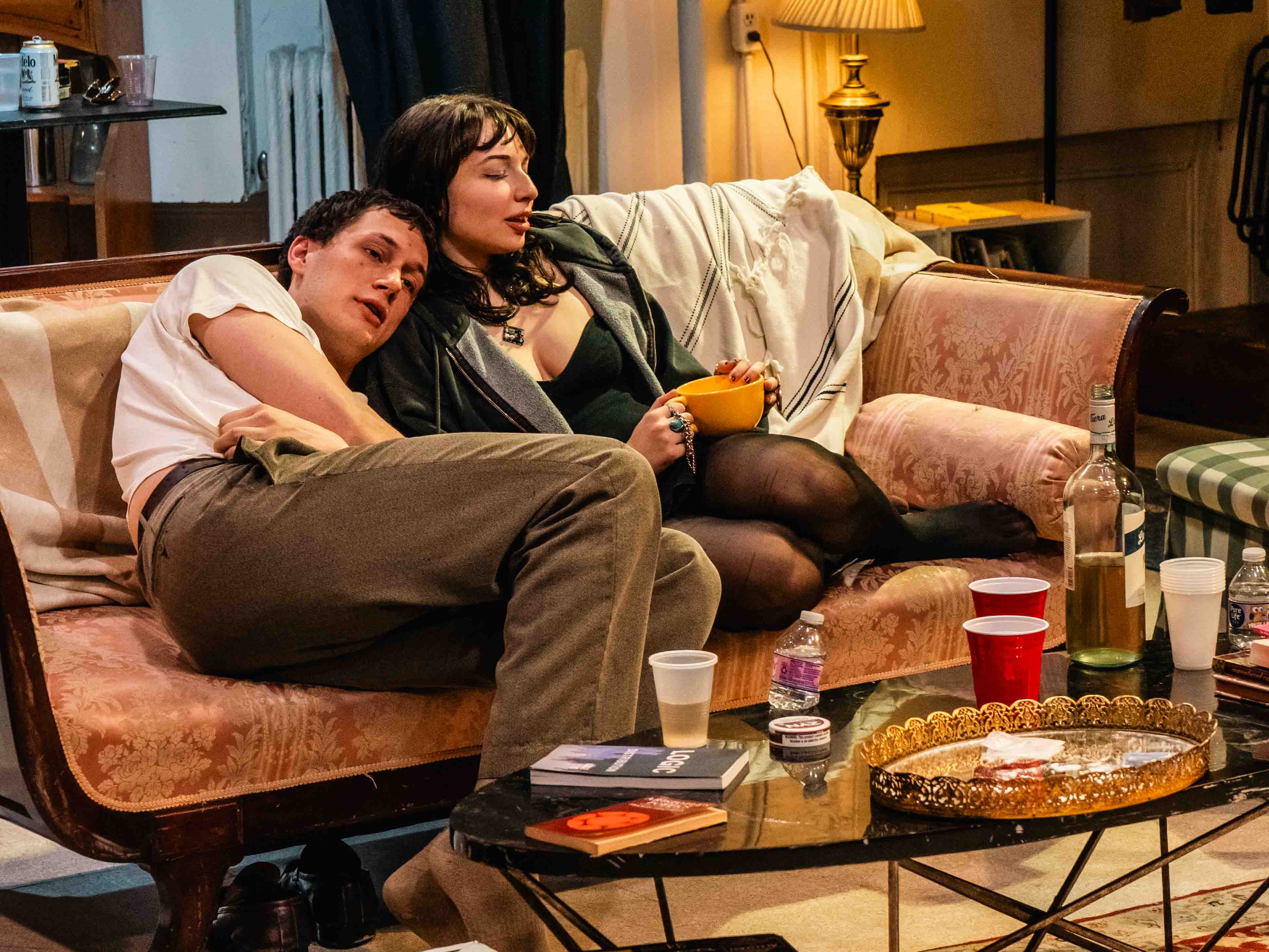
The play keeps returning to a single question, and it is the same one as the Bacchae: what is the relationship between aesthetic life and biological life? Between art and reproduction? Between the polis and the household, between the menagerie and the ménage?
When Victor delivers his aria of generational grievance, the line is aimed past the actors, into the house.
"None of you will be here in seven years: you won't be in New York City. You'll be living in Cleveland. Breeding."
"You will be in Cleveland breeding" is delivered as a curse, a fate worse than death; except the alternative Gasda depicts isn't life either. The play pulls no punches — the wickedness and the loneliness of phone addiction, of the nations of the internet age. The Houellebecq inheritance is everywhere.
The gap between portrait and prescription is one Gasda has made explicit. "My plays," he told Digital Party in 2023, "are what I don't want my life to become."
Calla Selicious, in Scene Six, just leaves the stage and uses the actual bathroom of the actual loft. The apartment's real plumbing being injected into the play's fictional space produces an estrangement where it stops being clear what's internal where, what's external, who's pissing on whom. Selicious caps the bit with a perfectly timed punchline: "I have to install a bidet in my house, no matter the cost — and then I found of the cost.”
H.G. Welp's score is terrific. Leonard Cohen drifting against classical, period markers against atemporal swells, the Fellini 8½ music breaking through the diegesis at the end. The schizophrenia of the score is the schizophrenia of the play's relationship to time. Is this 2009? Is this 2026? Is it the morning after the Trump election or the night before the pandemic? The music doesn't say.
Nick Walther A terrific shaggy archetype of the aging millennial.
Michael Berry plays Michael as eccentric, bespectacled, intermittently foaming at the mouth. Rumour is Gasda told him to "just play yourself" and this has turned out to be a great piece of direction.
Quinn Engstrom, apparently a Depop find of Gasda's whose wardrobe lends the production a kind of material realness — earns the singling-out. The costumes say it all. The cast looks like the audience.
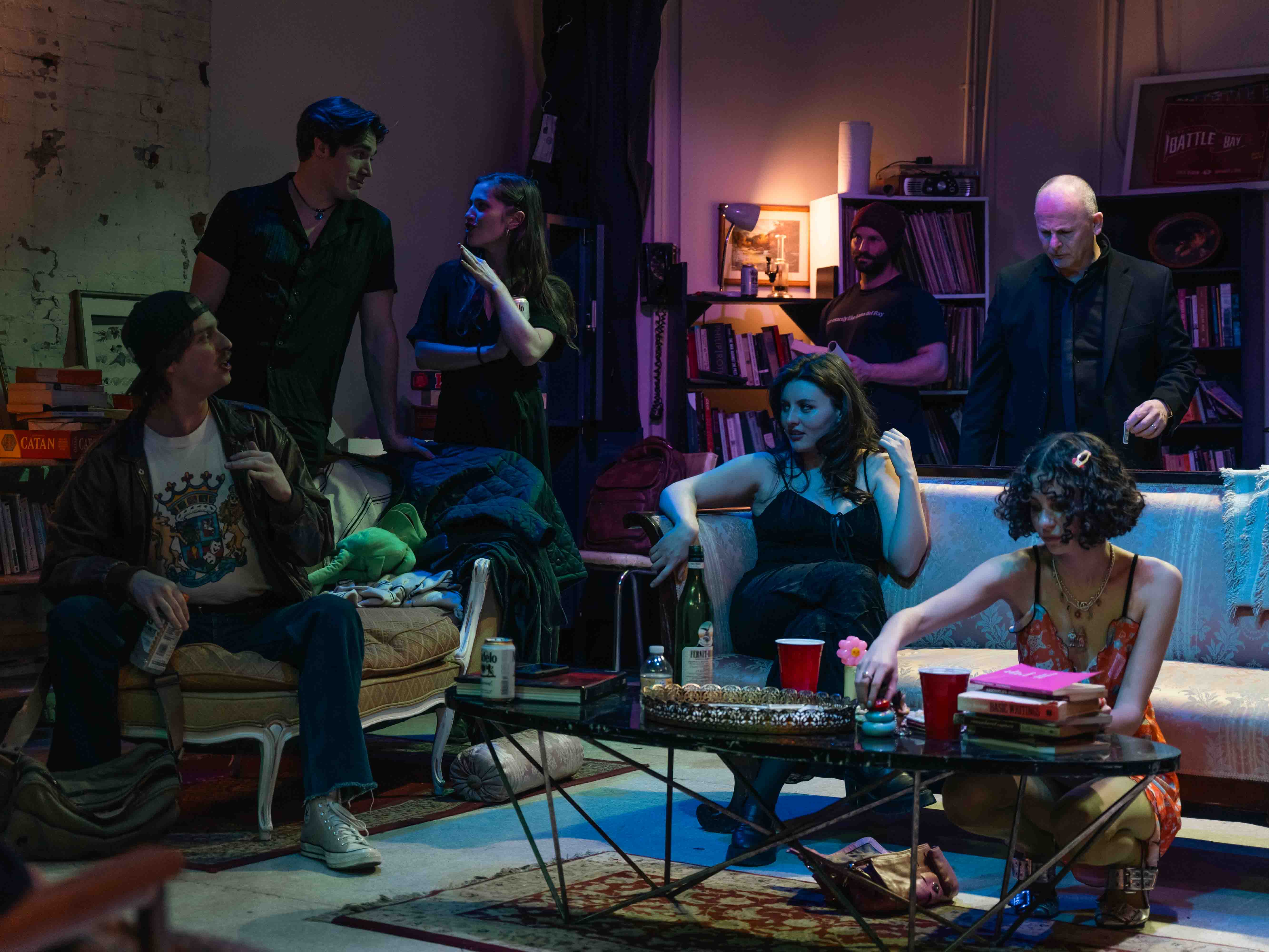
Sofia Whetstone's work as Associate Director. Her background in film is apparent immediately. The crowded scenes are composed as tableaux, with the quality of a widescreen ensemble shot. The eye roams the stage the way it does in an Altman or Anderson composition. That is Whetstone's blocking: visual storytelling, a trained eye for the kind of dense, simultaneous composition that theatre usually leaves to film.
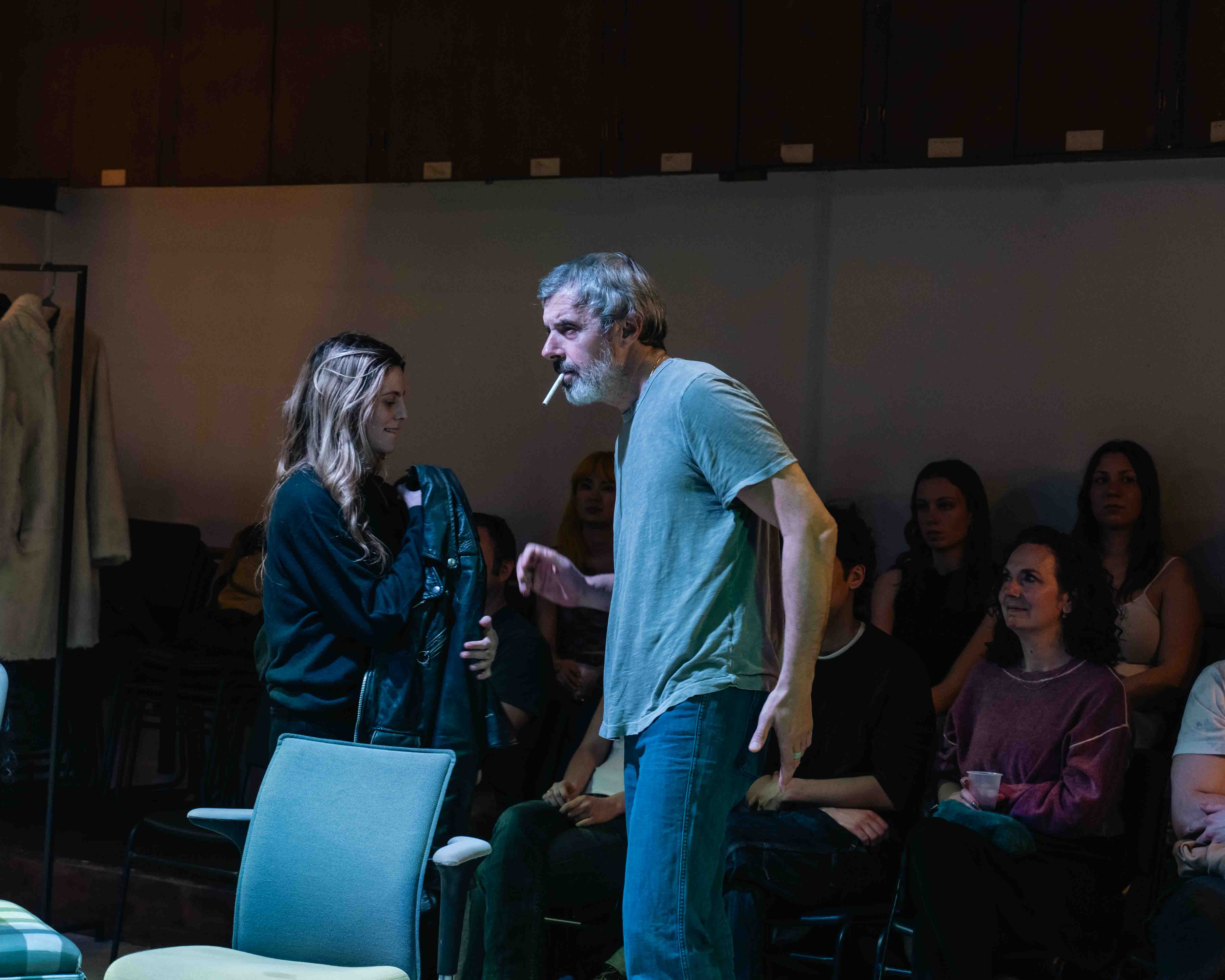
Dardan (Uliks Fehmiu, recently in the Sundance short Don't Tell Mama) is from Peć, an Albanian Catholic writing in Serbian, beefing with a Slavic-languages professor from Columbia who has accused him of being a tourist in the language. The injection of a foreigner as a way to get the polis to reorient itself is lifted directly out of the Bacchae: Dionysus arrives in Thebes as a stranger from Lydia, and the city has to reckon with him or come apart. This is one of the play's strongest moves.
What is most rewarding about Dardan as a figure is that Gasda refuses to let him be the play's exception. The idolised European Other downtown New Yorkers love to fetishise (the Žižek, the Knausgård, the Houellebecq) turns out just as ridiculous, just as mockable, as everyone else.
His invocation of "Augustine, Dante," paired with Mia’s "Pop! Six! Squish! Uh-uh! Cicero! Lipschitz!" from Chicago, says it all. The eclecticism of the present collapses every value system. The Western canon is rendered into noise. Dardan is, structurally, Pozzo to Chris's Lucky, or Lucky to Chris's Pozzo. Either way, we are in late stage, very late, comedy.
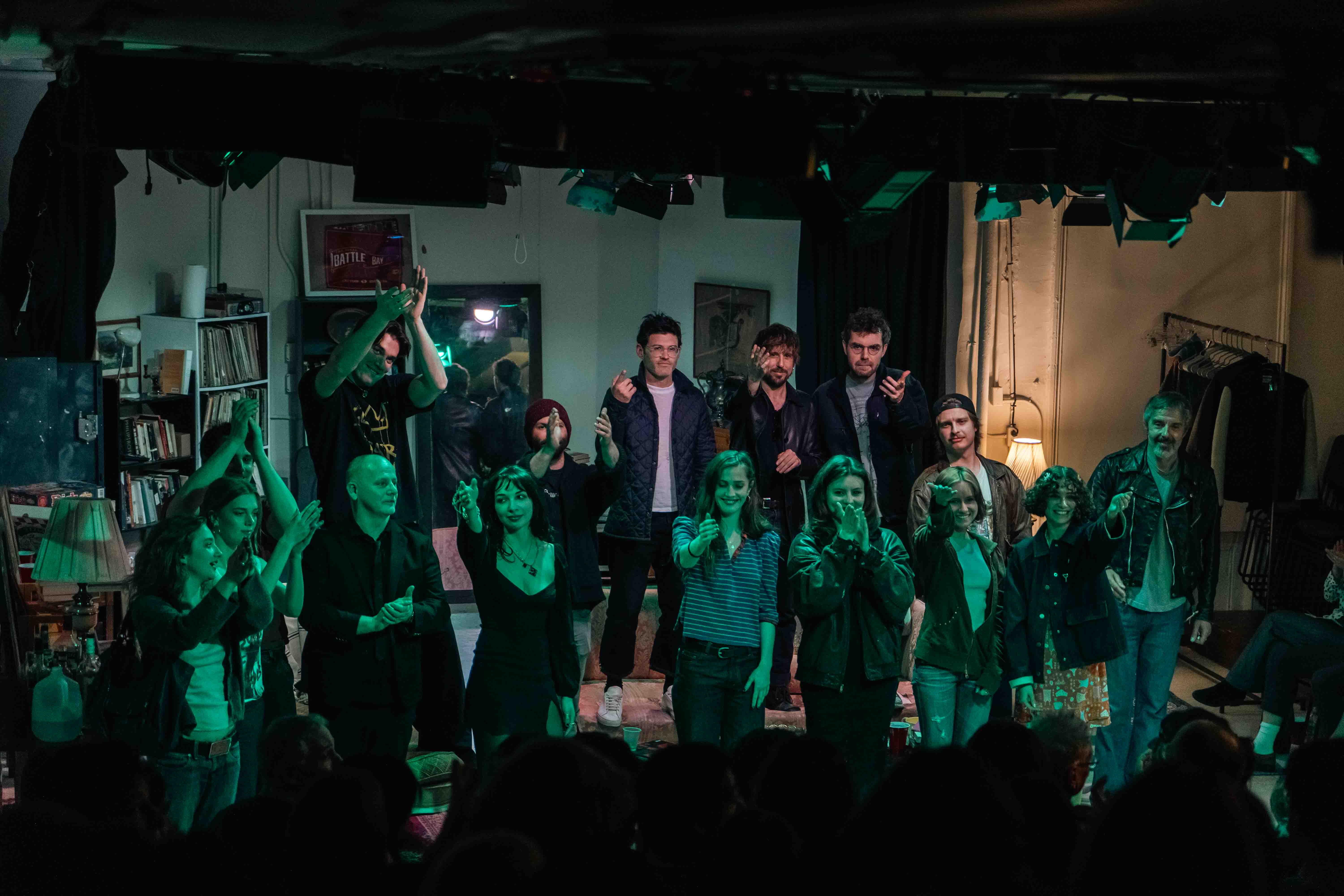
The full cast: Annabel Boardman, Aris Katafygiotis, Bob Laine, Calla Selicious, Claire Banse, Colette Gsell, Eowyn Young, George Olesky, Jonah Howell, Meg Spectre, Michael Berry, Nick Walther, Nicole Sollazzo, Paul Weintrob, Shamar James, and Uliks Fehmiu. Co-direction by Sofia Whetstone, stage management by Julia Levine.
The Last Days of Downtown, written and directed by Matthew Gasda. Performance reviewed: Sunday, April 19, 2026.
.webp)


