Booba
Sydney Dramaturgical Company at Sydney Fringe Festival 2025
In September 2025, Sydney Dramaturgical Company staged the world premiere of Booba at The Actors Pulse Playhouse, 103 Regent Street, Redfern (Gadigal Country), as part of Sydney Fringe Festival 2025. The production ran from 23–27 September 2025 with a running time of one hour and thirty minutes, following a preview on 11 September 2025 at World Tower Sydney. The show was rated M, with content warnings for strobe lighting, haze, coarse language, and discussion of sexual violence.
Booba was written by Aubrey Qiu-Qi Wang and marked the theatrical debut of director Ziggy Lumley Tow, best known prior to this as the creative force behind the See Thru Film Festival, an annual gathering of homegrown talent in Sydney's Inner West, and as co-director (with Alex Spear) of the short film Perfect Marble (11 mins), a finalist at the Inner West Film Festival 2024. Booba was Wang's second full-length play following Chinese Restaurant, developed in Melbourne and staged at Mothership Studios in Marrickville in June 2024.
Hi. The year is twenny twenny five. In twenny twenny noo the Earth exploded and all of the cool people went to the moon. The cringe losers moved to Mars. And now this is home.— Booba, Act 1 Scene 1
The play's premise is a surrealist tragicomedy: Booba, a self-proclaimed loser from Mars, lands an internship on the Moon and dreams of reuniting with her long-distance boyfriend, Homie. Halfway through, the pastel cartoon surface of her world cracks, and a shocking reveal forces her to confront the actual circumstances of her situation. The structure draws on the conventions of Japanese Noh theatre, in which a ghost returns to relive an unresolved trauma.
A liminal, dreamlike world.— Production marketing materials
Pre-season press described the work as a meeting of animated tragicomedy and Noh — tackling existential themes through absurdist humour and surreal charm. The play's stated thematic concerns were immigration, identity, and long-distance relationships under neoliberalism.
From the Director — Ziggy Lumley Tow
In a director's statement provided alongside the production, Ziggy Lumley Tow framed Booba as a play set in the future, between Mars and the Moon, but mainly focused on modern love. He described Booba and Homie as being in a situationship tested by the offer of a career on the Moon — a chance, in his words, at getting out of Mars, which he glossed as a stand-in for Australia. What follows, in his framing, is immigration hell, attempts not to be trafficked, and a bureaucratic nightmare: the Moon, in turn, a metaphor for New York, far from the ritzy paradise it had been sold to Booba as. Tow also linked Booba's predicament to that of the Homeless Man she meets in Act 1, suggesting that she, like him, came from somewhere you are born dead — a place with little room for upward mobility or growth.
On his own role as director, Tow was emphatic that the work was not his to impose on:
My role as a director is not to force my own individual vision onto the script but to merge the vision and styles of the writer, actors, and set designers, while maintaining my function as the lube of the production.— Ziggy Lumley Tow, director's statement
Working on this project has taught me about the wide variety of people in this city, and got me thinking about how they all fit together. Booba will be a merge and melt of many different and diverse minds — creating something hopefully entertaining, intelligent.— Ziggy Lumley Tow, director's statement
Cast and Creative Team
Lead Cast
Booba — Kyrah Brock-Fenton
Kyrah Brock-Fenton played Booba, the Martian intern at the centre of the play. Brock-Fenton is best known for her role as Holden Jones — daughter of the iconic Shazza — on the Logie Award–winning Australian comedy series Housos and its spin-offs Housos vs Virus, Housos: The Thong Warrior, and Housos: Holden On. Her television credits also include 7mate's Fat Pizza: Back in Business and Channel 7's Home and Away. A graduate of the Hunter School of Performing Arts in Newcastle, Brock-Fenton is concurrently a student at the University of Newcastle. Booba was her stage debut.
Homie — Agustin Lamas
Agustin Lamas played Homie, Booba's long-distance boyfriend. Homie is a stable, present-tense counterpoint to Booba's reverie — the relationship to which she is trying to return, the figure to whom her interior monologues are directed. In the production's second-act Noh sequence, Lamas also performed the masked role at the centre of the play's most arresting stagecraft moment, descending the audience aisle in a paper-mâché oni mask before the late-show reveal.
Homie? Is that short for something?It's short for Homedawg. That's his government name.— Dexon and Booba, in flight
Supporting Cast
Hamish Bell played Dexon. Sosuia Pouhila Afa played the Homeless Man. Jack McEvoy played Tanya. Michael Brien and Diaan Vitnell played Erasmus and Yuridiana respectively, performing the pair as conjoined twins joined by a shared, sewn-together costume piece — a wardrobe choice doubling as blocking, since the two performers had to negotiate every movement in tandem. Vitnell was also the production's wardrobe designer and shared makeup duties with Lara Kariatlis.
Direction
Ziggy Lumley Tow
Booba was the theatrical debut of Ziggy Lumley Tow. Tow is the creative force behind the See Thru Film Festival, a yearly Sydney Inner West showcase for emerging Australian filmmakers, and co-directed the short film Perfect Marble (11 mins, 2024) with Alex Spear — a finalist at the Inner West Film Festival 2024. He brought a screen-trained sensibility to the production's pastel-cartoon visual logic and its mid-show tonal break.
Design
Set Design — Lottie Braun and Hamish Shorrocks
Lottie Braun, who records music as Lottie World, designed the set and contributed original music. Lottie World is a Sydney-based pop producer and visual artist with releases on Bandcamp including the EP My Pop Album, and was profiled by FBi Radio as one of its Independent Artists of the Week. Her work for Booba leaned into the genre-defying, lo-fi-pop aesthetic she has cultivated in Sydney's underground music scene. Hamish Shorrocks assisted on set design, and the pair also collaborated on a number of the production's bespoke prop fabrications — including the rolling frame used in the Skype call scene and the production's custom-made magazine Eye Sea You Pea, the ecopoetics journal Booba reads on her flight to the Moon.
Set Pieces — The Bower Reuse and Repair Centre and MSMatch
Set pieces for Booba were sourced from The Bower Reuse and Repair Centre in Marrickville and through MSMatch, a materials-matching platform for the Sydney independent theatre community. Both Lottie Braun and Hamish Shorrocks had professional connections to The Bower, which made the partnership a natural one. The Bower is a registered environmental charity established in 1998, operating shopfronts at Building 34, 142 Addison Road, Marrickville and at 7 Prospect Road, Summer Hill. The Bower's House to Home program outfits social housing for people who have been homeless, refugees, or domestic violence survivors — making the partnership a thematic as well as a practical fit for a play about migration and displacement. MSMatch provided additional secondhand scenic elements through its circular-economy network, sourcing materials between productions. Additional furniture, including the dining-scene chairs, was provided courtesy of Sydney Theatre Company.
Wardrobe — Diaan Vitnell
Wardrobe was designed by Diaan Vitnell, performing under the alias "Dumb Bitch" Diaan. Vitnell is a National Art School (NAS) BFA Sculpture graduate and a PUSH Magazine favourite, with an idiosyncratic, sculptural approach to costume that played into the production's surreal, layered visual language. Vitnell also appeared onstage in the role of Yuridiana, and contributed a set of hand-made soft sculptures to the production — including a small herd of funny pillows used as set dressing across the apartment scenes, their fabric faces and absurd proportions sitting somewhere between children's-book illustration and uncanny gallery object.
Makeup — Lara Kariatlis and Diaan Vitnell
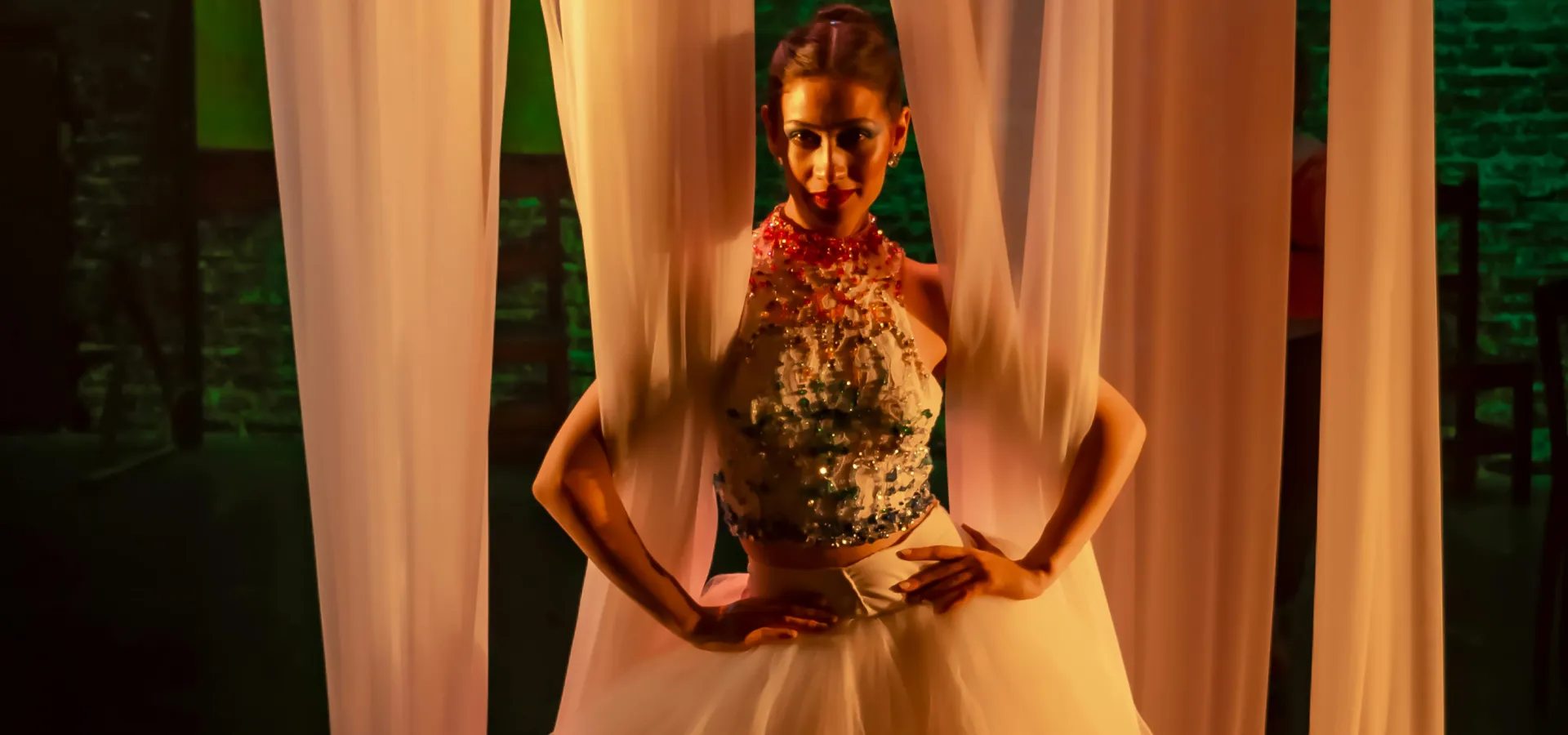
Makeup design was a collaboration between Lara Kariatlis and Diaan Vitnell. Their work for Booba ran in the same sculptural register as Vitnell's costuming — saturated washes of pink and red around the eyes, brows lifted into theatrical arches, and finishes that read as cartoon-bright under the first-act lighting and slid into something more haunted under the second-act colour shifts. The makeup carried a significant share of the production's tonal work, sustaining the cartoon idiom of Act 1 and then surviving the Noh-inflected reframing of Act 2 without needing to be re-set between scenes.
Ambient Soundtrack — Umki
The ambient soundtrack was composed by Umki, a multidisciplinary artist from Ngunnawal and Ngambri Country (Canberra), known for blending post-club textures with ceremonial performance. Umki is a long-standing collaborator of Sydney Dramaturgical: she previously composed the original live score for the company's earlier production Chinese Restaurant (2024), and her broader practice has included collaborations with Hiatus Kaiyote, Ana Roxanne, Third Space, and Rainbow Chan. At the time of the Booba season, Umki was working at the National Gallery of Australia.
Photography — Jack Okeby
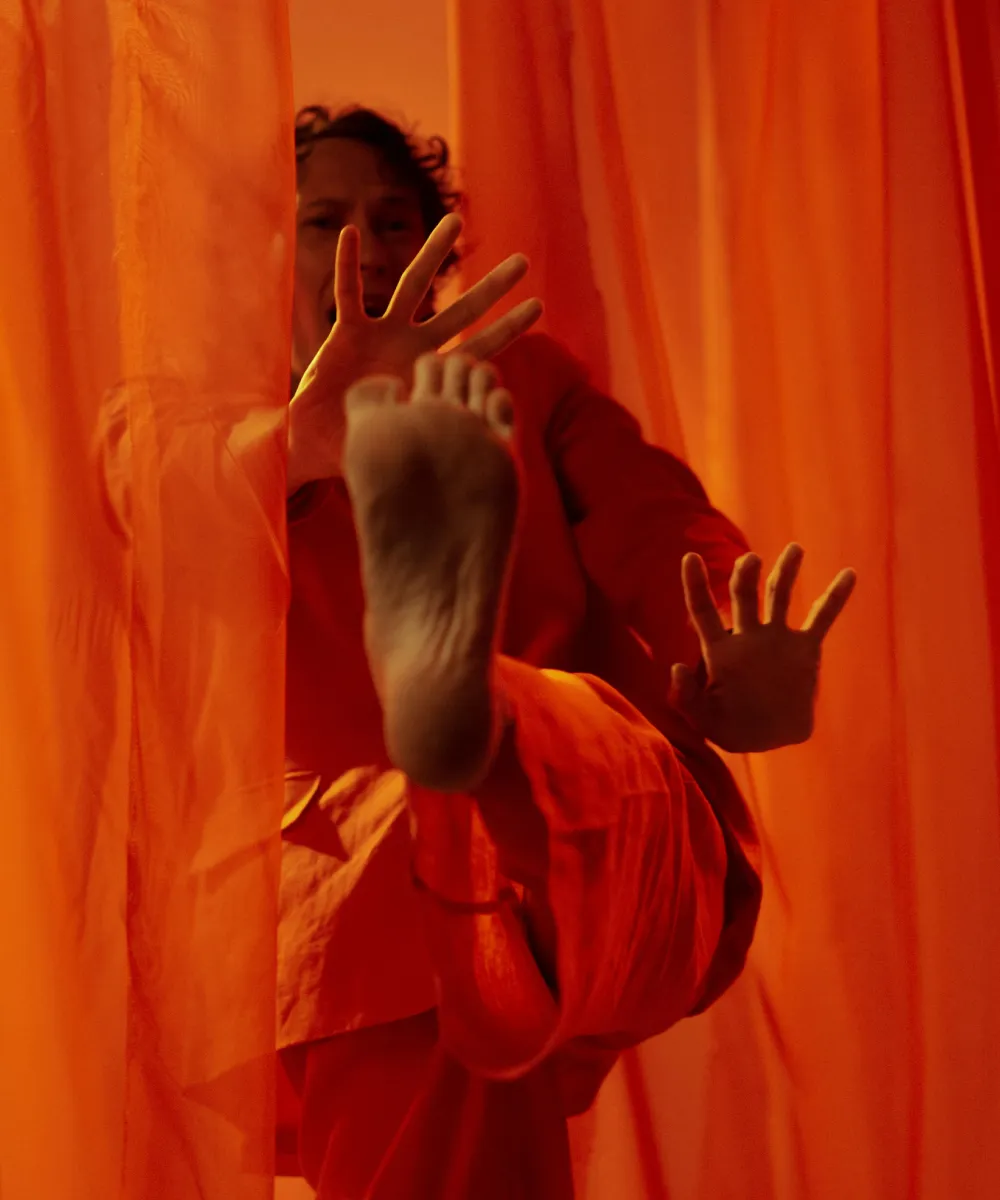
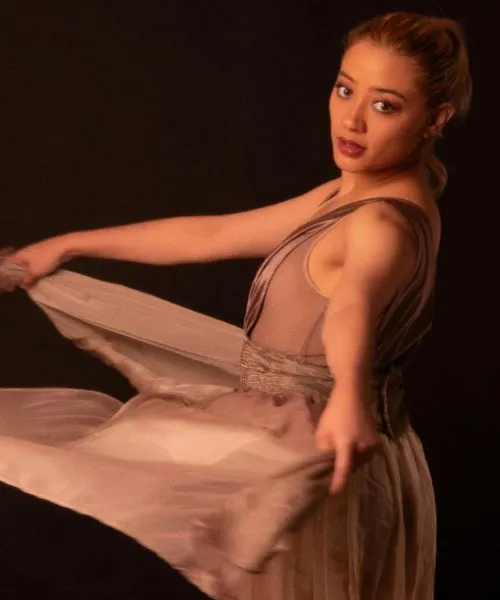
Preview production stills were photographed by Jack Okeby at World Tower Sydney on 11 September 2025, in advance of the show's Fringe opening. Okeby's images form the basis of the production's archival record.
Development and Rehearsal
Rehearsals for Booba took place across two domestic spaces over the months leading up to the September premiere: Aubrey Wang's apartment in Haymarket and Ziggy Lumley Tow's sharehouse in Marrickville. The choice of working out of lived-in private spaces rather than a hired studio shaped the production's domestic grain — many of the script's quieter scenes (the Mars kitchen, the late-show apartment, the dinner party) were first blocked across actual kitchens and lounge rooms, and a number of household objects from those rehearsals quietly made their way onto the set.
The production then moved to World Tower Sydney for a private preview on 11 September 2025, twelve days before its Fringe opening. Tow has described his approach to the production as a deliberate aggregation of collaborators rather than a single authorial vision — a function he characterised in his director's statement as relating each individual's style and vision to the broader Sydney ecosystem.
The Staging
The Actors Pulse Playhouse is a forty-five-seat black-box on the ground floor of 103 Regent Street, Redfern — an intimate venue that offered a close audience–performer relationship suited to Noh's slow gestural register and to a play whose emotional grain frequently sits in micro-expression.
The production's staging strategy was a deliberate two-part visual arc. The first half was rendered as pastel cartoon (bright, flattened, pop-coloured) borrowing from the visual lexicon of streaming animation and online imagery. The mid-show reveal repositioned the action within a Noh dramaturgical structure, in which a ghostly figure relives unresolved trauma in a liminal, dreamlike world.
I rehearsed all seven stages of grief. In case if we broke up.Oh yeah, did you get to acceptance?Beyond.— Booba and Homie, Act 1 Scene 1
Set and Spatial Logic
The stage was organised around two raised square platforms — Stage Major and Stage Minor — adjoined by a bridge that read as a deliberate, abbreviated quotation of the Noh hashigakari, the bridgeway by which spirits enter the playing space.
Stage Major carried the production's domestic and confrontational scenes — the Mars kitchen, the immigration office, the Moon apartment dinner party — while Stage Minor sat in its back-left orbit and operated as a kind of purgatory: a holding space for figures not yet, or no longer, fully present. The two-platform geometry let the production stage simultaneity without crosscutting, with characters appearing on Stage Minor in an intermediate dramaturgical register before crossing the bridge into the principal action.
The rice-paper backdrop
Behind the platforms, a wall of translucent rice-paper screens framed in wood, fabricated by Hamish and Lottie, formed the production's primary visual surface. The screens were lit from behind — orange for the Mars apartment, harsh white for the immigration office, blue-violet for the Moon — and also served as the projection surface for the production's real-time visuals.
Furniture, props and bespoke objects
Furniture was deliberately spare: two chairs and a Sori Yanagi replica butterfly stool, the latter inverted to become a stove in the opening scene and reset throughout the play. Larger set pieces (the dining table, the flight-row seats, the lounge furniture for the Grimes Square scene) were sourced second-hand from The Bower, MSMatch, and Sydney Theatre Company's stock, lending the world a curated thrift-shop materiality that read both as the bricolage of an under-resourced Martian moving to the Moon and as a quiet ecological commitment in a play about extraction and displacement.
Hamish and Lottie also fabricated several of the play's signature props from scratch. The most visible of these was Eye Sea You Pea, the in-world ecopoetics magazine Booba is handed on her flight to the Moon by Dexon — a hand-bound zine with chunky stencilled lettering across the cover, the title's pun (I see you, P — I.C.U.P.) repurposed across the design. The same pair built the rolling frame used in the Skype call scene (see Blocking and Physical Performance, below). Diaan Vitnell contributed the funny pillows and the conjoined-twin costume piece, both of which doubled as set elements when not being worn.
A snack? For me?Go on, shake me down.— Booba and Homie
Lighting
The Playhouse's house rig is modest — an Atom LSC twelve-channel desk, a twelve-channel dimmer rack, ten Par 38 cans, five fresnels, and two spots — and the production's lighting design was built around making that constrained kit do scene-by-scene tonal work.
Scene-by-scene colour logic
- Mars kitchen: warm orange wash through the rice-paper backdrop
- In-flight cabin: cool blue, with low aisle floor-lights as the dominant fixture once the cabin dimmed
- Immigration interview: harsh, surgical white
- Tunnel sequence: stroboscopic sweeps and hard geometric punches in electroclash rhythm
- Moon apartment: apartment lamps and blue moon-glow
- Final scene: a single parcan as direct sunlight
The tunnel sequence simulated the punctuated visual experience of moving fast under a row of fluorescent tubes, with cool strobes raking across the stage in an electroclash rhythm and harder geometric beats punching in over the top — a deliberate point of maximum sensory load before the play settles into the slower domestic tempo of the Moon apartment. By Act 2, lighting cooled into apartment lamps, blue moon-glow, and finally a parcan as direct sunlight, retreating in scope as the play's emotional aperture narrowed.
Sound and Live Music
Sound design ran on QLab and combined three layers:
- Umki's through-composed ambient score — the through-line beneath the show
- Scene-specific found and synthesised sound — rocket-launch rumble, in-cabin air-conditioning, immigration-office room tone, highway-tunnel drones, Skype ringtones, glaciers hissing, street ambience, harsh moon-wind
- Comic-timing diegetic effects — doorbells, buzzers, the Skype call-and-disconnect tones — that landed as punctuation
The cue stack ran in the high twenties, with most cues triggered manually to allow performers to play scenes at their own tempo.
Live percussion and flute in Act 2
In the second act, the sound design opens out into live music. A flautist and a percussionist enter and seat themselves behind Booba, slightly to the right, in a configuration that visually quotes the Noh hayashi ensemble.
The Burning sequence is delivered as a call-and-response cycle: the flute summons, Yuridiana speaks a verse from a poem that Booba has just torn from her own notebook, and the percussionist marks each verse with the snap of a kotsuzumi. Ten verses, ten snaps — a metronomic executioner's march that moves Homie down the audience aisle toward the stage and locks the audience's attention in the same suspended, ceremonial duration the rest of the design has been preparing them for.
Flute, verse, snap. Flute, verse, snap. An executioner's march.— Stage direction
The transition from recorded ambient score to live percussion is itself a dramaturgical event: a literal tightening of the world from the diffuse atmospheric to the immediate physical.
Projection and Real-Time Visuals
Projection onto the rice-paper backdrop was driven by a custom TouchDesigner patch assembled by the production team. The patch was not a single composition but a network of scene-specific sub-graphs, switched between as the show progressed and fed live by audio analysis, webcam tracking, and direct manual input.
The architecture of the patch
The main composition was built around a conventional TouchDesigner rendering pipeline — a 3D scene assembled from primitive geometries (box, sphere, torus, and a starfield) driven through geo and attribcreate operators, lit by two light components feeding an environment node, and rendered through a cam → render → antialias → over → dither chain whose final pass gave the projected image its signature pixelated, low-bit-depth grain. PBR materials (pbr, substance, two normal map nodes) supplied the surfaces, but the dither operator at the end of the chain stripped everything back to a deliberately degraded, almost console-era resolution — a key part of the production's visual identity, refusing the high-gloss render aesthetic in favour of something that read closer to early-2000s screensaver or amateur web art.
Three parallel particle/scatter chains (one originating from a box, one from a sphere, one from a torus) ran through sprinkle → null → sopto → chopto operator sequences, then merged through a switch, noise generator, position, and scale chain that gave the projected geometry its drifting, breathing quality. Three brick nodes provided the architectural texture used in the immigration office scene.
A separate audio-reactive composition (used principally in the Skype call scene) ran live audio through an audiospect operator into a spectrograph reactive to vocal frequency content. Audio-reactive parameters were fed into envelope followers, lag filters, and count operators (envelope, lag, math, count, speed chains) which in turn drove circle position, circle size, and noise movement on the back screen — the planetary-heartbeat feel of the Mars apartment scene was a direct product of this signal flow. A bank of rgbkey, level, fit, hsvadj, and reorder TOPs handled colour compositing across the composition, with a feedback2 operator and level7 (highlighted in the patch) providing the looping, smearing quality the back screen took on during the more saturated passages.
A separate external TOX module handled the MediaPipe integration: a virtual filesystem loaded the ML models, a websocket server brokered pose, face, hand, object, and image-embedding data from the webcam feed, and a webserver/webbrowser pair hosted the inference interface at localhost:59512. The hand-tracking data was piped through a chain of select, limit, math, and logic CHOPs before being routed into the main composition. The TOX exposed parameter outputs for face landmarks, face detection, hand results, pose estimation, object detection, and image embeddings in parallel — only some of which were used in performance, with the others left running as headroom.
Act 1 — Projection as scene-painter
- Scene 1 — Mars apartment: audio-reactive marbled surface that breathed against Umki's score, the Martian orange shifting in slow eddies as a kind of planetary heartbeat
- Scene 2 — Immigration office: brutalist register — dithered, hard-edged geometry that read almost as architectural rendering and amplified the scene's sterile, fluorescent affect. This composition was hand-controlled via MediaPipe webcam tracking, mapping an offstage performer's hand position to the geometry's orientation and rotation, so that the projected wall behind the immigration scene appeared to subtly respond to the unseen pressure of an authority figure
- Scene 3 — The Tunnels: real-time spectrograph reactive to the live audio, treating the punctuated tunnel sound as a literal data signal
- Scene 5 — Office dorm: a single isolated laser dot — a bureaucratic surveillance image, but also the cat-toy that Booba ends up chasing across the stage
Act 2 — Projection withdrawn, then restored
Through Act 2 the projection drops out almost entirely, the rice-paper screens reverting to back-lit colour fields, until it returns for the Burning sequence as the visual partner to the live music.
Hand-tracking input
The hand-tracking layer drew on MediaPipe via webcam — face landmark detection, hand detection, pose estimation, and object detection all running in parallel against the live camera feed, with hand position then mapped into the main composition. The brutalist immigration-office composition was the most explicit use of this layer; elsewhere the hand-tracking ran more subtly, as a kind of unseen conductor over the audio-reactive circles and noise fields.
Costume and Makeup
Wardrobe by Diaan Vitnell
Diaan Vitnell's wardrobe was built on found pieces — patterned plaid shirts and hand-painted ties for the Mars kitchen, a textured red-and-multicolour fabric snood that made one supporting figure read as a creature out of a children's book, and a shared, sewn-together garment that bound Yuridiana and Erasmus into a single conjoined-twin silhouette for their dinner-party scene.
The colour palette across the wardrobe stayed deliberately heightened — primary reds, oranges, soft greens, washed pastels — to hold the Act 1 cartoon register in the audience's eye even when the dialogue had begun to darken.
Vitnell's contributions extended beyond costume into a set of soft sculptures scattered through the apartment scenes: a collection of funny pillows, hand-stitched faces and bodies with the cartoon-illustrative quality of children's-book characters, doubling as set dressing and as comic punctuation.
Makeup by Lara Kariatlis and Diaan Vitnell
Makeup, designed by Lara Kariatlis and Diaan Vitnell, ran in the same idiom. Eyes were painted in saturated pinks and reds, brows lifted, finishes left intentionally glossy under the first-act lights so that performers read almost as printed images of themselves.
As the lighting shifted into the Act 2 cool blues and reds, the same makeup palette began to read as something more haunted — the cartoon over-application of colour started to look like fever, like flushing, like crying that has not yet happened. The design was built to survive the tonal break without re-setting, so that the audience experiences the same face becoming something different rather than a costume change between acts.
Blocking and Physical Performance
Blocking across the production moved between two distinct registers.
Act 1 — The cartoon register
Act 1 worked in a cartoon register — broad, frontal, choreographed: the flight-safety-demonstration dance in Scene 2 was a fully choreographed mimed sequence performed downstage of Stage Major, the Mars kitchen scenes used picked-up-and-spun romantic gestures and wide pratfalls, and the immigration interview was staged with the deliberate symmetrical confrontation of two figures across a metallic table.
Tell me. When we grow up do we ever go home?Well, I suppose not. Adulthood is defined by leaving home. It is never-going-homeness.— Booba and Dexon, in flight to the Moon
Scene 4 — The Skype call
The Skype call scene was staged through a rolling frame built by Lottie Braun and Hamish Shorrocks: a freestanding rectangular structure on castors, the size of a small window, wheeled into position as the scene began. Booba played the call live, downstage and facing the audience; Homie delivered his half of the conversation from behind the frame, his image effectively framed by the structure as if the audience were looking through a video-call window.
The choice externalised the geometry of a long-distance relationship into a piece of furniture. The frame itself was both the connection and the barrier: a thing you can see through but cannot pass. Audio cues — the Skype ringtone, the connect tone, the cut-out and drop-out artefacts of an unstable call — punctuated the scene from QLab. When the call ended, the frame was wheeled off, and with it Homie left the visible stage entirely.
I'll video call you every day! I'll send you moon rocks! I'll write your name in the moon dust! With Weapons of Mass Destruction! So you can see it!— Booba
Act 2 — Narrowed and slowed
Act 2 narrowed the physical vocabulary. Performers held longer beats, stillnesses got longer, and the bridge between Stage Major and Stage Minor began to be used as a deliberate threshold — a place where characters paused before entering a scene rather than a corridor through which they passed.
The Burning sequence — the production's signal stagecraft moment
The Burning sequence in Act 2 is the production's signal stagecraft moment, and it is essentially a blocking event with its supporting designs subordinated to it.
Homie enters not from the wings but from the back of the audience, all the way across the hall at the end of an aisle, wearing a real paper-mâché oni mask handmade for the production.
All the way across the hall, to the back of the audience, at the end of an aisle, stands HOMIE. He is wearing an Oni mask.— Stage direction, Aubrey Qiu-Qi Wang
As the flute and drum work through the ten-verse poem, Homie walks slowly down the aisle toward Booba, who is centre stage holding airport flowers and a cheap teddy bear. The audience is implicated in the geometry — Homie passes within inches of seated viewers, the masked figure briefly becoming part of the room rather than the stage picture.
Can't you see that I'm burning?— Booba, Act 2 Scene 2
On the final drum snap he removes the mask, and the play's central revelation lands not as exposition but as physical fact: the spirit was always Homie, the trauma being relived was always shared, and the cartoon world of Act 1 has been retroactively recoloured.
The mask itself — paper, hand-built, slightly imperfect — was a deliberate refusal of the slick prosthetic register; it read as ritual object rather than special effect.
Dramaturgical Context
The Noh framing
The Noh-theatre framing is the production's central dramaturgical reference. In classical Noh, a shite (主役) — typically a ghost or spirit — appears to a wandering monk and replays the moment that bound them to the world after death. The dramatic engine is recurrence, not progression.
Booba's mid-show reveal applies that engine to a contemporary register: an internship under neoliberalism, an immigration narrative, a long-distance relationship sustained across an interplanetary distance that stands in for a more familiar kind of border. The production's staging choices — the bridge as hashigakari, the live flute-and-percussion ensemble seated upstage, the masked figure's slow processional entrance from beyond the playing space — are not decorative quotations of the form but operational reproductions of its central mechanics.
Allegory: Mars as Australia, the Moon as New York
Tow's director's statement is explicit about the play's geographic allegory. Mars stands in for Australia — the cultural and economic periphery from which an ambitious young person might feel compelled to leave — and the Moon for New York, the imagined centre, sold to the protagonist as a kind of paradise and then revealed, on arrival, as something quite different. The internship that takes Booba away from Homie is therefore not just a job opportunity but the entire architecture of upward mobility under contemporary global capital: the ritzy promise, the bureaucratic reality, the human cost of accepting the offer.
I'm not even on the moon yet, and I've already gotten a marriage proposal.— Booba
The animated tragicomedy lineage
Pre-season press positioned the production alongside contemporary animated tragicomedy — work that uses anthropomorphic distance to address depression, addiction, and emotional self-deception. The combination is what the production set out to deliver: a dark existential play wearing a cartoon costume, with the costume itself becoming legible as a defence mechanism by the time it cracks.
Aubrey Qiu-Qi Wang's writing has elsewhere worked with similar contrasts; his earlier Chinese Restaurant was billed as a warehouse melodrama and used immersive, walking-permitted staging at Mothership Studios in Marrickville.
Accessibility
The Actors Pulse Playhouse listed wheelchair access, accessible toilets, and hearing assistance among its venue accessibility features. Strobe lighting and haze were declared in advance as content warnings, and the venue's accessible page provided further information for prospective audiences.
The production did not include integrated Auslan performance — unlike the company's Antigone!, which premiered at the same venue earlier in the same Fringe season — but the company's stated commitment to embedding accessibility within its broader programming framed the season as a whole.
Production Details
Preview and Season
- Preview: 11 September 2025, World Tower Sydney
- Season: 23–27 September 2025, The Actors Pulse Playhouse, Redfern
Tickets and Ratings
Tickets ranged from $0 to $29.50, with a Preview tier at $14.00. The production was rated M.
Venue
The Actors Pulse Playhouse, 103 Regent Street, Redfern 2016 (Gadigal Country). Telephone: 0414 475 515.
Listed accessibility features: wheelchair accessible, accessible toilet, hearing assistance.
House rig: Atom LSC twelve-channel lighting desk, twelve-channel dimmer rack, ten Par 38 cans, five fresnels, two spots. Forty-five-seat black-box on the ground floor.
Rehearsal Spaces
- Aubrey Wang's apartment, Haymarket
- Ziggy Lumley Tow's sharehouse, Marrickville
- Preview at World Tower Sydney
Continuing Development
Sydney Dramaturgical Company is continuing to develop the work of Aubrey Qiu-Qi Wang, including planned redevelopment of Chinese Restaurant and new commissions. Director Ziggy Lumley Tow is continuing to direct stage and screen work alongside the See Thru Film Festival, following his Inner West Film Festival 2024 finalist credit for Perfect Marble.
The company's broader 2026–2028 program — proposed to Creative Australia under its Arts Projects for Organisations stream — includes commissioned new Australian writing and salon-scale studio works in dialogue with the experimental, cross-form practice Booba demonstrated.
Credits
Creative Team
- Writer — Aubrey Qiu-Qi Wang
- Director — Ziggy Lumley Tow
- Producer — Sydney Dramaturgical Company
- Set Designer — Lottie Braun
- Set Designer — Hamish Shorrocks
- Wardrobe and Soft Sculpture — Diaan Vitnell
- Makeup — Lara Kariatlis and Diaan Vitnell
- Ambient Soundtrack — Umki
- Production Photography — Jack Okeby
Cast
- Booba — Kyrah Brock-Fenton
- Homie — Agustin Lamas
- Dexon — Hamish Bell
- Homeless Man — Sosuia Pouhila Afa
- Tanya — Jack McEvoy
- Erasmus — Michael Brien
- Yuridiana — Diaan Vitnell
Materials and Fabrication
- Set Pieces — The Bower Reuse and Repair Centre, Marrickville; MSMatch
- Additional Furniture — Sydney Theatre Company
- Rice-paper Backdrop, Rolling Frame, Eye Sea You Pea Magazine — Lottie Braun and Hamish Shorrocks
- Funny Pillows and Conjoined-Twin Garment — Diaan Vitnell
- Paper-Mâché Oni Mask — handmade for the production
Presented by Sydney Dramaturgical Company.
Special Thanks
Sydney Dramaturgical Company gratefully acknowledges The Bower Reuse and Repair Centre, Marrickville — and in particular the working relationships maintained there by set designers Lottie Braun and Hamish Shorrocks — for the loan and donation of set pieces; MSMatch for facilitating the sourcing of additional scenic elements; and Sydney Theatre Company for the loan of additional furniture used in the dining and apartment scenes. Thanks also to World Tower Sydney for hosting the production's preview, to Jack Okeby for the preview photography, and to the residents of Aubrey Wang's apartment and Ziggy Lumley Tow's sharehouse for putting up with rehearsals.
From the Play
A selection of lines from Aubrey Qiu-Qi Wang's script:
Hi. The year is twenny twenny five. In twenny twenny noo the Earth exploded and all of the cool people went to the moon. The cringe losers moved to Mars. And now this is home.— Booba, Act 1 Scene 1
Tell me. When we grow up do we ever go home?Well, I suppose not. Adulthood is defined by leaving home. It is never-going-homeness.— Booba and Dexon, in flight to the Moon
I'm not even on the moon yet, and I've already gotten a marriage proposal.— Booba
Can't you see that I'm burning?— Booba, Act 2 Scene 2 — the Burning sequence
Press and Listings
- Sydney Fringe Festival listing — sydneyfringe.com/events/booba
- Sydney Dramaturgical production page — sydneydramaturgical.com/booba